Private Label, White Label, Wholesale partnerships available - EU, USA and UK - Free shipping from €75
Why reliable delivery is critical for lab research success
Discover the importance of reliable delivery in lab research success. Protect your experiments from supply chain disruptions with our essential guide.
TL;DR:
- Supply chain reliability significantly influences experimental reproducibility, and disruptions can compromise data integrity.
- Lab managers should treat reagent delivery as a critical scientific process, requiring qualification, tracking, and quality control.
Labs frequently underestimate how deeply supply chain reliability shapes experimental outcomes. A delayed shipment, a swapped reagent lot, or a temperature excursion during transit is rarely treated as a scientific event, yet reagent performance is inseparable from reproducibility, meaning that any disruption upstream can corrupt data downstream. This guide addresses why delivery reliability deserves the same rigorous attention as protocol design, and what lab managers and research scientists can do to protect their science from supply-side vulnerabilities.
Table of Contents
- Why delivery reliability matters for scientific research
- What can go wrong: Risks from unreliable deliveries
- How to build robust delivery and QC processes
- Special considerations: Cold chain and reagent stability
- Rethinking the value of delivery reliability: What most labs overlook
- Reliable solutions for your lab: Taking the next step
- Frequently asked questions
Key Takeaways
| Point | Details |
|---|---|
| Delivery reliability prevents errors | Consistent delivery protects experiments from avoidable variability and irreproducible outcomes. |
| Upstream risks disrupt studies | Delays and lot substitutions create challenges that can threaten research timelines and validity. |
| Cold chain is quality assurance | Temperature-controlled logistics must be validated to ensure reagent integrity from shipping to use. |
| QC and logistics must be aligned | Integrating supplier assessment, material qualification, and receiving QC protects your lab’s scientific investment. |
| Proactive management builds credibility | Labs that prioritize logistics reliability position themselves for robust, trustworthy research. |
Why delivery reliability matters for scientific research
With the stage set, it becomes clear that delivery reliability is not a convenience factor but a foundational element of meaningful, defensible scientific results. The connection between supply chain performance and experimental quality runs deeper than most labs formally acknowledge, and delivery and accurate results are far more tightly coupled than procurement workflows typically reflect.
Consider what happens when a critical reagent lot changes mid-study. Even when the substitute product is nominally identical, subtle differences in purity, pH, or residual moisture content can shift assay baselines or introduce systematic error that only becomes visible during data analysis. Published guidance is explicit on this point: substituting reagent lots or changing suppliers can measurably change experimental outcomes, and labs should qualify and track critical reagent lots rather than assume equivalence across deliveries or batches.
The practical implications extend across every phase of a research program:
- Timing disruptions force protocol adjustments that introduce uncontrolled variables and may invalidate time-sensitive assays.
- Lot substitutions under pressure bypass the qualification steps that are supposed to confirm product suitability before use.
- Receiving failures (e.g., accepting materials with incomplete documentation or without temperature verification) allow substandard materials to enter the workflow undetected.
- Chain-of-custody gaps make it impossible to retrospectively identify the cause of anomalous results, undermining the entire scientific record.
“Reliability of reagent performance is inseparable from reproducibility. Substituting reagent lots or changing suppliers can change experimental outcomes. Labs should qualify and track critical reagent lots rather than assume equivalence across deliveries or batches.”
Maintaining consistent reagent quality control protocols throughout the supply chain is therefore not administrative overhead. It is the mechanism by which the integrity of the scientific process is preserved from manufacturer to bench.
What can go wrong: Risks from unreliable deliveries
Now that you understand why delivery matters, it is crucial to see exactly how things can go wrong and what ripple effects this creates throughout a research program. The consequences of a single failed delivery event are rarely contained to one experiment. They cascade across timelines, budgets, and data quality in ways that are difficult to reverse.
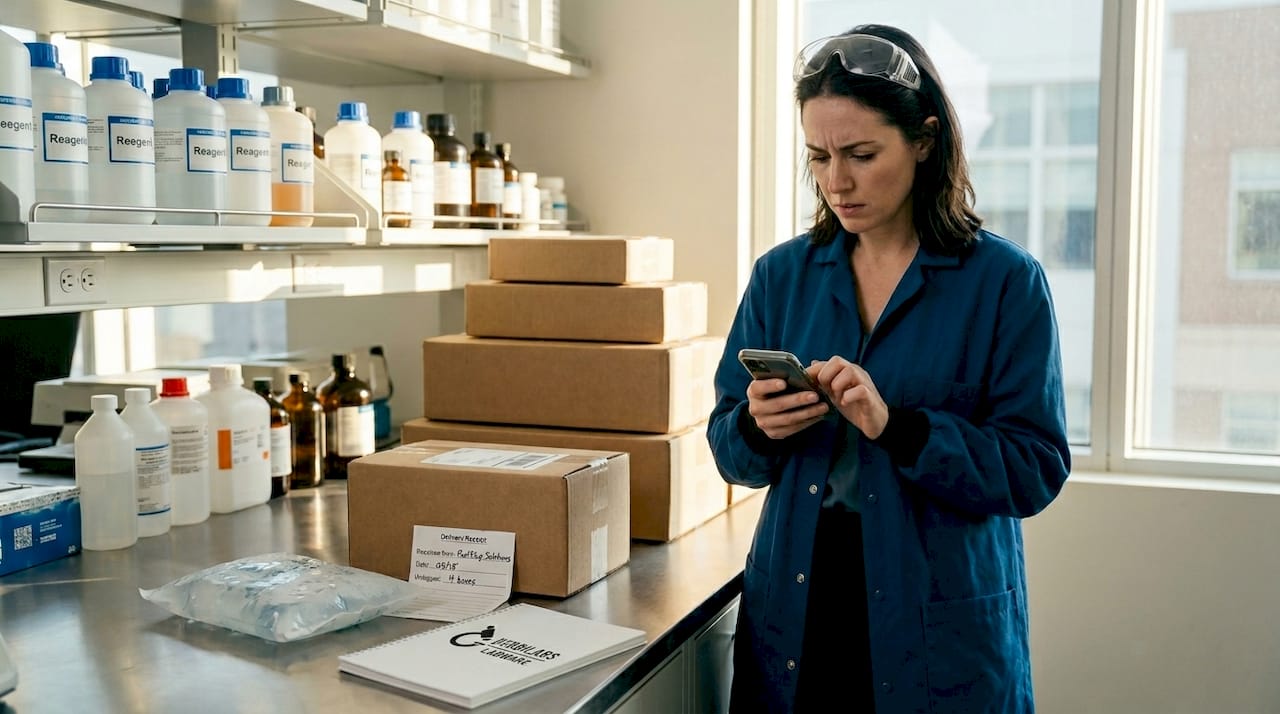
Lab managers should treat reagent delivery reliability as both a contract and an operational risk. Published lead times may reflect best-case scenarios, and upstream constraints such as release testing queues, customs holds, and third-party testing backlogs can extend actual delivery windows significantly, often without proactive communication from the supplier.
The following table maps the spectrum of delivery scenarios and their research impact:
| Scenario | Delivery condition | Likely research impact |
|---|---|---|
| Routine delivery | On time, correct lot, full documentation | No disruption; standard QC verification |
| At-risk delivery | Minor delay, lot substitution without pre-qualification | Protocol adjustment required; lot qualification retroactive or skipped |
| Worst-case delivery | Significant delay, temperature excursion, incomplete documentation | Experiment abort or repeat; data integrity compromised; compliance exposure |
The following sequence outlines how an apparently minor supply disruption can escalate into a material research problem:
- A supplier’s release testing is delayed by an unexpected compliance audit, extending delivery timescales by seven to ten days beyond published estimates.
- The lab, working against a grant milestone deadline, accepts an alternative lot without completing qualification testing.
- The alternative lot performs within nominal specification but introduces a 12% shift in assay signal that is not detected until statistical analysis.
- The anomalous data must be excluded, the experiments repeated, and the timeline extended by several weeks.
This sequence is not hypothetical. It represents a failure mode that structured laboratory supply chain risks management is specifically designed to prevent.
Pro Tip: Before signing any supply agreement for critical reagents, request the supplier’s historical on-time delivery rate for your specific product category and ask explicitly what triggers a lead time extension. Suppliers who cannot or will not provide this data represent an elevated operational risk.
Understanding the interconnected nature of lab logistics and research outcomes allows lab managers to frame supply reliability as a scientific governance issue, not merely a purchasing preference.
How to build robust delivery and QC processes
Recognizing risks is only half the solution. The following guidance provides actionable steps for labs to establish reliable delivery workflows and integrate quality control at the point of receipt, drawing on established best practices for temperature-sensitive and research-critical materials.
For biological and chemical reagents, shipping and storage must prevent changes to safety, identity, potency, purity, quality, and physical properties. Temperature-controlled logistics (cold chain) is therefore a component of quality assurance, not merely a logistical convenience.
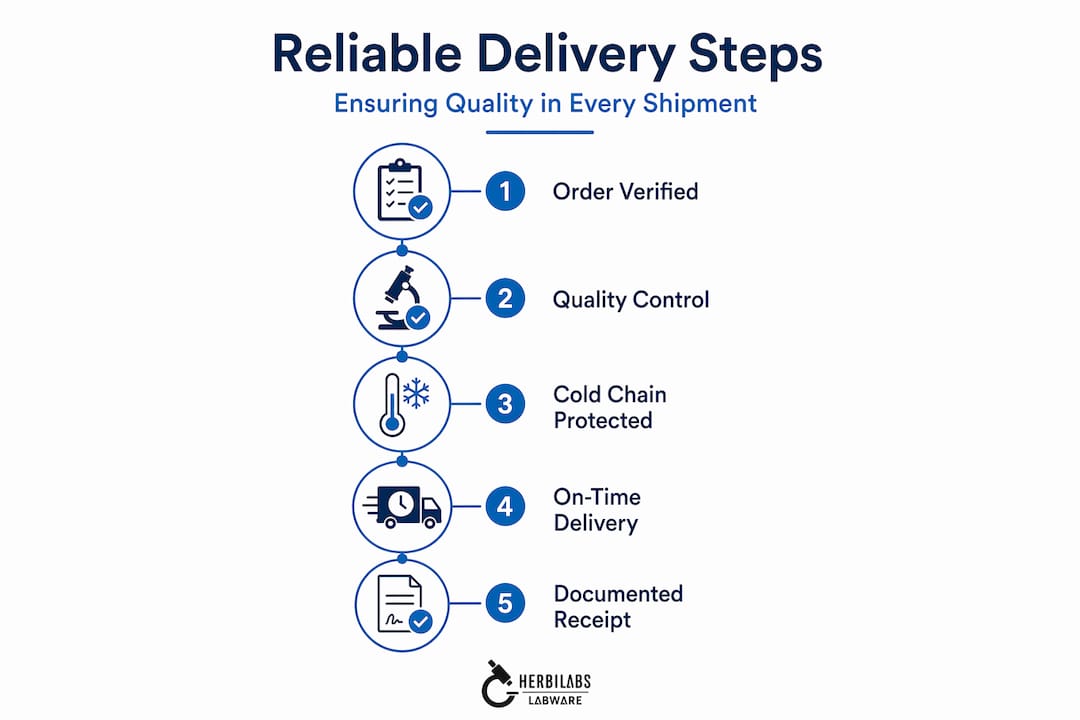
The following table outlines the key verification checks that should occur at each stage of the delivery and receiving process:
| Delivery stage | Key checks | Documentation required |
|---|---|---|
| Pre-shipment | Supplier qualification, cold chain protocol review | Supplier audit records, cold chain SOP |
| In transit | Temperature logger data, chain of custody | Shipping manifest, logger download |
| Receipt | Physical integrity, temperature range confirmation | Signed receipt record, temperature log |
| Post-receipt QC | Identity verification, lot qualification | Certificate of analysis, internal QC result |
Implementing this framework requires attention to several interconnected areas:
- Supplier qualification should include a review of the supplier’s quality management system, manufacturing standards, and historical performance data. A supplier with robust quality documentation reduces the risk of receiving non-conforming materials.
- Cold chain validation must cover the complete journey from manufacture to receipt, including any intermediate storage points. Even a brief excursion outside the specified temperature range can alter the characteristics of sensitive reagents.
- Lot qualification protocols should be executed proactively, before a new lot is needed urgently, so that any performance differences are detected and documented under controlled conditions.
- Receiving documentation must be complete and retained as part of the experimental record. Missing or incomplete documentation at receipt is a regulatory and scientific liability.
Integrating safe handling practices with these delivery protocols ensures that the quality preserved during transport is not compromised at the bench. Similarly, applying lab QC tips consistently across all receiving events creates a reliable evidence base for both internal audits and external regulatory review.
Pro Tip: Establish a standardized receiving form that captures lot number, delivery time, condition at receipt, temperature log range, and the identity of the person who accepted the shipment. This takes less than five minutes per delivery and creates an audit trail that has repeatedly proven its value when anomalous results require investigation.
Special considerations: Cold chain and reagent stability
Some of your highest-stakes experiments depend on sensitive or high-purity solutions. Understanding what it actually takes to keep these materials uncompromised from dispatch through receipt and to the bench is essential for any lab handling lyophilized peptides, biological standards, or sterile reconstitution solutions.
Cold chain management for temperature-sensitive materials is both a regulatory and quality-driven requirement. As established in validated guidance, shipping and storage must be qualified so that materials are not altered during transit. Additional qualification steps may be required for unique or known material-specific vulnerabilities, particularly for products intended for commercial distribution or regulated research.
The practical implications of this requirement are often underestimated. A vial of bacteriostatic water or a lyophilized reagent may appear physically unaltered after a temperature excursion, yet its functional properties, including pH stability, osmolality, and preservative efficacy, may have shifted beyond acceptable bounds. Visual inspection alone cannot confirm compliance with cold chain requirements.
Furthermore, small procedural or handling differences at the point of reconstitution or preparation can produce large within-unit variability. This evidence supports the broader principle that consistency across every handling event, including those that occur immediately after delivery, is critical when working with solutions that must be homogeneous or precisely prepared for quantitative research applications.
Key best practices for maintaining reagent stability through shipping and receipt include:
- Specify and verify temperature range in every purchase order and confirm that the supplier’s cold chain protocol explicitly covers your required range, not just a generic refrigerated or frozen category.
- Request temperature logger data as part of standard delivery documentation for all cold chain shipments. Where a logger is not included, treat the delivery as unverified and initiate your non-conformance process.
- Minimize bench time before reagents are returned to proper storage conditions. Repeated temperature cycling, even within specification on each individual occasion, can cumulatively affect reagent performance.
- Document reconstitution conditions including the volume used, the identity of the diluent, the time elapsed after reconstitution, and any observed anomalies in appearance or solubility.
“Cold-chain management for temperature-sensitive materials is regulated and quality-driven. Shipping and storage must be qualified so that materials are not altered during transit, and additional qualification may be required for unique or known issues or for commercial distribution.”
Sourcing high-purity reagents from suppliers who can document their cold chain qualification process, rather than relying on informal assurances, is one of the most effective ways to reduce variability attributable to pre-receipt handling. The quality of the reagent when it leaves the manufacturer is a necessary but insufficient condition for research-grade performance. The quality of the entire delivery process determines what actually arrives at your bench.
Rethinking the value of delivery reliability: What most labs overlook
These nuances illustrate why delivery reliability warrants strategic focus. The more challenging conversation in many labs is why this focus is so rarely applied in practice, and what the actual cost of that omission is.
The prevailing assumption in many research environments is that delivery is a procurement task. Someone places an order, a box arrives, and the scientist proceeds. The operational and scientific risks embedded in that sequence are treated as someone else’s problem until something goes wrong. This is a structural blind spot, and it carries costs that go well beyond the price of an expedited reorder.
Consider the full cost of a single failed delivery event: the direct expense of replacement reagents, the researcher time consumed by protocol adjustment and repeated experiments, the delay to a grant milestone, the potential need to disclose a reproducibility issue in a manuscript, and in regulated environments, the cost of a non-conformance investigation and corrective action. None of these costs appear in a shipping invoice. They accumulate silently in budget overruns, timeline extensions, and in some cases, retracted publications.
The labs that build genuine scientific and reputational advantage are those that treat lab supply management as a strategic function. They qualify suppliers with the same rigor they apply to analytical instruments. They track lot performance over time and detect drift before it becomes a data problem. They integrate logistics and QC into their quality management systems rather than treating them as parallel administrative processes.
This is not an argument for bureaucracy. It is an argument for proportionality. The level of rigor applied to delivery and receiving should match the sensitivity of the science being conducted. For labs working with high-purity reconstitution solutions, lyophilized peptides, or biologics, that level of rigor needs to be considerably higher than a visual check at the loading dock.
The uncomfortable reality is that the cost of getting delivery reliability right is modest. The cost of getting it wrong, at the wrong moment in a study, can be career-defining. Labs that recognize this asymmetry and act accordingly are the ones that maintain both data integrity and scientific credibility over the long term.
Reliable solutions for your lab: Taking the next step
Ready to put these reliability insights into action? Herbilabs Labware is purpose-built to support exactly the kind of quality-focused supply chain that this guide describes.
Our manufacturing standards, documented cold chain protocols, and rigorous quality control processes ensure that every shipment of bacteriostatic water, sterile diluent, or reconstitution solution arrives with the documentation and purity verification your research requires. Whether you are selecting laboratory reagents for a new peptide study, sourcing high-purity reconstitution solutions for ongoing protocols, or reviewing your lab’s labware purity standards, Herbilabs provides the traceability and consistency that serious research demands. Contact our team to discuss your supply requirements or explore our full product range online.
Frequently asked questions
What are the main risks of unreliable reagent delivery?
Unreliable delivery can lead to experimental delays, forced reagent substitutions, and jeopardized reproducibility due to uncontrolled variability. Published lead times may reflect best-case conditions, and upstream constraints can cause real disruptions that force substitutions under time pressure.
How can labs verify that delivery and storage conditions did not affect reagent quality?
Labs should request documented temperature logs, cold chain qualification records, and certificates of analysis as standard components of each delivery. Shipping and storage must prevent changes to safety, identity, potency, purity, and physical properties, and temperature-controlled logistics is a quality assurance requirement, not optional documentation.
Why is lot tracking and qualification important for research reagents?
Lot tracking ensures that any shift in experimental results can be traced to a specific material source and that substitutions are made only after qualification confirms suitability. Labs should qualify and track critical reagent lots rather than assume equivalence across deliveries or batches.
What role does cold chain management play in scientific deliveries?
Cold chain protocols ensure that temperature-sensitive materials maintain their functional properties throughout shipping and storage, protecting potency, purity, and physical stability. Cold chain management is regulated and quality-driven, requiring formal shipping qualification rather than informal best-effort handling.
Can minor handling differences after delivery really affect experimental results?
Yes. Even small procedural variations at reconstitution or preparation can produce significant within-unit variability, particularly for solutions that must be homogeneous or precisely measured. Small handling differences can produce large variability, which underscores why consistent post-delivery handling protocols are as important as pre-shipment quality assurance.