Private Label, White Label, Wholesale partnerships available - EU, USA and UK - Free shipping from €75
Reagent quality control guide: ensure reliable lab results
Learn how to implement effective reagent quality control with this step-by-step guide covering setup, daily workflows, automation, and documentation best practices.
TL;DR:
- Reagent quality control is vital to ensure experimental integrity and reproducibility.
- Daily QC, third-party controls, and proper documentation help prevent costly experimental failures.
- Advanced strategies include automation, trend analysis, and continuous process improvement.
A single contaminated reagent batch can invalidate months of carefully designed experiments, forcing teams to repeat costly assays, revisit statistical analyses, and, in worst cases, retract published findings. Daily QC is essential for maintaining the integrity of every analytical result your lab produces. This guide presents a structured, stepwise framework covering prerequisites, routine workflows, advanced strategies, and documentation practices, giving research scientists and laboratory managers the practical tools needed to establish and sustain reagent quality control that genuinely protects experimental integrity and data trustworthiness.
Table of Contents
- Why reagent quality control matters
- Reagent quality control: prerequisites and setup
- Routine quality control: daily and batch-level steps
- Advanced strategies: automation, bias, and troubleshooting issues
- Documentation, reporting, and continuous improvement
- Breaking the mold: rethinking reagent quality control for modern labs
- Next steps: proven tools for robust reagent quality control
- Frequently asked questions
Key Takeaways
| Point | Details |
|---|---|
| Daily QC is essential | Running daily quality controls with multiple levels ensures reagent reliability and valid lab results. |
| Third-party controls add integrity | Using third-party QC materials reduces bias and helps detect reagent failures early. |
| Proper setup prevents errors | Following strict SOPs and documenting all steps minimizes contamination and procedural lapses. |
| Automation boosts consistency | Adopting automation and modern data tools helps catch errors faster and improves QC efficiency. |
| Continuous improvement matters | Regular audits and updates to QC methods strengthen long-term experimental reliability. |
Why reagent quality control matters
Poor reagent quality is one of the most underappreciated sources of experimental failure in both academic and commercial research settings. Unlike instrument malfunction, which typically triggers an obvious error, reagent degradation or lot variability introduces subtle, systematic bias that can propagate silently through an entire study before anyone notices. The consequences range from inconvenient to career-defining: invalid results, wasted consumables, delayed timelines, and, in high-profile cases, public retractions that damage institutional credibility.
The most common risk factors include:
- Contamination from improper handling, inadequate storage separation, or compromised packaging
- Lot-to-lot variability, where batch variation can alter results by up to ±25% in bio-reagents
- Degradation caused by temperature excursions, light exposure, or exceeding shelf life
- Insufficient documentation, which prevents traceability when failures do occur
Reproducibility is not a luxury in modern research. It is the minimum standard by which scientific findings earn credibility, and reagent quality is the foundation on which reproducibility rests.
Beyond individual experiments, robust reagent standards protect the entire research pipeline. Labs that invest in rigorous QC spend less time troubleshooting anomalous data and more time generating actionable insights. Understanding the importance of purity in research-grade materials is a prerequisite for building any effective QC program. Aligning with established quality management guidelines provides a recognized framework that supports both internal audits and external regulatory reviews.
Reagent quality control: prerequisites and setup
With the importance established, it is time to assemble the foundational setup and materials needed for robust quality control before any active testing begins.
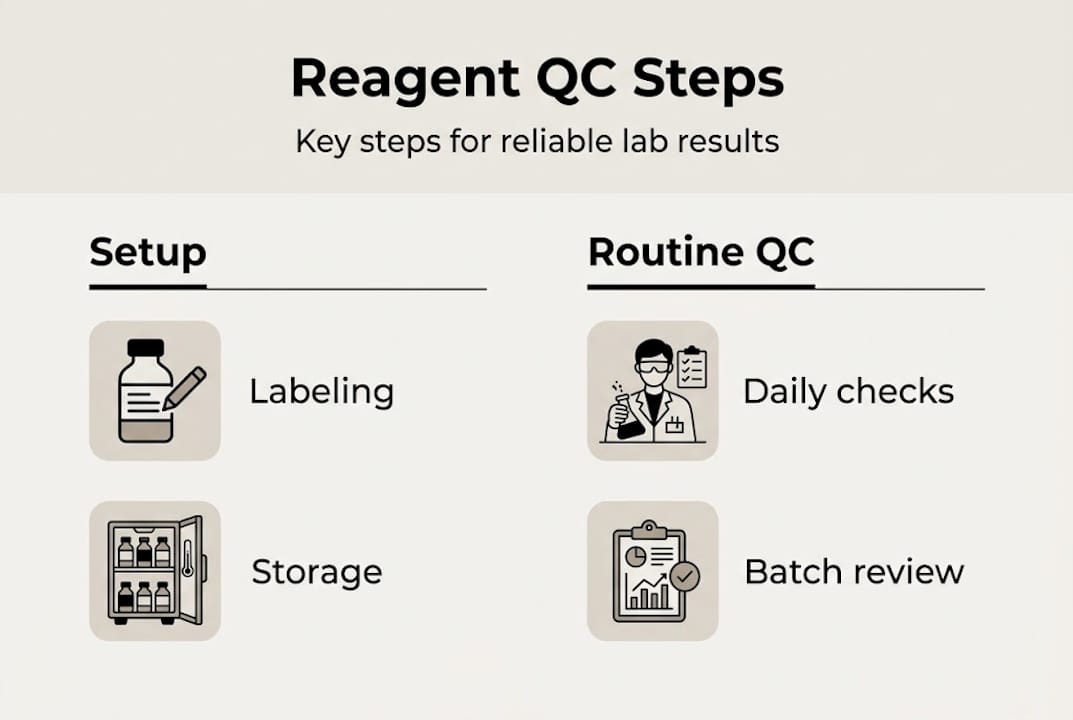
Every effective QC program starts with documentation. Certificates of Analysis (CoA) from the manufacturer must accompany each reagent lot, and standard operating procedures (SOPs) should define acceptance criteria, storage requirements, and testing intervals before the reagent ever reaches the bench. Upon receipt, inspect packaging, confirm the CoA, and test identity and purity prior to first use.
Essential setup checklist:
- Obtain and file CoA for every incoming lot
- Verify storage conditions (temperature, humidity, light sensitivity) match SOP requirements
- Physically separate incompatible chemicals in designated storage zones
- Log receipt date, lot number, expiration date, and initial inspection findings
- Assign a responsible staff member for each reagent category
The following table summarizes critical storage parameters for common reagent classes:
| Reagent class | Temperature range | Humidity control | Light sensitivity |
|---|---|---|---|
| Enzyme substrates | 2 to 8°C | Required | High |
| Antibodies | -20°C (long-term) | Controlled | Moderate |
| Buffer solutions | 15 to 25°C | Standard | Low |
| Lyophilized standards | -80°C | Required | High |
Standardized LQMS documentation standards prevent overlooked failure points by ensuring every team member follows an identical intake protocol. Reviewing safe handling practices at the SOP level reduces contamination risk at the point of first contact, while consulting established quality control tips helps labs avoid the most common setup errors before they become embedded in routine workflows.

Pro Tip: Always use third-party control materials rather than relying exclusively on manufacturer-supplied controls during the setup phase. Third-party materials provide an independent benchmark that exposes method or reagent bias that manufacturer controls are structurally unlikely to detect.
Routine quality control: daily and batch-level steps
With setup complete, follow this workflow to carry out daily and batch-level reagent quality control consistently and traceably.
- Inspect packaging and documentation. Before opening any reagent, verify seal integrity, check for visible damage, and confirm the CoA lot number matches the container label.
- Confirm identity, purity, and strength. Use appropriate analytical methods (spectrophotometry, titration, or chromatography) to verify the reagent meets specification before use.
- Test for microbial contamination. For aqueous reagents and reconstitution solutions, conduct bioburden testing or endotoxin assays as specified in the SOP.
- Run daily QC samples. Run QC materials daily, using 2 to 3 control levels per SOP, and monitor results using Levey-Jennings plots to detect shifts, trends, and random error.
- Log results and deviations. Record every result, including out-of-control events, corrective actions taken, and the identity of the analyst.
Levey-Jennings charts are particularly valuable because they visualize QC data over time, making it straightforward to distinguish random error from systematic drift. A trend of six consecutive points moving in one direction is a recognized warning signal that warrants investigation before results are reported.
| QC source | Bias risk | Independence | Cost |
|---|---|---|---|
| Manufacturer controls | Higher (method-matched) | Low | Lower |
| Third-party controls | Lower | High | Moderate |
Adapting CLSI EP15 protocol for batch verification provides a statistically rigorous method for confirming precision and bias when introducing new reagent lots. Reviewing essential QC steps alongside guidance on maintaining labware ensures the entire analytical system remains within specification.
Pro Tip: Set QC control limits at clinically or experimentally relevant concentrations, not just within normal ranges. Testing at both low and high abnormal levels reveals performance characteristics that normal-range controls will never expose.
Advanced strategies: automation, bias, and troubleshooting issues
Even with a solid QC process in place, labs face evolving challenges. Here is how to take quality assurance further and diagnose unexpected issues when they arise.
Laboratory automation and artificial intelligence (AI) driven monitoring systems are reshaping how QC data is collected and interpreted. Automation reduces errors by removing manual transcription steps and enabling real-time flagging of out-of-control results. However, automated systems require rigorous validation before deployment and periodic performance verification to ensure they remain fit for purpose.
Failure Mode and Effects Analysis (FMEA), as outlined in CLSI EP18-en.pdf), provides a structured risk management framework that identifies potential failure points before they manifest as QC failures, enabling proactive rather than reactive quality management.
Common root causes of QC failures and their recommended responses include:
- Lot-to-lot variability: Perform parallel testing of old and new lots before full deployment; adjust control limits if statistically justified
- Improper storage: Audit temperature logs and storage conditions immediately; quarantine suspect reagents pending investigation
- Contamination: Identify the contamination source (reagent, container, or analyst technique) and decontaminate or replace as appropriate
- Procedural lapses: Retrain staff, update SOPs, and implement a secondary verification step for high-risk procedures
- Supplier issues: Cross-reference with supply chain reliability data and consider alternative certified sources
Recognizing bias introduced by manufacturer controls is a subtler but equally important challenge. Because manufacturer controls are often matrix-matched to the same reagent system being tested, they may mask performance issues that an independent third-party material would reveal. Labs that prioritize selecting reliable reagents from suppliers with transparent manufacturing standards are better positioned to detect and resolve these biases before they affect reported data.
Documentation, reporting, and continuous improvement
Effective QC is not complete without strong records and a structured path to improvement. Here is how labs can close the loop between data collection and ongoing quality enhancement.
Traceable records are the backbone of any defensible QC program. Every QC result, deviation, corrective action, and SOP revision must be documented with sufficient detail to reconstruct the full analytical history of any reagent lot. This level of traceability is indispensable during external audits, regulatory inspections, and internal investigations.
Key documentation and improvement practices include:
- Levey-Jennings trend analysis: Review charts weekly to identify gradual drift that individual daily checks may not flag
- Recurring audits: Schedule quarterly internal audits to verify SOP compliance, storage conditions, and reagent inventory accuracy
- Training records: Maintain current competency records for every analyst handling controlled reagents
- SOP revision cycles: Review and update SOPs at least annually or whenever a significant process change occurs
- Feedback loops: Use corrective and preventive action (CAPA) reports to convert QC failures into systematic improvements
Statistic callout: LQMS with 12 quality system essentials (QSEs) supports continual improvement by providing a structured framework that links documentation, personnel training, equipment management, and process control into a unified quality management system.
Consulting ongoing QC tips and applying quality improvement insights from validated frameworks helps labs transition from reactive troubleshooting to proactive quality governance. The goal is not simply to pass audits but to build a culture where quality is embedded in every procedural decision.
Breaking the mold: rethinking reagent quality control for modern labs
The labs that consistently generate reproducible, publication-ready data are rarely the ones following standard QC checklists passively. They are the ones questioning whether their current controls are actually capable of detecting the failures that matter most.
Manufacturer-provided controls are convenient, but their structural alignment with the reagent system they accompany creates an inherent blind spot. Third-party QC materials provide more reliable, unbiased assessments precisely because they are independent of the manufacturer’s formulation decisions. Adopting them is not an optional upgrade. It is a methodological necessity for labs serious about data integrity.
Digital QC tools and automated trend monitoring detect performance degradation weeks before it would become apparent through manual review. This predictive capacity transforms QC from a compliance exercise into a genuine early-warning system. Labs that have integrated these tools report fewer unplanned assay repeats and more consistent inter-operator agreement.
Pro Tip: Revisit SOPs that were written more than three years ago and benchmark them against current CLSI or WHO guidance. Procedures that were adequate for yesterday’s reagent portfolio may introduce systematic error when applied to today’s higher-sensitivity assays.
The future of reagent QC belongs to labs that treat it as a dynamic, data-driven discipline rather than a static checklist. Exploring options for evaluating reagent sources with rigorous manufacturing standards is a practical first step toward that higher standard.
Next steps: proven tools for robust reagent quality control
To translate these best practices and insights into everyday lab success, Herbilabs provides additional tools tailored for modern researchers.
Herbilabs Labware supplies research-grade reagents and reconstitution solutions manufactured to strict purity standards, with full traceability and transparent CoA documentation for every lot. Whether you are selecting lab reagents for a new protocol or reviewing the high-purity reagent benefits that protect your experimental baseline, Herbilabs offers certified products backed by rigorous in-house QC. For guidance on safer reagent handling and sourcing solutions that align with your lab’s quality standards, explore the Herbilabs resource library and product catalog.
Frequently asked questions
What is the minimum QC frequency for lab reagents?
QC materials should be run daily, using at least 2 to 3 control levels that span both normal and abnormal concentration ranges to ensure comprehensive method performance monitoring.
Why use third-party QC materials instead of manufacturer controls?
Third-party QC materials are structurally independent of the reagent system being tested, which means they provide objective performance assessments and are more likely to reveal method or reagent failures that manufacturer controls are designed to pass.
What causes common reagent QC failures?
The most frequent causes are lot-to-lot variability, improper storage leading to degradation, cross-contamination during handling, and reliance on outdated SOPs that no longer reflect current analytical conditions.
Which guidelines help standardize lab reagent QC?
CLSI EP15, WHO GPPQCL, and LQMS frameworks each provide structured, benchmarked approaches to reagent QC that support both internal consistency and external regulatory compliance.
How does automation impact reagent quality control?
Automation reduces human error by eliminating manual transcription, enabling real-time anomaly detection, and streamlining documentation in ways that manual QC workflows cannot reliably replicate at scale.