Private Label, White Label, Wholesale partnerships available - EU, USA and UK - Free shipping from €75

Essential labware checklist: Reliable tools for research
Discover the essential labware checklist for UK and EU researchers. Covers ISO compliance, RUO labeling, peptide-specific items, and maintenance best practices.
TL;DR:
- Proper labware selection ensures regulatory compliance, safety, and reproducibility in research.
- Essential labware includes ISO-certified borosilicate glassware and RUO-labeled consumables.
- Ongoing maintenance and documentation are critical for audit readiness and research integrity.
Assembling a fit-for-purpose labware inventory is one of the most consequential decisions an independent researcher can make, yet it rarely receives the systematic attention it deserves. A single non-compliant vessel, an unlabeled reagent-grade consumable, or an unverified borosilicate specification can unravel months of experimental work and trigger regulatory scrutiny from bodies such as the MHRA or national competent authorities across Europe. This checklist addresses both the foundational requirements common to all bench-level labs and the specialized demands of peptide and high-precision research environments, covering regulatory alignment, materials selection, and procurement strategy in a single, structured reference.
Table of Contents
- Setting your selection criteria: Regulations, safety, and reliability
- Core general labware: Every bench scientist’s must-haves
- Specialized additions: Peptide and high-precision research essentials
- Maintenance, storage, and everyday compliance tips
- What we wish every independent lab knew about labware procurement
- Ready to build a labware checklist that truly performs?
- Frequently asked questions
Key Takeaways
| Point | Details |
|---|---|
| Regulatory foundations | Borosilicate glassware, RUO labeling, and supplier traceability are UK/EU essentials. |
| Checklist approach | Break your labware needs into basics and niche items to avoid gaps and compliance surprises. |
| Peptide research focus | Specialized vessels and advanced labeling are non-negotiable for peptide and analytic labs. |
| Maintenance matters | Clean, stored, and documented labware reduces risk and supports consistent results. |
| Trusted sourcing | Reputable suppliers streamline compliance and help avoid regulatory headaches. |
Setting your selection criteria: Regulations, safety, and reliability
Every labware procurement decision rests on three non-negotiable pillars: regulatory compliance, personal and lab safety, and the reliable reproducibility of results. Ignoring any one of these pillars creates cascading risk, from voided experimental data to enforcement action. Before adding a single item to a purchase order, every researcher should map their inventory against the applicable legal and standards framework.
For UK and European laboratories, that framework is well-defined. UK/Europe standards emphasize borosilicate glass conforming to ISO 3819 and ISO 1773, Ph. Eur. compliance for materials used in analysis, REACH and CLP chemical compliance, and research-use-only (RUO) labeling, particularly for peptide research applications. Missing any of these markers on incoming stock is not a minor administrative oversight; it is a compliance gap that can disrupt procurement approval workflows, invalidate batch records, and attract regulatory inspection.
The REACH and CLP regulations govern chemical classification, labeling, and packaging throughout the UK and EU, and they extend to labware that contacts regulated reagents. A plasticware item that leaches plasticizers into a peptide sample, for instance, may represent both a safety violation and a data-integrity failure simultaneously.
Key criteria every ordering decision must satisfy:
- Regulatory alignment: ISO-standard glassware, Ph. Eur.-compliant materials, and REACH/CLP-conformant consumables
- RUO designation: Verify that all specialty items carry a clear research-use-only label, especially for EMA peptide lab guidelines compliance
- Supplier traceability: Procurement from established distributors such as Fisher Scientific UK and Camlab provides documented supply chains
- Safety classification: SDS (Safety Data Sheet) availability and chemical compatibility for all labware in contact with hazardous reagents
- Audit readiness: Purchase records, certificates of conformance, and batch documentation stored for inspection
“Regulatory compliance begins at procurement, not at the point of use. Labware without adequate documentation is, from an audit perspective, labware that does not exist.”
Pro Tip: Structure your ordering list around your next scheduled regulatory audit or institutional review. Use the audit checklist as the baseline specification for every item, so that every purchase automatically satisfies inspection criteria rather than retrofitting documentation after the fact. Consulting a lab quality control checklist before finalizing orders is a practical first step, and reviewing labware integrity basics ensures your selection criteria are grounded in operational reality.
With compliance and safety top of mind, let’s look at the foundational labware categories every serious lab should cover.
Core general labware: Every bench scientist’s must-haves
Selection criteria defined, here’s what every reliable lab bench needs. Foundational labware forms the backbone of any research operation, and the compliance stakes are higher than many independent researchers initially assume.
The essential general labware items, in priority order:
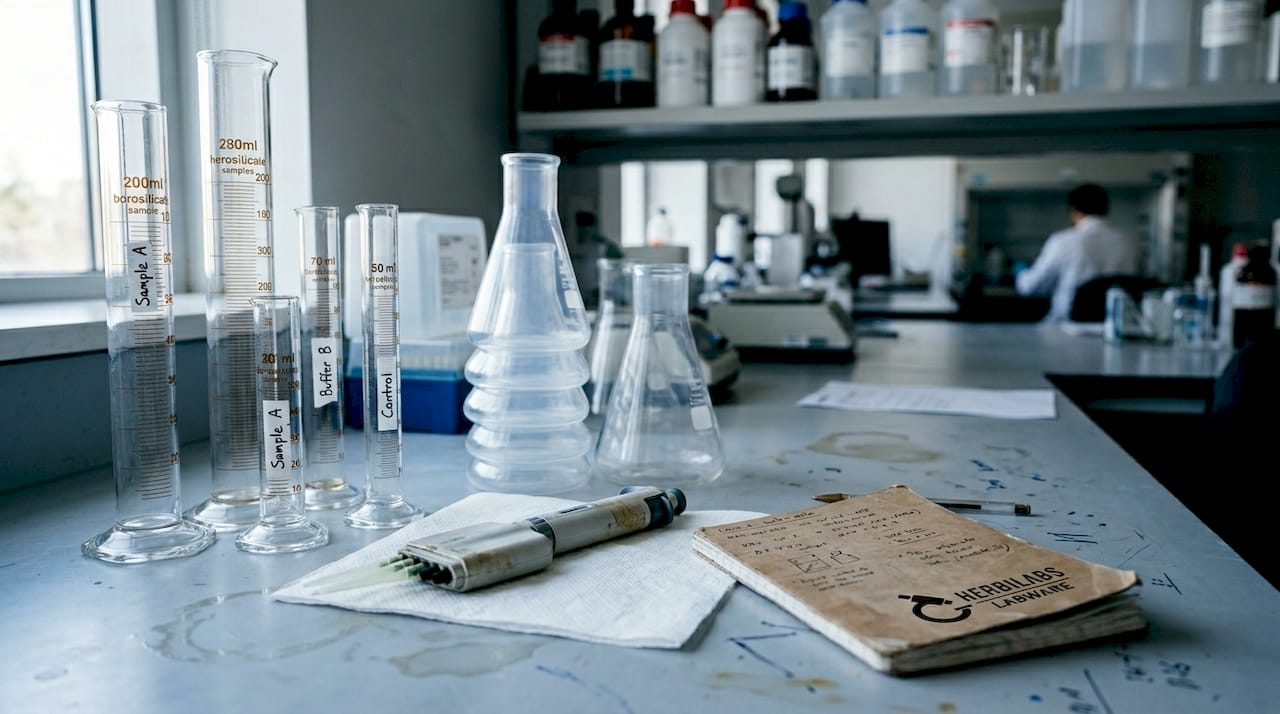
- Borosilicate glass graduated cylinders (ISO 3819-compliant): Critical for volumetric accuracy; borosilicate construction resists thermal shock and chemical attack from strong acids and alkalis
- Erlenmeyer flasks (borosilicate, ground-glass or PTFE-stoppered): Standard for solution preparation and culture media; stopper material must be chemically inert
- Beakers (various volumes, borosilicate): Versatile mixing and reaction vessels; verify graduation accuracy to ISO 1773
- Volumetric flasks (Class A): Required for precise molar solution preparation; Class A designation confirms calibration traceability
- Micropipettes and calibrated tips: Accuracy within ±1% is the working standard; tips must be certified sterile if handling biological or peptide samples
- Petri dishes and culture plates: Material selection depends on assay requirements; glass for high-temperature sterilization, polystyrene for single-use cell work
- Wash bottles and safety containers: CLP-labeled, compatible with the specific solvents in use
- Spatulas, forceps, and weighing boats: Often overlooked but critical for contamination control
UK/Europe labs should prioritize borosilicate glassware and Ph. Eur.-compliant materials across all general labware categories. This is not a preference; it is the baseline expected during regulatory inspection.
| Item | Glass | Plasticware |
|---|---|---|
| Graduated cylinders | Best for precision; reusable | Adequate for non-critical volumes |
| Erlenmeyer flasks | Required for organic solvents | Suitable for aqueous buffers only |
| Beakers | Preferred for heat applications | Acceptable for room-temp mixing |
| Pipette tips | Not applicable | Low-bind required for proteins/peptides |
| Petri dishes | Reusable; sterilizable | Single-use; lower cost per run |
Pro Tip: Label every item in your inventory with a unique identifier linked to your procurement record. This single practice significantly reduces traceability failures during audits and connects physical labware to its certificate of conformance. The essential consumables guide offers detailed guidance on documentation protocols, and the consumables comparison table helps researchers make defensible material choices.
Specialized additions: Peptide and high-precision research essentials
General labware is only part of the story; peptide and high-precision research demands more focused inventory decisions. Researchers working in peptide synthesis, biologics characterization, or advanced analytical environments require a distinct set of specialized items that carry their own compliance considerations.
Peptide-focused labware essentials include:
- Reaction vials (silanized or low-adsorption glass): Prevent peptide loss through surface adsorption, a critical concern for low-concentration samples
- Synthesis resins (polystyrene-based, Rink amide, Wang resin variants): Must carry supplier certification for loading capacity and purity
- Low-bind pipette tips and tubes: Standard polypropylene can adsorb up to 30% of peptide content from dilute solutions, making low-bind surfaces essential
- Automated dispensers and fraction collectors: Required for solid-phase peptide synthesis (SPPS) workflows; must be compatible with organic solvents such as DMF and DCM
- HPLC vials and inserts (certified for analytical purity): Septum material must be inert to the mobile phase composition
- 96-well plates (low-bind, V-bottom or flat-bottom): Application-specific selection is critical for binding assays and ELISA workflows
RUO, or research-use-only, labeling is a legal classification indicating that a material is not approved for diagnostic or clinical use. In the UK and EU, RUO compliance is essential to avoid MHRA enforcement action; using non-RUO-designated items in a research context, or failing to document the RUO status of specialty vessels, places the entire study under scrutiny.
| Feature | Peptide research labware | General research labware |
|---|---|---|
| Surface treatment | Silanized, low-bind | Standard glass or plastic |
| Resin compatibility | Organic solvent-resistant | Aqueous systems primarily |
| Tip specification | Low-bind, filtered | Standard, unfiltered options |
| Volume range | Microliter to milliliter | Milliliter to liter |
| Documentation | RUO certificate required | CoC and ISO marking |
Approximately 40% of regulatory observations in peptide research facilities relate to improper vessel selection or missing RUO documentation, according to EMA inspection trend analyses, underscoring why this is not a box-checking exercise. For practical guidance on sourcing appropriate materials, reviewing peptide reagent selection and the reagent standards guide provides a structured starting point.
Maintenance, storage, and everyday compliance tips
Having the right gear is only part of compliance; ongoing maintenance and documentation are equally critical. Even ISO-certified borosilicate glassware becomes a liability if it is stored incorrectly, cleaned with incompatible reagents, or allowed to accumulate micro-fractures that distort volumetric readings.
Critical cleaning practices:
- Use glassware-specific detergents that are validated to rinse cleanly and leave no residue; standard hand soap leaves a film that can interfere with pH-sensitive assays
- Rinse with ultrapure water (Type 1, ≤0.056 μS/cm) as the final step before drying
- Never use abrasive cloths on volumetric or graduated glassware; micro-scratches impair graduation legibility and create nucleation points for contamination
- Autoclave-compatible glassware should be marked clearly and separated from non-autoclavable plasticware in storage
Mistakes that most commonly trigger regulatory penalties:
- Using glassware past its calibration or inspection date without re-verification
- Storing incompatible chemicals in proximity to labware, risking vapor-phase chemical attack on glass or plasticware surfaces
- Failing to rotate stock so that older items remain in use beyond their rated lifecycle
- Mixing RUO and non-RUO items in the same storage location without clear physical separation and labeling
- No written cleaning log, leaving no audit trail for glassware that contacts critical reagents
“Suppliers such as Fisher Scientific UK and Camlab provide not only products but also technical documentation and compliance support that independent labs often underestimate in value.”
Pro Tip: Build maintenance tasks directly into your experimental workflow using digital lab notebook reminders or ELN (Electronic Lab Notebook) scheduled entries. Treat glassware inspection and storage rotation as experimental steps, not administrative afterthoughts, to ensure they are never skipped under time pressure. The practical labware maintenance guide and quality control tips resource both provide step-by-step frameworks that translate easily into recurring workflow tasks.
What we wish every independent lab knew about labware procurement
The checklist approach to labware is necessary, but it carries a subtle trap: researchers who treat a completed list as sufficient protection often discover too late that the real compliance risk lies in how a lab operates day-to-day, not what it ordered last quarter.
Cost-driven procurement is the most common source of hidden regulatory risk. Choosing a lower-cost alternative glassware supplier may save 15% on unit price, but if that supplier cannot provide a traceable certificate of conformance, a batch record, or ISO marking verification, the savings evaporate entirely during a single audit cycle. Trusted distributors provide documentation ecosystems, not just products, and that difference is measurable in audit outcomes.
There is also a long-term credibility dimension that independent researchers frequently overlook. Peer reviewers increasingly scrutinize materials and methods sections for labware and reagent sourcing details, particularly in peptide research where contamination and adsorption variables directly affect data integrity. Labs that can cite verified, traceable materials demonstrate methodological rigor that translates to publication credibility and, critically, funding competitiveness.
The most overlooked truth: a checklist is only as strong as the culture that enforces it. Supply lists do not maintain themselves. Reviewing consumables workflow strategies reveals that the highest-performing independent labs integrate procurement review into their experimental planning cycles, not as a separate administrative task, but as a core research function.
Ready to build a labware checklist that truly performs?
Translating a well-designed checklist into consistent, compliant procurement requires more than a spreadsheet. It requires access to verified, research-grade products and the guidance to use them correctly in demanding research environments.
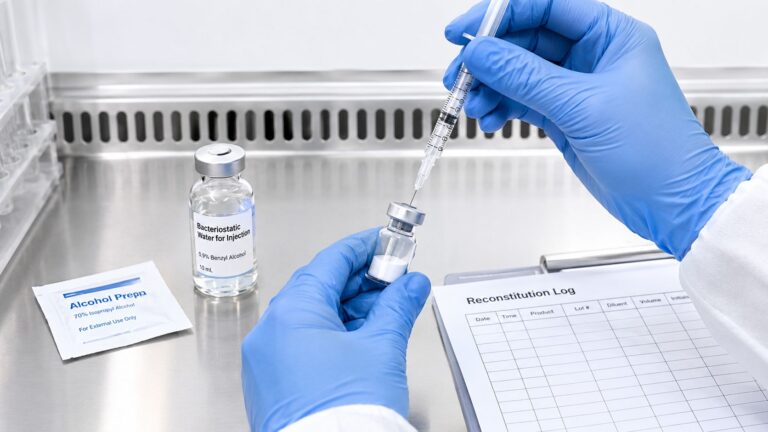
At Herbilabs, we supply independent researchers and laboratory professionals across the UK and Europe with rigorously quality-controlled products, including high-purity reconstitution options and bacteriostatic water solutions that meet the standards peptide research demands. Our resources cover reagent selection for peptide labs and step-by-step labware maintenance steps to keep your lab audit-ready. Contact us for tailored procurement guidance or explore our full product catalog to support your next research cycle.
Frequently asked questions
What must UK/EU labs look for in compliant labware?
UK and European labs need ISO-standard borosilicate glassware, RUO labels, and supplier traceability to meet both legal requirements and research reproducibility standards.
Why is RUO labeling important in peptide labs?
RUO labeling is a legal requirement under EU and UK frameworks, and its absence or misapplication can trigger MHRA enforcement action and invalidate the research record.
How can labs ensure ongoing compliance after initial setup?
Routine maintenance, documented cleaning logs, and purchasing from reputable suppliers with traceable documentation keep labware compliant and inspection-ready throughout the research lifecycle.
What is the biggest compliance pitfall for independent researchers?
Missing or incorrect documentation, particularly the failure to verify RUO status on specialized items, is consistently the leading compliance gap identified during regulatory review of independent research facilities.