Private Label, White Label, Wholesale partnerships available - EU, USA and UK - Free shipping from €75
Why Reliable Delivery Drives Accurate Research Results
Learn why reliable delivery of bacteriostatic water and reconstitution solutions is critical to research accuracy, reproducibility, and compliance in scientific labs.
TL;DR:
- Delivery reliability is crucial for maintaining reagent integrity and experimental consistency.
- Effective sourcing and logistics practices prevent delays, temperature excursions, and contamination risks.
- Continuous verification upon receipt and active handling protocols are essential for research quality.
Many researchers treat reagent ordering as the critical step and view delivery as a logistical formality. This assumption is costly. Delivery reliability directly governs whether bacteriostatic water, sterile diluents, and reconstitution solutions arrive in a condition fit for use, and whether experimental timelines remain intact. A single temperature excursion or a delayed shipment can introduce variability that invalidates otherwise rigorous protocols. For laboratory managers coordinating multiple concurrent studies, the downstream consequences of delivery failures extend far beyond inconvenience. This article examines what reliable delivery actually means in a research context, where logistics most commonly break down, how to evaluate suppliers critically, and what post-delivery protocols protect reagent integrity from the moment a shipment arrives at the bench.
Table of Contents
- Why delivery reliability matters in research
- Common pitfalls in sourcing and logistics
- Essential qualities of reliable suppliers
- Best practices for maintaining reliability from order to bench
- A fresh perspective: Why perfect delivery isn’t enough
- Enhance your research with truly reliable solutions
- Frequently asked questions
Key Takeaways
| Point | Details |
|---|---|
| Delivery reliability is critical | Relying on dependable logistics prevents experiment delays and maintains reagent quality. |
| Supplier choice shapes outcomes | Selecting qualified suppliers ensures research consistency and compliance. |
| Protocols boost lab reliability | Clear, automated systems reduce errors from order to bench. |
| Vigilance beats assumptions | Even with perfect delivery, labs must verify and monitor materials to ensure reliable results. |
Why delivery reliability matters in research
In scientific research, ‘reliable delivery’ refers to the consistent, on-time arrival of materials in a condition that fully preserves their chemical, physical, and microbiological integrity. For reconstitution solutions such as bacteriostatic water, this definition is particularly exacting. The product must arrive within specified temperature ranges, with packaging that maintains sterility, and within the timeframe that supports the lab’s experimental schedule. Any deviation from these parameters constitutes a delivery failure, even if the shipment technically arrives on the expected date.
Delivery conditions directly affect reagent performance. Temperature-sensitive solutions can undergo hydrolysis, microbial contamination, or pH drift if cold-chain protocols are not maintained during transit. Timing matters equally: a shipment that arrives two days late may force a researcher to proceed with a compromised lot or postpone experiments, both of which introduce unwanted variability. Quality reagents ensure reliability only when the supply chain preserves what the manufacturing process establishes.
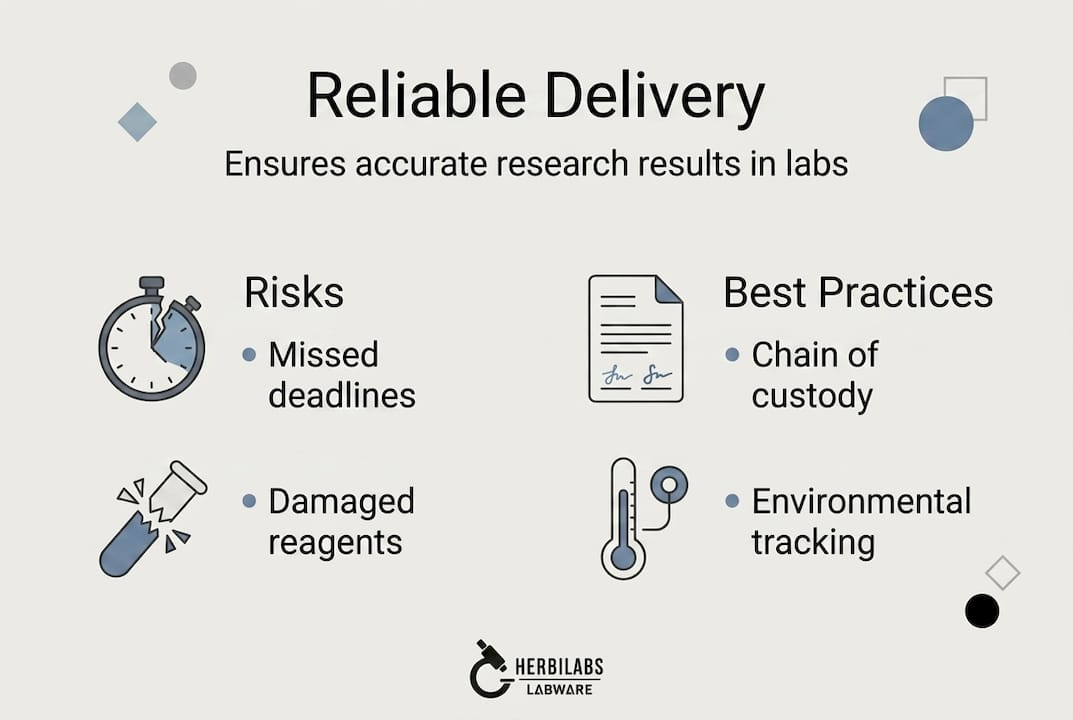
The immediate risks of unreliable delivery include:
- Reagent degradation due to temperature excursions during transit
- Sterility breaches from damaged or inadequate packaging
- Experiment delays that cascade into missed milestones and funding reporting deadlines
- Compliance issues when chain-of-custody documentation is incomplete or missing
- Data variability introduced by inconsistent lot quality across separate shipments
“Delivery delays or quality lapses can compromise sample and reagent functionality, with measurable consequences for downstream experimental outcomes.”
For laboratories operating under GLP or GMP frameworks, a compromised delivery is not simply a practical inconvenience. It is a compliance event that requires documentation, root-cause analysis, and often a repeat of the affected experiments. Proactively selecting suppliers who treat delivery as an extension of quality control, rather than a separate logistical function, is the most effective mitigation strategy available to lab managers.
Common pitfalls in sourcing and logistics
Having underscored the importance of reliability, it is worth examining where real-world lab logistics most frequently fail. Logistics errors are one of the top causes of failed or delayed experiments in the life sciences, yet many of the underlying mistakes are preventable with structured planning.
The most common sourcing and delivery errors observed in research environments include:
- Last-minute ordering without accounting for supplier lead times, cold-chain scheduling, or courier availability during peak periods
- Inadequate supplier vetting, particularly skipping verification of cold-chain certifications and temperature excursion reporting practices
- Poor communication protocols, where labs do not establish escalation contacts with suppliers before a problem occurs
- Incomplete shipment tracking, leaving the lab unaware of a delay or excursion until the package physically arrives
- Accepting deliveries without inspection, proceeding directly to storage without checking temperature indicators, seal integrity, or accompanying documentation
Shipping and packaging design significantly influence the condition of bacteriostatic water and similar solutions upon arrival. Inadequate insulation, incorrect gel pack ratios, or poorly designed secondary containment can all allow temperature excursion even on short transit routes. Suppliers who invest in validated packaging configurations and use data loggers for temperature-sensitive shipments provide a measurable advantage.
Effective lab supply chain optimization requires treating logistics as a quality-critical function rather than an administrative one. This means building stock buffers for high-use reagents, standardizing order cycles, and developing formal supplier communication agreements before disruptions occur.

Pro Tip: When evaluating a new logistics partner or supplier, request a sample delivery with a calibrated temperature logger included. Review the logger data upon arrival to verify cold-chain compliance before committing to volume orders. This single step can identify inadequate packaging before it compromises critical experiments. Identifying trusted lab suppliers early in the procurement cycle saves significant time and resources later.
Essential qualities of reliable suppliers
Recognizing common pitfalls leads naturally to defining what separates a genuinely reliable supplier from one that merely claims to be. Supplier quality determines research repeatability and regulatory compliance, making supplier selection one of the highest-leverage decisions a laboratory manager can make.
Key criteria for evaluating suppliers of bacteriostatic water and reconstitution solutions include quality certifications (ISO, GMP, or equivalent), batch-level traceability with Certificate of Analysis documentation, validated cold-chain logistics, and transparent regulatory compliance records.
| Attribute | Reliable supplier | Unreliable supplier |
|---|---|---|
| Quality certification | ISO or GMP certified | No verifiable certification |
| Batch traceability | Full CoA per lot | Lot documentation absent or incomplete |
| Cold-chain logistics | Validated, data-logged | Unverified standard shipping |
| Regulatory compliance | Documented and current | Unknown or self-reported |
| Communication | Dedicated point of contact | Generic customer service only |
| Excursion response | Formal corrective action protocol | Ad hoc or absent |
Beyond the initial evaluation, ongoing supplier assessment is required. Supplier performance can degrade over time due to manufacturing changes, staff turnover, or logistics partner substitutions. Establishing a formal annual review process that includes delivery performance data, CoA consistency, and responsiveness metrics protects laboratories from gradual erosion of supply quality.
Questions to ask prospective suppliers:
- What quality certifications govern your manufacturing process?
- How is batch traceability maintained from production through delivery?
- What temperature monitoring is used during transit, and how are excursions documented?
- What is your corrective action process when a delivery does not meet specifications?
- Can you provide references from research institutions with similar volume and product requirements?
Integrating quality control in research begins at the supplier selection stage. Laboratories that treat procurement as a quality function consistently achieve better experimental reproducibility than those that optimize only for price or convenience.
Best practices for maintaining reliability from order to bench
Once the right suppliers are chosen, reliability also depends on what happens to materials after delivery. Even a perfectly shipped batch of bacteriostatic water can be compromised by inadequate receiving protocols or improper storage.
A structured workflow for receipt, inspection, and storage should include the following touchpoints:
| Step | Action | Responsible party | Documentation |
|---|---|---|---|
| Order placement | Confirm lead time, cold-chain requirements | Lab manager | Purchase order log |
| Pre-arrival | Confirm tracking and expected temperature range | Receiving staff | Tracking record |
| Arrival inspection | Check packaging integrity, temperature indicators, CoA | Receiving staff | Inspection checklist |
| Temperature log review | Download and verify data logger if included | QC officer | Logger report |
| Storage assignment | Place in appropriate temperature-controlled environment | Lab technician | Inventory log |
| Periodic recheck | Monitor storage conditions through expiry | Lab manager | Environmental log |
Environmental monitoring and chain-of-custody documentation are not optional for compliance-grade research. Temperature loggers placed inside storage units, combined with automated alert systems that flag out-of-range excursions, allow labs to respond before reagent integrity is lost. Proper tracking and handling protocols increase research reproducibility by eliminating ambiguity about reagent condition history.
Common handling errors to avoid include storing solutions near the door of refrigeration units (where temperature fluctuates most), failing to re-seal containers under aseptic reagent prep conditions, and neglecting to document partial use of a lot, which can obscure traceability during audits.
Pro Tip: Configure automated email or SMS alerts at critical shipment milestones, specifically at dispatch, customs clearance if applicable, and out-for-delivery status. Pairing these alerts with a pre-defined receiving checklist ensures that the appropriate staff member is prepared to inspect and log the shipment immediately, reducing the risk that a temperature-sensitive package sits unattended. Reviewing protocols for maintaining labware integrity alongside delivery workflows creates a continuous quality chain from production to use.
A fresh perspective: Why perfect delivery isn’t enough
There is a tendency among laboratory managers, once reliable suppliers and robust logistics are in place, to treat delivery oversight as a resolved problem. This overreliance on established systems is itself a risk. Even validated cold-chain logistics, meticulous CoA documentation, and top-tier packaging cannot substitute for active verification inside the laboratory upon receipt.
Consider a scenario where a shipment of bacteriostatic water arrives with all external indicators intact. Temperature logger shows no excursion. Packaging is undamaged. Yet the internal temperature logger positioned near the center of the pallet reveals a brief but significant excursion during a transfer point. Without this secondary check, the batch enters storage without flag. The subsequent experiment produces anomalous results that take weeks to trace back to that single shipment.
The point is not that logistics systems fail often. It is that researchers who apply rigorous quality testing to received materials as a standard practice, rather than reserving it for suspected problems, catch edge cases that automated systems miss. Reliable delivery is the foundation. Internal lab diligence is the structure built on top of it. Both are necessary.
Enhance your research with truly reliable solutions
Understanding delivery reliability as a quality-critical function changes how laboratories should approach sourcing. Herbilabs provides research-grade bacteriostatic water and reconstitution solutions manufactured under strict purity standards, with logistics designed to preserve product integrity from production through delivery.
Researchers seeking consistent, traceable, and reliably delivered solutions can explore our top reconstitution solutions formulated for demanding research environments. For those looking to strengthen procurement protocols, our guidance on how to ensure reagent reliability and implement best labware practices provides a practical framework for improving reproducibility from the first order onward. Quality and delivery are not separate concerns at Herbilabs. They are the same commitment.
Frequently asked questions
How does delayed delivery impact research reproducibility?
Delivery timing affects reagent quality and experimental consistency, meaning even brief delays can introduce variability that undermines reproducibility across repeated experiments. Sample degradation during an extended transit window is among the most common and underreported causes of between-batch result discrepancies.
What should I look for in a reliable research supplier?
Prioritize suppliers with documented quality certifications, batch-level traceability, and validated cold-chain logistics rather than those competing solely on price. Supplier quality and process transparency directly enhance the repeatability and compliance standing of your research program.
What are the best protocols for handling delivered reagents?
Log each shipment upon arrival, inspect temperature indicators and packaging integrity, and store materials immediately according to the manufacturer’s specifications. Lab protocols maintain reagent integrity from delivery to bench when applied consistently and documented formally.
Can automation improve delivery reliability in research labs?
Yes. Automation in logistics boosts delivery reliability by reducing human error at critical handoff points, and automated inventory tracking combined with shipment alerts ensures timely, documented handling of temperature-sensitive materials.