Private Label, White Label, Wholesale partnerships available - EU, USA and UK - Free shipping from €75
Why contaminant-free labware is critical for reliable research
Discover the importance of contaminant-free labware for ensuring reliable research. Learn strategies to eliminate contamination risks today!
TL;DR:
- Labware contamination, often underestimated, can compromise sensitive analytical results even from single-use equipment. Ensuring labware purity requires controlling contamination sources throughout manufacturing, cleaning, and handling processes, especially in high-sensitivity workflows like trace metal analysis and PFAS testing. Implementing validated cleaning protocols, rigorous quality control, and routine blank testing are essential for maintaining research integrity and data reliability.
Labware contamination remains one of the most underestimated threats to experimental integrity in modern research environments. Most researchers associate contamination risk with poor technique or visibly dirty equipment, yet even single-use labware can introduce sufficient background contaminants to compromise sensitive analytical measurements. This guide examines the true sources of labware contamination, identifies which workflows carry the highest risk, and details validated strategies for achieving and maintaining labware purity standards that genuine scientific reliability demands.
Table of Contents
- Understanding sources of labware contamination
- When labware purity matters most: High-sensitivity workflows
- Validated labware cleaning and handling: Best practices
- Integrating contaminant control in everyday lab practice
- A fresh perspective: Labware purity is a process, not a purchase
- Explore trusted solutions for contaminant-free research
- Frequently asked questions
Key Takeaways
| Point | Details |
|---|---|
| Invisible contamination risks | Even minor residues or materials can compromise high-sensitivity lab results. |
| Validated cleaning is essential | Automated systems and routine verification are key to minimizing contamination. |
| Risk-based purity standards | Labware purity demands depend on your experiment’s sensitivity and goals. |
| Daily controls and documentation | Routine blanks, quality checks, and strong protocols ensure ongoing reliability. |
| Culture over consumption | Persistent vigilance and staff training matter as much as product choice in ensuring lab integrity. |
Understanding sources of labware contamination
Now that we have established why pure labware matters, it is important to examine where contamination actually originates. The answer is rarely limited to one source, and the mechanisms are often invisible to routine visual inspection.
Labware can acquire contaminants at multiple stages: during raw material selection and manufacturing, throughout packaging and shipping, in storage environments, and perhaps most critically, during the cleaning and reuse cycle within the laboratory itself. A flask that looks spotless under laboratory lighting may still carry residual detergent, trace metal ions, plasticizer leachates, or organic carbon residues from previous reagents. Researchers who rely on visual assessment alone are, in practical terms, flying blind.
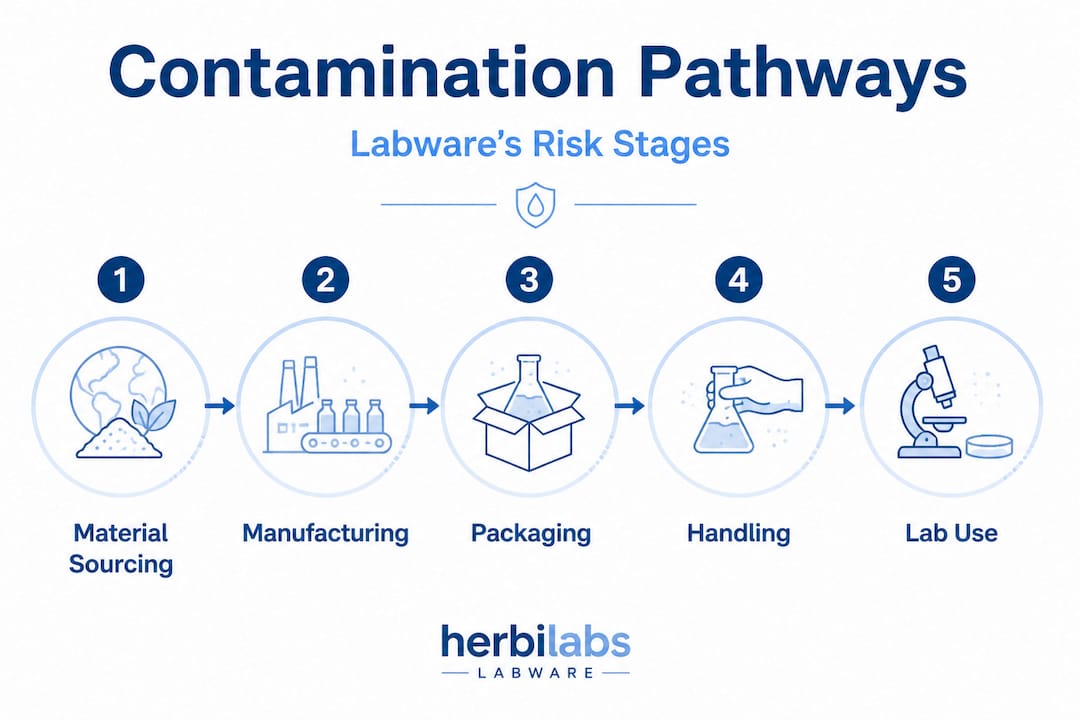
Contamination stems from both material composition and cleaning carryover variables, including incomplete detergent removal, inconsistent acid rinse procedures, and variability introduced by operator-dependent manual washing. Polymer-based labware introduces an additional layer of complexity, since certain plastics leach plasticizers, endocrine-disrupting compounds, or metal oxides under common laboratory conditions, particularly when exposed to heat or acidic solutions. Borosilicate glass, while chemically resistant, can release boron and sodium ions, which become analytically significant in ultra-trace work.
Key contamination sources researchers should account for include:
- Manufacturing residuals: Mold release agents, processing lubricants, and polymer additives embedded during production
- Packaging materials: Cardboard dust, particulate matter from plastic wrapping, and volatile organic compounds from foam inserts
- Wash cycle carryover: Residual detergent films, especially phosphate-containing formulations, and incomplete final rinse with non-compliant water
- Storage environment: Particulate deposition, volatile contamination from laboratory air, and cross-contamination from nearby chemical storage
- Operator handling: Skin oils, nitrile glove contaminants, and airborne particulates introduced during manipulation
Understanding labware purity explained in depth requires accepting that “clean” is a relative and method-specific term. For general biochemical work, a standard detergent wash followed by deionized water rinsing may be entirely adequate. For ICP-MS (inductively coupled plasma mass spectrometry) trace metal analysis, that same labware would be considered grossly contaminated.
Critical note: USP (United States Pharmacopeia) and EP (European Pharmacopoeia) specifications for final rinse water often require water meeting conductivity thresholds of less than 1.3 µS/cm, which corresponds to high-purity water produced by reverse osmosis or equivalent systems. Using tap water or standard deionized water as a final rinse step introduces ions at concentrations that directly interfere with pharmaceutical-grade cleaning validation. Effective manufacturing quality control begins with this level of specification adherence.
The broader implication is that contamination is not solely a laboratory practice problem; it is also a materials and process design problem. Addressing it requires attention at every stage of the labware lifecycle.
When labware purity matters most: High-sensitivity workflows
Understanding these contamination sources makes it clear that the stakes rise considerably for specific categories of research. Certain workflows are extraordinarily sensitive to trace-level background contributions, and contamination in these contexts does not merely reduce data quality; it can invalidate entire datasets or generate false conclusions.
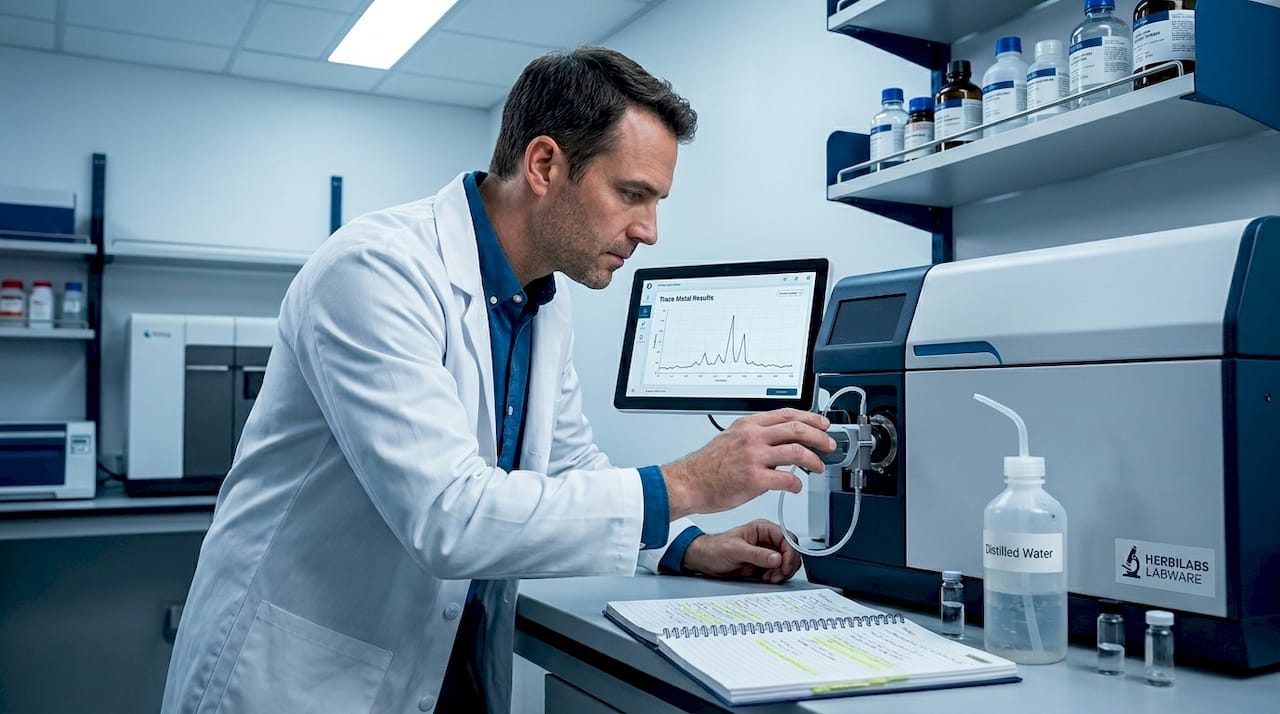
ICP-MS and trace metal analysis represent perhaps the most demanding context. In this technique, instruments routinely measure analyte concentrations in the sub-parts-per-trillion range. A single rinse with non-compliant water, or a brief contact with a polypropylene container that leaches trace quantities of titanium dioxide from its pigment system, can introduce metal concentrations that exceed the target analyte level. Contamination can dominate results in low-level and trace workflows such as these, where even the smallest background contributions distort quantitative outcomes.
PFAS (per- and polyfluoroalkyl substances) testing has emerged as another area where labware purity is non-negotiable. These ultra-persistent compounds are present as trace contaminants in many laboratory environments and in some plastics used for labware manufacturing. PFAS and other ultra-persistent contaminants illustrate precisely why batch qualification of labware and method blanks are not optional formalities; they are fundamental quality controls that distinguish reliable data from artifact-driven results. In regulatory PFAS testing, a single contaminated vessel used for a method blank can trigger a false exceedance, with significant downstream consequences.
Forensic and ecological analyses present similar challenges. Diatom analysis in drowning investigations, for example, requires isolating biological markers from water-derived matrices; contamination introduced by labware during digestion steps directly inflates background diatom counts and compromises evidentiary value. The same principle applies to environmental monitoring, pharmaceutical dissolution testing, and proteomics workflows where even microgram quantities of exogenous protein can alter mass spectrometry outcomes.
| Workflow type | Primary contamination risk | Critical labware specification |
|---|---|---|
| ICP-MS trace metals | Metal ion leaching from plastics and glass | Trace-metal-grade, acid-rinsed vessels |
| PFAS analysis | PFAS leaching from fluoropolymer labware | PFAS-free certified materials |
| Pharmaceutical testing | Detergent residue, endotoxin carryover | USP/EP-compliant rinse water, validated cycles |
| Ecological/forensic markers | Particulate and biological carryover | Dedicated, single-use or thoroughly validated glassware |
| Peptide research | Endotoxin, metal ions, organic residues | Ultra-low binding, endotoxin-tested vessels |
Understanding labware purity for peptides is particularly important when working with sensitive biological targets. Peptide adsorption onto container surfaces, metal-catalyzed oxidation, and endotoxin carryover are all labware-dependent variables that must be controlled through both material selection and validated preparation procedures.
Pro Tip: Always run a minimum of two method blanks per analytical batch, using the same lot of labware as test samples. This approach detects lot-specific contamination that a single blank would fail to identify, and it also provides statistical confidence in background subtraction.
Additionally, the importance of lab water quality control cannot be overstated in these contexts. The final rinse water quality directly determines residual ionic contamination, and many laboratories underinvest in monitoring water purity at the point of use, not just at the purification system outlet.
Statistic callout: In ICP-MS environmental monitoring workflows, studies have documented that up to 60% of quantification errors in low-concentration analyte ranges trace back to labware-derived contamination rather than instrument calibration or reagent-grade issues. This proportional contribution underscores that instrument precision is only as reliable as the vessel delivering the sample.
Validated labware cleaning and handling: Best practices
Given the sensitivity in trace-level workflows and the multiple contamination pathways identified above, researchers and lab managers require concrete, validated approaches rather than generalized guidance. The following best practices reflect current standards in pharmaceutical compliance, environmental analysis, and research laboratory management.
Automating washing and standardizing cleaning cycles significantly reduce variability and trace-metal contamination risk compared to manual washing, where operator technique introduces inconsistency in water temperature, contact time, detergent concentration, and rinse volume. Automated laboratory glassware washers with programmable cycles allow laboratories to define and lock in parameters for each labware category, and their outputs can be validated and documented for regulatory purposes.
Recommended cleaning validation sequence for trace-sensitive labware:
- Pre-rinse cycle with purified water (conductivity less than 5 µS/cm) to remove gross contamination and particulates
- Alkaline wash cycle using a validated low-foaming laboratory detergent at defined temperature (typically 65°C) and contact time
- Hot water rinse to remove detergent residues, with verification that rinse water conductivity rebounds to baseline
- Acid rinse step (typically dilute nitric acid at 1-5% v/v for trace metal work) with adequate contact time for metal desorption
- Final rinse with high-purity water meeting USP/EP conductivity specifications, confirmed at point of use
- Drying in a clean, enclosed environment to prevent recontamination from laboratory air
Methodology and validation matter as much as product selection for pharmaceutical compliance, and this principle extends broadly across research settings. A cleaning procedure that has never been validated against acceptance criteria is, from a quality assurance perspective, an assumption rather than a control.
| Cleanliness indicator | Measurement method | Acceptance criterion (trace work) |
|---|---|---|
| Residual ions | Conductivity of final rinse water | Less than 1.3 µS/cm |
| Organic residues | Total organic carbon (TOC) analysis | Less than 0.5 mg/L |
| Visual inspection | White-light and UV illumination | No visible residue or films |
| Trace metals | Blank ICP-MS run | Below method detection limit |
| Microbial carryover | Endotoxin testing (LAL assay) | Meets assay-specific threshold |
Maintaining labware integrity steps as a formal, documented laboratory procedure also serves a compliance function. Regulatory inspectors and journal peer reviewers increasingly expect documentation of cleaning validation as part of analytical method validation records, particularly in pharmaceutical research and environmental testing.
Quality control tips for labs consistently emphasize batch and lot verification as a separate but complementary control. Even when cleaning procedures are optimized, a new batch of labware from the same supplier can differ in surface chemistry, trace element content, or extractable organic profile. Establishing incoming material testing protocols closes this gap.
Pro Tip: Maintain a dedicated log for each labware batch that records supplier lot number, receipt date, incoming inspection results, assigned cleaning protocol, and any deviation from the standard cycle. Cross-reference this log against analytical blank trends to identify lot-specific contributions to background contamination before they affect study results.
The lab quality control checklist provides a structured reference for establishing these controls systematically, covering both routine daily checks and periodic deeper audits.
Integrating contaminant control in everyday lab practice
With validated cleaning procedures and equipment specifications established, the next challenge is embedding these controls into the rhythm of daily laboratory operations. Validated procedures only protect research quality when they are consistently followed, which requires both structural supports and a well-informed team.
Contamination control should be treated as a standing agenda item in laboratory quality meetings rather than an issue addressed reactively when results appear anomalous. Proactive trending of method blank data is the single most powerful early-warning system available; upward trends in blank analyte concentrations signal emerging contamination sources before they escalate to result invalidation.
Contaminant control is a quality attribute to manage through both labware selection and routine process controls, not a one-off concern addressed at the procurement stage. This requires a formal schedule for auditing labware sources, reviewing supplier certificates of analysis, re-qualifying cleaning procedures after any change in reagents or equipment, and retraining staff when procedure updates occur.
Practical daily integration measures include:
- Designated clean labware storage zones separated from general storage, fitted with covers or enclosed cabinet systems to minimize particulate deposition and volatile organic exposure
- Color-coded or labeled labware sets assigned to specific experiment types, eliminating cross-use between trace metal work and routine biochemistry that would require full requalification
- Pre-use blank checks for high-sensitivity experiments, where a final rinse of each vessel is tested before sample introduction, providing an immediate pass or fail check at the point of use
- Staff training records that document not only procedure instruction but competency assessment in recognizing and reporting potential contamination events
- Incident reporting system for contamination events, including near-misses, to enable root cause analysis and procedure improvement
The essential labware checklist provides a practical framework for auditing these controls across different research contexts, ensuring that both material qualification and process controls are consistently addressed.
Communication across laboratory teams is often overlooked as a contamination control mechanism. When different research groups share equipment or facilities, inconsistent cleaning practices can introduce cross-experiment contamination. Establishing shared written standards and communicating them actively is as important as any technical control.
A fresh perspective: Labware purity is a process, not a purchase
There is a pervasive assumption in laboratory procurement that selecting a certified, reputable labware brand is sufficient to guarantee purity. This assumption is understandable, given that supplier quality assurance programs and product certifications provide genuine value. However, it conflates the quality of the starting material with the quality of the delivered analytical result.
A high-purity, certified polypropylene tube does not remain high-purity after twenty minutes of contact with a detergent-containing rinse water that was never tested for conductivity compliance. Certification describes the product at the point of manufacture, not at the point of use. The interval between those two moments is where most contamination problems actually originate.
The practical implication is that every laboratory should invest in process validation with the same rigor applied to instrument qualification. This means defining acceptance criteria for cleaning, measuring against them routinely, and documenting the results. It means treating labware as a critical reagent with a shelf life, usage history, and qualification status, rather than as a passive container.
Not all experiments demand the same standard, and resource allocation should reflect that reality. Applying trace-metal-grade protocols to every piece of glassware in a general biochemistry laboratory would be operationally unsustainable. The appropriate response is a risk-based tiered system: identify which workflows are genuinely sensitive to labware-derived contamination, apply rigorous validated controls to those specifically, and maintain proportionate but still documented controls for lower-sensitivity work.
Maximizing research reliability ultimately depends on culture as much as process. When staff understand the mechanism by which invisible residues affect quantitative results, they take ownership of contamination control rather than treating it as procedural overhead. The most effective labs we observe treat labware purity as shared scientific responsibility, not as a quality management obligation imposed from above.
Explore trusted solutions for contaminant-free research
For researchers and lab managers who are ready to strengthen contamination controls across their workflows, having access to properly qualified products and evidence-backed guidance is the necessary next step.
Herbilabs provides research-grade reagents and reconstitution solutions manufactured to strict purity standards, with rigorous quality control documentation that supports both routine and trace-sensitive research environments. Whether you are selecting consumables for peptide work, trace analysis, or pharmaceutical testing, our resources are designed to inform those decisions with precision. Review our labware checklist for research to audit your current setup, explore the rationale for high-purity reagents in sensitive workflows, and access guidance on how to select reagents for peptide research to align your reagent choices with your method requirements and purity standards.
Frequently asked questions
Can contaminants affect even single-use labware?
Yes. Both reusable and disposable labware can introduce contaminants, particularly in trace-level or highly sensitive workflows where single-use labware contributes measurable background to high-sensitivity analyses.
What are the most effective ways to validate labware cleanliness?
Automating washer systems, controlling rinse water quality, and regularly testing with method blanks are all effective; automating washing with validated parameters demonstrably reduces contamination variability compared to manual alternatives.
How do I know if my cleaning process is sufficient for trace analysis?
Use method blanks per analytical batch, and monitor both TOC and conductivity of final rinse water; TOC-based limits and conductivity are widely accepted surrogate measures for cleanliness verification in validated cleaning procedures.
Do all research projects require the same labware purity?
No. The required purity level depends entirely on method sensitivity; trace-level work is most vulnerable to labware-derived contamination, while routine biochemical procedures operate with substantially more tolerance.
What ongoing practices help prevent labware contamination?
Regular material and batch verification, validated cleaning cycles, thorough documentation, and consistent use of method blanks are all essential; blanks, batch qualification, and documentation form the backbone of reliable trace analysis quality assurance.