Private Label, White Label, Wholesale partnerships available - EU, USA and UK - Free shipping from €75
Build the ultimate lab quality control checklist for 2026
Build a robust 2026 lab quality control checklist with CLSI QSEs, ISO 17025 criteria, empirical QC benchmarks, and FDA QMSR compliance guidance for research labs.
TL;DR:
- Laboratory compliance in 2026 demands strict adherence to FDA QMSR, ALCOA+ data integrity, and automated QC.
- Core frameworks from CLSI QSEs and ISO 17025 form the basis for effective, audit-ready checklists.
- Empirical benchmarks help set realistic QC thresholds while targeted, practical checklists improve reliability.
Laboratory compliance in 2026 has grown measurably more demanding, with the FDA QMSR deadline arrived in February 2026, renewed scrutiny on 21 CFR Part 11 data integrity under ALCOA+ principles, and accelerating adoption of automated QC systems. For quality control managers and procurement specialists at research institutions and universities, managing these intersecting obligations without a structured, evidence-backed checklist creates serious operational risk. This article builds the framework from the ground up, covering core criteria drawn from CLSI and ISO 17025, a practical 2026 compliance checklist, a side-by-side framework comparison, and empirical metric benchmarks. Each section delivers actionable guidance calibrated for real laboratory settings.
Table of Contents
- Core criteria: Building the framework
- 2026 compliance checklist: Practical items you need
- Checklist comparison: CLSI QSEs vs ISO 17025 and QC audits
- Applying benchmarks: Actionable metrics and edge case strategies
- A practical perspective: Quality control that really works
- Optimize your lab’s quality control
- Frequently asked questions
Key Takeaways
| Point | Details |
|---|---|
| Framework first | Build your checklist on CLSI QSEs and ISO 17025 for solid coverage of both organizational and technical QC. |
| Update for 2026 | Integrate new regulatory deadlines, digital record requirements, and automated QC practices into your process. |
| Benchmark metrics | Use empirical data like CVa thresholds and omics QC metrics to set context-specific, actionable standards. |
| Tailor for audits | Add specific checklist items for supplier audits, CoA review, and OOS investigations based on audit readiness. |
| Automate QC | Leverage automation rules and real-time charting to improve efficiency and reduce compliance errors. |
Core criteria: Building the framework
Now that we have recognized the challenge, let us break down the foundational checklist frameworks every manager and procurement specialist needs. A quality control checklist is only as reliable as the framework behind it. Without structured criteria rooted in recognized standards, checklists become inconsistent, reactive, and difficult to audit. Two frameworks dominate laboratory quality management globally: the CLSI Quality System Essentials and ISO 17025.
CLSI’s 12 QSEs form the core framework for laboratory quality management, organizing requirements into twelve interconnected domains that cover everything from organizational governance to information management. These are not siloed requirements. They operate as a layered system where weakness in one domain, such as personnel qualifications, creates cascading risk in others, such as equipment performance and documentation accuracy. Understanding the lab QC essentials behind this layered design helps managers allocate their checklist efforts where they create the most systemic impact.
ISO 17025 checklists cover key areas including document control, personnel qualifications, and equipment calibration, making it the preferred accreditation standard for testing and calibration laboratories. Its dual structure separates management requirements from technical requirements, which is especially relevant when adapting checklists for multi-disciplinary university labs. Aligning with ISO standards in research environments means addressing both administrative controls and method-specific technical rigor simultaneously.
A preventative versus corrective distinction is central to both frameworks. Preventative controls address conditions before failures occur, covering training schedules, calibration intervals, and environmental monitoring. Corrective controls respond after deviations are identified, covering out-of-specification investigations, root cause analysis, and corrective action documentation. An effective checklist integrates both layers.
| Criterion | CLSI QSE domain | ISO 17025 requirement |
|---|---|---|
| Document control | Documents and records | Document control (Clause 8.3) |
| Personnel qualifications | Personnel | Personnel (Clause 6.2) |
| Equipment calibration | Equipment | Equipment (Clause 6.4) |
| Method validation | Process improvement | Technical requirements (Clause 7.2) |
| Supplier evaluation | Purchasing and inventory | Purchasing services (Clause 6.6) |
| Environmental monitoring | Facilities and safety | Environment (Clause 6.3) |
| Internal audits | Assessments | Internal audits (Clause 8.7) |
Core checklist building blocks across both frameworks include:
- Organization and governance: Defined roles, responsibilities, and quality policy documentation
- Document control: Version-controlled SOPs, access controls, and change management records
- Personnel: Competency records, training logs, and authorization matrices
- Equipment: Calibration schedules, maintenance logs, and performance verification data
- Supplier evaluation: Qualification criteria, approved vendor lists, and certificate of analysis (CoA) review protocols
- Environmental controls: Temperature, humidity, and contamination monitoring records
2026 compliance checklist: Practical items you need
With the framework in place, let us dive into the practical 2026 checklist items every lab needs to cover. Regulatory priorities have shifted sharply in 2026, and checklist items that were optional in previous cycles are now enforceable requirements.
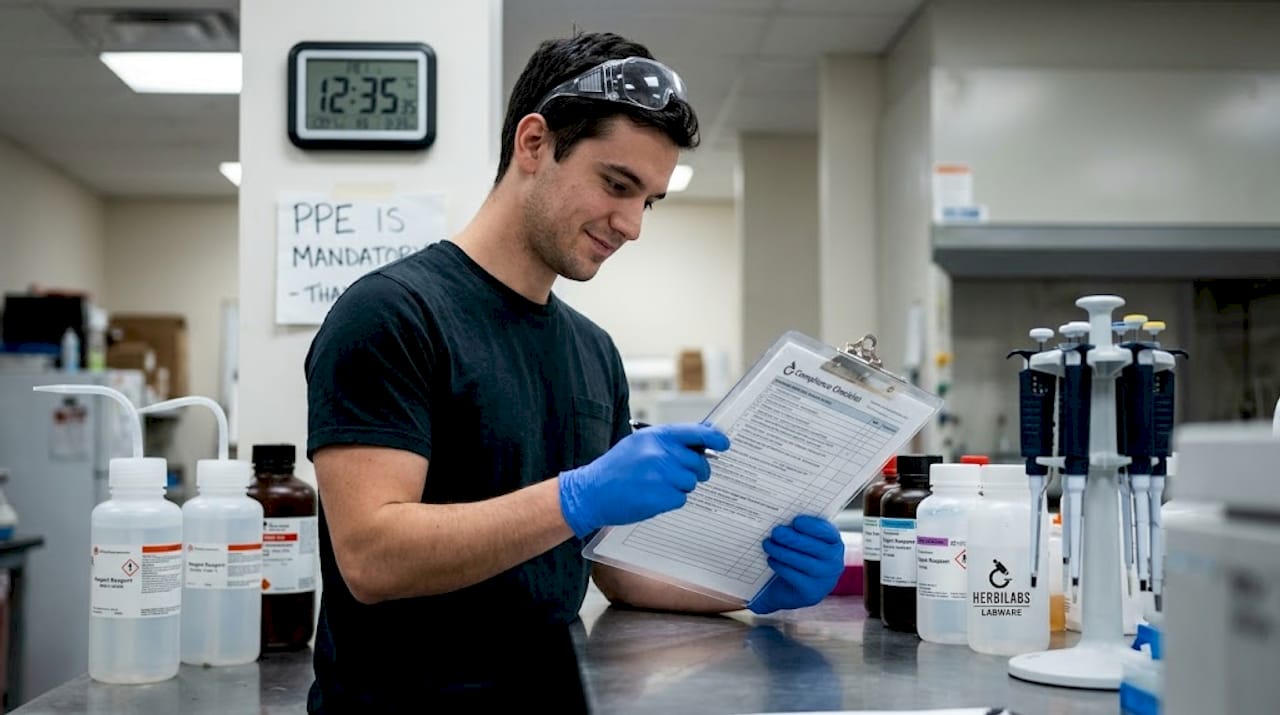
The 2026 laboratory compliance guide highlights FDA QMSR compliance as of February 2026, data integrity under ALCOA+ principles for 21 CFR Part 11, and automated QC using Westgard rules as priority focus areas. Simultaneously, ISO 17025:2025 updates include digital records, electronic signatures, software validation, and sustainability requirements, with a three-year transition period extending to September 2028.
The following numbered checklist reflects these 2026 priorities for research institutions:
- Document control: Confirm all SOPs are version-controlled, dated, and accessible via validated document management software
- Digital record management: Verify electronic records meet ALCOA+ criteria (attributable, legible, contemporaneous, original, accurate, plus complete, consistent, enduring, available)
- Personnel qualifications: Maintain current competency assessments and training completion records for all testing staff
- Equipment calibration: Review calibration certificates for all critical instruments; confirm calibration intervals are within tolerance
- Supplier evaluation: Conduct formal qualification reviews for all reagent and consumable suppliers; document CoA verification for each lot received
- Environmental monitoring: Record temperature, humidity, and air particulate data at defined intervals with alert and action limits specified
- Method validation: Confirm all test methods are validated or verified against current reference standards, with validation data archived
- QC automation review: Confirm Westgard multi-rule implementation for automated QC flagging; review QC charts for trending and bias
- Internal audit schedule: Verify audits are scheduled at defined frequencies with findings, corrective actions, and closure records documented
- Sustainability documentation: Begin recording energy and waste metrics in preparation for ISO 17025:2025 sustainability requirements
Pro Tip: Align procurement timelines with compliance calendar milestones. When renewing supplier contracts or placing bulk reagent orders, schedule CoA reviews and supply chain reliability audits to coincide with internal audit cycles. This integration prevents documentation gaps that frequently appear during accreditation reviews.
For day-to-day execution, QC tips for safe lab results should inform how staff interact with each checklist item. A checklist item that exists only as a document review task without linked procedural steps provides limited assurance and often fails during external audit scrutiny.
Checklist comparison: CLSI QSEs vs ISO 17025 and QC audits
After assembling the full checklist, understanding how different frameworks compare and interact is essential. Both CLSI QSEs and ISO 17025 address overlapping quality domains, but their scope, emphasis, and audit readiness implications differ meaningfully.
| Checklist area | CLSI QSEs | ISO 17025 | Unique to each |
|---|---|---|---|
| Document control | Yes | Yes | ISO: software validation for electronic records |
| Personnel qualifications | Yes | Yes | CLSI: broader organizational competency model |
| Equipment calibration | Yes | Yes | ISO: traceability to national/international standards |
| Method validation | Yes | Yes | ISO: measurement uncertainty required |
| Supplier evaluation | Yes | Yes | CLSI: vendor relationship management |
| Internal audits | Yes | Yes | ISO: mandatory management review meeting |
| Measurement uncertainty | No | Yes | ISO only |
| Customer communication | Partial | Yes | ISO: explicit complaint handling requirements |
| Sustainability metrics | No | Yes (2025) | ISO only |
QC department audit-specific additions that go beyond standard framework checklists include:
- Supplier qualification audits: Documented qualification evidence beyond standard CoA review, including facility audits or third-party certification verification
- Sampling integrity checks: Chain of custody documentation and sample integrity verification at receipt
- Out-of-specification (OOS) and out-of-trend (OOT) investigations: Formal investigation logs with root cause, impact assessment, and corrective action records
- QC department audit checklist items emphasize method version control and data integrity reviews as separate audit points from general document control
- Inter-instrument comparisons: Periodic cross-validation data between instruments performing equivalent tests
As the QA QC blueprint from Lab Manager clarifies:
Quality assurance is preventative and process-oriented, while quality control is corrective and product-oriented. Both functions must operate in parallel rather than in sequence for a laboratory to maintain reliable, reproducible results.
For university research labs specifically, combining CLSI QSEs with ISO 17025 technical requirements produces the most defensible framework. CLSI provides the organizational scaffolding, while ISO 17025 supplies the technical rigor needed for accreditation. Guidance on maintaining labware integrity and implementing a structured reagent QC guide are practical entry points for labs building a hybrid approach.
Applying benchmarks: Actionable metrics and edge case strategies
Comparisons clarify framework choices, so now let us anchor decisions to real-world metrics and expert strategies. Setting QC thresholds without empirical reference data leads to either excessive false positives or missed genuine deviations. Calibrating thresholds to published benchmarks provides defensible, evidence-based limits.
Empirical benchmarks from 2026 laboratory medicine data establish intra-lab coefficients of analytical variation (CVa) for coagulation tests at PT 5.1%, INR 5.3%, and aPTT 3.5%, with reference change values (RCVs) of 14.2%, 14.6%, and 11.0% respectively. For multi-omics research, omics QC thresholds recommend CV under 25% for metabolomics QC samples as an acceptance criterion. These figures are not arbitrary targets; they represent the variability achievable under controlled intra-laboratory conditions and serve as realistic starting points for threshold-setting.
Priority benchmarks for research labs and universities include:
- Analytical precision: CVa below 5% for high-precision assays; adjust upward for exploratory omics workflows
- Calibration frequency: Equipment calibration intervals not exceeding manufacturer specifications, with verification data archived
- Environmental control limits: Temperature logs within plus or minus 2 degrees Celsius of target for refrigerated storage
- Supplier lot-to-lot variability: Acceptable lot variation thresholds defined per reagent type, with trend data reviewed quarterly
- QC sample frequency: Minimum one QC sample per analytical batch; increase frequency when new lots or operators are introduced
Edge case management is where many labs lose control of their checklist rigor. OOS investigations and tightened sampling for new suppliers are documented best practices that prevent isolated deviations from becoming systemic failures. When inter-lab variability is present, as it always is in multi-site university settings, RCVs widen substantially and require site-specific threshold adjustment rather than universal application of published figures.
Pro Tip: Implement Westgard multi-rules (particularly 1-3s, 2-2s, R-4s, and 4-1s rules) within your automated QC software configuration. This structured approach to driving reliable research results flags systematic error, random error, and trending independently, enabling root cause identification before deviations escalate into reportable nonconformities.
A practical perspective: Quality control that really works
Most quality control failures in research settings do not happen because a checklist was missing. They happen because the checklist was not built for the lab that was using it. Generic templates borrowed from pharmaceutical GMP environments carry requirements, audit frequencies, and documentation burdens that are structurally mismatched to the workflows of university research facilities.
The counterintuitive truth is that shorter, targeted checklists consistently outperform exhaustive ones in real compliance audits. When every item carries equal weight, critical controls lose visibility. A checklist with 80 items where 15 are truly critical creates the same attentional risk as no checklist at all. Focus on the items where failure creates irreversible consequences: data integrity, equipment calibration traceability, and supplier qualification.
Ignoring inter-lab variability is the most common quantitative mistake. Published CVa benchmarks represent controlled intra-lab performance; applying them directly across multiple sites without local validation inflates false rejection rates and erodes staff confidence in QC systems. Involve bench-level staff when refining checklist items and thresholds. Their operational knowledge of where variability actually enters the workflow is more actionable than any regulatory guidance document. A checklist that evolves through team input, like the approach outlined in our guide to streamlining lab consumables, remains relevant rather than becoming a compliance formality.
Optimize your lab’s quality control
Putting these checklist principles into practice requires not only sound procedures but also reliable reagents and labware that meet the purity standards your QC framework depends on. At Herbilabs, we supply research-grade reagents and reconstitution solutions manufactured to strict quality standards, supporting the supplier evaluation and lot verification steps central to a robust 2026 checklist.
Our resources on lab reagent selection and the value of high-purity reagents provide procurement specialists with the technical criteria needed to evaluate suppliers against current ISO 17025 and FDA QMSR standards. For teams focused on maintaining consistent assay performance across batches, our guidance on maintaining labware integrity connects directly to the environmental and storage controls your QC checklist requires.
Frequently asked questions
What are the must-have items on a 2026 laboratory quality control checklist?
ISO 17025 checklists cover document control, personnel qualifications, equipment calibration, and data management as foundational requirements, while QC audit standards add supplier qualification, CoA review, and OOS investigation protocols as equally critical items.
How do CLSI QSEs and ISO 17025 differ for university labs?
CLSI’s 12 QSEs provide a broad organizational management framework suited to diverse lab settings, while ISO 17025 supplies the technical accreditation requirements including measurement uncertainty and traceability; most university research labs benefit from implementing both in parallel.
What are the new 2026 compliance deadlines for laboratory quality control?
The FDA QMSR deadline took effect in February 2026, and ISO 17025:2025 digital record requirements including electronic signatures and software validation carry a transition period ending in September 2028.
What metrics are recommended for setting QC thresholds in research labs?
Published 2026 benchmarks establish intra-lab CVa at PT 5.1%, INR 5.3%, and aPTT 3.5% for coagulation tests, with CV under 25% recommended for metabolomics QC samples; thresholds should be adapted to local intra-lab and inter-lab variability data before implementation.
How can QC automation improve efficiency and reduce errors?
Automated QC systems using Westgard rules and real-time statistical charting enable laboratories to flag systematic and random errors promptly, standardize review workflows, and maintain tighter compliance with 2026 regulatory benchmarks with reduced dependence on manual oversight.