Private Label, White Label, Wholesale partnerships available - EU, USA and UK - Free shipping from €75

Safely store sensitive chemicals: lab technician’s guide
Learn how to store sensitive chemicals safely with this comprehensive guide. Ensure laboratory safety and protect your research integrity today!
TL;DR:
- Proper chemical storage by hazard class and compatibility reduces the risk of fires and toxic releases in laboratories.
- Using approved cabinets, secondary containment, and regulated quantities enhances lab safety and compliance with standards.
A single misidentified container, one misplaced corrosive next to an oxidizer, or a standard household refrigerator used to store flammable solvents — any of these scenarios can trigger fires, toxic releases, regulatory violations, and the complete loss of months of research data. For laboratory technicians and researchers, safe chemical storage is not an administrative formality; it is an operational responsibility that directly shapes laboratory safety culture, personnel protection, and research integrity. This guide covers the full spectrum of storage best practices, from hazard classification and container selection to secondary containment, quantity limits, and the specialized handling of compressed gases and cryogens, drawing on current guidance from the NIH, AIHA, and NCBI.
Table of Contents
- Understand chemical compatibility and hazard classification
- Choose the right cabinets, containers, and cold storage
- Apply secondary containment and spill controls
- Regulate storage quantity and location for lab safety
- Special storage for compressed gases and cryogens
- Why treating chemical storage as part of chemical hygiene pays off
- Support your chemical management with reliable labware and solutions
- Frequently asked questions
Key Takeaways
| Point | Details |
|---|---|
| Sort by hazard class | Always segregate chemicals by compatibility group, not alphabetically, to avoid dangerous mix-ups. |
| Use proper storage | Store flammables in certified cabinets and use explosion-proof fridges when needed. |
| Contain and control spills | Provide secondary containment for hazardous liquids sized to institutional or regulatory benchmarks. |
| Limit and monitor quantities | Follow NFPA fire-safety rules to store only permitted quantities in each lab area. |
| Secure gases safely | Upright, secure storage and ventilation are must-haves for compressed gases and cryogens. |
Understand chemical compatibility and hazard classification
With the risks established, the first priority is learning how to classify and separate chemicals correctly before anything reaches a shelf or cabinet.
The foundational rule of chemical storage is this: chemicals must be organized by hazard class and chemical compatibility, never by convenience or alphabetical order. The NIH recommends that laboratories store chemicals by hazard class and compatibility rather than alphabetically, using Safety Data Sheet (SDS) Section 7 (Handling and Storage) and Section 10 (Stability and Reactivity) as the primary reference documents for segregation decisions.
The major hazard classes that require separate storage include:
- Flammables and combustibles (e.g., ethanol, acetone, hexane)
- Oxidizers (e.g., hydrogen peroxide, potassium permanganate)
- Corrosives: acids (e.g., hydrochloric acid, sulfuric acid)
- Corrosives: bases (e.g., sodium hydroxide, ammonium hydroxide)
- Acutely toxic chemicals (e.g., potassium cyanide, osmium tetroxide)
- Reactive and water-reactive chemicals (e.g., sodium metal, calcium hydride)
- Pyrophorics (e.g., tert-butyllithium in solution)
The table below summarizes common incompatible pairs that must never share the same storage area:
| Chemical group | Must be separated from |
|---|---|
| Flammables | Oxidizers, ignition sources |
| Oxidizing acids | Organic materials, flammables |
| Mineral acids | Bases, oxidizers, cyanides |
| Bases | Acids, reactive metals |
| Cyanides | Any acid |
| Water-reactive chemicals | Aqueous solutions, humid environments |
Referencing SDS Section 10 is particularly important for identifying reactivity hazards that may not be immediately intuitive. For example, acetic acid is classified as a flammable, but it is also incompatible with chromic acid and peroxides, information captured in Section 10 that a purely class-based approach might miss. Reviewing reagent handling best practices alongside SDS documentation builds a more complete picture of how each chemical should be handled and where it belongs.
Pro Tip: Post laminated compatibility charts at eye level near every primary storage area. Quick visual reference reduces the likelihood of placement errors during busy lab sessions, especially when multiple technicians share a storage space.
Alphabetical storage might seem systematic, but consider what it means in practice: acetic acid could end up next to acetonitrile, which may then sit adjacent to ammonium nitrate, an oxidizer. That proximity alone violates basic segregation rules and has been the precursor to serious lab incidents. Reviewing your current storage layout against the SDS Section 7/10 guidance as part of step-by-step reagent handling review cycles is a straightforward corrective action.
Choose the right cabinets, containers, and cold storage
Once chemicals are sorted by compatibility, attention turns to the actual storage infrastructure and how it prevents accidents.
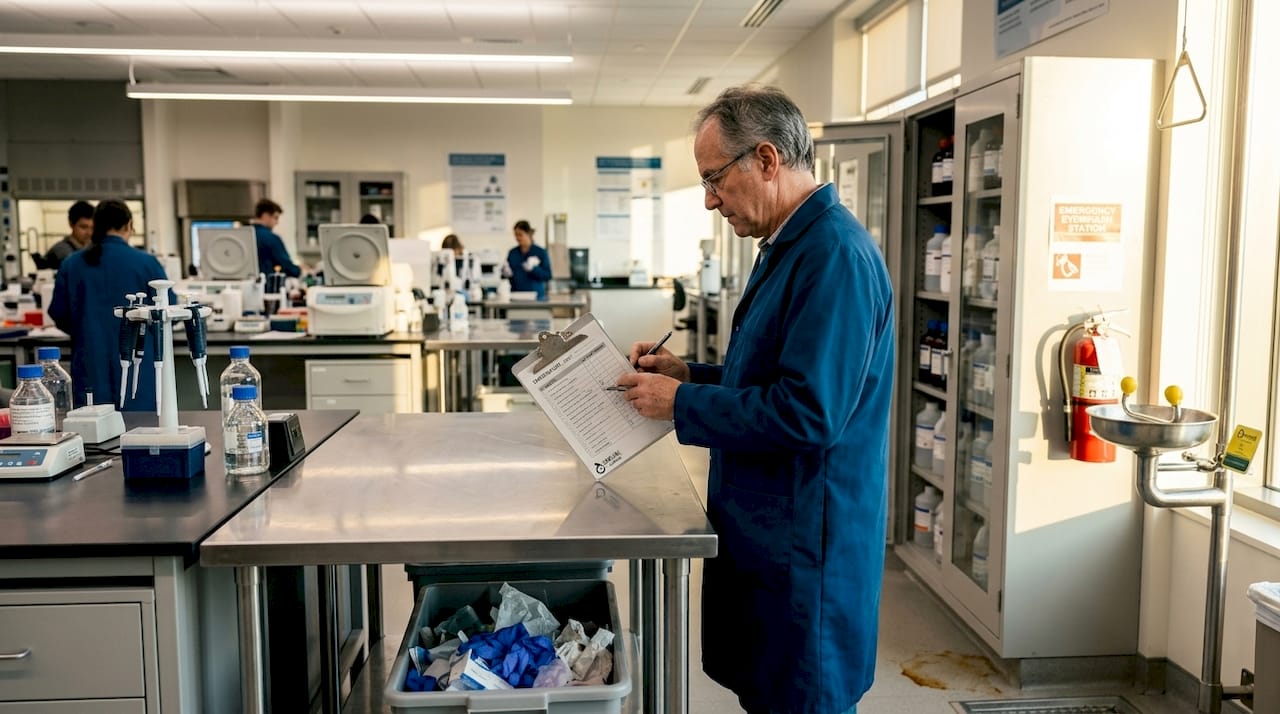
The physical storage system is where many labs invest insufficiently. A correctly classified chemical stored in the wrong cabinet or the wrong type of refrigerator is still a hazard. NCBI’s Prudent Practices in the Laboratory specifies that appropriate cabinets and engineering controls must be matched to the fire and chemical risk of the substances being stored, and that flammable storage in particular requires approved flammable safety cabinets rated to FM or UL standards.
| Storage scenario | Required equipment |
|---|---|
| Flammable solvents at room temperature | FM/UL-approved flammable safety cabinet |
| Significant quantities of flammables requiring refrigeration | Explosion-proof laboratory refrigerator |
| Corrosive acids | Acid-resistant, vented cabinet |
| Corrosive bases | Separate base-resistant cabinet |
| Highly toxic compounds | Lockable, ventilated security cabinet |
| Temperature-sensitive biologics/reagents | Standard laboratory-grade refrigerator (non-flammable contents only) |
To verify whether your cabinets and refrigerators comply, follow these steps:
- Locate the FM (Factory Mutual) or UL (Underwriters Laboratories) rating label on the interior door or side panel of every cabinet used for flammable storage.
- Confirm that laboratory refrigerators designated for flammable chemical storage are explicitly labeled “explosion-proof” or “laboratory safe for flammable storage,” not simply “laboratory refrigerator.”
- Check that corrosive storage cabinets are constructed from or lined with acid or base-resistant materials, not uncoated steel.
- Inspect container integrity quarterly: cracked polypropylene containers, corroded metal lids, and degraded rubber seals all compromise safe storage for reagents and must be replaced immediately.
- Review ventilation connections on solvent cabinets — passive vents should be open or actively connected to exhaust systems where required by local codes.
“Modified household refrigerators, even those with internal power sources relocated to prevent sparking, are not considered equivalent to purpose-built explosion-proof laboratory refrigerators and should not be used for significant quantities of flammables.” — NCBI, Prudent Practices in the Laboratory
Pro Tip: For especially sensitive or controlled agents, lockable cabinets with integrated alarm systems provide both physical security and an immediate alert if door seals fail or temperatures drift out of range. This is particularly relevant for Schedule I and II research compounds subject to DEA oversight.
Apply secondary containment and spill controls
Beyond proper primary storage, containment for potential spills is a critical layer of protection that is frequently underengineered in research labs.
Secondary containment refers to a second physical barrier, typically a tray, bin, or open-top container placed under primary storage vessels, designed to capture leaks and spills before they can migrate across shelves, contact incompatible chemicals, or reach floor drains. The NIH specifies that secondary containment systems for hazardous liquids should provide capacity for at least 10% of the total stored volume or the volume of the largest single container, whichever is greater.
Key implementation points for secondary containment include:
- Use chemical-resistant materials for trays (polyethylene for most acids and bases, stainless steel for concentrated oxidizers where polyethylene may not be suitable).
- Ensure trays are sized correctly: a single 20-liter solvent container requires a tray that holds at least 20 liters, even if total stored volume would calculate a smaller requirement.
- Never co-locate trays for incompatible chemical classes. Separate trays for acids and bases prevent accidental mixing if both containers leak simultaneously.
- Inspect trays monthly for cracks, staining, or deformation that could compromise their containment capacity.
- For cabinet-level storage, stainless steel or polyethylene drip shelves built into approved flammable cabinets often serve as passive secondary containment.
Pro Tip: Color-code spill trays using chemical-resistant paint or labeled tags — red for flammables, yellow for corrosives, blue for general hazardous liquids. Color coding enables rapid hazard identification during incident response, reducing response time and the likelihood of using an incompatible neutralizer.
When secondary containment functions as designed, the majority of lab spills are captured without environmental release, personnel exposure, or cross-contamination of incompatible materials. Reviewing published lab supply storage guidelines can help teams map containment requirements to specific bench and shelf configurations.
Regulate storage quantity and location for lab safety
With containment addressed, the next layer of protection involves limiting how much chemical is present in the laboratory at any one time and where it is physically positioned.
Quantity limits and storage location rules are not discretionary. They are codified in fire safety standards, with the National Fire Protection Association’s NFPA 45 (Standard on Fire Protection for Laboratories Using Chemicals) serving as the primary regulatory framework governing maximum allowable quantities of flammable liquids by laboratory fire hazard classification.
“Maximum allowable chemical storage quantities are regulated under NFPA 45 and local codes, and are directly determined by a laboratory’s fire hazard classification and the floor level at which the laboratory is located.”
Lab fire hazard classification under NFPA 45 divides laboratories into four types (A through D) based on the maximum amount of flammable and combustible liquids in use. The table below provides a simplified reference:
| Lab fire hazard class | General description | Max flammable liquid in use (liters per 100 sq ft) |
|---|---|---|
| Class A | High hazard | ~4 liters |
| Class B | Moderate hazard | ~2 liters |
| Class C | Low hazard | ~0.5 liters |
| Class D | Minimal hazard | Essentially none |
The AIHA specifies that storage quantities and location must be governed by fire-safety principles and that excess chemicals should be stored in designated remote chemical storage rooms rather than at bench level.
Key regulatory compliance points for quantity and location include:
- Never exceed the maximum allowable quantity for your laboratory’s fire hazard classification, as determined by your institutional safety officer.
- Keep all chemicals, including secondary containers and reserve stock, away from emergency exit routes. Obstructed egress is both a fire code violation and a life-safety risk.
- Store minimum working quantities at the bench. Transfer larger volumes from central storage only as needed.
- Clearly label all containers with chemical name, concentration, hazard class, and date received. Unlabeled containers are a regulatory violation and a spill risk.
Reviewing your facility against the lab quality control checklist provides a structured framework for confirming quantity and location compliance across all storage zones.
Special storage for compressed gases and cryogens
For specialized laboratories, storage of compressed or cryogenic materials introduces its own critical set of challenges that extend beyond typical liquid chemical protocols.
Compressed gas cylinders and cryogenic liquids (liquid nitrogen, liquid argon, liquid helium) present dual hazards: physical hazard from pressure or extreme cold, and asphyxiation risk from oxygen displacement. NIH compressed gas and cryogen safety guidelines state that released inert gases displace oxygen and can rapidly create oxygen-deficient atmospheres, particularly in enclosed or poorly ventilated spaces. An atmosphere below 19.5% oxygen is classified as oxygen-deficient and immediately hazardous to life.
“Released inert gas can quickly create oxygen-deficient environments, especially in enclosed spaces, making ventilation and continuous oxygen monitoring essential in any laboratory where cryogens or inert compressed gases are stored or dispensed.”
Follow this checklist for compressed gas and cryogen safety:
- Secure all gas cylinders upright in approved wall-mounted brackets, floor-standing racks, or cylinder carts using chains or nylon straps at two points: upper third and lower third of the cylinder body.
- Store full and empty cylinders separately and clearly label each status to prevent dispensing errors.
- Keep all cylinders and cryogenic vessels away from ignition sources, direct sunlight, and heat-generating equipment such as autoclaves or ovens.
- Ensure dedicated storage rooms for compressed gases have continuous mechanical ventilation with at least six air changes per hour.
- Install fixed oxygen-depletion monitors in any enclosed space where cryogens are regularly transferred or stored.
- Cap all cylinder valves with the manufacturer’s protective cap when cylinders are not in active use.
Pro Tip: Never store gas cylinders adjacent to laboratory exits or in public corridor areas. In the event of a valve failure or fire, a rolling or venting cylinder in a public corridor creates immediate risk to personnel and impedes emergency response. Refer to your institution’s labware for gas safety inventory to verify you have the correct securing hardware for each cylinder type in use.
Cryogenic liquids add the dimension of extreme cold contact risk. Personnel transferring liquid nitrogen must use cryogenic face shields, insulated gloves rated for cryogenic temperatures, and closed-toe footwear. Open-top dewar vessels should never be overfilled, and transfers should always be conducted in ventilated fume hoods or outdoor areas where possible.
Why treating chemical storage as part of chemical hygiene pays off
Many laboratory teams approach chemical storage as a static compliance task: a set of rules to be checked off during an annual safety inspection and then largely forgotten until the next audit cycle. This perspective is both operationally insufficient and, frankly, inconsistent with how institutional safety frameworks actually function.
The NIH Chemical Hygiene Plan (CHP) guidance makes clear that chemical storage is a component of a broader chemical hygiene and management system, one that requires current, reviewed standard operating procedures (SOPs) and active training responsibilities assigned to specific personnel. The OSHA Laboratory Standard (29 CFR 1910.1450) likewise mandates that CHPs be reviewed and updated regularly, not simply written and filed.
The operational argument is straightforward: chemical inventories change as research programs evolve. A laboratory that stored only aqueous buffers eighteen months ago may now routinely handle organic solvents and reactive intermediates. Without ongoing SOP review triggered by inventory changes, the storage layout built for the old inventory becomes a hazard for the new one.
Integrating storage reviews into safety audits, near-miss investigations, and grant compliance cycles creates a cadence that keeps practices current. Reviewing best practices for safe lab supply storage alongside CHP documentation review reinforces this integration.
Pro Tip: Update storage SOPs immediately following any safety audit finding or near-miss event, not at the next scheduled review. Near-misses are precise, real-world data points about gaps in your current system, and delaying their integration into written procedures represents a missed corrective opportunity.
Chemical storage practiced as an active management discipline, with regular SOP updates, assigned ownership, and integration into grant and compliance documentation, delivers measurable returns: fewer incidents, stronger audit outcomes, and a research environment where personnel trust that the systems around them have been thoughtfully designed.
Support your chemical management with reliable labware and solutions
As you implement these storage protocols, make sure your tools and labware are up to the task.
Selecting the right containers, trays, and dispensing equipment is as important as understanding the regulatory framework that governs how they are used. Substandard containers degrade under prolonged chemical contact, and incompatible materials create secondary hazards even in an otherwise well-organized storage system.

Herbilabs Labware supports research teams across the UK and Europe with research-grade consumables, reconstitution solutions, and labware designed to meet the demands of rigorous laboratory environments. Our lab consumables comparison resource helps teams evaluate containers, secondary containment trays, and storage vessels against material compatibility requirements, while the essential labware checklist provides a structured starting point for auditing your current storage infrastructure. Consistent, high-quality labware reduces the operational risk that comes with using mixed or unverified container stock.
Frequently asked questions
What is the minimum capacity required for secondary containment in labs?
Secondary containment must hold at least 10% of the total stored volume or the full volume of the largest single container, whichever is the greater value.
Can household refrigerators be used for storing flammable laboratory chemicals?
No. Only laboratory-rated explosion-proof refrigerators are considered safe for storing significant quantities of flammable chemicals; modified household units do not meet this standard.
How should compressed gas cylinders be stored in the laboratory?
Cylinders must be secured upright with chains or straps, kept away from ignition sources and exit routes, and housed in well-ventilated areas with continuous airflow.
Is alphabetical chemical storage safe if all containers are securely closed?
No. Storing by hazard class and compatibility is required to prevent dangerous reactions between incompatible chemicals, regardless of container closure status.
What regulatory framework governs lab chemical storage quantities?
NFPA 45 and local codes set maximum allowable chemical storage quantities based on each laboratory’s fire hazard classification and floor-level designation.