Private Label, White Label, Wholesale partnerships available - EU, USA and UK - Free shipping from €75
Lab water quality control: essential tips for researchers
Learn essential quality control practices for handling bacteriostatic water and reconstitution solutions in research, including benchmarks, storage, and monitoring protocols.
TL;DR:
- Consistent quality control ensures lab water meets microbiological, chemical, and physical standards.
- Selecting appropriate water type (bacteriostatic or sterile) depends on study design and reconstitution needs.
- Proper labeling, storage, and routine monitoring prevent contamination, data invalidation, and regulatory issues.
Lab water quality control: essential tips for researchers
Contamination of bacteriostatic water or a reconstitution solution at any stage of preparation can invalidate an entire study, skew dose-response data, and introduce variables that are nearly impossible to trace retrospectively. For independent researchers and lab managers working under European regulatory frameworks, the margin for error is narrow. This article covers the measurable benchmarks that define acceptable water quality, the critical decision between bacteriostatic and sterile water, practical storage and labeling safeguards, and the routine monitoring protocols that protect both data integrity and audit readiness across the full lifecycle of your reconstitution solutions.
Table of Contents
- Define quality control benchmarks for research water
- Choose the right water for your study: bacteriostatic vs. sterile
- Labeling, storage, and shelf-life: practical safeguards
- Routine validation and monitoring: your defense against contamination
- Why even experienced labs overlook simple quality control wins
- Tools for next-level lab quality control
- Frequently asked questions
Key Takeaways
| Point | Details |
|---|---|
| Follow validated water benchmarks | Aim for microbial counts under 10 CFU/100 mL in research water for optimal safety. |
| Choose the right solution type | Select bacteriostatic or sterile water based on study design and shelf-life needs. |
| Label and store with precision | Always note preparation date, concentration, and manage aliquots to prolong quality. |
| Conduct routine quality checks | Regularly validate water purity and document results to safeguard research reliability. |
Define quality control benchmarks for research water
Quality control (QC), as applied to laboratory water, refers to the systematic process of verifying that a water source or prepared solution meets predefined microbiological, chemical, and physical specifications before and during use in research. It is not a one-time check but an ongoing regime of testing, documentation, and corrective action. Without clearly defined benchmarks, QC efforts are subjective and unreliable, making it impossible to compare results across studies or satisfy regulatory review.
The three principal water types used in research and reconstitution work are Water for Injection (WFI), bacteriostatic water, and sterile water for injection. WFI represents the highest purity standard, produced by distillation or reverse osmosis and membrane filtration in a validated manufacturing environment. Sterile water is free of viable microorganisms but lacks preservatives, while bacteriostatic water contains benzyl alcohol (typically 0.9% w/v) to inhibit microbial growth across repeated use. Understanding these distinctions is foundational to applying the correct QC benchmarks, as discussed further in aseptic manufacturing basics.
For WFI, the empirical microbial benchmark is clear: validated PQ systems consistently demonstrate microbial counts below 10 CFU per 100 mL. CFU stands for colony-forming unit, a measure of viable bacterial cells capable of replicating on a culture medium. A result above 10 CFU/100 mL in a WFI system signals a process deviation that requires immediate investigation, not simply re-testing. This threshold is embedded in Ph. Eur. monograph 0169 and serves as the operational floor for any lab sourcing or producing high-purity water.
Key benchmark parameters every lab should monitor:
- Microbial count: Less than 10 CFU/100 mL for WFI; less than 100 CFU/mL for purified water
- Endotoxin level: Less than 0.25 EU/mL for WFI per European Pharmacopoeia standards
- Total organic carbon (TOC): Less than 500 ppb for purified water; less than 500 ppb for WFI
- Conductivity: Less than 1.3 µS/cm at 25°C for WFI
- Particulate matter: Compliant with Ph. Eur. 2.9.19 for visible and sub-visible particles
- pH: Typically 5.0 to 7.0 for reconstitution solutions depending on API stability requirements
- In-use time limit: Observed from preparation date per applicable EMA or institutional SOPs
| Parameter | WFI (Ph. Eur.) | Purified water | Bacteriostatic water |
|---|---|---|---|
| Microbial count | <10 CFU/100 mL | <100 CFU/mL | Inhibited by preservative |
| Endotoxin | <0.25 EU/mL | Not specified | Not specified |
| TOC | <500 ppb | <500 ppb | Varies by manufacturer |
| Conductivity | <1.3 µS/cm | <4.3 µS/cm | N/A |
Reviewing fundamental lab QC tips alongside your institutional SOPs will help translate these benchmarks into practical daily habits. A useful starting point is also a well-structured lab QC checklist that covers all parameter categories in a single reference document.
Choose the right water for your study: bacteriostatic vs. sterile
Selecting between bacteriostatic water and sterile water for injection is not simply a matter of availability or cost. It is a study design decision with direct implications for data reproducibility, regulatory compliance, and participant or sample safety. The wrong choice at this stage can compromise an entire experimental series.
Sterile water for injection contains no preservative and is intended exclusively for single-session use. Once the septum is punctured and the vial is accessed, the clock starts. Sterile water for single-session use carries a maximum in-use period of 24 hours before it must be discarded, regardless of visible clarity or storage conditions. This makes sterile water appropriate for one-time reconstitution of lyophilized compounds where the entire prepared volume will be used immediately or within a single experimental session.
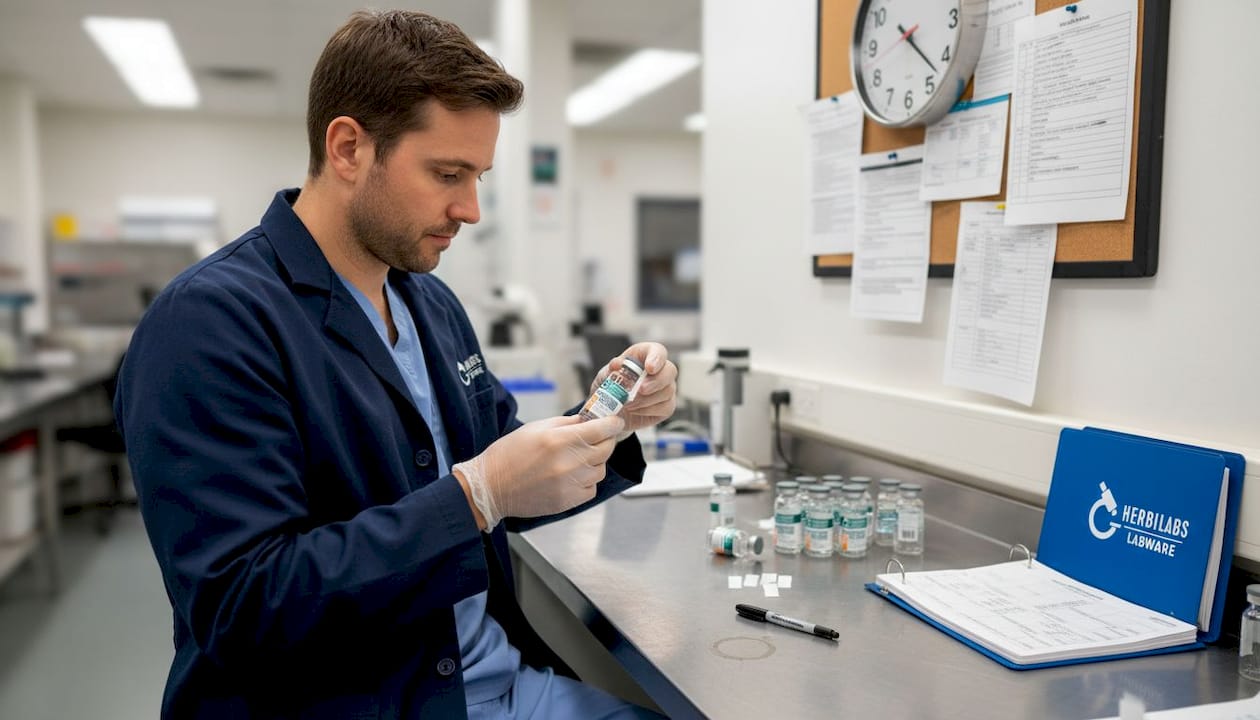
Bacteriostatic water, by contrast, is designed for multi-dose applications. The benzyl alcohol preservative suppresses bacterial growth, extending in-use shelf life to 28 days after first access. This makes it the preferred reconstitution vehicle when repeated small-volume withdrawals from a single vial are required, such as in longitudinal peptide dosing studies or repeated standard curve preparation across multiple days. Reviewing bacteriostatic water practices will clarify which applications are best suited to each type.
Step-by-step decision guide for ambiguous cases:
- Identify the total number of access events required over the study period. If more than one, bacteriostatic water is the appropriate choice.
- Confirm that the compound being reconstituted is compatible with benzyl alcohol. Some proteins and certain peptides may be sensitive to preservative content at specific concentrations.
- Review EMA and Ph. Eur. recommendations specific to your compound class, particularly if the research is intended to support a regulatory submission.
- If reconstituting for immediate single-use assay work, choose sterile water and discard any remaining volume within 24 hours.
- Document the rationale for your selection in the study protocol or SOP to support traceability and peer review.
| Feature | Sterile water for injection | Bacteriostatic water |
|---|---|---|
| Preservative | None | 0.9% benzyl alcohol |
| In-use shelf life | 24 hours post-access | Up to 28 days post-access |
| Best application | Single-session reconstitution | Multi-dose, longitudinal studies |
| Regulatory guidance | Ph. Eur., EMA | Ph. Eur., EMA |
| Microbial protection | None after opening | Active across in-use period |
Pro Tip: Always cross-reference EMA scientific guidelines and the current Ph. Eur. monograph for your specific compound before finalizing your choice. Institutional biosafety committees may also have specific mandates that override general best practice, particularly in GLP-compliant environments. A solid grasp of quality control essentials will help you frame this decision within your broader QC strategy.
Labeling, storage, and shelf-life: practical safeguards
Once the correct reconstitution solution has been selected and prepared, the integrity of that solution depends entirely on how it is labeled, stored, and managed throughout its in-use period. Labeling errors and storage lapses are among the most common and most preventable causes of data loss in independent research settings.
Best practice requires that vials be labeled with the preparation date, the concentration of any reconstituted compound, and precise storage conditions at the time of preparation, not retrospectively. A label written from memory two days after preparation introduces ambiguity that cannot be resolved during an audit or peer review. Each label should also carry a calculated discard date based on the product’s in-use shelf life, which for bacteriostatic water is 28 days after opening per EMA guidance on preserved sterile products.
Aliquoting is a core safeguard that many labs underutilize. Rather than returning to a single master vial repeatedly, preparing smaller single-use or limited-use aliquots reduces both the frequency of septum puncture and the cumulative thermal stress on the solution. Repeated freeze-thaw cycles degrade both preservative efficacy and compound stability, which can systematically bias experimental results without triggering any obvious visual warning sign.
“Label vials with preparation date, concentration, and storage conditions; aliquot to avoid repeated freeze-thaw cycles.” This principle, recommended in current reconstitution best practice literature, reflects a simple truth: the structure you impose on your reagent management directly determines the reliability of your downstream data.
Common labeling errors and how to avoid them:
- Missing preparation date: Use a printed label template with a mandatory date field, completed at the bench before the vial is capped.
- Absent discard date: Calculate and write the discard date at the time of labeling, not later. For bacteriostatic water, this is always preparation date plus 28 days.
- Unlabeled aliquots: Treat every aliquot as a primary sample. Each must carry its own complete label, not a reference to the master vial.
- Storage condition omission: Specify the temperature range (for example, 2 to 8°C) and light sensitivity requirements directly on the vial label, not only in the protocol document.
- Illegible handwriting: Use printed labels or indelible fine-tip markers. Thermal labels that fade under cold storage are a frequent source of compliance failures.
Pro Tip: Set calendar reminders for seven days before each vial’s discard date. This gives adequate time to prepare fresh aliquots before any experimental series is interrupted. Proper adherence to aseptic techniques in reagent prep during aliquoting is equally important, as even a correctly labeled vial can become compromised by a single lapse in technique.
Routine validation and monitoring: your defense against contamination
A single validated batch of bacteriostatic water does not guarantee ongoing water quality. Contamination can enter a water system or prepared solution through equipment degradation, improper handling, environmental exposure, or supply chain variation. Routine monitoring is the only reliable mechanism for detecting these events before they affect study outcomes.
A structured validation schedule should distinguish between two monitoring frequencies. Monthly checks are appropriate for in-house purified water systems and frequently used reconstitution solutions. Quarterly checks, combined with full documentation review, are the minimum standard for less frequently accessed water sources or seasonal studies. Each monitoring cycle should generate a written record that is retained and available for inspection.
Recommended steps for routine water QC validation:
- Collect water samples using sterile, pre-labeled collection vessels from the point of use, not from a reservoir or mid-system tap.
- Submit samples for microbial enumeration using membrane filtration or pour-plate methods per Ph. Eur. 2.6.12.
- Conduct endotoxin testing by Limulus Amebocyte Lysate (LAL) assay or recombinant factor C method per Ph. Eur. 2.6.14.
- Record TOC and conductivity at the point of use using calibrated inline or offline instruments.
- Compare all results against the established benchmarks. Validated WFI systems should return microbial counts below 10 CFU/100 mL as the accepted standard for process qualification.
- Log results in a QC monitoring register with the date, operator name, instrument calibration reference, and any corrective action taken.
| Monitoring parameter | Frequency | Action limit | Corrective action |
|---|---|---|---|
| Microbial count | Monthly | >10 CFU/100 mL (WFI) | Investigate source, re-sanitize, re-test |
| Endotoxin | Quarterly | >0.25 EU/mL | Quarantine batch, root cause analysis |
| TOC | Monthly | >500 ppb | Check system integrity, replace filters |
| Conductivity | Monthly | >1.3 µS/cm | Inspect and recalibrate system |
Warning signs that indicate elevated contamination risk:
- Visible turbidity or particulate matter in a solution that was previously clear
- Unexpected color change or unusual odor upon vial access
- Any microbial count trending upward across two consecutive monitoring cycles
- Gap in monitoring documentation of more than 35 days for a monthly-frequency parameter
- Recent supply chain change affecting source water, filter media, or container closure systems
When results fall outside benchmarks, the appropriate response is not to re-test and average results. Each excursion is a process signal. Implementing rigorous lab QC protocols means treating every out-of-specification result as a mandatory investigation trigger, quarantining affected materials, and documenting the full corrective action chain before returning to normal operations. A clear framework for this is outlined in established quality control best practices for research environments.
Why even experienced labs overlook simple quality control wins
The assumption that technical sophistication compensates for foundational lapses is one of the most persistent and costly misconceptions in laboratory management. Across independent research settings and mid-sized institutional labs, the majority of QC failures we observe are not caused by inadequate instrumentation or complex regulatory gaps. They are caused by skipped labeling steps, extended in-use periods that exceed the 28-day limit, or monitoring schedules that slip during heavy experimental phases.
Experienced teams are, paradoxically, more susceptible to these lapses than newer labs because familiarity breeds informality. A researcher who has handled bacteriostatic water for three years is less likely to consult the SOP on discard dates and more likely to rely on habit, which degrades under pressure. The corrective action is not more sophisticated technology. It is a structured QC checklist best practices approach that removes reliance on individual memory, combined with scheduled retraining at least once per year. Checklists are not bureaucratic overhead. They are the mechanism by which complex knowledge becomes reliable behavior.
Tools for next-level lab quality control
Putting the benchmarks and protocols outlined in this article into practice requires not only sound procedures but also access to research-grade materials that meet the purity standards your studies demand.
At Herbilabs, we supply high-purity reagent value solutions manufactured under strict quality control conditions, giving independent researchers and lab managers across Europe a reliable foundation for reconstitution work. Our top reconstitution solutions are produced to pharmacopeial standards and supported by documentation suitable for audit environments. If you are refining your sourcing strategy, our guide on laboratory reagent selection provides a structured framework for evaluating purity, compatibility, and supplier reliability in peptide and protein research contexts.
Frequently asked questions
What is the maximum shelf life for bacteriostatic water after opening?
According to EMA guidelines, bacteriostatic water should not be used longer than 28 days after first access. Discard dates should be calculated and written on the label at the time of preparation.
How should vials of research water be labeled for best practice?
Vials should be labeled with the preparation date, concentration of any reconstituted compound, and storage conditions to ensure full traceability and regulatory compliance.
What microbial count is considered safe for Water for Injection in labs?
Validated WFI systems should demonstrate microbial counts below 10 CFU per 100 mL, consistent with European Pharmacopoeia process qualification standards.
Why is it important to aliquot lab water solutions?
Aliquoting limits the number of access events per vial and prevents the cumulative degradation caused by repeated freeze-thaw cycles, preserving both preservative efficacy and compound stability across the in-use period.