Private Label, White Label, Wholesale partnerships available - EU, USA and UK - Free shipping from €75
Build a laboratory supplies checklist for reliable research
Create your essential laboratory supplies checklist for reliable research. Ensure compliance, reproducibility, and workflow efficiency today!
TL;DR:
- Running out of bacteriostatic water or missing compliance checks can disrupt research workflows and compromise results.
- A systematic laboratory supplies checklist is essential for ensuring reproducibility, regulatory adherence, and operational efficiency.
Running out of bacteriostatic water mid-reconstitution or discovering a compliance gap during an audit are exactly the kinds of disruptions that derail otherwise well-designed research. For independent researchers and lab managers sourcing supplies across the UK and Europe, a systematic laboratory supplies checklist is not a bureaucratic formality. It is the operational backbone that protects reproducibility, flags regulatory obligations before they become violations, and keeps workflows running with the precision that scientific work demands.
Table of Contents
- Why every researcher needs a checklist framework
- Essential checklist items for UK/EU labs
- Compliance checks: Navigating regulatory triggers
- Comparison of bacteriostatic water and reconstitution solutions
- Why checklist rigor outperforms improvisation in modern labs
- Explore quality supplies and expert guides from Herbilabs
- Frequently asked questions
Key Takeaways
| Point | Details |
|---|---|
| Use checklist frameworks | A checklist aligned with global standards reduces errors and boosts reproducibility in lab research. |
| Prioritize purity and documentation | High-quality supplies and rigorous documentation are essential for reliable experimental workflows. |
| Don’t overlook compliance | Regulatory triggers like ABS/Nagoya Protocol can impact supply choices—always check before procurement. |
| Compare solutions wisely | Side-by-side comparisons make it easier to select between bacteriostatic water and reconstitution solutions for your use case. |
Why every researcher needs a checklist framework
Building on the risks of missing supplies, let’s break down why a checklist is your best defense against workflow failure. A checklist framework does more than remind you to reorder pipette tips. It aligns your supply planning with proven scientific standards, creates traceable documentation for replication, and reduces the probability of missed steps at critical junctures in your experimental design.
The evidence supports this directly. An OSIRIS Delphi study reached international consensus on a checklist intended to address core items across the full research lifecycle, covering planning, design, analysis, and dissemination. The Delphi approach, which aggregates expert judgment iteratively until consensus is reached, produced items relevant to globally diverse laboratory contexts. This means a well-structured checklist is not subjective best practice. It reflects collective expert knowledge about what gets missed and why.
The core stages of a functional laboratory supplies checklist map directly onto this lifecycle model:
- Planning: Identify all reagents, standards, and consumables required before the first experiment begins. Include not just primary reagents but also backup quantities for lyophilized (freeze-dried) peptides and biologics that may need multiple reconstitution attempts.
- Sourcing: Confirm supplier documentation, including certificates of analysis (CoAs), HPLC purity reports, and batch records. Verify lead times, particularly for UK/EU imports that may carry customs delays.
- Analysis: Check that your reconstitution solutions and buffers are within their validated shelf life at the time of use. Record batch numbers alongside experimental results for full traceability.
- Maintenance: Schedule regular inventory audits, calibration records for cold storage units, and expiry date reviews for all bacteriostatic agents and sterile diluents.
- Dissemination: Retain full supply chain documentation to support methods reproducibility when publishing or submitting to peer review.
A solid lab quality control checklist builds on exactly this structure, translating the lifecycle model into actionable inventory and compliance steps.
“Checklists based on consensus methodologies provide a structured and globally applicable safeguard for research reproducibility, reducing the likelihood that critical supply or procedural items are overlooked during any project phase.”
Pro Tip: Customize checklist items for your specific experiment type (e.g., cell-based assays vs. analytical chemistry), but always verify whether any new reagent or biological material triggers regulatory obligations before ordering.
Equally important is the physical condition of your equipment. Knowing how to maintain labware integrity is an often underestimated element of checklist design, since degraded vials or contaminated reconstitution vessels introduce variables that no statistical correction can fully resolve.
Essential checklist items for UK/EU labs
With the checklist framework established, let’s detail the items UK/EU labs should prioritize in their procurement planning. The specific needs of peptide and biologic research create a distinct supply profile compared to general chemistry or cell biology workflows.
Bacteriostatic water is among the most frequently required reconstitution reagents in peptide research. It is sterile water preserved with 0.9% benzyl alcohol, which inhibits microbial growth and extends the usability of reconstituted solutions beyond what water for injection (WFI) alone permits. The purity of bacteriostatic water directly affects downstream assay results, which makes supplier documentation non-negotiable. Only source bacteriostatic water with accompanying endotoxin test results and confirmed sterility testing, since substandard batches introduce pyrogens that confound bioassay outcomes.
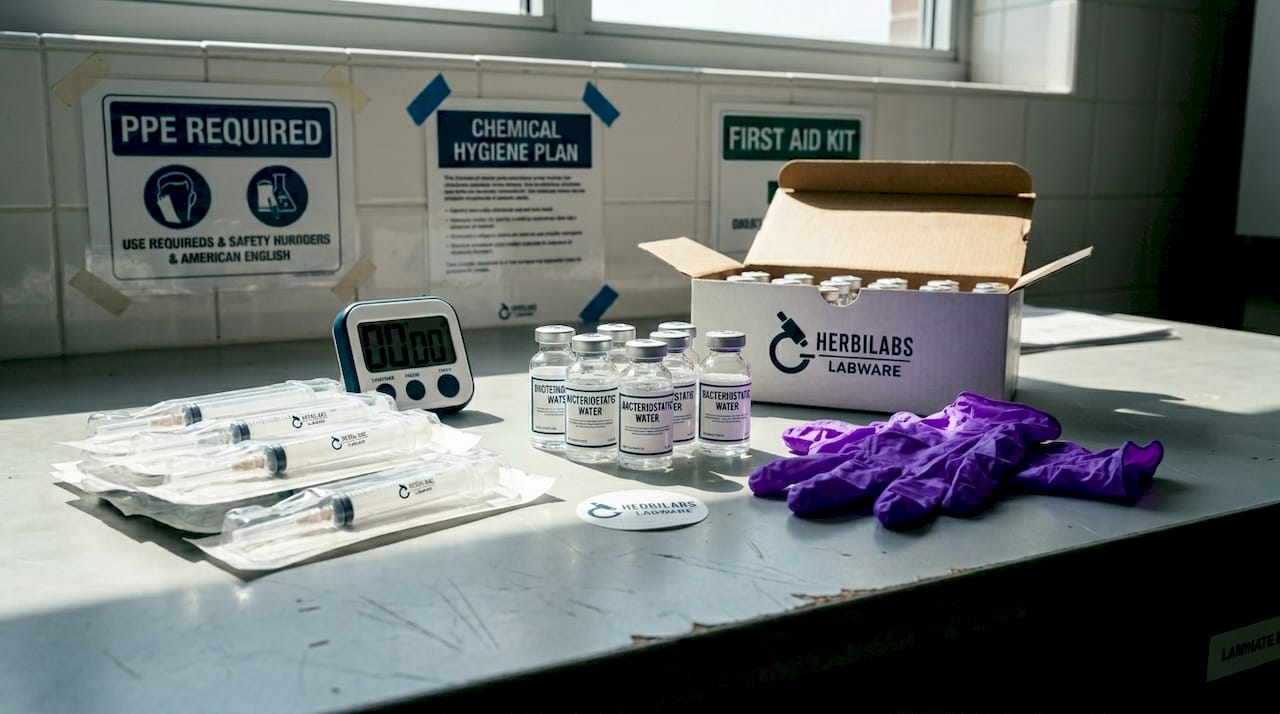
Sterile reconstitution solutions vary by application. Acetic acid solutions (typically 0.1% or 1%) are preferred for reconstituting acidic peptides, while phosphate-buffered saline (PBS) suits neutral or basic formulations. The choice of solvent must match the peptide’s isoelectric point (pI) and intended storage conditions. Published methods now serve as empirical benchmarks for solvent selection, purity assessment, and storage parameters. For example, documented reconstitution benchmarks using reversed-phase high-performance liquid chromatography (RP-HPLC) and matrix-assisted laser desorption ionization time-of-flight mass spectrometry (MALDI-TOF) provide validated reference points for your own SOPs.
The remaining items on an essential labware checklist should include:
- Sterile vials and closures: Low-binding polypropylene vials for peptide storage; rubber septa rated for repeated puncture when using multi-dose preparations.
- Pipettes and calibrated tips: Volumetric precision matters significantly when preparing reconstitution volumes for dose-response studies.
- Gloves and personal protective equipment (PPE): Nitrile gloves rated for chemical resistance; additional splash protection for concentrated acid solvents.
- Cold storage consumables: Labeled cryovials, LN2-rated storage boxes, and silica gel desiccant for lyophilized stocks.
- pH measurement tools: Calibrated bench-top pH meters or precision test strips for verifying reconstitution buffer pH within tolerance.
- Timers and data logging tools: Precise timing during incubation steps and automated logging of storage temperatures protect data integrity.
An updated lab consumables checklist can supplement this framework with category-specific procurement tables that align with current UK and EU supplier landscapes.
Pro Tip: Request HPLC and MALDI-TOF purity reports directly from your supplier before committing to a batch, especially for bacteriostatic water and sterile diluents used in sensitive in vitro or ex vivo workflows. Suppliers who cannot provide this documentation should be deprioritized regardless of price.
Compliance checks: Navigating regulatory triggers
After confirming your supply list, it is vital to check compliance triggers before procurement, particularly for labs working with biological materials of non-UK or non-EU origin. Failure to identify applicable regulations at the sourcing stage can result in material forfeiture, research delays, and institutional liability.
The most commonly overlooked regulatory framework for UK/EU researchers is the Nagoya Protocol, a supplementary agreement to the Convention on Biological Diversity that governs access to genetic resources and the fair and equitable sharing of benefits arising from their utilization (ABS: Access and Benefit Sharing). Non-human genetic resources obtained from countries that have ratified the Nagoya Protocol may be subject to prior informed consent (PIC) and mutually agreed terms (MAT) requirements.
Using a stepwise compliance framework is the most practical approach. The following numbered process, modeled on decision-tool style compliance checklists developed for UK research institutions, provides a reliable method for determining scope:
- Identify the material: Is the resource a biological specimen, genetic sequence, or derived biochemical compound? Synthetic peptides manufactured from publicly available sequence data generally fall outside scope; harvested biological tissues do not.
- Determine origin: Was the material obtained from a country that has ratified the Nagoya Protocol and implemented domestic ABS legislation? Check the ABS Clearing House database for country-specific status.
- Assess utilization: Will the research involve utilizing the genetic resource, meaning extracting functional genetic or biochemical information? Storage-only or shipping-only roles typically do not trigger obligations.
- Check for exemptions: Model organism databases, certain pathogen collections, and materials with pre-Nagoya collection dates may carry exemption status. Verify with your institution’s research compliance office.
- Document your determination: Record the answers to each of the above questions within your checklist, attaching any supporting correspondence or certificates.
“Decision-tool style compliance checklists streamline risk management for UK/EU labs by converting complex multi-jurisdictional obligations into answerable yes/no questions that produce a clear, auditable compliance record.”
Every compliance determination should be logged as a dated entry in your master checklist. Incomplete records are treated as non-compliance in many institutional audit frameworks. For a practical reference, the compliance guide at Herbilabs provides procurement-oriented guidance for UK and EU researchers managing these documentation obligations.
Comparison of bacteriostatic water and reconstitution solutions
Now that compliance is covered, comparing the critical supplies for your laboratory’s most common reconstitution workflows will help you make more targeted procurement decisions. Bacteriostatic water and alternative reconstitution solutions are not interchangeable, and selecting the wrong diluent for a given peptide or biologic can compromise both stability and bioactivity.
The following table provides a practical side-by-side comparison of the two main reconstitution supply types used in UK/EU peptide and biologic research:
| Feature | Bacteriostatic water (BAC water) | Reconstitution solutions (acetic acid, PBS, DMSO) |
|---|---|---|
| Primary preservative | 0.9% benzyl alcohol | None (or buffer-specific salts/acids) |
| Microbial inhibition | Yes, suitable for multi-dose use | No; single-use volumes recommended |
| Typical purity requirement | Endotoxin tested, sterility confirmed | Analytical grade or HPLC grade depending on assay |
| Shelf life post-reconstitution | Up to 28 days at 2 to 8°C for most peptides | 24 to 72 hours unless frozen immediately |
| Recommended storage | Refrigerated (2 to 8°C) | Application-specific; DMSO stocks at minus 20°C |
| Compatible applications | Most lyophilized peptides, growth factors, antibody fragments | Acid-soluble peptides, membrane proteins, hydrophobic compounds |
| Documentation benchmark | Endotoxin report, sterility certificate, benzyl alcohol concentration | Solvent grade certificate, RP-HPLC purity, MALDI-TOF confirmation |
As published methodologies now confirm, empirical benchmarks for reconstitution should include documented solvent selection rationale, purity assessment by RP-HPLC, and defined storage conditions as minimum criteria for SOP validation.
Key practical considerations when working with either supply type:
- Benzyl alcohol sensitivity: Some cell lines and primary cultures are sensitive to benzyl alcohol at 0.9%. In those cases, WFI or a specific buffer is preferable even at the cost of shorter reconstituted product shelf life.
- DMSO (dimethyl sulfoxide) handling: DMSO is a highly penetrating solvent. Use it only in a fume hood with appropriate gloves; concentration above 1% v/v in cell culture is cytotoxic for most cell types.
- pH matching: Ensure the diluent pH falls within the stability window of your target peptide. Deviations beyond plus or minus 0.5 pH units from the manufacturer’s recommended range can cause accelerated aggregation or degradation.
Reviewing the lab consumables guide provides additional context on selecting grade-appropriate supplies, while guidance on how to maintain labware integrity can help minimize pre-use contamination risks.
Pro Tip: Always note expiry dates for both bacteriostatic water and reconstitution solvents directly in your master checklist at the time of receipt, not at the time of use. Expired bacteriostatic agents lose antimicrobial efficacy before obvious visual changes appear.
Why checklist rigor outperforms improvisation in modern labs
Having compared supply options, let’s reflect on the broader lessons for modern laboratories and what separates consistently reproducible research from inconsistent work.
The instinct to improvise when supplies are missing is understandable. Labs operate under budget pressure, time constraints, and competing priorities. But substituting an unlabeled solvent “equivalent” or skipping a compliance check because a material “looks similar” to a previously approved source introduces uncontrolled variables. In the short term, the experiment may proceed. Over a series of experiments, those improvised decisions compound into irreproducible results that reviewers flag and auditors question.
We have observed that laboratories treating their checklists as living documents, updated with each new supplier relationship, regulatory change, or protocol revision, consistently perform better in peer review and internal audit scenarios. The checklist is not a constraint. It is a record of institutional knowledge made portable and verifiable.
There is also a subtler point worth making. Researchers who resist checklist rigor often assume that their expertise makes such tools redundant. But expertise is precisely what makes a well-designed checklist valuable. An experienced researcher designing a checklist encodes nuanced judgments, such as when to substitute a solvent, how to handle an edge-case compliance trigger, and what documentation a reviewer will demand, into a form that any team member can apply reliably. That transfer of expertise is not possible with improvisation alone.
The supply chain reliability challenge in UK/EU research is also real. Post-Brexit customs timelines, varying supplier quality across European distributors, and the increasing sensitivity of peptide-based research all argue for more disciplined procurement planning, not less. A checklist mindset is not overkill. It is a measurable mark of scientific maturity.
“Success in modern labs comes from treating every supply as critical, not optional. The difference between a robust research program and a fragile one is often a checklist that was never written.”
Explore quality supplies and expert guides from Herbilabs
Herbilabs supports the kind of systematic, documentation-driven research workflows described throughout this article. Whether you are building your first formal procurement checklist or refining an existing SOP for peptide reconstitution, having a reliable supply partner is part of the equation.
Herbilabs offers high-purity bacteriostatic water, sterile reconstitution solutions, and research-grade consumables manufactured to rigorous quality standards, with full documentation including endotoxin test reports and sterility certificates. The site also features curated expert guides covering compliance, reconstitution protocols, and supply selection for UK and EU laboratory environments. Wholesale pricing is available for lab managers and resellers sourcing in volume. Browse the full range at herbilabs.com and access the resources your research workflow depends on.
Frequently asked questions
What should be included in a laboratory supplies checklist?
Include all consumables, reagents, documentation steps, and compliance checks relevant to your experiments; a well-structured checklist covers core reproducibility items across every project stage to ensure both scientific validity and regulatory safety.
How do I check for Nagoya Protocol compliance?
Use a stepwise compliance decision tool to determine whether your materials qualify as non-human genetic resources originating outside the UK, and document each determination with dated records for ABS regulatory purposes.
Why is documentation of reconstitution methods important?
Clear documentation of solvent choice, purity assessment, and storage conditions supports reproducibility and serves as the empirical benchmark against which your own SOPs can be validated and reviewed.
How do checklists fit into lab audits?
A robust checklist that logs every supply decision and compliance determination creates a traceable, audit-ready record that minimizes oversight gaps and demonstrates process discipline to internal and external reviewers.
Recommended
- Essential labware checklist: Reliable tools for research
- Essential lab consumables: The 2026 procurement checklist
- Maintain labware integrity: practical steps for reliable research
- Laboratory consumables: essential guide for reliable research
- Manufacturing productivity checklist for efficiency in 2026
- Industrial equipment safety checklist: Essential steps for compliance – CONQUEST MFG USA