Private Label, White Label, Wholesale partnerships available - EU, USA and UK - Free shipping from €75
Lab supply storage best practices: safe, organized, compliant
Discover effective lab supply storage best practices to ensure safety, compliance, and organization in your laboratory. Enhance efficiency today!
TL;DR:
- Proper hazard-based storage prevents safety hazards and regulatory violations in labs.
- Essential tools include compliant cabinets, secondary containment, labels, spill kits, and inventory systems.
- Regular audits and staff training ensure ongoing safety, compliance, and a strong safety culture.
Disorganized chemical storage does not simply create inconvenience. It generates real safety hazards, exposes laboratories to failed regulatory audits, and can result in costly shutdowns that interrupt funded research programs. Laboratory technicians and managers operating in academic and research environments face the constant challenge of balancing strict compliance obligations with day-to-day operational efficiency, and an unstructured storage system undermines both simultaneously. This guide presents a structured, step-by-step framework for implementing lab supply storage best practices that are applicable across research institutions and universities, covering safety classification, physical organization tools, labeling standards, inventory control, and ongoing audit processes.
Table of Contents
- Understand risks and requirements in lab supply storage
- Essential supplies and organization tools for safe storage
- Step-by-step lab supply organization and storage process
- Inventory management, audits, and common storage pitfalls
- Why storage best practices are more than compliance
- Upgrade your lab with compliant storage, tools, and support
- Frequently asked questions
Key Takeaways
| Point | Details |
|---|---|
| Hazard-based storage | Always organize chemicals by hazard class, not alphabetically, to prevent dangerous reactions and meet regulations. |
| Complete labeling | Use comprehensive labels showing content, hazards, concentrations, and important dates on every container. |
| Secondary containment | Liquids need secondary trays and shelving must be secured to avoid spills and prevent tip-overs. |
| Ongoing inventory control | Track, audit, and update inventory regularly; remove expired items and use FIFO to maintain accuracy. |
| Compliance as a baseline | Go beyond compliance by building a culture of proactive safety and continuous improvement among lab staff. |
Understand risks and requirements in lab supply storage
Improper storage of laboratory chemicals and reagents creates compounding risks. A single mislabeled container, an incompatible chemical pairing on the same shelf, or a flammable solvent stored in a standard cabinet rather than an approved flammable storage unit can result in fire, toxic exposure, or a regulatory citation that flags the entire facility.
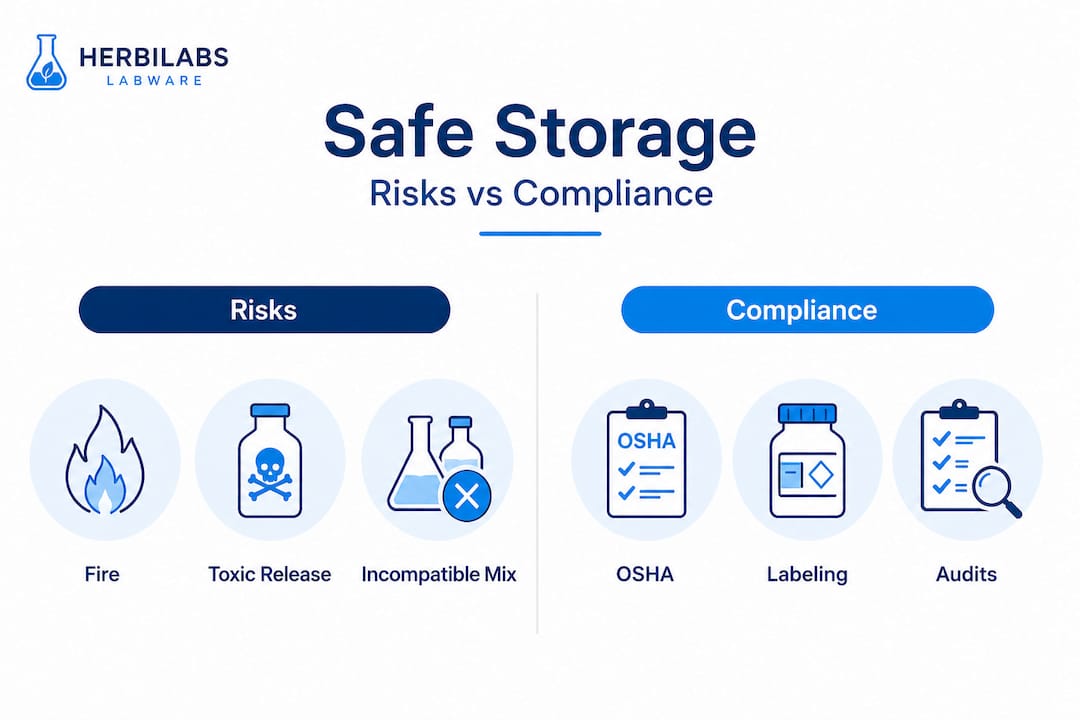
The regulatory baseline for most U.S. research institutions is set by OSHA’s Hazard Communication Standard (29 CFR 1910.1200) and NFPA 45 (Standard on Fire Protection for Laboratories Using Chemicals). These standards define minimum requirements for storage cabinet specifications, quantity limits, ventilation, and labeling. University environmental health and safety (EHS) policies typically layer additional requirements on top of these federal standards.
One of the most critical principles in compliant storage is hazard-based segregation. The 8 chemical storage plan fundamentals from Lab Manager make clear that alphabetical storage is common in many labs but is genuinely dangerous, while hazard-based storage is universally recommended by universities, lab managers, OSHA, and NIH. Alphabetical organization can place, for example, acetic acid directly next to acetaldehyde, an incompatible pairing that risks exothermic reactions or toxic vapor release.
The four major hazard classes requiring distinct storage strategies are:
- Flammables: Must be stored in NFPA/OSHA-compliant flammable storage cabinets. These cabinets are constructed of double-walled steel with 1.5-inch air space and self-closing doors that contain a fire for at least 10 minutes.
- Corrosives (acids and bases): Require dedicated corrosive storage cabinets lined with chemically resistant materials. Acids and bases must also be separated from each other within the corrosive category.
- Toxics: Stored in lockable cabinets when classified as acutely toxic, with restricted access and clear SDS (Safety Data Sheet) documentation.
- Reactives: Includes oxidizers, peroxide-formers, and water-reactive compounds. These require isolated, dedicated storage away from flammables and organics.
“Laboratories that store chemicals alphabetically rather than by hazard class consistently demonstrate higher incident rates and fail regulatory audits at significantly greater frequency.”
Reviewing your institution’s OSHA and NFPA standards alongside your EHS department’s specific guidelines should always be the first action before reorganizing any storage area. Compliance is not optional, and the consequences of non-compliance range from corrective action notices to suspension of research activities.
| Hazard class | Cabinet type required | Key regulation |
|---|---|---|
| Flammables | Steel flammable storage cabinet | NFPA 45, OSHA 1910.106 |
| Corrosive acids | Acid-resistant corrosive cabinet | OSHA 1910.1200 |
| Corrosive bases | Corrosive cabinet, separated from acids | OSHA 1910.1200 |
| Toxics | Lockable cabinet, SDS accessible | OSHA HazCom Standard |
| Reactives/oxidizers | Isolated, dedicated cabinet | NFPA 45 |
Essential supplies and organization tools for safe storage
With an understanding of the risks and regulatory requirements, the next step is assembling the physical tools and organizational systems needed to implement compliant storage. Many labs underinvest in this area, relying on makeshift shelving and generic containers, which creates ongoing risk regardless of how well staff understand the rules.
Storage cabinets by hazard type represent the primary investment. Flammable cabinets, corrosive cabinets, and general chemical storage cabinets are not interchangeable. Each must meet the specifications outlined by the relevant standard. When evaluating cabinets, confirm that they carry appropriate UL (Underwriters Laboratories) listings or FM (Factory Mutual) approvals.
Secondary containment is a critical but frequently overlooked component. Chemical-resistant secondary containment trays placed beneath all liquid chemical storage catch spills before they spread to incompatible materials or reach floor drains. According to Prudent Practices in the Laboratory, secondary containment is required for all liquid chemicals, shelving must be secured to walls to prevent tipping, and flammable quantity limits outside approved cabinets are typically capped at 10 to 25 gallons depending on the fire code jurisdiction.
The following tools and materials should be part of every compliant lab storage setup:
- Chemical-resistant labels and a label maker: Standard paper labels degrade rapidly in chemical environments. Use solvent-resistant, GHS-compliant labels rated for your specific conditions.
- Secured shelving units: Shelving used for chemical storage must be anchored to walls or fixed structures. Lip restraints on shelves prevent containers from sliding or tipping.
- Spill control kits: Each storage zone should have an accessible spill kit appropriate to the hazard type. Acid spills require different neutralizing agents than solvent spills.
- PPE (personal protective equipment) staging: Chemical-resistant gloves, safety goggles, and appropriate respiratory protection should be stored adjacent to the storage area for immediate access.
- Inventory management system: Small labs can manage with well-structured spreadsheets, but larger labs benefit significantly from dedicated chemical inventory software such as ChemInventory, EHS Insight, or similar platforms.
Review your essential labware checklist to confirm you have accounted for all required tools before beginning the organization process.
| System type | Suitable for | Advantages | Limitations |
|---|---|---|---|
| Paper/spreadsheet inventory | Small labs, fewer than 200 items | Low cost, simple to implement | Error-prone, no real-time alerts |
| Chemical inventory software | Medium to large labs | Automated expiration alerts, audit trails | Higher cost, requires training |
| Barcode/RFID systems | High-throughput research labs | Real-time tracking, reduced human error | Significant upfront investment |
Pro Tip: Before purchasing any storage cabinet, cross-reference the cabinet’s fire rating with the flammable storage limits defined in your institution’s EHS policy, not just the manufacturer’s specifications. Local requirements frequently exceed federal minimums.
Step-by-step lab supply organization and storage process
Once the right tools and cabinets are in place, the organization process itself must follow a logical, hazard-priority sequence. Improvising the order of operations introduces gaps that create both safety and compliance problems.
-
Conduct a full chemical inventory. Before moving anything, catalog every chemical in the lab: name, quantity, concentration, storage location, and expiration date. This baseline inventory is essential for identifying expired, orphaned, or misplaced items.
-
Sort by hazard class, not alphabetically. Group all chemicals by their primary hazard class. Use SDS documents to confirm classification for any ambiguous items. For chemicals with multiple hazards, the more severe classification takes precedence.
-
Assign and label storage zones. Designate specific cabinets and shelving sections for each hazard class. Post clear zone labels at eye level. This makes both daily use and emergency response faster and safer.
-
Apply secondary containment to all liquids. Place secondary containment trays in all liquid storage areas before placing containers. Size trays to hold at least 110% of the largest container’s volume, which is the standard recommended by EPA secondary containment guidelines.
-
Store liquid chemicals below shoulder height. The risk of spills during retrieval increases substantially when containers are stored above shoulder height, because researchers must reach overhead and risk losing control of heavy or slippery containers.
-
Label every container completely. Every container must display the chemical name, hazard class, concentration, dates received, opened, and expiration, along with required storage conditions. Pre-printed GHS labels from the manufacturer satisfy some requirements, but lab-prepared solutions or repackaged chemicals require fully custom labels. Do not rely on abbreviations or informal shorthand.
-
Apply special handling for peroxide-formers. Chemicals such as diethyl ether, tetrahydrofuran, and isopropyl ether form explosive peroxides over time. These require test strips and testing dates recorded directly on the container. Containers exceeding safe peroxide levels must be disposed of immediately through your institution’s hazardous waste program.
-
Secure all shelving and verify stability. After placing chemicals, test all shelving for stability under load. Confirm that lip restraints are installed and that no container overhangs a shelf edge.
Pro Tip: Photograph each storage zone immediately after organizing it. These photographs serve as a reference baseline for audits and help staff restore proper organization after high-activity periods.
Research from multiple institutions shows that labs implementing formalized storage protocols report a reduction in chemical spill incidents of up to 40% within the first year of adoption, demonstrating that structured organization delivers measurable safety returns.
Refer to your lab’s safe handling practices documentation to ensure that storage configurations align with the handling procedures staff use daily. Storage and handling protocols must be consistent with each other. Additionally, labware integrity strategies should be reviewed to ensure that containers and closures are appropriate for long-term storage of each reagent type.

Inventory management, audits, and common storage pitfalls
Proper organization at the point of setup is only the beginning. Maintaining a safe and compliant storage system over time requires structured inventory management, scheduled audits, and active staff engagement.
The FIFO (first-in, first-out) principle is the standard for managing consumables and chemical reagents alike. New stock should always be placed behind existing stock, ensuring that older materials are used before newer ones. According to lab inventory management best practices, effective inventory systems track quantities, storage locations, and expiration dates continuously, and regular audits are used to dispose of expired items promptly.
The structured inventory process should include:
-
Assign unique storage locations to each chemical. Every item should have a designated home, and that location should be recorded in the inventory system. Floating storage creates confusion and increases the risk of incompatible chemicals being left in proximity.
-
Track lot numbers for all reagents. Lot number tracking enables rapid identification of affected materials in the event of a product recall or quality concern, which is particularly important for research-grade reagents used in sensitive assays.
-
Schedule quarterly audits at minimum. Audits should review expiration dates, container integrity, label completeness, segregation compliance, and quantity limits. Larger or more active labs may require monthly reviews for high-turnover items.
-
Train staff consistently and document training. Regular training ensures that all personnel, including new hires and visiting researchers, understand storage protocols. Documented training records are required during regulatory inspections.
-
Remove orphaned chemicals promptly. Unknown or unlabeled chemicals, sometimes called “orphans,” cannot be safely stored or used. These must be characterized by EHS staff or disposed of through hazardous waste channels immediately.
Common storage pitfalls that undermine otherwise solid systems include:
- Allowing informal “temporary” placement of chemicals outside their assigned zones
- Relying on spreadsheet-based inventory systems that are not updated in real time, which digital inventory systems outperform significantly in large and mid-sized labs
- Failing to track opened-on dates for time-sensitive reagents
- Skipping peroxide testing for ethers stored beyond recommended intervals
- Treating audit preparation as a separate activity rather than an ongoing daily practice
Reviewing your consumables workflow processes can help identify where inventory gaps most often occur in your specific lab context, allowing targeted improvements rather than generalized reorganization efforts.
Why storage best practices are more than compliance
There is a perspective worth stating directly: compliance frameworks are the floor of acceptable lab safety, not the ceiling. Labs that treat OSHA checklists and EHS audits as the endpoint of their storage program consistently underperform compared to labs that build a genuine culture of safety accountability.
The difference between a lab that passes audits and a lab that rarely has incidents is typically not found in cabinet specifications or label formats. It is found in whether staff feel empowered to flag a problem immediately, whether technicians understand why the rules exist rather than just what the rules are, and whether managers treat safety feedback as operational intelligence rather than administrative overhead.
Labs that reduce lab waste through better inventory discipline also tend to demonstrate stronger safety cultures, because both outcomes depend on the same underlying behavior: consistent, attentive management of materials from receipt through disposal. The two are inseparable.
Digital inventory systems, regular team-level review meetings, and anonymous incident reporting mechanisms are practical tools that move a lab from reactive compliance to proactive safety management. The investment in these systems pays dividends not just in audit outcomes, but in researcher productivity, reagent quality, and institutional reputation. Compliance is what regulators require. Excellence is what research demands.
Upgrade your lab with compliant storage, tools, and support
Implementing these best practices becomes significantly more manageable when you have access to high-quality resources, reliable reagents, and expert guidance in one place.
Herbilabs provides laboratory professionals with access to the tools and resources needed to maintain compliant, well-organized lab operations. From our essential labware checklist that helps you assess and close gaps in your storage setup, to our labware purity guide covering standards and risk mitigation for research-grade materials, our resources are built specifically for the demands of institutional and academic research environments. Explore our catalog of high-purity reagents and compliant lab supplies, and connect with our expert support team for guidance tailored to your research program.
Frequently asked questions
What is hazard-based chemical storage, and why not alphabetize?
Hazard-based storage organizes chemicals by their risk class, which prevents dangerous reactions between incompatible materials. Alphabetical storage is common but dangerous because it can place incompatible chemicals directly adjacent to one another, and it is not recommended by OSHA, NIH, or lab safety professionals.
How should I store flammables and corrosives to meet compliance?
Store flammables in NFPA/OSHA-approved cabinets specifically rated for flammable storage, and keep acids and bases in dedicated corrosive cabinets with chemically resistant interiors. Never mix hazard types within the same cabinet, even when storage space is limited.
What should be on every chemical label in a research lab?
Every label must include the chemical name, hazard class, concentration, dates received, opened, and expiration, and all required storage conditions such as temperature range and light sensitivity.
How often should labs audit supply storage and inventory?
Labs should conduct formal storage audits and inventory reviews at least quarterly, and expired, unknown, or improperly stored items should be addressed immediately rather than deferred to the next scheduled review cycle.