Private Label, White Label, Wholesale partnerships available - EU, USA and UK - Free shipping from €75

Laboratory Reagents Explained: Grades, Compliance, and Best Practices
Discover what are laboratory reagents and learn essential grades, compliance standards, and best practices to enhance your research outcomes.
TL;DR:
- Proper reagent selection is critical for reliable and reproducible laboratory results.
- Reagent quality depends on grade, purity, verification, and compliance with regional regulations.
- Thorough batch verification and adherence to regulatory standards prevent data corruption and ensure safety.
Substandard reagent selection is responsible for a significant proportion of irreproducible laboratory results, yet many research teams treat reagent procurement as a routine administrative task rather than a critical scientific decision. Laboratory reagents are the chemical foundation upon which every assay, titration, and analytical measurement is built, and selecting the wrong grade or failing to verify batch quality can silently corrupt data long before a result reaches peer review. This guide addresses the full spectrum of practical knowledge that laboratory scientists and managers need: clear definitions, grade comparisons, verification protocols, regulatory obligations across the UK and Europe, and the operational pitfalls that most technical references overlook.
Table of Contents
- What are laboratory reagents?
- Understanding reagent grades and purity
- How reagent quality is verified
- Regulatory compliance for laboratory reagents in the UK and Europe
- The overlooked factors in reagent selection: What most guides miss
- Your next steps: High-quality reagents and reliable lab solutions
- Frequently asked questions
Key Takeaways
| Point | Details |
|---|---|
| Reagent grades matter | Choosing the proper grade ensures experimental accuracy, safety, and regulatory compliance. |
| Verify quality every time | Always check Certificates of Analysis and verify with independent tests for reproducible results. |
| Stay compliant | Follow EU and UK regulations for labeling, standards, and safety when sourcing reagents. |
| Match grade to method | Align reagent purity with experimental sensitivity to prevent costly errors and questionable data. |
What are laboratory reagents?
Now that we have established why reagent selection is vital, the logical starting point is a precise understanding of what laboratory reagents actually are and how they function within experimental workflows.
Laboratory reagents are purified chemical compounds or mixtures used in scientific experiments to cause, detect, measure, or facilitate chemical reactions, analyses, or tests. That definition, while concise, encompasses an enormous range of substances, from simple inorganic acids like hydrochloric acid used in titrations to complex biological buffers employed in enzyme kinetics studies. The unifying characteristic is intentional purification and characterization for a defined scientific purpose, which separates reagents from industrial or technical chemicals.
In practice, laboratory reagents perform four broad functional roles:
- Causing reactions: Oxidizing or reducing agents, acids, and bases initiate the chemical transformations under investigation.
- Detecting analytes: Indicators such as phenolphthalein change color in response to pH shifts, and chromogenic substrates produce measurable color upon enzymatic cleavage.
- Measuring quantities: Calibrated standard solutions establish reference points for quantitative analysis in techniques such as spectrophotometry and titration.
- Facilitating reactions: Buffers maintain stable pH environments, solvents dissolve substrates, and catalysts increase reaction rates without being consumed.
“Reagent integrity is not optional. It is the single most important variable a researcher can control before data collection begins.”
Common applications span an extensive range of scientific disciplines. In microbiology, reagents are used for growth media preparation, where precise molarity of nutrients and buffering salts directly influences microbial behavior. In analytical chemistry, HPLC mobile phases require HPLC-grade solvents to avoid baseline noise from contaminants. In peptide research, reconstitution solutions must be sterile and endotoxin-free to avoid interference with biological activity. Researchers working with high-purity reagents will recognize that even trace-level impurities at the parts-per-billion scale can distort results in sensitive assays.
Understanding reagent grades and purity
With a foundation in what laboratory reagents are, the next logical question is: what makes one reagent different from another? The answer lies in their grades and purity specifications.

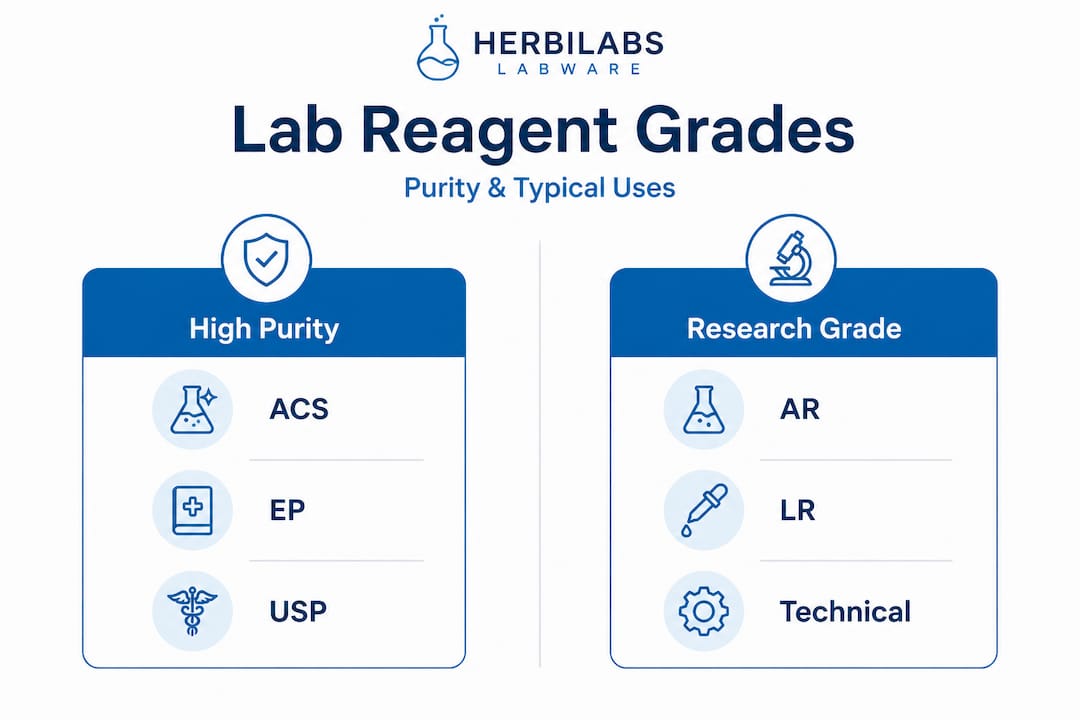
Reagent grading systems exist precisely because different experimental applications demand different levels of chemical purity. The most common reagent grades include ACS (American Chemical Society, typically 95 to 99% minimum purity for analytical use), AR (Analytical Reagent, greater than 95% purity for precise quantitative analysis), LR (Laboratory Reagent, suitable for general-purpose use), USP/EP (pharmacopeial standards for GMP-compliant pharmaceutical and clinical applications), and Technical grade (70 to 90% purity, appropriate for non-critical industrial or educational contexts). Higher grades are compulsory for sensitive methods such as HPLC and mass spectrometry; lower grades are acceptable for qualitative educational demonstrations.
| Grade | Purity range | Typical application |
|---|---|---|
| ACS | 95 to 99%+ | Quantitative analysis, reference standards |
| AR (Analytical Reagent) | Greater than 95% | Precise volumetric and instrumental analysis |
| LR (Laboratory Reagent) | Variable, moderate | General laboratory use, less critical work |
| USP/EP | Pharmacopeial spec | GMP manufacturing, clinical research |
| Technical | 70 to 90% | Industrial processes, non-critical education |
Understanding these distinctions is not merely academic. Using LR-grade methanol as the mobile phase in an HPLC method designed for ACS-grade solvent, for example, will introduce UV-absorbing impurities that create ghost peaks and elevate baseline noise, potentially causing researchers to misidentify or misquantify analytes entirely. The reliability of high-purity reagents is therefore directly proportional to the sensitivity threshold of the analytical method being employed.
How to choose the right reagent grade for your method:
- Identify the detection limit and sensitivity requirements of your assay or instrument.
- Review the method’s published or validated solvent and reagent specifications, including any pharmacopeial monographs that apply.
- Determine whether the application falls under GMP obligations, which would mandate USP or EP grade materials.
- Consult the reagent standards framework relevant to your region and experimental context.
- Confirm with your supplier that the grade offered meets the specification, and request documentation before ordering.
Pro Tip: When your method requires ACS-grade solvents but your budget is constrained, do not substitute LR-grade material for anything upstream of the detector. Reserve cost savings for preparative or washing steps where purity is demonstrably less critical.
Peptide researchers face particularly nuanced grade decisions, because reconstitution solvents must satisfy both analytical purity requirements and biological safety requirements simultaneously. Guidance on reagent selection for peptide research addresses this dual requirement in detail, covering both chemical and biological compatibility criteria.
How reagent quality is verified
Knowing which reagent to select is only part of the story; just as vital is verifying that what you receive actually matches its label.
Verification begins at the analytical level. Purity is verified through a suite of established techniques: HPLC for quantitative purity assessment (typically reporting 98 to 99% or greater for research-grade materials), mass spectrometry for definitive molecular identity confirmation, endotoxin testing using the limulus amebocyte lysate (LAL) assay to confirm values below 1 EU/mg for research-grade applications, residual solvent analysis per ICH Q3C limits, and Karl Fischer titration for water content. A batch-specific Certificate of Analysis (CoA) is the primary documentation vehicle for all of these parameters, and it must correspond exactly to the lot number of material received.
| Verification method | What it confirms | Acceptable threshold (research-grade) |
|---|---|---|
| HPLC | Chemical purity | 98% or greater |
| Mass spectrometry | Molecular identity | Exact mass match |
| LAL endotoxin assay | Endotoxin content | Less than 1 EU/mg |
| ICH Q3C residual solvent | Solvent residues | Class-specific limits |
| Karl Fischer titration | Water content | Method-dependent |
The CoA is a necessary but not sufficient condition for confidence in reagent quality. Manufacturers that maintain ISO 17025 accreditation for their testing laboratories provide an additional layer of independent verification, because ISO 17025 requires demonstrated technical competency, calibrated instrumentation, and audited measurement uncertainty. Third-party quality control for reagents through accredited external laboratories adds a further layer of assurance, particularly when in-house and supplier data conflict.
Pre-use verification checklist for incoming reagent batches:
- Confirm the lot number on the container matches the lot number on the CoA.
- Verify that all CoA parameters meet or exceed the method’s minimum specifications.
- Check the expiry date and storage conditions, confirming that the reagent has been stored correctly throughout the supply chain.
- Inspect the container for physical integrity, including seal status and absence of visible contamination.
- Run a system suitability test using the new lot before incorporating it into live assays.
Pro Tip: Maintain a shadow lot of any critical reagent so that you can bridge immediately to a new supply without disrupting ongoing assay series. This is especially relevant for reagents with long lead times from specialist manufacturers.
The best quality control practices for laboratory environments consistently recommend integrating lot validation into the standard operating procedure for every new reagent delivery, rather than treating verification as an ad hoc activity triggered only when problems arise. Building this discipline into your intake workflow is one of the most cost-effective forms of research insurance available.
Regulatory compliance for laboratory reagents in the UK and Europe
Quality and purity are integral to rigorous lab work, but regulatory compliance is the backbone of safe and approved research, especially across the UK and Europe.
Research institutions and independent laboratories operating in the UK and European Union navigate a layered compliance environment. The key regulatory frameworks include the EU CLP Regulation (Classification, Labeling, and Packaging), which mandates standardized hazard classification and labeling for all chemical substances and mixtures placed on the market; the European Pharmacopoeia (Ph. Eur.), now in its 12th edition, which specifies quality standards for substances used in pharmaceutical manufacturing and research; ISO 17034, the international standard for the production of certified reference materials; and the Medical Devices Regulation (EU 2017/745) for reagents used in specific diagnostic and clinical contexts such as blood grouping.
“Compliance with Ph. Eur. monographs and CLP labeling is not only a regulatory obligation but an operational safeguard that protects both personnel and experimental integrity.”
In practical terms, daily laboratory operations must address several compliance obligations consistently:
- CLP labeling verification: All incoming reagents must carry appropriate hazard pictograms, signal words, and H/P statements in compliance with CLP Regulation. Unlabeled or incorrectly labeled materials must not enter the active laboratory.
- SDS currency: Safety Data Sheets must reflect the most current regulatory revision and must be accessible in the laboratory at the point of use.
- Traceability documentation: Every reagent used in a research study or GMP-adjacent process must have a documented chain of custody from manufacturer to point of use, including lot number, receipt date, and storage conditions.
- Ph. Eur. compliance for pharmacopeial materials: Substances referenced in the European Pharmacopoeia must meet the corresponding monograph specifications, which include identity tests, purity tests, and assay requirements.
Statistical context: As of 2025, the European Pharmacopoeia contains over 2,400 monographs covering chemical substances, antibiotics, biologicals, and excipients, representing the largest unified reference standard for pharmaceutical-grade reagent quality in the world.
For laboratories engaged in peptide research or working with reconstitution solutions, safe reagent handling practices are equally governed by these frameworks, because many lyophilized peptides are reconstituted with injectable-grade water or buffered diluents that must satisfy sterility and endotoxin specifications aligned with pharmacopeial standards. Post-Brexit, UK laboratories must also reconcile GB and EU regulatory divergence, particularly for reagents crossing borders, making supplier documentation and regulatory clarity more important than ever.
The overlooked factors in reagent selection: What most guides miss
Now that the practical and regulatory landscape is clear, it is worth addressing the factors that most technical documentation glosses over, because they have a disproportionate impact on real-world research outcomes.
The most pervasive mistake is trusting a label without interrogating the data behind it. Supplier-stated purity figures often represent minimum specification values rather than actual batch performance. A reagent labeled 99% pure may routinely test at 99.6% for most batches, but a statistically outlying batch at exactly 99.0% may still carry an impurity profile that is qualitatively problematic for a specific assay. The impurity species matters as much as the impurity quantity, a distinction that CoA review alone may not fully reveal.
Expert practice consistently emphasizes matching grade precisely to methodology: EP-grade materials for GMP contexts, ultra-pure solvents for mass spectrometry, and ACS-grade for validated HPLC methods. Running blanks at every analytical session is not a suggestion but a necessity, because reagent blank signals establish whether method-level contamination is entering from the solvent system rather than the sample matrix. Lot-to-lot validation, where a new reagent batch is run in parallel with the current qualified lot before full deployment, is standard in regulated environments but inconsistently applied in academic research settings where the pressure to begin data collection is high.
Third-party testing resolves the most intractable disagreements between in-house results and supplier claims. If your in-house HPLC method shows 96% purity for a material the supplier certifies at 99%, the correct response is not to accept either figure uncritically but to commission ISO 17025-accredited independent analysis. The labware purity pitfalls that most commonly derail research projects are rarely dramatic. They accumulate quietly through small, unexamined deviations in reagent quality that compound across experimental series.
The second most overlooked factor is storage-induced degradation between lot qualification and actual use. A reagent that passes incoming verification may still fail mid-experiment if storage conditions deviate, particularly for hygroscopic materials or photosensitive compounds. Incorporating periodic in-use stability checks, rather than relying solely on manufacturer-stated shelf-life data, provides substantially greater assurance that what is entering your assay is what you believe it to be.
Your next steps: High-quality reagents and reliable lab solutions
Armed with a structured understanding of reagent grades, verification protocols, and compliance requirements, the logical next step is translating that knowledge into reliable procurement decisions.
At Herbilabs, we supply research-grade reagents and bacteriostatic water manufactured to strict purity standards, with full batch documentation and transparent quality control data for every product. Our resources are designed to support laboratories operating under demanding research conditions, from independent peptide research to institutional analytical programs. The reagent selection guide provides structured, method-specific guidance for researchers navigating grade and purity decisions, while our detailed overview of the benefits of high-purity reagents explains precisely why grade selection directly impacts reproducibility, compliance, and the scientific value of your results. We offer wholesale pricing for resellers and institutional buyers, secure ordering, and customer support oriented toward the technical needs of the research community across the UK and Europe.
Frequently asked questions
What makes a laboratory reagent different from a regular chemical?
Laboratory reagents are purified chemical compounds or mixtures specifically tested for quality, traceability, and reliability in scientific experiments, whereas regular chemicals lack these standardized purity certifications and documentation requirements.
Why are reagent grades important for experiments?
Reagent grades define the acceptable purity threshold for a given application, and using an inappropriate grade introduces contaminants that compromise analytical accuracy. Higher grades are required for sensitive methods like HPLC and mass spectrometry, where even trace impurities produce measurable interference.
How do I verify the quality of a reagent batch?
Verify quality through batch-specific Certificates of Analysis supported by HPLC purity data, mass spectrometry identity confirmation, and endotoxin testing. Third-party ISO 17025 verification provides independent confirmation when supplier and in-house results conflict.
What regulations must reagents comply with in the UK and Europe?
Reagents used in UK and European research environments must comply with EU CLP Regulation, European Pharmacopoeia standards, and ISO 17034 requirements for certified reference materials, with additional Medical Devices Regulation obligations for diagnostic applications.