Private Label, White Label, Wholesale partnerships available - EU, USA and UK - Free shipping from €75

What is high-purity reagent? Essential guide for accurate lab results
Learn what high-purity reagents are, how lab standards like Ph. Eur. and ACS differ, and how to select and verify the right grade for peptide research and analytics.
TL;DR:
- Trace impurities at parts-per-billion levels can significantly affect sensitive analytical and synthetic results.
- High-purity reagents exceed 99.9% purity, with impurity profiles verified via certificates of analysis.
- Selecting the appropriate reagent grade based on application sensitivity prevents costly errors and ensures data integrity.
A single trace contaminant, present at parts-per-billion concentrations, can invalidate months of carefully designed research. For independent researchers and laboratory professionals working with sensitive analytics or peptide synthesis, trace impurities can alter results even at parts-per-billion levels, making reagent selection far more consequential than it might initially appear. The assumption that all reagents are essentially equal is one of the most costly misconceptions in applied research. This guide covers the definition of high-purity reagents, the standards that govern them, the meaningful differences between grades, and the best practices that protect your results from the moment of sourcing through to final analysis.
Table of Contents
- What defines a high-purity reagent?
- Grades and standards: How purity is categorized in the lab
- High-purity vs standard grade: What’s the real difference?
- How high-purity reagents impact peptide research and analytics
- Best practices for sourcing, storage, and verification in European labs
- Most experts over-simplify: The real art of choosing high-purity reagents
- Elevate your lab results with expertly sourced high-purity reagents
- Frequently asked questions
Key Takeaways
| Point | Details |
|---|---|
| Purity matters | High-purity reagents exceed 99.9% purity and prevent invisible contaminants from derailing sensitive research. |
| Know your standards | ACS, Ph. Eur., and EMSURE® set benchmarks for reagent grades and ensure consistency in laboratories. |
| Match grade to application | Use high-purity for analytic or peptide work but avoid paying for unnecessary purity in routine tasks. |
| Documentation is crucial | Always confirm purity with a certificate of analysis and match documentation to recognized standards. |
| Best practices protect results | Expert sourcing, storage, and verification in your lab safeguard the integrity of your research. |
What defines a high-purity reagent?
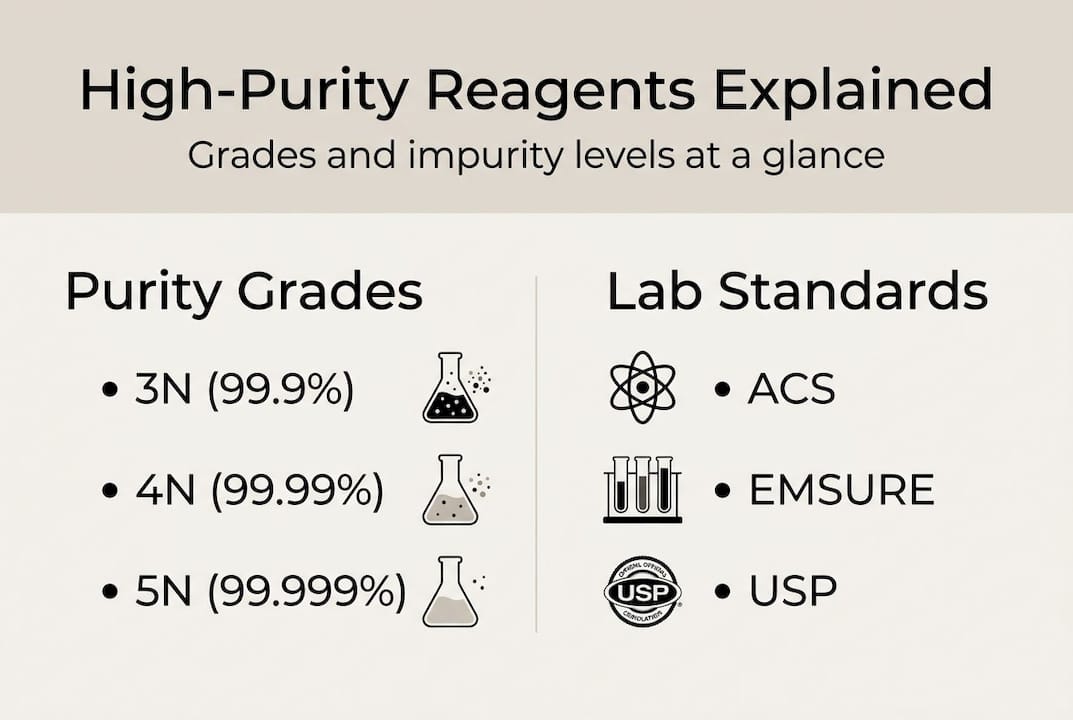
Now that you know why this matters, let’s pin down exactly what counts as a high-purity reagent. At its core, a high-purity reagent is a chemical substance in which the concentration of unintended components, collectively referred to as impurities, is reduced to a defined and verifiable minimum. In practice, high-purity reagents exceed 99.9% purity, which corresponds to impurity levels measured in parts per million (ppm) or parts per billion (ppb).
Purity notation in the laboratory often uses the “N” system, where 3N denotes 99.9% purity, 4N denotes 99.99%, and 5N denotes 99.999%. Each additional nine represents a tenfold reduction in total impurity load. For routine analytical work, 3N may be sufficient. For trace-level mass spectrometry or long-chain peptide synthesis, 4N or 5N reagents are often required to prevent background interference or side-reaction accumulation.
Impurities are not always chemically inert. Metallic ion contaminants, for example, can catalyze unwanted reactions during solid-phase peptide synthesis, leading to racemization or incomplete coupling. Organic impurities may co-elute with target analytes during chromatographic separation, producing false positives or suppressing signal intensity. These effects are not hypothetical. They represent documented failure modes in analytical and synthetic workflows.
The table below summarizes common purity designations and their typical impurity thresholds:
| Purity designation | Purity level | Impurity threshold |
|---|---|---|
| Reagent grade | 95.0 to 99.5% | 0.5 to 5.0% |
| High purity (3N) | 99.9% | <1,000 ppm |
| Ultra-high purity (4N) | 99.99% | <100 ppm |
| Semiconductor grade (5N) | 99.999% | <10 ppm |
Key characteristics of high-purity reagents include:
- Verified impurity profiles documented in a certificate of analysis (CoA)
- Trace metal content specified individually, not as a combined total
- Moisture and residual solvent levels controlled and declared
- Lot-to-lot consistency supported by batch-specific testing
For researchers who depend on reliable research results, understanding these thresholds is the foundation of sound experimental design. Consulting detailed purity benchmarks from recognized analytical chemistry sources provides additional context for matching specification to application.
Grades and standards: How purity is categorized in the lab
Not all high-purity reagents are created equal, and understanding formal lab standards is critical to making defensible sourcing decisions. Several internationally recognized classification systems define what purity thresholds, testing protocols, and documentation requirements a reagent must meet before it can carry a given grade designation.
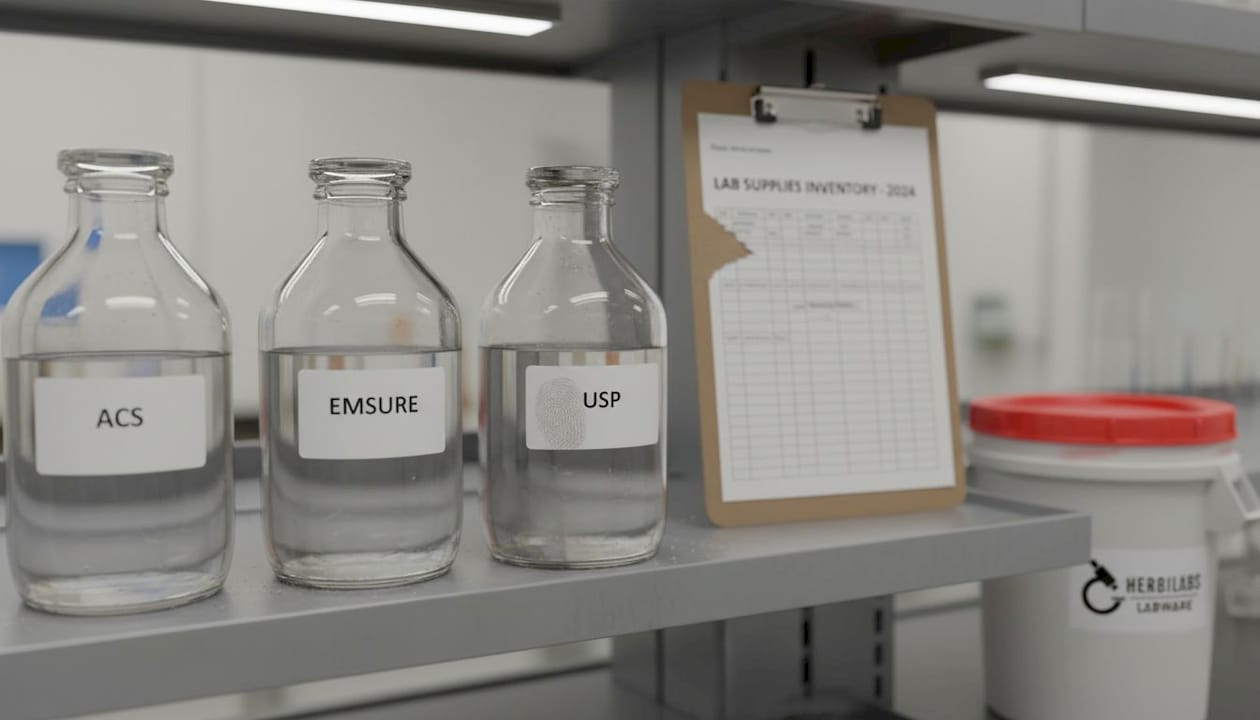
Standards including ACS, EMSURE®, and USP/Ph. Eur. each define distinct purity and impurity thresholds, and each is suited to different laboratory contexts. The table below provides a direct comparison:
| Standard | Governing body | Typical purity | Primary application |
|---|---|---|---|
| ACS grade | American Chemical Society | ≥95 to 99%+ | General analytical chemistry |
| USP/Ph. Eur. | US/European Pharmacopoeia | Varies by monograph | Pharmaceutical testing |
| EMSURE® | Merck KGaA | Exceeds ACS/Ph. Eur. | High-sensitivity analytics |
| ISO 6353 | International Organization for Standardization | Defined per substance | Laboratory reagent testing |
Interpreting these standards correctly requires attention to the certificate of analysis provided with each lot. A compliant CoA should include:
- Lot number and manufacturing date
- Purity assay result with method reference
- Individual impurity values (not aggregate totals)
- Residual solvent and water content where applicable
- Reference to the applicable standard (e.g., Ph. Eur. monograph number)
For European laboratories, the Ph. Eur. standard carries particular weight. Reagents produced under Good Manufacturing Practice (GMP) for pharmacopoeia testing must meet strict traceability requirements, and documentation must be available for audit. This is especially relevant for labs operating under regulatory oversight or supplying data to regulatory submissions.
Pro Tip: When evaluating a new supplier, request the CoA for the specific lot you will receive, not a generic or historical document. Lot-to-lot variation is real, and a CoA from a different batch provides no assurance about the material you are actually using.
For a structured overview of how these classifications apply to your workflow, the lab reagent standards resource at Herbilabs provides practical guidance, and the quality control guide covers verification steps in detail.
High-purity vs standard grade: What’s the real difference?
Choosing the right grade can make or break your experiment, and the distinction between high-purity and standard grades is more consequential than many researchers initially appreciate. Standard reagent grade chemicals, typically ranging from 95% to 99.5% purity, are appropriate for general laboratory tasks such as buffer preparation, cleaning, or non-critical synthesis steps. High-purity grades, by contrast, are specified for applications where impurity-driven interference would compromise the validity of results.
Consider the following use-case comparison:
| Application | Recommended grade | Rationale |
|---|---|---|
| Buffer preparation | Reagent grade | Impurities do not affect outcome |
| HPLC mobile phase | HPLC/ACS grade | Baseline noise sensitivity |
| Peptide coupling reagents | High purity (3N to 4N) | Side reactions from trace metals |
| Mass spectrometry standards | Ultra-high purity (4N+) | Signal suppression risk |
| Pharmacopoeia testing | Ph. Eur./USP grade | Regulatory compliance required |
The risks of mismatching grade to application are concrete. In solid-phase peptide synthesis, for example, coupling reagents contaminated with residual amines can generate deletion sequences, reducing overall yield and complicating purification. A researcher synthesizing a 30-mer peptide with suboptimal reagent purity may find that final product purity drops below acceptable thresholds, requiring additional purification steps that add both time and cost.
Key considerations when selecting between grades:
- Sensitivity of the detection method (e.g., UV vs. mass spectrometry)
- Length and complexity of the synthetic sequence
- Regulatory or publication requirements for the research
- Budget constraints balanced against the cost of failed experiments
“Over-specifying wastes cost, under-specifying risks failures; use reagent grade for general tasks, high-purity for sensitive research.”
Pro Tip: Map your reagent grade selection to the most sensitive step in your workflow, not the average step. A single under-specified reagent at a critical juncture can compromise an otherwise well-controlled experiment.
For researchers working specifically with peptides, the guide on selecting peptide reagents provides application-specific decision frameworks that go beyond generic grade comparisons.
How high-purity reagents impact peptide research and analytics
Applying this knowledge to practice reveals how directly reagent purity connects to critical research outcomes. In peptide synthesis, the relationship between reagent purity and product quality is measurable and well-documented. High-purity reagents ensure reproducibility and high yields, with data showing that 99.5% enantiomeric excess (ee) in coupling reagents results in approximately 78% yield for a 50-mer peptide, while 99.8% ee raises that yield to 90%.
That 12-percentage-point difference in yield is not trivial. For a research group synthesizing milligram quantities of a complex peptide, it can represent the difference between a successful experiment and a failed batch that must be repeated.
In analytical chemistry, the impact of impurities operates through different mechanisms but produces equally significant consequences. Trace metal ions in solvents or buffers can suppress ionization in electrospray mass spectrometry, causing underestimation of analyte concentrations. Organic impurities in HPLC-grade solvents can produce ghost peaks that obscure or co-elute with target compounds.
Actionable steps for ensuring reagent suitability before use:
- Review the CoA for the specific lot, focusing on impurity profiles relevant to your application
- Cross-reference with your method’s sensitivity requirements, particularly the detection limit of your instrument
- Run a blank or reagent control to establish a baseline before introducing your sample
- Document reagent lot numbers in your lab notebook for traceability and reproducibility
- Perform incoming QC checks on critical reagents, particularly for long-running or multi-batch studies
Reagent purity is not a procurement decision. It is a scientific decision with direct consequences for data integrity.
For a detailed examination of how labware purity for peptides affects synthesis outcomes, Herbilabs provides targeted resources for researchers at every stage of the peptide workflow.
Best practices for sourcing, storage, and verification in European labs
Once you know what to look for, the next step is putting best practices into action in your own lab. For European researchers, sourcing high-purity reagents involves navigating a specific regulatory and documentation landscape that differs meaningfully from other regions.
In Europe, Ph. Eur. reagents are produced under GMP for pharmacopoeia testing, and documentation and traceability are essential components of compliance. This means that both the supplier and the end user carry responsibility for maintaining an auditable chain of custody from manufacture to point of use.
Sourcing checklist for European laboratories:
- Confirm the applicable standard (Ph. Eur., ACS, ISO 6353) before placing an order
- Request a lot-specific CoA and verify that impurity values are individually listed
- Check for GMP certification if reagents will be used in regulated research or testing
- Evaluate supplier traceability by asking about manufacturing site, batch records, and re-testing intervals
- Assess delivery conditions, particularly cold-chain requirements for moisture-sensitive or temperature-sensitive materials
Storage and handling practices that protect purity after delivery:
- Store reagents in their original, sealed containers under the manufacturer’s specified conditions
- Use inert tools (e.g., PTFE spatulas) to avoid introducing metallic contamination during weighing
- Minimize headspace exposure by re-sealing containers immediately after use
- Maintain a reagent log that records opening date, usage, and any observed changes in appearance
- Segregate high-purity reagents from general-grade chemicals to prevent cross-contamination
Pro Tip: Assign a dedicated area in your storage facility for high-purity reagents, clearly labeled and physically separated from lower-grade materials. Contamination events in storage are preventable, and segregation is the most effective control.
For comprehensive guidance on safe reagent handling, including disposal and safety protocols, Herbilabs provides resources aligned with European laboratory standards.
Most experts over-simplify: The real art of choosing high-purity reagents
The prevailing advice in many lab training programs reduces reagent selection to a simple rule: when in doubt, buy the purest available. This guidance is well-intentioned but operationally incomplete. Experienced researchers who have navigated real-world budget constraints and complex multi-step workflows understand that the decision is contextual, not absolute.
Over-specifying purity carries genuine costs. Ultra-high-purity reagents can be an order of magnitude more expensive than reagent-grade equivalents, and that premium is only justified when the application demands it. Conversely, under-specifying, even by a single grade, at a critical synthetic or analytical step can propagate errors through an entire dataset, requiring costly repetition.
The researchers who consistently get this right share one habit: they map reagent specification to the most sensitive step in their protocol, not the average step. They also consult lab quality tips and build grade selection into their experimental design phase, not as an afterthought during procurement. Purity specification is a scientific decision, and it deserves the same rigor as any other experimental variable.
Elevate your lab results with expertly sourced high-purity reagents
Ready to put this knowledge to work in your lab? Herbilabs can help you take the next step. Understanding reagent grades and purity standards is only the beginning. Translating that knowledge into consistent, reproducible results requires access to well-documented, reliably sourced materials that meet the specific demands of your research environment.
Herbilabs provides research-grade reagents and reconstitution solutions manufactured to strict purity standards, with full documentation and traceability suited to European laboratory requirements. Whether you are working through the process of how to choose lab reagents for a new peptide project or looking to ensure research accuracy across an ongoing analytical program, Herbilabs offers the product quality, supplier transparency, and technical support that demanding research requires.
Frequently asked questions
What is the main difference between high-purity and standard reagents?
High-purity reagents have impurity levels below 0.1%, with trace impurities measured in parts per billion, while standard grades can contain significantly higher concentrations of contaminants that may interfere with sensitive applications.
Which lab applications absolutely require high-purity reagents?
Sensitive analytics such as mass spectrometry and HPLC, as well as peptide synthesis, demand high-purity reagents because reproducibility and high yields depend on the absence of trace contaminants that can suppress signals or introduce side reactions.
How can I verify reagent purity when sourcing for my lab?
Always request a lot-specific certificate of analysis and cross-reference the listed impurity values against the requirements of recognized standards such as Ph. Eur., ACS, or EMSURE® before accepting a shipment.
Does using the highest purity always deliver better results?
Not always. Over-specifying purity increases procurement cost without improving outcomes in applications where lower-grade reagents are fully adequate, making grade-to-application matching the more effective strategy.