Private Label, White Label, Wholesale partnerships available - EU, USA and UK - Free shipping from €75
Why certified lab suppliers matter for reliable research
Learn why certified lab suppliers with ISO/IEC 17025, ISO 9001, and GMP credentials are critical for audit-ready, defensible research. Includes a supplier verification framework.
TL;DR:
- Certification ensures suppliers meet standards like ISO/IEC 17025, ISO 9001, or GMP, providing regulatory confidence.
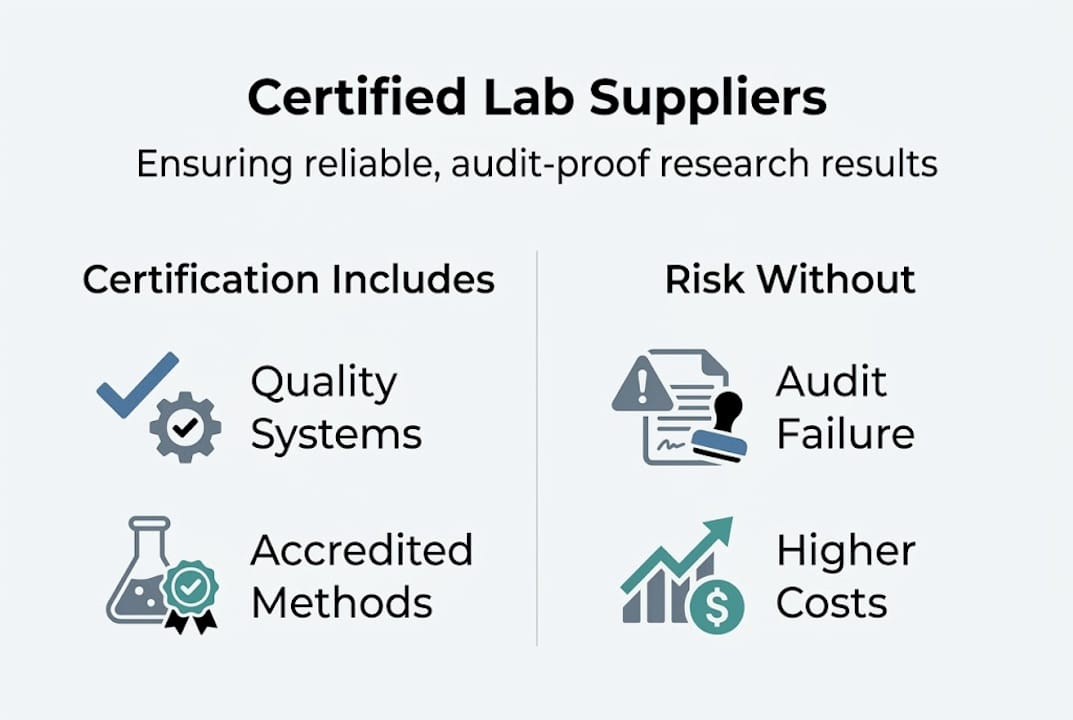
- Mismatched or uncertified suppliers increase risks of data rejection, re-testing, and audit failures.
- Ongoing verification, scope checking, and supplier relationship management are essential for research compliance and resilience.
Relying on an uncertified or scope-mismatched supplier is one of the most preventable ways to invalidate research outcomes. A single audit finding tied to supplier qualification can stall a project for weeks, force re-testing of archived samples, or disqualify entire data sets from regulatory submissions. Certification is not administrative overhead; it is the structural backbone of defensible, repeatable science. This guide covers what specific certifications actually guarantee, how to verify them rigorously, what goes wrong when verification is skipped, and how certified supply chains future-proof laboratory operations against evolving regulatory expectations.
Table of Contents
- What does certification mean for lab suppliers?
- The risks of uncertified or mismatched suppliers
- Certification and supplier qualification: What labs must check
- How certified suppliers future-proof your research and audits
- Our perspective: What the paperwork doesn’t tell you about certified lab suppliers
- Where to find certified lab supplies and take the next step
- Frequently asked questions
Key Takeaways
| Point | Details |
|---|---|
| Certification protects results | Using certified suppliers keeps research defensible, repeatable, and reduces audit risk. |
| Check scope, not just certificates | Always verify that a supplier’s accreditation covers your exact assay or material. |
| Prevents costly setbacks | Certified suppliers help avoid re-testing, delays, and compliance failures. |
| Enhances audit readiness | Certified partners simplify documentation and respond faster to regulatory or client audits. |
What does certification mean for lab suppliers?
Certification in the laboratory supply context refers to formal, third-party verification that a supplier’s processes, testing methods, or quality management systems meet defined international standards. Three standards dominate supplier qualification decisions in research and regulated environments.
ISO/IEC 17025 is the internationally recognized standard for the technical competence of testing and calibration laboratories. It verifies that a laboratory produces technically valid results through defined methods, calibrated equipment, and trained personnel. ISO 9001 is a quality management system standard that governs documented processes, continuous improvement frameworks, and audit-ready procedures across any organization. GMP (Good Manufacturing Practice) establishes requirements for manufacturing environments where product quality directly affects downstream use, particularly relevant in pharmaceutical, biopharmaceutical, and research reagent production.
| Standard | Primary focus | Key guarantee | Relevant for |
|---|---|---|---|
| ISO/IEC 17025 | Testing and calibration competence | Technical validity of results | Analytical labs, reference material suppliers |
| ISO 9001 | Quality management systems | Documented process control and auditability | All supplier types |
| GMP/GxP | Manufacturing quality | Contaminant-free, traceable product batches | Reagent, buffer, and diluent suppliers |
Practical implications for research labs include the following:
- Compliance documentation: Certified suppliers provide Certificates of Analysis (COAs), calibration records, and method validation data that satisfy internal SOPs and external auditor requirements.
- Audit trail integrity: Each certified supplier maintains documented evidence that supports traceability from raw material to finished product.
- Method validity: Data generated using certified reference materials or calibrated instruments carries defensible provenance in regulatory submissions.
- Reduced re-testing burden: Recognized certification reduces the likelihood that purchased materials will require additional in-house verification before use.
Using supplies from a supplier without recognized accreditation, or whose certification scope does not cover your specific assay or material type, means the data generated may not be accepted by regulatory bodies or external auditors, regardless of its apparent quality.
As the ISO/IEC 17025 overview makes clear, certified lab suppliers reduce regulatory and audit risk by providing defensible, third-party verified documentation for testing, calibration, and analytical methods. Understanding ISO standards in research is therefore not optional for labs operating under GxP or accreditation frameworks.
The risks of uncertified or mismatched suppliers
Knowing what certification guarantees makes the consequences of its absence easier to assess. The risks are both operational and financial, and they compound across the research lifecycle.
| Factor | Certified supplier | Uncertified or mismatched supplier |
|---|---|---|
| Traceability | Full batch and material traceability | Limited or absent documentation |
| Documentation | COAs, calibration records, scope-specific data | Generic or incomplete paperwork |
| Regulatory acceptance | Data recognized by auditors and regulatory bodies | Data potentially rejected |
| Re-testing likelihood | Low | High |
| Audit outcome risk | Minimal | Significant |
The sequence of impact when supplier certification is missing or mismatched follows a predictable path:
- Purchase approval stage: Procurement teams cannot complete supplier qualification forms without valid accreditation documentation, delaying ordering cycles.
- Incoming inspection: Materials from non-certified suppliers require additional in-house verification, increasing labor time and reagent consumption.
- Experimental execution: If reference materials or calibration standards lack recognized accreditation, downstream assay data carries qualified or conditional status.
- Data review and submission: Quality assurance reviewers flag supplier gaps; data packages require remediation before submission.
- Audit or inspection: Regulatory inspectors identify supplier qualification failures as a systemic issue, triggering corrective action requirements across related studies.
The cost of re-testing is not trivial. Material costs, analyst time, and project schedule impact can represent a significant fraction of a study’s total budget when compounded across multiple affected batches. Unaccredited test data risks are well documented: non-scope-matching test data can trigger re-testing delays and compliance challenges that cascade across interdependent workstreams.

Scope mismatch is a subtler but equally serious problem. A supplier holding ISO 9001 certification is not automatically qualified to supply reference standards for an ISO/IEC 17025-governed calibration program. The certificate must cover the specific activity, material type, or method relevant to the purchasing lab’s use case. Maintaining a robust lab supply chain reliability framework requires actively checking scope, not merely confirming that a certificate exists. A quality control checklist that includes scope verification at the supplier qualification stage prevents the majority of these issues before they reach the bench.
Certification and supplier qualification: What labs must check
Verifying a supplier’s certification requires more than reviewing a scanned document. A structured qualification process examines the issuing body, the scope of accreditation, the certificate’s expiry date, and the alignment between scope and intended use.
Key documents to request and verify from any prospective supplier include:
- Certificate of accreditation or registration: Issued by the relevant national or international body (e.g., UKAS, DAkkS, RvA), showing the standard, scope, and validity period.
- Certificate of Analysis (COA): Batch-specific documentation confirming that the supplied material meets stated specifications, ideally referencing the analytical methods used.
- Calibration records: For instruments or reference materials, calibration certificates demonstrating traceability to national or international measurement standards.
- Traceability artifacts: Documentation linking raw materials, in-process controls, and final product specifications in an unbroken chain.
- Deviation and corrective action logs (where relevant): Evidence that the supplier’s quality system responds to non-conformances in a documented, systematic way.
Pro Tip: Always request a breakdown of the certification scope specifically relevant to your application. A supplier certified for water purity testing is not necessarily certified for the preparation of sterile injectable diluents. Scope specificity is the single most frequently overlooked element in supplier qualification.
Regulatory frameworks reinforce this expectation. GxP supplier oversight frameworks treat suppliers as extensions of the quality system; data integrity, controlled documentation, and risk-based oversight are core expectations that apply throughout the supply relationship, not only at initial qualification. Similarly, a supplier’s “certified” claims may be insufficient unless the certification is the right standard and scope for your specific use.
Labs should also schedule periodic re-qualification of approved suppliers, particularly following certificate renewals, changes in manufacturing site, or updates to the supplier’s quality management system. Maintaining labware integrity depends on supplier qualification being a living process, not a one-time check. Reviewing lab quality control tips aligned with current GxP expectations helps teams structure this ongoing oversight efficiently.
How certified suppliers future-proof your research and audits
The long-term value of working with certified suppliers extends well beyond avoiding individual compliance failures. It creates a structural advantage in audit readiness, tender eligibility, and operational resilience.
Benefits that accrue over time include:
- Audit readiness: Pre-qualified, certified suppliers with current documentation reduce preparation time when regulatory inspections are announced. Auditors expect supplier qualification files to be immediately accessible.
- Documented process control: Suppliers operating under ISO 9001 or GMP frameworks maintain version-controlled SOPs, change control records, and internal audit trails that support your own quality system.
- Risk mitigation: Systematic supplier certification reduces the probability of receiving out-of-specification materials, counterfeit reagents, or inadequately characterized reference standards.
- Tender and grant eligibility: Many public funding bodies and contract research organizations require demonstration of compliant supply chains as a condition of award.
- Regulatory change resilience: Certified suppliers adapt quality systems to reflect updated standards; labs that rely on them inherit that adaptability without absorbing the full compliance burden internally.
Pro Tip: Maintaining a supplier register with certification type, issuing body, scope, and renewal date simplifies re-accreditation for your own laboratory. When assessors ask for evidence of supplier control, a structured register with current documentation closes that finding before it opens.
Continuous improvement embedded in ISO 9001-certified quality management systems helps laboratories and their suppliers demonstrate documented, auditable process control, reducing systemic errors through structured procedures and long-term audit readiness.
As ISO 9001 benefits illustrate, certified quality management systems help laboratories and suppliers demonstrate documented, auditable process control, which is directly useful for supplier qualification and for reducing errors. Partnering with trusted suppliers who invest in certification signals operational maturity and reduces the compliance burden on your own quality team. For labs conducting rigorous quality testing in biotech and pharma settings, this translates directly into more reliable study outcomes and fewer inspection findings.
Our perspective: What the paperwork doesn’t tell you about certified lab suppliers
Certification documents are necessary. They are not sufficient. After working through supplier qualification processes across multiple research settings, the pattern that emerges is consistent: labs that treat certification as a binary check (present or absent) face the same problems as those that skip the check entirely, just later in the project.
Scope alignment and recency matter more than the certificate’s existence. A certificate issued three years ago against a scope that no longer matches your current assay is operationally worthless, even if it looks impressive in the supplier file. The verification process must ask whether this certificate covers this specific material or method for this specific use, not simply whether a certificate exists.
Documentation is only as useful as the process that verifies it. Accepting a COA at face value without cross-referencing the issuing body’s accreditation status or the method cited is a systemic gap, not just a procedural shortcut. Trust, but verify remains the correct operational posture.
Prioritizing ongoing supplier relationships over transactional one-time checks also matters practically. Suppliers who understand your research context and proactively communicate certification renewals, scope changes, or batch deviations are structurally more valuable than those who simply provide correct paperwork on initial qualification. Building that relationship into your supply chain best practices framework is what separates labs that consistently pass audits from those that are perpetually reacting to them.
Where to find certified lab supplies and take the next step
Applying the criteria covered in this guide starts with sourcing from suppliers who proactively publish their certifications, maintain traceable manufacturing records, and align their product specifications with research-grade requirements.
Herbilabs offers high-purity reconstitution solutions manufactured to strict quality standards, with documentation structured to support supplier qualification in research and laboratory settings. Understanding why high-purity reagents matter for research validity is the first step; the second is selecting laboratory reagents that carry the traceability and certification your quality system requires. Review available certificates, request scope documentation, and use the qualification framework outlined above to make every purchase audit-ready from the point of order.
Frequently asked questions
What certifications should I require from lab suppliers?
Look for ISO/IEC 17025 for testing and calibration competence, ISO 9001 for quality management systems, and GMP alignment for regulated GxP settings. Certified suppliers with these credentials reduce regulatory and audit risk by providing defensible, third-party verified documentation.
How do I check if a supplier’s certification covers my required tests?
Request the full accreditation scope document from the issuing body and verify that the specific method, material type, or analyte is listed. Generic certificates without scope-specific coverage may be insufficient for your application regardless of the standard cited.
What happens if I use an uncertified or mismatched supplier?
You risk failed audits, mandatory re-testing, and potentially invalid research data, all of which create costly schedule delays. Non-scope-matching test data can trigger re-testing requirements and compliance challenges that affect entire study datasets.
Do regulatory agencies recognize all certifications equally?
No. Agencies verify that the certification is issued by an accepted accreditation body and that its scope matches the method or material under review. Scope verification before contracting is explicitly recommended, not certificate existence alone.