Private Label, White Label, Wholesale partnerships available - EU, USA and UK - Free shipping from €75

5 key benefits of high-purity solutions in research
Discover the key benefits of high-purity solutions for peptide and laboratory research: improved reproducibility, lower contamination risk, and better assay sensitivity.
TL;DR:
- Using high-purity solutions enhances reproducibility, minimizes contamination risks, and improves assay sensitivity.
- Purity standards like USP, EP, and GMP are essential for sensitive experiments and regulatory compliance.
- Prioritizing reagent purity prevents costly errors, long-term project failures, and ensures data credibility.
Selecting the wrong purity grade for a reconstitution solution or reagent can compromise months of work, rendering costly peptide batches unusable and skewing assay data beyond recovery. For independent researchers and lab managers across the UK and Europe, solution purity is not a secondary specification but a primary experimental variable. This article examines the essential criteria for evaluating high-purity solutions, contrasts their performance against lower-grade alternatives, and identifies the specific laboratory scenarios where a higher purity standard is non-negotiable. By the end, you will have a practical framework for making purity decisions that protect both your data and your research budget.
Table of Contents
- Key criteria for selecting high-purity solutions
- Top advantages of high-purity solutions for laboratory research
- How high-purity solutions compare to lower-grade alternatives
- Situational recommendations: When high-purity is essential
- A candid look: Why purity standards matter more than ever
- Find your ideal high-purity solution partner
- Frequently asked questions
Key Takeaways
| Point | Details |
|---|---|
| Essential for accuracy | High-purity solutions significantly reduce contamination risk in research applications. |
| Better reproducibility | Labs using high-purity materials achieve more reliable and repeatable results. |
| Cost savings over time | Lower experiment failure rates offset the higher upfront investment in purity. |
| Critical for sensitive assays | Advanced peptide and molecular research require the strictest purity standards. |
| Supplier validation matters | Always verify purity claims with certificates and reputable sourcing before purchase. |
Key criteria for selecting high-purity solutions
High-purity solutions are reagents, solvents, and diluents manufactured to meet or exceed stringent quality benchmarks defined by recognized pharmacopoeial and chemical standards bodies. The most widely referenced frameworks include the United States Pharmacopeia (USP), the European Pharmacopoeia (EP), and the American Chemical Society (ACS) reagent grade specifications. Each establishes concentration limits for trace metals, microbial contaminants, endotoxins, and particulate matter. Understanding which standard applies to your application is the starting point for any responsible sourcing decision.
When evaluating a supplier, the following criteria deserve careful scrutiny:
- Documented purity grade: Confirm whether the product meets USP, EP, ACS, or GMP specifications relevant to your application.
- Lot-to-lot consistency: Reproducibility across batches is essential; a single inconsistent lot can invalidate comparative data.
- Supplier validation records: Qualified suppliers maintain internal and third-party testing data for each production run.
- Endotoxin and microbial limits: For injectable diluents and bacteriostatic water, endotoxin levels must fall within pharmacopoeial limits.
- Packaging integrity: Container closure systems must prevent contamination during storage and handling.
Contaminants present at even sub-parts-per-million concentrations can inhibit enzymatic activity, alter peptide folding, or introduce background signal in sensitive immunoassays. Labware purity in peptide research is documented as essential to minimize contamination and ensure accurate results, particularly where lyophilized peptides are reconstituted for biological assays.
“Even trace-level impurities in reconstitution media can shift dose-response curves and produce false activity readings, making supplier qualification as important as the assay protocol itself.”
Pro Tip: Always request lot-specific certificates of analysis (CoA) before accepting a delivery. A reputable supplier will provide third-party analytical data confirming purity parameters for the exact batch shipped to your facility.
Understanding what is high-purity reagent and how grading systems differ will help you align your purchasing specifications with your experimental requirements from the outset.
Top advantages of high-purity solutions for laboratory research
Once you understand what to look for, it is essential to recognize how high-purity solutions can directly improve your lab’s outcomes. The performance difference between grades is not theoretical. It surfaces in day-to-day experimental data, resource consumption, and the downstream credibility of your findings.
Core advantages of using high-purity solutions include:
- Improved reproducibility: Consistent high-purity solutions reduce experimental variation and increase reproducibility, a critical factor when publishing or replicating work across sites.
- Reduced background noise: Lower contaminant loads mean cleaner baselines in fluorescence, mass spectrometry, and ELISA-based assays, allowing detection of lower-abundance targets.
- Enhanced assay sensitivity: With fewer interfering species present, assays can detect biologically relevant signals at concentrations that would otherwise be masked.
- Greater downstream safety: For injectable diluents such as bacteriostatic water, purity directly correlates with safety profiles relevant to handling and research subject welfare.
- Longer effective shelf life: High-purity solutions formulated under controlled conditions tend to maintain stability specifications for longer periods, reducing waste from early degradation.
The financial case is equally compelling. Labs operating under strict quality control in labs protocols report up to 80% fewer failed experiments when high-purity standards are applied consistently across reagent selection. In peptide synthesis workflows, this translates directly to fewer repeat syntheses, reduced solvent consumption, and lower labor costs per validated batch.
Consider a practical example: a research group reconstituting a lyophilized peptide in a bacteriostatic water solution containing residual endotoxins at 0.5 EU/mL. In a cell-based bioactivity assay, that endotoxin level alone can activate NF-kB pathways, producing a false-positive proliferation signal indistinguishable from peptide-driven activity. Switching to a certified low-endotoxin diluent eliminates this confounding variable entirely.
How high-purity solutions compare to lower-grade alternatives
Comparing high-purity and standard-grade solutions clarifies how these advantages translate into tangible lab performance metrics. The table below summarizes key outcome parameters across both categories:
| Parameter | High-purity grade | Standard/lower grade |
|---|---|---|
| Assay reliability | High, lot-consistent | Variable, batch-dependent |
| Contamination risk | Very low | Moderate to high |
| Background interference | Minimal | Significant in sensitive assays |
| Shelf life stability | Extended, well-documented | Often shorter or unspecified |
| Regulatory compliance | Meets USP/EP/GMP requirements | May not satisfy regulated contexts |
| Cost per unit | Higher upfront | Lower upfront |
As purity grades directly impact assay reliability and research outcomes, the cost-per-unit comparison above does not reflect total project cost when failed experiments and repeat runs are factored in.
Three principal disadvantages apply when lower-grade solutions are used in sensitive research:
- Unpredictable contaminant profiles: Lower-grade products often carry broader impurity tolerances, making it impossible to distinguish experimental effects from reagent artifacts.
- Reduced data defensibility: Research data generated with unvalidated reagents is harder to defend during peer review, regulatory submission, or grant reporting.
- Incompatibility with downstream applications: Some analytical instruments and chromatography columns are sensitive to specific contaminants present in lower-grade solvents, leading to column degradation and instrument maintenance costs.
A justified investment in high-purity solutions is warranted when: the assay involves detection limits below nanomolar concentrations; regulatory or accreditation requirements mandate pharmacopoeial compliance; multi-site reproducibility is a project deliverable; or any component of the workflow involves injectable preparations for research subject use. Reviewing reagent quality control documentation from your supplier is an efficient way to validate whether a product’s specifications meet these conditions.
Situational recommendations: When high-purity is essential
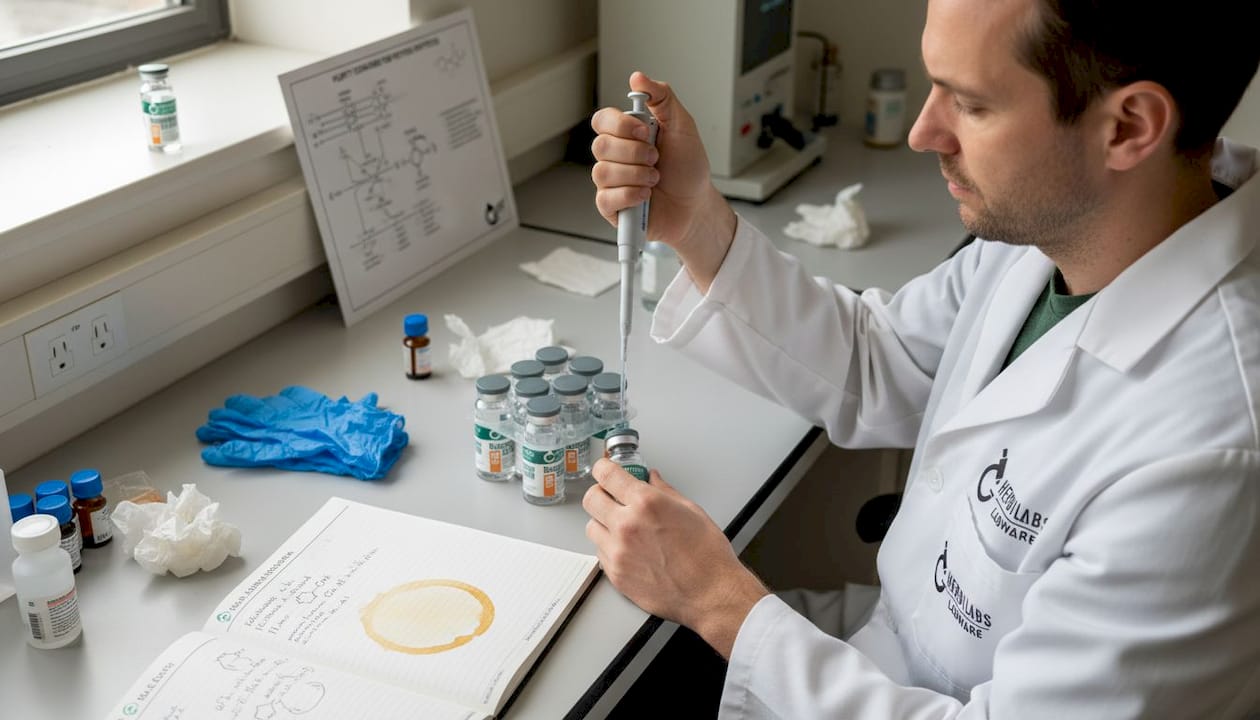
To make the benefits concrete, let us explore when prioritizing high-purity solutions is essential for your next experiment. The decision is not always binary, but certain scenarios make the case for the highest available purity unambiguous.
| Laboratory scenario | Recommended purity level | Rationale |
|---|---|---|
| Lyophilized peptide reconstitution | USP/EP bacteriostatic water | Endotoxin and particulate control |
| Cell-based bioactivity assays | GMP or USP grade diluents | Avoids cytotoxic contaminant interference |
| Mass spectrometry sample prep | LC-MS grade solvents | Prevents ion suppression from trace impurities |
| ELISA and immunoassays | ACS or USP reagent grade | Reduces non-specific binding artifacts |
| Routine equipment rinsing | Technical or lab grade | No analytical sensitivity requirement |
| Teaching laboratory demonstrations | Technical grade acceptable | Cost-efficiency appropriate at this level |
For regulated diagnostics and peptide therapeutics research, the choice of purity has critical consequences in regulated environments, and research-grade alone is frequently insufficient. GMP-grade or pharmaceutical-grade specifications are required where documentation trails, batch release testing, and regulatory defensibility are mandatory.
Pro Tip: When your routine assay results suddenly show elevated background signal or inconsistent dose-response curves across replicate runs, suspect a reagent purity issue before investing time in protocol troubleshooting. A purity upgrade is often faster and less costly than an exhaustive protocol audit.
Red flags that indicate a purity upgrade is warranted include: persistent inter-run variability despite consistent technique; anomalous peaks in chromatographic profiles; or unexpected toxicity in cell culture that cannot be attributed to the test compound. Proactive steps to maintain labware integrity alongside a purity upgrade provide a more complete resolution to such problems. For UK and EU labs operating under institutional governance frameworks, the cost of one failed experiment cycle typically exceeds the annual premium paid for higher-purity reagents.
A candid look: Why purity standards matter more than ever
Stepping back, it is worth reconsidering the philosophy that many research labs still apply when it comes to purity selection, specifically the assumption that “good enough” is an acceptable threshold. This mindset was understandable when assay technologies operated at relatively coarse detection limits. It is no longer defensible.
Advances in proteomics, single-cell transcriptomics, and high-sensitivity mass spectrometry now resolve signals at concentrations where picogram-level contaminants become statistically significant variables. The reproducibility crisis documented across biomedical research fields is not solely a design or statistics problem. A substantial portion of irreproducible findings trace back to undocumented reagent variability, including unverified purity specifications from suppliers who do not provide lot-specific CoA data.
Supply chain disruptions observed between 2020 and 2024 further exposed how labs substituted reagent suppliers without re-validating purity parameters, introducing silent variables into long-running study protocols. The clinical research sector has absorbed this lesson at significant financial and reputational cost. Independent labs and research managers navigating laboratory supply chain challenges now recognize that supplier qualification is a continuous process, not a one-time onboarding step.
Investing in purity from the start is not a luxury reserved for well-funded institutional labs. It is a risk management strategy that protects the integrity of the data and, ultimately, the credibility of the research.
Find your ideal high-purity solution partner
Ready to implement these advantages in your laboratory? Herbilabs provides curated high-purity reconstitution solutions manufactured to USP and EP standards, designed specifically for peptide research workflows and sensitive assay applications across the UK and Europe.
Our product range supports your selection process with transparent CoA documentation, lot-specific purity data, and direct access to technical guidance. Whether you are comparing grades for your first peptide study or scaling up a validated protocol, the benefits of high-purity reagents translate directly into fewer failed runs and more defensible data. Explore our practical guide to choosing lab reagents to match your specific application requirements with the appropriate purity grade and format.
Frequently asked questions
What purity level is required for sensitive peptide research?
Pharmaceutical- or GMP-grade solutions are recommended for sensitive peptide research where even trace contaminants impact results. High standards are essential in peptide research, particularly when reconstituting lyophilized compounds for biological or cell-based assays.
Are high-purity solutions more expensive?
High-purity solutions carry higher upfront unit costs, but they substantially reduce the risk of failed experiments and repeat runs, generating long-term savings. Contaminants in lower grades lead to increased material waste and cumulative project cost overruns.
How do I verify the purity of a laboratory solution?
Request a lot-specific certificate of analysis and review the analytical data for endotoxin levels, trace metals, and microbial counts. Reputable suppliers provide third-party testing documentation as a standard component of product delivery, and certificates of analysis are a recognized validation tool within the industry.
When is it acceptable to use lower-purity solutions?
Lower-purity solutions are appropriate for routine equipment rinsing, glassware cleaning, or teaching laboratory demonstrations where no analytical measurement is involved. High-purity is essential for any work requiring accurate quantification or sensitive detection.
Can high-purity solutions improve assay sensitivity?
Yes, by reducing baseline noise and eliminating contaminant-driven interference, high-purity solutions allow detection of lower-abundance targets with greater confidence. Assay sensitivity depends directly on the purity standards applied to every component of the assay system.