Private Label, White Label, Wholesale partnerships available - EU, USA and UK - Free shipping from €75
ISO standards in research: ensure quality and compliance
Learn how ISO standards like ISO/IEC 17025 help UK and European research labs achieve quality, compliance, and accreditation with practical implementation steps.
TL;DR:
- ISO standards ensure laboratory results are reliable, credible, and legally defensible.
- Implementing ISO/IEC 17025 involves structured gap analysis, documentation, staff training, and continual improvement.
- Proper validation, verification, and staff understanding are critical to passing audits and maintaining quality.
Reproducibility failures cost the global research community an estimated $28 billion annually, yet many of the underlying causes trace back to poorly implemented or absent quality management frameworks. For laboratory professionals in the UK and Europe, ISO standards represent the most rigorously validated pathway to consistent, credible, and legally defensible results. This article covers the core ISO standards applicable to scientific research environments, explains the structural requirements of ISO/IEC 17025 in practical terms, and outlines implementation strategies that move labs from theoretical compliance to operational excellence. Whether you are preparing for your first UKAS assessment or refining an existing quality management system (QMS), the guidance here is designed to be immediately actionable.
Table of Contents
- What are ISO standards and why do they matter in research?
- Breaking down ISO/IEC 17025: Structure and core requirements
- Implementation in practice: From gap analysis to continual improvement
- Validation, verification, and common pitfalls: What most labs miss
- Which standard when? Comparing ISO options for the research lab
- An experienced perspective: Why ISO isn’t a box-ticking exercise
- How Herbilabs helps you go further
- Frequently asked questions
Key Takeaways
| Point | Details |
|---|---|
| ISO 17025 is essential | This standard ensures research labs are technically competent, reliable, and globally credible. |
| Implementation is holistic | Success requires leadership, documentation, training, and ongoing risk-based review. |
| Avoid common pitfalls | Go beyond checklists to embed a culture of quality and open communication in your lab. |
| Choose standards wisely | Select the ISO standard suited for your lab’s scope—17025 for general labs, 15189 for medical, 9001 for overall QMS. |
| Accreditation improves value | ISO-accredited labs see greater productivity, market access, and resilience. |
What are ISO standards and why do they matter in research?
ISO standards are internationally recognized frameworks developed by the International Organization for Standardization to define requirements for quality, safety, and technical competence across industries. In research and testing environments, these standards serve as the structural backbone of a laboratory’s quality management system, ensuring that methods, personnel, equipment, and data handling all meet defined thresholds of reliability.
For testing and calibration laboratories, ISO/IEC 17025 is the primary international standard for laboratory competence, covering everything from method validation to impartiality obligations. ISO 15189 applies specifically to medical laboratories where patient safety is a direct concern, while ISO 9001 provides a broader QMS framework applicable to organizations of all types. ISO 35001 addresses biorisk management, and Good Laboratory Practice (GLP) governs nonclinical safety studies submitted to regulatory authorities. Understanding which standard applies to your specific research context is the first step toward meaningful compliance.
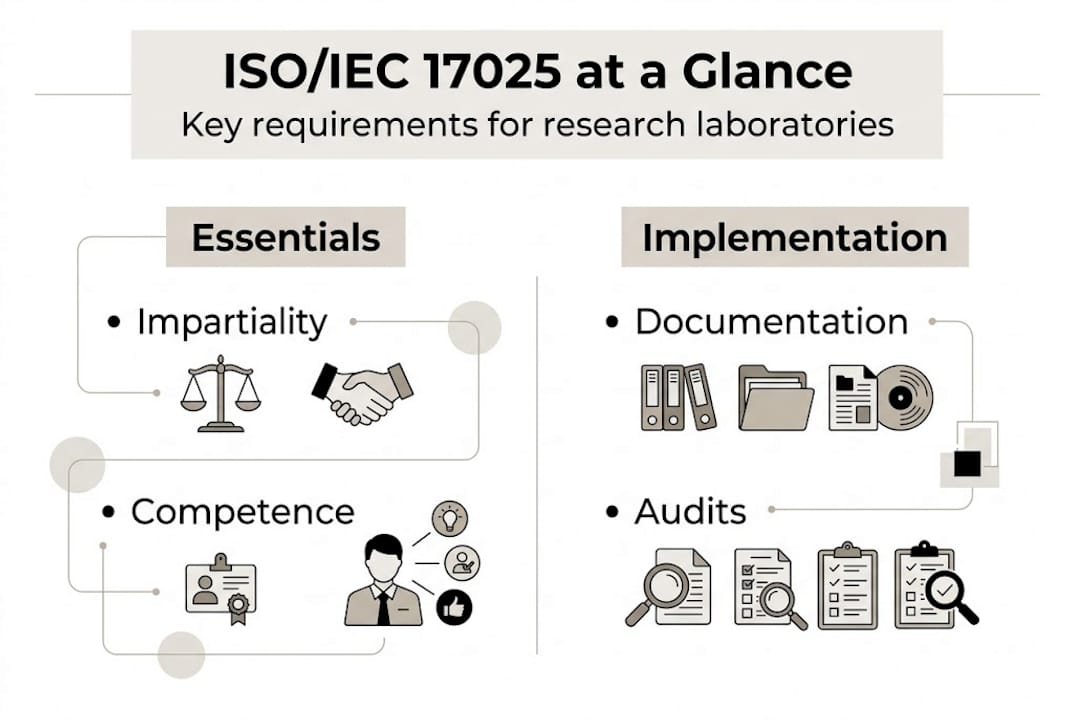
Accreditation bodies such as UKAS (United Kingdom Accreditation Service) in the UK and EA (European Cooperation for Accreditation) member bodies across Europe formally assess and confirm laboratory competence against these standards. Accreditation is not merely a credential. It signals to regulators, collaborators, funding bodies, and commercial partners that your laboratory’s results are technically sound and independently verified.
The practical benefits of ISO compliance extend well beyond audit readiness. QMS-aligned research labs demonstrate measurably improved data integrity, reduced rates of nonconformance, and stronger cross-institutional reproducibility. Additionally, certified labs typically see higher productivity and resilience, including better staff retention and fewer costly rework cycles. For lab quality control essentials, ISO accreditation provides the formal scaffolding that transforms individual good practices into a system-wide standard.
Key standards relevant to research laboratories include:
- ISO/IEC 17025: Testing and calibration laboratory competence
- ISO 15189: Medical laboratory quality and competence
- ISO 9001: General quality management systems
- ISO 35001: Biorisk management for laboratories
- GLP: Good Laboratory Practice for regulatory nonclinical studies
Breaking down ISO/IEC 17025: Structure and core requirements
ISO/IEC 17025 is organized into five major clause groups, each targeting a distinct dimension of laboratory operations. Understanding the intent behind each clause is essential before attempting to map your existing procedures against the standard’s requirements.
| Clause group | Focus area | Research relevance |
|---|---|---|
| Impartiality | Freedom from bias and conflicts of interest | Protects result integrity and credibility |
| Confidentiality | Data protection and client information | Supports regulatory and contractual obligations |
| Resources | Personnel, facilities, equipment, reagents | Ensures technical capability is maintained |
| Processes | Method validation, uncertainty, QC | Governs how reliable results are generated |
| Management system | Documentation, audits, reviews | Drives continual improvement and accountability |
The ISO 17025 structure includes clauses on impartiality, resources, processes, and management systems, and each clause carries equal weight during formal assessments. A common misconception is that the management system clause is less technically demanding than the processes clause. In practice, weaknesses in documentation control or management review directly undermine the credibility of technical outputs.
ISO/IEC 17025 complements ISO 9001 but is specifically tailored for technical laboratory activities. Where ISO 9001 focuses on organizational quality management broadly, ISO/IEC 17025 adds technical competence requirements such as measurement uncertainty estimation, method validation, and proficiency testing participation.
To begin aligning your lab with ISO/IEC 17025, the following steps provide a structured starting point, drawing on UKAS implementation guidance:
- Assign clause ownership to named individuals within the lab
- Audit existing procedures against each clause requirement
- Document all methods, including scope, acceptance criteria, and uncertainty estimates
- Establish a calibration and maintenance schedule for all critical equipment
- Implement a formal nonconformance and corrective action process
Pro Tip: When assigning clause ownership, avoid concentrating responsibility in a single quality manager. Distributing ownership across senior scientists builds broader institutional understanding and reduces single-point-of-failure risks during staff transitions. For additional quality management tips, practical frameworks are available to support this process.
Implementation in practice: From gap analysis to continual improvement
Translating ISO/IEC 17025 requirements into daily laboratory operations requires a structured implementation methodology. The process begins with a gap analysis, which systematically compares current practices against each clause requirement and identifies areas where documentation, training, or procedures are insufficient.

Implementation methodologies include management commitment, documentation, training, internal audits, and external accreditation, and each element must be treated as interdependent rather than sequential. Management leadership is particularly critical in the early stages, as resource allocation decisions directly affect the pace and depth of implementation.
Formal documentation requirements under ISO/IEC 17025 include a quality manual, standard operating procedures (SOPs) for all test methods, equipment records, personnel competency records, and a register of nonconformances. Each document must be version-controlled and accessible to relevant staff.
UKAS and EA are the primary accreditors in the UK and Europe, and both require laboratories to demonstrate ongoing competence through proficiency testing (PT) and interlaboratory comparison (ILC) programs. Participation in PT schemes is not optional under ISO/IEC 17025. It provides objective evidence that your laboratory’s results are consistent with peer institutions using the same methods.
The Plan-Do-Check-Act (PDCA) cycle underpins continual improvement under ISO/IEC 17025. Labs that embed PDCA into their annual audit and management review cycles consistently outperform those that treat compliance as a static achievement. QMS principles applied systematically reduce the likelihood of recurring nonconformances.
Key implementation milestones to track:
- Gap analysis completed with prioritized action plan
- Quality manual and SOPs drafted and approved
- All staff trained and competency records documented
- Internal audit program established with defined frequency
- PT/ILC participation scheduled and results reviewed
- Pre-assessment conducted before formal UKAS or EA submission
Pro Tip: Schedule your internal audit at least three months before your formal accreditation assessment. This window allows sufficient time to address findings, implement corrective actions, and verify their effectiveness before external scrutiny. Maintaining labware integrity and reagent quality best practices are equally important supporting factors during this period.
Validation, verification, and common pitfalls: What most labs miss
Method validation and verification are among the most technically demanding requirements of ISO/IEC 17025, and they are also among the most frequently cited sources of nonconformance during assessments. Understanding the distinction between the two is foundational.
Validation applies to new or significantly modified methods and requires the laboratory to demonstrate fitness for purpose across parameters including accuracy, precision, linearity, limit of detection, limit of quantification, selectivity, and robustness. Verification applies to standard methods already validated by external bodies, where the laboratory must confirm that it can achieve the published performance characteristics under its own conditions.
Method validation and verification processes include accuracy, precision, limits, and statistical tools such as the F-test for variance comparison and the t-test for mean comparison. Measurement uncertainty estimation, expressed as an expanded uncertainty at a defined confidence level, is a mandatory output of the validation process and must be reported alongside results.
“The most resilient laboratories treat validation not as a regulatory obligation but as an ongoing scientific commitment to understanding the boundaries of their methods.”
Common pitfalls in ISO 17025 assessments include superficial audits and diluted staff understanding of the standard’s intent. Specific failure patterns observed across UK and European labs include:
- Conducting internal audits that check documentation without evaluating actual practice
- Failing to identify and manage risks to impartiality, particularly in contract research settings
- Inadequate management review that does not result in documented decisions or resource commitments
- Treating corrective actions as closed before verifying their effectiveness
- Insufficient staff awareness of how their individual roles contribute to overall QMS integrity
Root cause analysis (RCA) is the recommended tool for addressing nonconformances. A robust RCA process identifies the systemic cause rather than the immediate symptom, preventing recurrence. For reagent standards overview and how reagent quality intersects with method performance, traceability to certified reference materials is a key validation requirement. Comparing approaches across ISO 17025 vs 17020 contexts also clarifies where inspection-focused requirements diverge from testing lab obligations.
Pro Tip: Build impartiality risk assessments into your annual management review agenda rather than treating them as a one-time exercise. Personnel changes, new commercial contracts, and shifts in research focus can all introduce new impartiality risks that require documented evaluation.
Which standard when? Comparing ISO options for the research lab
Not every research laboratory requires ISO/IEC 17025 accreditation, and selecting the appropriate standard depends on the laboratory’s primary function, regulatory context, and stakeholder requirements. A clear comparison of available standards prevents over-engineering compliance systems or, conversely, applying an insufficient framework.
| Standard | Primary focus | Typical application |
|---|---|---|
| ISO/IEC 17025 | Technical competence, testing, calibration | General research, environmental, food, forensic labs |
| ISO 15189 | Medical laboratory quality and patient safety | Clinical, pathology, diagnostic labs |
| ISO 9001 | Organizational quality management | Supporting framework for any lab type |
| ISO 35001 | Biorisk management | Microbiology, virology, biosafety labs |
| GLP | Regulatory nonclinical study integrity | Pharmaceutical, toxicology, safety testing |
Other relevant standards including ISO 9001, ISO 15189, ISO 35001, and GLP each address distinct risk profiles and regulatory expectations. ISO/IEC 17025 covers technical competence, ISO 15189 addresses medical labs, and ISO 17020 governs inspection bodies, making the selection process a matter of matching standard scope to operational reality.
Research institutions operating across multiple disciplines may need to implement more than one standard simultaneously. A university laboratory conducting both environmental testing and clinical sample analysis, for example, may need ISO/IEC 17025 for its analytical work and ISO 15189 for its medical testing activities. Proficiency testing is a crosscutting requirement across all major standards, providing a common thread of external validation regardless of which framework applies.
For supply chain reliability, the choice of standard also affects supplier qualification requirements. ISO/IEC 17025-accredited labs must verify that externally sourced materials, including reagents and reference standards, meet defined specifications and traceability requirements. For ISO standards for labs, the broader QMS literature confirms that alignment across standards delivers cumulative compliance benefits.
Key selection criteria to evaluate:
- Regulatory requirements from funding bodies or national authorities
- Nature of testing activities (clinical, environmental, analytical, inspection)
- Customer or partner accreditation expectations
- Scope of biorisk or biosafety obligations
An experienced perspective: Why ISO isn’t a box-ticking exercise
After observing how laboratories across the UK and Europe approach accreditation, one pattern stands out consistently: the labs that struggle most are not those with inadequate documentation. They are the ones where quality is treated as the quality manager’s problem rather than a shared professional standard.
ISO/IEC 17025 is designed to be a living system, not a static credential. The standard’s emphasis on impartiality, continual improvement, and management review exists precisely because quality degrades when it is not actively maintained. Labs that achieve accreditation and then coast until their next surveillance visit almost always show measurable declines in data quality and staff engagement within 18 months.
The most effective labs we observe treat every nonconformance as a learning opportunity rather than a compliance failure. They conduct real-world quality control reviews that generate genuine corrective actions, not paperwork. Every team member understands why the standard exists, not just what it requires. That cultural alignment is what separates labs that pass audits from labs that produce genuinely reliable science.
How Herbilabs helps you go further
Ready to take the next step in your lab’s quality journey? Building ISO-compliant research practices requires more than procedural documentation. It demands materials and reagents that meet the same standards of purity, traceability, and consistency that your QMS requires.
At Herbilabs, we supply research-grade reagents and reconstitution solutions manufactured to strict purity standards, with rigorous quality control at every stage of production. Whether you are focused on selecting reliable reagents for your validated methods, understanding the high-purity reagent benefits that support reproducible results, or ensuring you maintain labware integrity across your workflows, Herbilabs provides the products and guidance to support your compliance goals from documentation through to daily practice.
Frequently asked questions
What is ISO/IEC 17025 and who needs it?
ISO/IEC 17025 sets quality, competence, and technical requirements for testing and calibration laboratories, making it essential for any research lab seeking accredited, defensible results recognized by regulators and partners. Labs involved in environmental analysis, food testing, forensic science, and general analytical research are the most common applicants.
How is ISO 17025 different from ISO 9001 or 15189?
ISO/IEC 17025 focuses on technical laboratory competence and result validity, while ISO 9001 covers general quality management applicable to any organization and ISO 15189 specifically addresses medical laboratory requirements including patient safety and diagnostic accuracy.
What steps are involved in achieving ISO 17025 accreditation?
Key steps include gap analysis, documentation, training, internal audits, and external accreditation through bodies such as UKAS in the UK or EA member bodies across Europe, with proficiency testing participation required throughout the process.
Why do labs still fail ISO audits?
Common pitfalls include superficial audits and insufficient staff understanding of the standard’s intent, meaning that documentation may appear compliant while actual laboratory practice diverges significantly from stated procedures.
What’s the economic benefit of ISO certification?
Certified labs typically see higher productivity and resilience, with accreditation supporting stronger funding applications, expanded commercial partnerships, and reduced costs associated with rework and nonconformance resolution.