Private Label, White Label, Wholesale partnerships available - EU, USA and UK - Free shipping from €75
How to optimize lab supply management for efficient research
Discover how to optimize lab supply management for efficient research. Streamline operations, reduce costs, and enhance compliance today!
TL;DR:
- Inefficient supply management increases costs, delays experiments, and causes compliance issues.
- Accurate inventory audits and optimized reorder points prevent stockouts and overstocking.
- Cross-functional teamwork and digital tools improve supply chain reliability and research integrity.
Inefficient lab supply management quietly drains research budgets, stalls experiments, and creates compliance headaches that compound over time. A single missing reagent or an untracked reconstitution solution can delay a critical assay by days, while chronic overstocking ties up capital that should fund research priorities. Laboratory managers and procurement specialists in academic and institutional research settings know the operational cost of these gaps all too well. This article walks through a systematic, step-by-step process for optimizing supply management, from baseline inventory audits through digital tool selection, cross-functional coordination, and special handling of high-purity reconstitution solutions, delivering practical, immediately applicable guidance at every stage.
Table of Contents
- Assessing your lab’s baseline: Inventory essentials
- Setting smart reorder points and stock levels
- Leveraging digital tools (without the common pitfalls)
- Enabling cross-functional coordination and visibility
- Special considerations: Managing and reconstituting critical solutions
- Beyond basics: The uncomfortable truth about lab supply optimization
- Recommended solutions to support optimized supply management
- Frequently asked questions
Key Takeaways
| Point | Details |
|---|---|
| Start with a full inventory | A baseline physical inventory is the first critical step for effective lab supply management. |
| Use historical data | Let past consumption patterns set smart reorder points and stock levels to avoid shortages and excess. |
| Digitalize carefully | Digital inventory tools offer value but come with short-term setup challenges and learning curves. |
| Integrate workflows | Optimizing supply management requires coordination across receiving, storage, usage, and compliance teams. |
| Prioritize critical supplies | Treat reconstitution solutions and high-purity consumables with extra care for quality assurance and compliance. |
Assessing your lab’s baseline: Inventory essentials
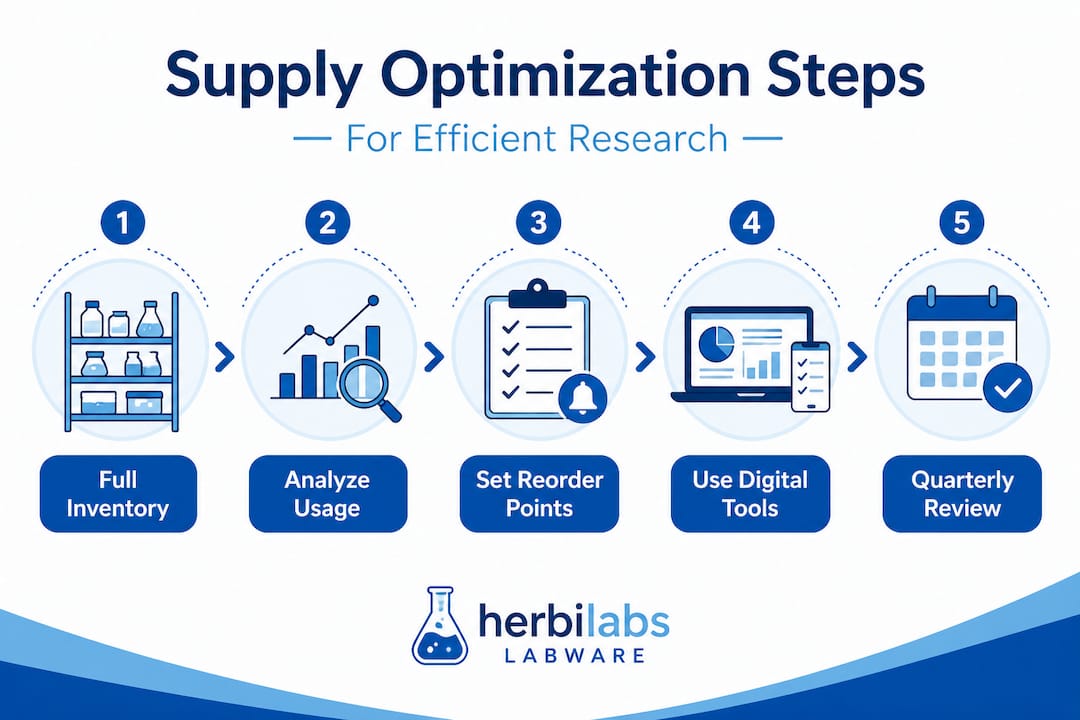
With the stakes established, the first foundation for any optimization effort is an accurate, current picture of what the lab actually holds and how quickly it uses those supplies. Ad-hoc spot checks are insufficient because they capture only a momentary snapshot and frequently miss supplies stored in secondary locations, cold rooms, or dedicated reagent fridges. A structured physical inventory audit, by contrast, creates a defensible, auditable record that supports both operational decisions and regulatory compliance.
The Lab Manager inventory guide recommends beginning with a full inventory count, then analyzing historical consumption to set reorder points for critical supplies. This sequential logic is sound: without accurate stock data, any minimum or maximum thresholds you set will be approximations at best. The audit should assign clear ownership, with each team member responsible for a defined section of the lab.
A sample baseline inventory table helps structure the output:
| Supply item | Location | Current quantity | Unit | Last ordered | Estimated monthly use |
|---|---|---|---|---|---|
| Bacteriostatic water, 30 mL | Cold room A | 24 vials | Vial | 2026-01-15 | 18 vials |
| PBS buffer, 500 mL | Shelf B2 | 6 bottles | Bottle | 2025-12-10 | 4 bottles |
| Sterile diluent, 10 mL | Fridge 2 | 12 vials | Vial | 2026-02-01 | 10 vials |
| Microcentrifuge tubes, 1.5 mL | Bench supply | 400 units | Unit | 2026-01-22 | 350 units |
Common pitfalls during the audit phase include duplicate entries when one supply spans multiple storage locations, and missed items stored in personal desk drawers or secondary cold storage. Establishing a single unified catalog prior to the count, then reconciling locations afterward, prevents most duplication errors. A structured consumables workflow guide can provide the procedural scaffold for this process.
Key steps for a reliable baseline audit:
- Assign one primary auditor per storage zone and a secondary reviewer
- List every supply by catalog number, not just common name, to avoid ambiguities
- Record unit price to enable value-based prioritization of high-cost items
- Note expiration dates for all perishables and reagents during the count
- Flag any items with no recorded purchase history for immediate investigation
Pro Tip: Run the audit on the same day each period, ideally at the start of a workweek before new deliveries arrive, to minimize the variable of in-transit stock distorting your numbers.
Inventory accuracy is also a compliance requirement in many institutional research environments. Traceability of reagents and solutions is increasingly scrutinized by ethics boards and quality assurance teams, making a clean, timestamped audit record an asset beyond its operational utility. The guide to essential lab consumables outlines which categories typically require the most rigorous documentation.
Setting smart reorder points and stock levels
Once a reliable baseline is in place, the next optimization focuses on determining when and how much to reorder. Reactive purchasing, ordering only after a supply runs out, is the most disruptive pattern in research labs because it creates stoppage events that invalidate in-progress experiments. Setting structured minimum and maximum stock levels eliminates this risk by triggering reorders before critical thresholds are breached.
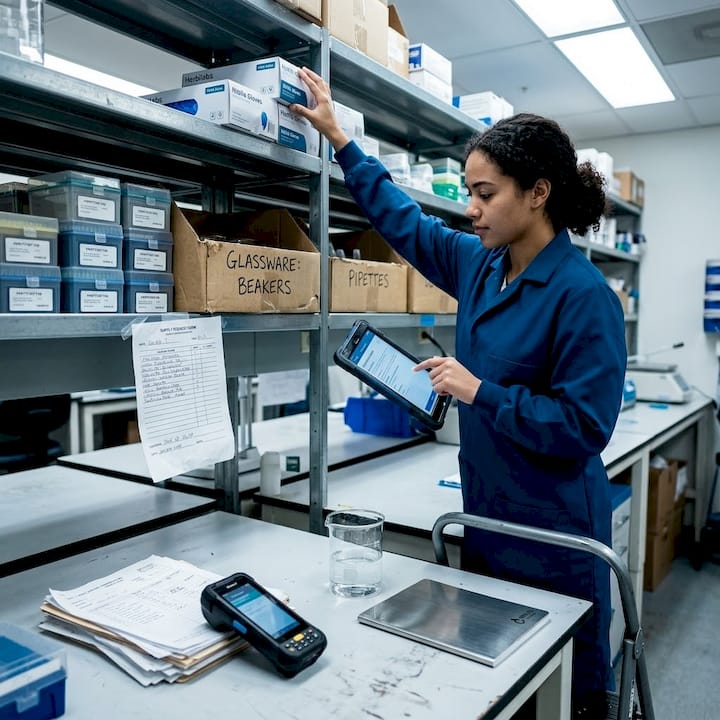
The Lab Manager guide specifically recommends using historical consumption data to set minimum stock levels (restock alerts) and maximum stock levels to avoid over-purchasing. The calculation is straightforward in principle but requires accurate historical data, which is why the baseline audit in the previous section is a prerequisite.
Step-by-step process for setting reorder points:
- Pull purchase and usage records for the previous 6 to 12 months for each critical supply
- Calculate average monthly consumption and note any seasonal spikes (project start dates, grant reporting periods)
- Identify your supplier’s lead time for each item (typically 2 to 10 business days for standard consumables)
- Set the minimum stock level as: average daily use multiplied by lead time in days, plus a safety buffer of 20 to 30 percent
- Set the maximum stock level based on storage constraints, shelf life, and budget availability
- Document these thresholds in your inventory system and assign an alert responsible party for each category
A direct comparison illustrates the operational impact of this approach:
| Ordering approach | Stockout risk | Overstock risk | Administrative burden | Experimental disruption |
|---|---|---|---|---|
| Ad-hoc (reactive) | High | Moderate | High (emergency orders) | Frequent |
| Optimized reorder points | Low | Low | Low (automated alerts) | Rare |
| Bulk annual purchasing | Very low | Very high | Low initially | Low, but waste-intensive |
Reorder thresholds should not be treated as permanent settings. Quarterly reviews, aligned with project milestones, allow adjustments for seasonal demand variations, new research programs, or changes in grant funding. A dedicated lab consumables procurement checklist provides a structured framework for these periodic reviews.
Pro Tip: For high-value or long-lead-time items, maintain a secondary supplier option in your records. Single-supplier dependency for critical reagents introduces a supply chain vulnerability that even the best reorder logic cannot compensate for.
Leveraging digital tools (without the common pitfalls)
With ordering logic in place, technology can amplify efficiency, but only if you approach implementation with realistic expectations. Digital inventory management tools range from simple cloud-based spreadsheets and shared databases to full laboratory information management systems (LIMS) with barcode scanning, automated reorder triggers, and integration with procurement platforms.
Digitalization challenges in research labs are real and frequently underestimated: implementation overhead, including staff training, software configuration, data migration, and a period of parallel paper and digital tracking, can temporarily increase administrative workload before yielding gains. Many labs operate in a partially manual state for months after nominally “going digital.”
Implementation warning: Transitioning to a digital inventory system is not a one-time event. Labs commonly underestimate the 4 to 8 week period of parallel tracking required to validate the new system’s accuracy against physical stock. During this window, administrative burden will increase, not decrease. Plan for this explicitly in your project timeline.
Checklist for choosing the right approach:
- Full digital (LIMS or dedicated software): Best suited for labs with more than 10 staff members, high SKU counts, compliance reporting requirements, and a dedicated IT resource for initial configuration
- Hybrid (digital catalog plus paper tracking logs): Appropriate for mid-size labs with stable supply lists and limited IT support; allows incremental digitalization without full disruption
- Structured spreadsheets: Sufficient for small labs with fewer than 50 distinct supply items, provided version control and access permissions are rigorously maintained
- Barcode or QR scanning add-ons: High-value upgrades for any approach, reducing manual entry errors significantly and enabling rapid stock verification
Maintaining lab workflow efficiency during a digital transition requires deliberately staging the rollout. Identify which supply categories create the most friction in current workflows and digitalize those first.
Pro Tip: Pilot any digital inventory tool with a single department or a single supply category before committing to lab-wide rollout. This surface-tests the user interface, identifies configuration gaps, and generates practical feedback without risking system-wide disruption.
The goal is not the technology itself but reliable, real-time visibility into supply status. Understanding that principle helps avoid the trap of over-investing in sophisticated software that outpaces the lab’s actual operational complexity. A resource on mastering lab supply chains addresses the broader infrastructure perspective within which tool selection makes most sense.
Enabling cross-functional coordination and visibility
Digital tools help only if the overall workflow is cross-functional and visible to all responsible parties. In most research labs, supply chain failures are not caused by a lack of stock; they result from breakdowns in communication between the people receiving deliveries, those using supplies at the bench, those responsible for compliance documentation, and those authorized to reorder.
Key insight: The majority of time lost in laboratory supply workflows is not attributable to stockouts alone, but to the gaps between operational phases: supplies received but not logged, reagents used but not tracked, expiration dates unmonitored, and reorder signals ignored by the wrong person. Treating inventory as a cross-functional workflow eliminates these inter-phase losses.
Numbered actions for each supply phase:
- Receiving: Verify delivered items against the purchase order immediately upon arrival; log batch numbers and expiration dates before transferring to storage
- Storage: Assign fixed storage locations for every supply category and label shelves clearly; never place new stock in front of older stock (FIFO rotation)
- Usage tracking: Require all bench users to log withdrawals in the inventory system at the time of use, not retrospectively
- Compliance checks: Designate a compliance officer or senior researcher to conduct monthly spot checks on controlled reagents and reconstitution solutions
- Reordering: Ensure the person responsible for triggering reorders receives automated alerts from the inventory system and is empowered to act without delay
Key roles and responsibilities in a coordinated supply workflow:
- Lab manager: Owns the overall inventory system, sets reorder thresholds, conducts periodic audits, and resolves discrepancies
- Procurement specialist: Manages supplier relationships, processes purchase orders, and maintains secondary supplier contacts
- Research technicians: Log daily usage accurately, flag damaged or contaminated supplies immediately, and verify storage conditions
- Compliance officer: Audits documentation trails for controlled substances and high-purity reagents, ensures traceability records meet regulatory standards
Integrating this structure with practical improving lab supply workflows principles and reinforcing it with clear labware integrity steps at the storage phase creates a robust, error-resistant system.
Special considerations: Managing and reconstituting critical solutions
With fundamentals in place, it is vital to apply extra rigor to the supplies that most directly underpin experimental validity. Reconstitution solutions, including bacteriostatic water, sterile diluents, and high-purity buffers, are inventory priorities because their compromise or depletion can invalidate entire experimental datasets. Unlike standard plasticware, these solutions carry expiration constraints, contamination risks, and quality specifications that require dedicated tracking protocols.
The Lab Manager inventory guide specifically addresses critical supplies as requiring stricter controls than standard consumables, a principle that applies directly to reconstitution solutions used in peptide research and biological assays.
Best practices for managing reconstitution solutions and high-purity reagents:
- Maintain a dedicated refrigerator or cold storage unit exclusively for reconstitution solutions and critical diluents, separated from general reagent storage to prevent cross-contamination and temperature fluctuations
- Implement a usage log specific to each solution type, recording the date of use, volume withdrawn, researcher name, and experiment identifier for full traceability
- Label all opened vials with the date first opened, initials of the researcher, and calculated expiry date from first use (not just the manufacturer’s printed date)
- Track batch and lot numbers from suppliers to enable rapid isolation in the event of a quality concern or supplier recall
- Store solutions according to the manufacturer’s specification and never assume that “room temperature stable” applies after reconstitution
- Conduct a monthly visual inspection of all reconstitution solutions for particulate matter, color change, or cloudiness, which may indicate contamination or degradation
Proper documentation of reconstitution procedures, including the solution used, the diluent volume, and the resulting concentration, is essential for experimental reproducibility. Guidance on labeling and storing reconstituted samples provides a practical labeling protocol that integrates with the inventory workflow described above. For regulatory and safety compliance, reviewing reagent handling safety practices is equally important.
Pro Tip: Audit all reconstitution solutions and high-purity reagents specifically during every quarterly inventory review, checking not only quantities but expiration status and physical condition. A vial that passes a quantity check can still be out of specification if it has been stored incorrectly.
Beyond basics: The uncomfortable truth about lab supply optimization
Having covered the how, it is necessary to discuss why even well-designed optimization systems frequently stall within six to twelve months of implementation. The failure mode is rarely a software problem or a poorly calibrated reorder point. It is a process discipline problem, and it originates at the frontline, not in the manager’s office.
Most labs that attempt supply optimization invest heavily in the setup phase: they run the baseline audit, configure the spreadsheet or software, write the SOPs, and assign roles clearly. For the first few months, compliance is high and the system works. Then, gradually, shortcuts appear. A technician logs usage retrospectively at the end of the week instead of at the point of withdrawal. A delivery is received and stored without updating the system because “it only takes a minute and the centrifuge is running.” Within three to four months, the inventory data no longer reflects reality, and the system loses credibility.
The root cause is that supply management is perceived as administrative overhead rather than as a direct contributor to experimental quality. Shifting that perception requires framing every inventory action in terms of research outcomes. When a researcher understands that an untracked vial of bacteriostatic water is a potential data integrity issue, not a filing task, the behavioral calculus changes. Operational reliability depends on laboratory supply chain reliability being treated as a shared scientific value, not a management imposition.
Sustainable optimization therefore depends less on the tools chosen and more on three organizational habits: regular audits with published results visible to the full team, shared accountability where every staff member sees their role in the system’s accuracy, and leadership that treats supply discrepancies as serious operational signals rather than minor administrative failures. The labs that maintain supply management excellence over multi-year periods are those that have embedded these habits into their standard scientific culture, making the discipline as automatic as pipette calibration or instrument maintenance.
Recommended solutions to support optimized supply management
Labs that have built a rigorous supply management process recognize quickly that the quality of their consumables and reconstitution solutions is as important as the quality of their tracking systems. Herbilabs Labware supplies high-purity reconstitution solutions manufactured under strict quality controls specifically suited to demanding research environments.

For procurement specialists building or refreshing their supply infrastructure, the labware checklist for reliable research provides a structured reference aligned with the best practices covered in this article. Labs evaluating their current consumable suppliers will also find the lab consumables comparison resource useful for benchmarking quality and pricing across categories. Reliable supply management starts with reliable supply sources, and Herbilabs is positioned to support both the product and process dimensions of that goal.
Frequently asked questions
What is the first step for optimizing lab supply management?
Begin with a complete physical inventory to identify current stock, locate all storage points, and establish accurate usage baselines before making any system or process changes.
How often should lab supplies be audited?
Supplies should be audited at least quarterly, with adjustments to minimum and maximum stock levels reviewed whenever a major project or staffing change occurs.
Do digital inventory systems always save time?
Not immediately. Implementation overhead, including training, configuration, and a parallel tracking period, typically increases short-term workload before delivering the expected efficiency gains.
Why is cross-functional coordination important in supply management?
It prevents the inter-phase breakdowns, missed deliveries, untracked usage, and delayed reorders, that account for most inventory errors. Treating inventory as a cross-functional workflow ensures every stage is monitored and communicated by an accountable person.