Private Label, White Label, Wholesale partnerships available - EU, USA and UK - Free shipping from €75

Why Choose Certified Lab Reagents for Reliable Results
Discover why choose certified lab reagents for reliable results. Ensure accuracy, compliance, and defend your lab’s findings today!
TL;DR:
- Using certified lab reagents ensures measurement traceability, regulatory compliance, and points of reproducibility. Uncertified reagents lack documented uncertainty and homogeneity, increasing risks of failed validation and audit findings. Systematic supplier management and thorough documentation embed quality and defend results amidst analytical challenges.
When a single reagent with undocumented purity compromises months of experimental data, the cost goes far beyond a failed batch. Understanding why choose certified lab reagents is not a philosophical question for laboratory professionals. It is a practical necessity rooted in measurement science, regulatory compliance, and the defensibility of every quantitative result your lab produces. This article examines the certification frameworks behind reagent standards, the tangible risks of uncertified alternatives, and the workflow practices that turn certified reagent use from a procurement habit into a systematic quality commitment.
Table of Contents
- Key Takeaways
- Why choose certified lab reagents: definitions and standards
- Reliability and accuracy in certified reagent use
- Certified vs. non-certified reagents: a direct comparison
- Implementing certified reagents in laboratory workflows
- My perspective on certified reagents and research integrity
- Certified, high-purity reagents from Herbilabs
- FAQ
Key Takeaways
| Point | Details |
|---|---|
| Certification means metrological traceability | Certified reagents carry documented uncertainty budgets and traceability chains linking measurements to national standards. |
| Documentation is audit-ready by design | Certificates include lot numbers, homogeneity data, and stability assessments that satisfy regulatory scrutiny. |
| Non-certified reagents carry hidden costs | Failed validations and repeated testing from batch variability often exceed the cost premium of certified materials. |
| Certification is necessary but not sufficient | Expert interpretation of matrix effects and measurement system behavior remains required even with certified reagents. |
| Supplier monitoring must be continuous | Qualification at onboarding is only the starting point; ongoing evaluation sustains reagent integrity across supply cycles. |
Why choose certified lab reagents: definitions and standards
The phrase “certified reagent” carries a specific technical meaning that is frequently conflated with marketing terms like “high-purity” or “research-grade.” A certified lab reagent, or more precisely a Certified Reference Material (CRM), is a material whose property values have been metrologically characterized by a technically valid procedure, accompanied by a certificate that states each property value, its associated uncertainty, and a clear traceability path to a recognized national or international standard.
The primary international framework governing CRM production is ISO 17034, which specifies requirements for reference material producers, covering competence, consistency, and impartiality. Bodies such as the National Institute of Standards and Technology (NIST) in the United States and national metrology institutes (NMIs) in Europe produce reference materials under these frameworks. A certified reference material must carry documentation that covers the full uncertainty budget, a unique lot identifier, and explicit references to the national or international standards used in characterization.
This is categorically different from a reagent sold as “pure” or “analytical grade” without a certificate. Purity designations describe chemical composition at a point in production. Certification describes a material whose measurement properties have been validated across multiple analytical methods, often at multiple laboratories, with statistical rigor applied to every value assignment.
Key elements that distinguish a legitimate CRM certificate include:
- Expanded uncertainty expressed at a defined coverage probability, typically 95%
- Homogeneity and stability data confirming property values are consistent within and across units
- Traceability statement explicitly linking the assigned value to SI units or a recognized NMI reference
- Lot or batch number enabling end-to-end documentation for audit purposes
Pro Tip: When reviewing a certificate of analysis from any supplier, verify that the uncertainty is expressed as expanded uncertainty with a stated coverage factor, not just as “purity greater than 99%.” A purity percentage alone provides no measurement traceability.
Understanding reagent grades and compliance requirements is a necessary precursor to selecting the right material for a given application, particularly in regulated research environments.
Reliability and accuracy in certified reagent use
The scientific case for certified reagents rests on metrological traceability. An unbroken chain of comparisons, each with stated uncertainty, links a laboratory’s measured value back to a defined reference point such as an NMI standard. Without that chain, a lab’s reported values are anchored only to the reagent vendor’s internal processes, which may or may not align with any external reference.

Consider NIST Standard Reference Material 1568c Rice Flour, a well-documented example of rigorous CRM production. This material was characterized across multiple NMIs and interlaboratory comparisons, with certified values assigned for over 30 analytes. The multi-institute approach removes reliance on any single laboratory’s methodology, producing value assignments that are anchored in the broader measurement science community rather than one vendor’s calibration chain.
The following table summarizes how certified reagents support key laboratory quality objectives compared to the requirements that drive those objectives:
| Quality objective | How certified reagents contribute | Regulatory or scientific basis |
|---|---|---|
| Method validation | Provide traceable reference values for calibration and accuracy assessment | ISO 17511, ICH Q2(R1) |
| Audit readiness | Supply certificates with lot ID, uncertainty, and traceability chain | GLP, FDA 21 CFR Part 211 |
| Reproducibility across sites | Standardize measurement anchors across different labs or instruments | ISO 17034, ILAC guidelines |
| Uncertainty reporting | Enable calculation of combined measurement uncertainty | GUM (JCGM 100:2008) |
Despite these advantages, certified reagents improve method validation but do not guarantee elimination of all analytical challenges. A bilateral evaluation of CRMs for macro and trace elements in food showed particle concentration discrepancies among participating laboratories even when identical certified reference materials were used. The conclusion is instructive: certified reagents anchor the measurement reference correctly, but matrix effects and instrument-specific behaviors still require expert characterization.
“Certificate documentation with uncertainty and traceability is the backbone of defensibility in quantitative analytical labs.” — Inorganic Ventures
Audit readiness deserves specific attention. Regulatory inspectors in GLP, GMP, and clinical laboratory settings now routinely request traceability documentation as part of method qualification reviews. A certificate that includes defined uncertainty, stability, and homogeneity data allows a lab to construct a complete traceability story: the reagent used, its certified value, the uncertainty of that value, and its connection to a national standard. Without that documentation, a lab’s only defense is the vendor’s word.
Certified vs. non-certified reagents: a direct comparison
The practical differences between certified and non-certified reagents become most apparent at three decision points: method qualification, routine quality control, and regulatory inspection.
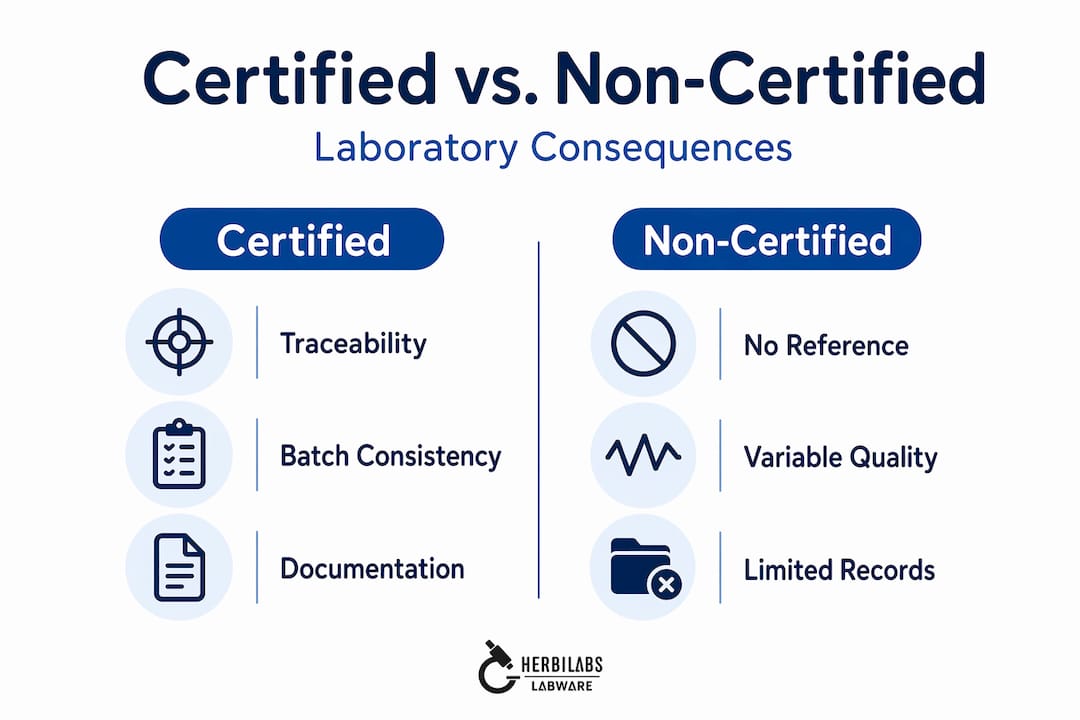
| Attribute | Certified reagent | Non-certified reagent |
|---|---|---|
| Purity documentation | Expanded uncertainty with coverage factor | Nominal purity percentage |
| Traceability | Linked to NMI or SI reference | Manufacturer internal standard |
| Batch consistency | Homogeneity tested and documented | Variable, often untested |
| Audit defensibility | Full certificate with lot ID and traceability | Certificate of analysis only |
| Regulatory acceptance | GLP, GMP, ISO compliant | Dependent on lab’s internal validation |
| Shelf-life assurance | Stability data provided | May or may not be characterized |
Uncertified reagents introduce several categories of risk that are frequently underestimated during procurement decisions:
- Reproducibility failure: Without a defined reference value, it is impossible to determine whether a shift in results reflects a genuine biological or chemical change or a change in the reagent lot.
- Audit exposure: Inspectors reviewing method qualification records expect traceable reference materials. Absent traceability documentation, labs face findings that can delay product approvals or invalidate study data.
- Repeated validation costs: When a new lot of an uncertified reagent performs differently from the previous lot, method revalidation may be required. These costs accumulate quickly and often exceed any savings made at the point of purchase.
The benefits of certified reagents, including traceability, documentation, and batch-to-batch consistency, directly address each of these risks. Reagent grade accuracy in method-critical applications is not a preference. It is a defensibility requirement.
Pro Tip: When evaluating a certified reagent supplier, request the full certificate of analysis and cross-reference the stated traceability path against the issuing NMI’s published reference standards. Any gap in that chain is a gap in your audit defense.
Implementing certified reagents in laboratory workflows
Integrating certified reagents into a laboratory workflow requires more than selecting the correct material at the point of purchase. Sustainable use of certified reagents depends on disciplined supplier management, rigorous documentation, and systematic lot-to-lot controls.
A robust supplier control program, as outlined by IMDRF guidance, encompasses selection, initial qualification, acceptance criteria, and continuous monitoring. The following steps reflect best practice for laboratories operating under GLP, ISO 17025, or equivalent frameworks:
- Establish supplier qualification criteria before sourcing. Define minimum requirements for certificate content, including expanded uncertainty, traceability statement, homogeneity data, and lot identification.
- Review each incoming certificate against those criteria before the reagent enters inventory. Do not rely on blanket approvals based on supplier name or historical performance alone.
- Maintain a complete reagent log that records lot number, certificate reference, storage conditions, date of receipt, and expiry date for every certified reagent used in a study or QC protocol.
- Assess lot-to-lot variability by running bridging experiments when transitioning between certified reagent lots, particularly for calibration standards and method-critical materials.
- Integrate certified reagents explicitly into method SOPs so that the specific CRM used is documented at the method level, not only at the run level. This supports both reproducibility and audit traceability.
- Monitor supplier performance continuously through periodic re-evaluation, including review of any certificate updates, product reformulations, or changes in NMI reference values.
Complementary quality controls matter equally. Pharmaceutical-grade water systems, for example, require validated continuous monitoring to meet USP purified water standards, reflecting the same principle that applies to certified reagent management. Certification is not a one-time event. It is a continuous quality commitment requiring validation, monitoring, and documented maintenance at every stage of the supply and use cycle. Guidance on mastering laboratory supply chains provides additional frameworks for building this kind of supplier-to-bench traceability into routine operations.
My perspective on certified reagents and research integrity
In my experience reviewing method qualification packages and traceability documentation across multiple laboratory settings, the most common failure mode is not a lack of certified reagents. It is incomplete documentation of the ones that were used. Researchers acquire a CRM, use it correctly in the method, and then file only the packing slip rather than the full certificate with its uncertainty budget and traceability path. When an auditor requests the traceability story six months later, the data is there but the defensibility is not.
I have also seen labs attempt to reduce reagent costs by substituting certified materials with high-purity analytical-grade reagents in calibration protocols, reasoning that the stated purity is high enough to serve the same purpose. This logic fails at the audit stage almost every time. Purity and traceability are not interchangeable concepts. A 99.9% pure reagent with no traceability chain is analytically equivalent to an uncertified reagent for the purposes of a GLP inspection or ISO 17025 assessment.
What I would encourage any laboratory director or QA lead to consider is this: treating certified reagent selection as a continuous quality commitment rather than a procurement checkbox changes the entire culture around data defensibility. When the reagent quality control process is embedded in the SOP and tracked through the documentation system, the audit readiness is structural rather than reactive. The quality control guide for reliable lab results offers a practical framework for building that structure into daily laboratory operations.
Certification in lab reagents is not the final guarantee of accuracy. It is the necessary foundation on which accuracy can be demonstrated, defended, and reproduced.
— Ragnar
Certified, high-purity reagents from Herbilabs
Herbilabs supplies research-grade reagents and reconstitution solutions manufactured to strict purity standards, with quality controls designed to meet the demands of scientific research institutions, universities, and independent researchers. Every product in the Herbilabs catalog is produced in a dedicated facility with documented manufacturing standards and rigorous quality assurance processes that prioritize contaminant-free, consistent outputs across production batches.
For researchers working with peptides or requiring precise reconstitution solutions, the top high-purity reconstitution solutions available through Herbilabs represent a curated selection of materials designed for accuracy-critical applications. Complementary guidance on selecting reagents for peptide research supports informed procurement decisions aligned with the certification principles covered in this article. Herbilabs also offers wholesale pricing for resellers and institutional procurement teams, with secure ordering and direct customer support across the UK and Europe.
FAQ
What makes a lab reagent “certified”?
A certified lab reagent is a material whose property values have been metrologically characterized and documented with expanded uncertainty, traceability to a national standard, and homogeneity and stability data, typically in compliance with ISO 17034.
How do certified reagents support regulatory audits?
Certified reagent certificates provide the unbroken traceability chain, lot identification, and documented uncertainty that auditors require as evidence of result defensibility under GLP, GMP, and ISO 17025 frameworks.
Are certified reagents sufficient to guarantee accurate results?
Certified reagents anchor measurement references correctly but do not eliminate all analytical challenges. Particle concentration discrepancies observed across labs using identical CRMs confirm that matrix effects and instrument behavior still require independent expert assessment.
What are the risks of using non-certified reagents?
Non-certified reagents lack traceable reference values and homogeneity documentation, exposing labs to reproducibility failures, audit findings, and repeated validation costs when lot-to-lot performance shifts without a documented reference point.
How often should certified reagent suppliers be re-evaluated?
Supplier evaluations should be conducted periodically and whenever a supplier changes a product formulation, reference standard, or certificate format, in line with continuous monitoring requirements outlined by IMDRF guidance on supplier qualification programs.