Private Label, White Label, Wholesale partnerships available - EU, USA and UK - Free shipping from €75
What Is a Dedicated Facility? Definition and Benefits
Discover what a dedicated facility is and how it benefits organizations by providing exclusive control over essential resources. Learn more now!
TL;DR:
- A dedicated facility is a site where a single client has exclusive use of all infrastructure, including space, equipment, labor, and technology, ensuring full operational control for compliance. This model offers benefits such as regulatory isolation, high customization, and long-term cost predictability, making it ideal for high-stakes research and manufacturing environments. Organizations with steady demand and specialized handling needs gain the most, but flexible contracts are essential to manage demand fluctuations effectively.
A dedicated facility is defined as a site or zone where a single client holds exclusive use of all infrastructure, including space, equipment, labor, and technology, with no resources shared across other tenants or clients. This model, formally called dedicated warehousing or a dedicated facility arrangement, gives organizations complete operational control over their environment. For research institutions, pharmaceutical manufacturers, and laboratory supply operations, that control is not a convenience. It is a compliance requirement. This article covers the definition, operational structure, real-world examples, and the specific advantages that make dedicated facilities the preferred model for high-stakes scientific and manufacturing environments.

What is a dedicated facility and how is it defined?
A dedicated facility is a single-tenant exclusive space where every resource, from racking systems and climate controls to trained personnel and warehouse management software, serves one client only. No other organization shares floor space, equipment, or staff within that environment. This is the foundational distinction between dedicated and shared facility models.
The term “dedicated facility” appears across logistics, pharmaceutical manufacturing, food production, and laboratory supply chains. In each context, the core definition remains consistent: exclusive allocation of physical and operational resources to a single client’s requirements. For laboratory and research applications, this exclusivity extends to environmental controls such as temperature regulation, humidity management, and contamination prevention protocols.
Dedicated facilities align with GMP compliance requirements in pharmaceutical and biotech manufacturing, where exclusive control of the environment is not optional but mandated by regulatory bodies. The facility becomes an extension of the client’s quality management system, operating under their standard operating procedures (SOPs) rather than a generalized third-party framework.
How does a dedicated facility differ from shared or public facilities?
The distinction between a dedicated and a shared facility comes down to resource exclusivity and operational control. In a shared facility, multiple clients divide floor space, equipment, and sometimes labor. In a dedicated arrangement, all resources serve one client, which eliminates the scheduling conflicts, contamination risks, and compliance complications that arise in multi-tenant environments.
Dedicated warehousing contracts typically run 2 to 5 years, providing long-term price predictability and operational stability. This contract length reflects the capital investment required to configure a facility exclusively for one client’s needs. Shared facilities, by contrast, operate on shorter, more flexible terms because the provider spreads infrastructure costs across multiple tenants.
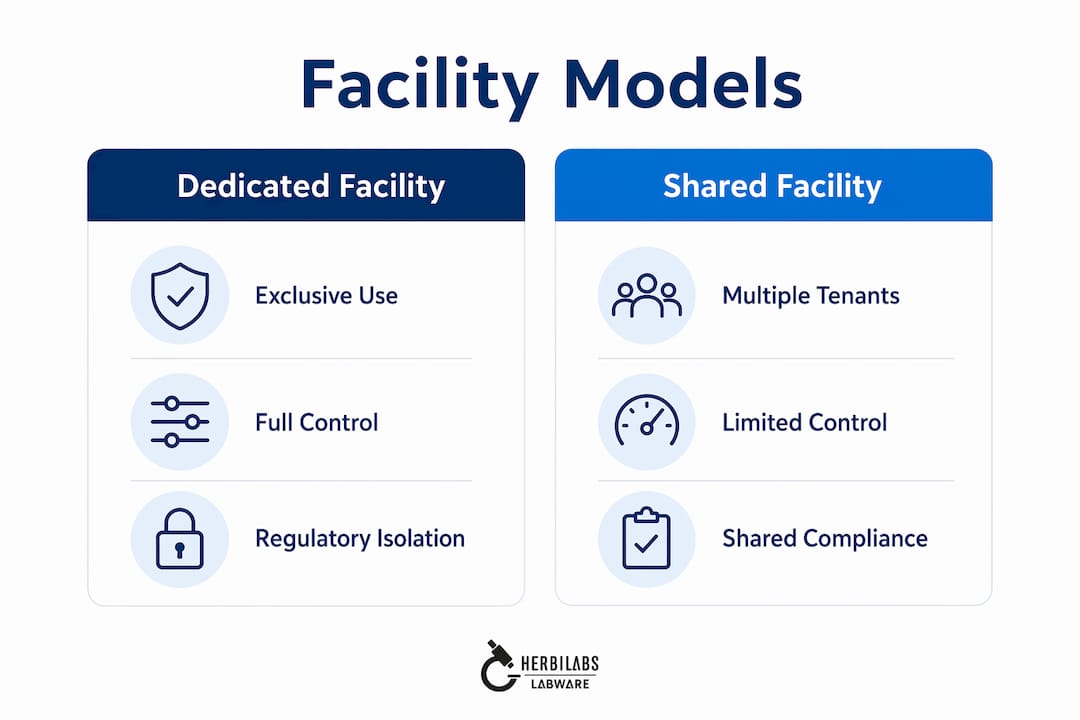
The table below summarizes the primary differences between dedicated and shared facility models across the dimensions most relevant to research and laboratory professionals.
| Feature | Dedicated facility | Shared facility |
|---|---|---|
| Resource exclusivity | All space, equipment, and labor serve one client | Resources divided among multiple clients |
| Operational control | Full implementation of client SOPs | Generalized procedures across all tenants |
| Contamination risk | Minimal, controlled environment | Higher cross-contamination exposure |
| Contract length | Typically 2 to 5 years | Shorter, more flexible terms |
| Cost structure | Higher baseline investment, predictable long-term costs | Lower upfront cost, variable pricing |
| Regulatory isolation | Complete isolation from other tenants’ compliance events | Shared audit exposure with co-tenants |
| Customization | Full customization of layout, handling, and technology | Limited customization within shared infrastructure |
The regulatory isolation column in this table carries particular weight for laboratory and pharmaceutical operations. A recall or safety violation affecting another client in a shared facility can trigger facility-wide audits. In a dedicated environment, compliance risks stay contained to a single tenant, protecting the client’s regulatory standing and brand integrity.
What are the key advantages of using a dedicated facility?
The advantages of dedicated facilities extend well beyond simple space allocation. For organizations with specialized handling requirements, the benefits compound across compliance, workflow efficiency, and long-term cost management.
The core advantages include:
- Operational consistency. Because the facility operates exclusively under the client’s SOPs, every process from receiving to dispatch follows a single, auditable standard. This consistency is critical for aseptic manufacturing environments where deviations from protocol carry direct product safety implications.
- Full customization. Customization in dedicated facilities allows tailoring of racking layouts, handling protocols, temperature zones, and technology integrations to match the client’s exact product requirements. Shared warehouses cannot replicate this level of specificity.
- Regulatory isolation. As noted above, dedicated environments contain compliance events to a single tenant, providing a defense against facility-wide audits triggered by co-tenants’ violations.
- Long-term cost predictability. While dedicated facilities carry higher baseline costs, the reduction in errors, rework, and contamination incidents offsets those costs over the contract period. Predictable pricing also simplifies budget planning for multi-year research programs.
- Workforce alignment. Staff in a dedicated facility are trained exclusively on one client’s products and procedures, which reduces handling errors and accelerates onboarding for new product lines.
Pro Tip: Before committing to a dedicated facility arrangement, assess whether your operation meets what logistics professionals call the “consistency threshold.” Organizations with steady demand and specialized handling needs gain the most from dedicated spaces. If your volume fluctuates significantly by season or project cycle, negotiate elasticity clauses into the contract before signing.
The compliance benefit deserves additional emphasis for laboratory professionals. USP standards for labs and equivalent regulatory frameworks require documented control over the storage and handling environment. A dedicated facility makes that documentation straightforward because every process within the space is attributable to one client’s quality management system.
Dedicated facility examples in research and manufacturing
Dedicated facilities appear across a wide range of industries, each applying the exclusivity model to address specific operational or regulatory requirements. The following examples illustrate how the concept translates into practice.
- Pharmaceutical and biotech manufacturing. Dedicated facilities in pharmaceutical and biotech labs align with stringent GMP and aseptic manufacturing standards that require exclusive control of the environment and all processes within it. A contract manufacturer producing sterile injectable solutions, for example, will operate a dedicated cleanroom suite for a single pharmaceutical client to prevent cross-contamination between product lines.
- Allergen-free food production. Dedicated allergen-free facilities segregate production lines entirely, eliminating cross-contamination risk for products such as nut-free or gluten-free foods. A nut processing facility that dedicates an entire production wing to a single allergen-free product line is a direct application of this model.
- Temperature-controlled research storage. Research institutions storing biological samples, reagents, or lyophilized compounds require dedicated cold storage environments where temperature profiles, access controls, and inventory management systems are configured exclusively for their materials. Shared cold storage introduces the risk of temperature excursions caused by other tenants’ access patterns.
- Hazardous materials warehousing. Organizations handling controlled substances, flammable solvents, or biohazardous materials operate dedicated facilities to meet regulatory requirements for segregation and containment. These environments include dedicated ventilation, spill containment, and security systems that cannot be shared without compromising compliance.
- Laboratory reagent and reconstitution solution manufacturing. Suppliers of research-grade bacteriostatic water and sterile diluents, such as Herbilabs, manufacture products in dedicated facilities to maintain the purity standards required for research applications. Shared production environments introduce contamination variables that are incompatible with the quality specifications demanded by research institutions and pharmaceutical clients.
The common thread across all these examples is that the dedicated model exists because the product or process cannot tolerate the variability introduced by shared infrastructure. Optimizing lab supply management becomes significantly more tractable when the supply chain originates from a facility operating under a single, auditable quality framework.
How does a dedicated facility work in practice?
Understanding the operational mechanics of a dedicated facility helps organizations evaluate whether this model fits their requirements and how to structure the arrangement for maximum benefit.
- Facility configuration and SOP integration. The setup phase involves mapping the client’s existing processes, quality standards, and technology systems to the facility’s physical layout and warehouse management system. Transitioning to a dedicated facility requires careful alignment of legacy systems with new configurations, and underestimating this phase is the most common cause of delayed operational readiness.
- Staff training on client-specific protocols. All personnel operating within the dedicated facility receive training on the client’s SOPs rather than generic facility procedures. This training investment is substantial but produces a workforce that functions as an extension of the client’s quality and operations teams.
- Technology and reporting integration. Dedicated facilities typically integrate with the client’s enterprise resource planning (ERP) or laboratory information management system (LIMS), providing real-time inventory visibility and audit-ready documentation. This integration is not possible in shared environments where system access is restricted to protect co-tenants’ data.
- Ongoing compliance and audit management. Because the facility operates under one client’s quality framework, regulatory audits are scoped to that client’s products and processes. The facility manager and the client’s quality assurance team conduct joint internal audits against standards such as GMP, ISO, or USP requirements.
- Contract management and scalability planning. Shifting demands can create idle capacity costs unless contracts include elasticity clauses or shared-overflow agreements. Reviewing demand forecasts before contract renewal and negotiating flexible capacity provisions protects against paying for unused space during low-volume periods.
Pro Tip: One misconception about dedicated facilities is that they are exclusively for large corporations with massive inventory volumes. Businesses with specialized compliance needs or high-value inventory benefit from dedicated arrangements regardless of scale, provided their volume justifies the investment. For laboratory reagent suppliers and research institutions, the compliance and purity requirements alone often justify the dedicated model even at moderate volumes.
Lab supply storage best practices reinforce this point: the organizational and safety standards required for research-grade materials are most reliably maintained when the storage environment is configured and managed exclusively for those materials.
Key takeaways
A dedicated facility delivers exclusive operational control, regulatory isolation, and long-term cost predictability that shared environments cannot replicate, making it the standard model for pharmaceutical manufacturing, research reagent production, and specialized laboratory supply chains.
| Point | Details |
|---|---|
| Core definition | A dedicated facility gives one client exclusive use of all space, equipment, labor, and technology. |
| Regulatory isolation | Compliance events from other tenants cannot affect a dedicated facility, protecting audit standing. |
| Consistency threshold | Organizations with steady demand and specialized handling needs gain the most from this model. |
| Transition planning | Underestimating SOP integration and staff training time is the most common setup failure. |
| Scalability risk | Contracts without elasticity clauses can generate idle capacity costs during demand downturns. |
Why operational control is the real argument for dedicated facilities
From my experience working with laboratory supply chains, the conversation about dedicated facilities almost always starts with contamination risk and ends with compliance. Those are legitimate concerns, but they miss the deeper operational argument.
The real value of a dedicated facility is that it allows an organization to treat its supply chain as an extension of its quality management system rather than a separate, partially controlled variable. When every person in the facility, every piece of equipment, and every documented procedure exists solely to serve your product, the gap between your internal quality standards and what actually happens on the floor narrows to near zero. That gap is where most quality failures originate in shared environments.
I have seen research institutions invest heavily in internal quality controls while sourcing from suppliers operating in shared production environments. The internal controls are rigorous, but the incoming materials carry variability that no amount of in-house testing fully eliminates. The dedicated facility model addresses that variability at the source.
The scalability concern is real and should not be dismissed. Idle capacity costs in a long-term dedicated contract are a genuine financial risk. The solution is not to avoid dedicated arrangements but to negotiate contracts with sufficient flexibility to accommodate demand changes. Organizations that treat the contract negotiation as carefully as the facility configuration itself consistently achieve better outcomes.
The trend toward dedicated manufacturing for research-grade reagents and reconstitution solutions reflects a broader recognition that purity specifications and regulatory requirements have become too demanding for shared production environments to reliably satisfy.
— Ragnar
How Herbilabs supports dedicated facility standards
Herbilabs manufactures bacteriostatic water and sterile reconstitution solutions in a dedicated facility operating under strict purity and quality control standards. Every product in the Herbilabs catalog is produced in an environment configured exclusively for research-grade output, with no shared production lines that could introduce contamination variables. For research institutions and laboratory professionals who depend on consistent, contaminant-free reagents, the manufacturing origin matters as much as the specification sheet. Explore Herbilabs’ high-purity reconstitution solutions to see how dedicated facility manufacturing translates directly into product reliability for your research workflow.
FAQ
What is the definition of a dedicated facility?
A dedicated facility is a site where a single client has exclusive use of all infrastructure, including space, equipment, labor, and technology, with no resources shared across other tenants. This exclusivity enables full implementation of the client’s operational and quality standards.
What are the main advantages of dedicated facilities over shared ones?
The primary advantages include complete operational control, regulatory isolation from other tenants’ compliance events, full customization of handling protocols, and long-term cost predictability. For laboratory and pharmaceutical applications, contamination prevention and audit integrity are the most operationally significant benefits.
How does a dedicated facility work for laboratory or pharmaceutical operations?
The facility is configured to the client’s SOPs, staffed with personnel trained on client-specific protocols, and integrated with the client’s quality management and inventory systems. Regulatory audits are scoped exclusively to the client’s products and processes, simplifying compliance documentation.
Who benefits most from a dedicated facility arrangement?
Organizations with steady demand, specialized handling requirements, or stringent regulatory obligations benefit most. This includes pharmaceutical manufacturers, research reagent suppliers, allergen-free food producers, and any operation where cross-contamination or shared audit exposure poses an unacceptable risk.
What is the typical contract length for a dedicated facility?
Dedicated facility contracts typically run 2 to 5 years, reflecting the capital investment required to configure the space exclusively for one client. Contracts should include elasticity clauses to manage idle capacity costs if demand fluctuates during the contract period.