Private Label, White Label, Wholesale partnerships available - EU, USA and UK - Free shipping from €75

Bacteriostatic Water vs Sodium Chloride: Lab Guide
Standing at the bench with a lyophilized vial in one hand and two small bottles on the counter, the choice can look simple until it matters. One vial says bacteriostatic water, the other says 0.9% sodium chloride, and the label alone rarely tells a researcher whether the next step is a clean multi-dose workflow, an isotonic match for a sensitive protein, or a single-use prep that should not be carried past opening.
| Criterion | Bacteriostatic Water | 0.9% Sodium Chloride |
|---|---|---|
| Core composition | Sterile water plus 0.9% benzyl alcohol, with no salt | 0.9% sodium chloride solution, isotonic saline |
| Tonicity | Hypotonic because it lacks sodium chloride | Isotonic by definition |
| Preservative system | Preserved for repeated access | May be preserved or preservative-free depending on format |
| Multi-dose behavior | Commonly treated as usable for up to 28 days after puncture when stored correctly | Preserved versions can be multi-dose, non-preserved versions are generally single-use once opened |
| Bench implication | Changes osmotic environment and adds benzyl alcohol exposure | Adds sodium and chloride load and matches physiological salinity better |
That is why bacteriostatic water vs sodium chloride is not a cosmetic choice. It is a workflow decision, and the workflow starts with chemistry, but it does not end there. The right vial depends on what is being reconstituted, how long the solution will stay in rotation, and whether repeated puncture is part of the plan or a liability.
Table of Contents
- The Bench Moment That Starts the Question
- What Each Diluent Actually Is
- Composition and Tonicity Compared Side by Side
- Peptide and Protein Compatibility Considerations
- Multi-Dose Handling and the 28-Day Reality
- Matching the Diluent to Real Lab Workflows
- Practical Selection Guidance and Common Questions
The Bench Moment That Starts the Question
A researcher reaches for a lyophilized peptide vial, checks the reconstitution note, and finds no clear answer. The vendor sheet is silent, the protocol only says “reconstitute with diluent,” and both bottles on the tray look acceptable at first glance. That is the moment where many bench errors begin, not because the user is careless, but because the two options can seem almost identical until the formulation details come into focus.
The choice matters before the first draw. Bacteriostatic water brings a preservative and no salt, while sodium chloride injection brings salinity and, depending on the product, sometimes no preservative at all. Those differences affect not just sterility, but how the reconstituted material behaves once it leaves the vial.
Practical rule: if the protocol expects repeated access, the vial format matters as much as the chemistry.
That is why a quick visual inspection of the labels is not enough. The researcher has to think through three filters at once, chemistry, compatibility, and handling. Chemistry answers what is in the bottle. Compatibility answers what the material can tolerate. Handling answers whether the vial will be used once, several times, or pushed too long after first puncture.
Herbilabs publishes a useful overview of sterile diluents for research labs in its role of sterile diluents in research labs article, and that framing is helpful because the decision often starts with the workflow rather than the drug class. The same logic applies when the user is working through peptide reconstitution, antibody dilution, or a small batch of working aliquots. The bottle is only the starting point. The core question is which diluent fits the task without forcing a compromise later.
What Each Diluent Actually Is
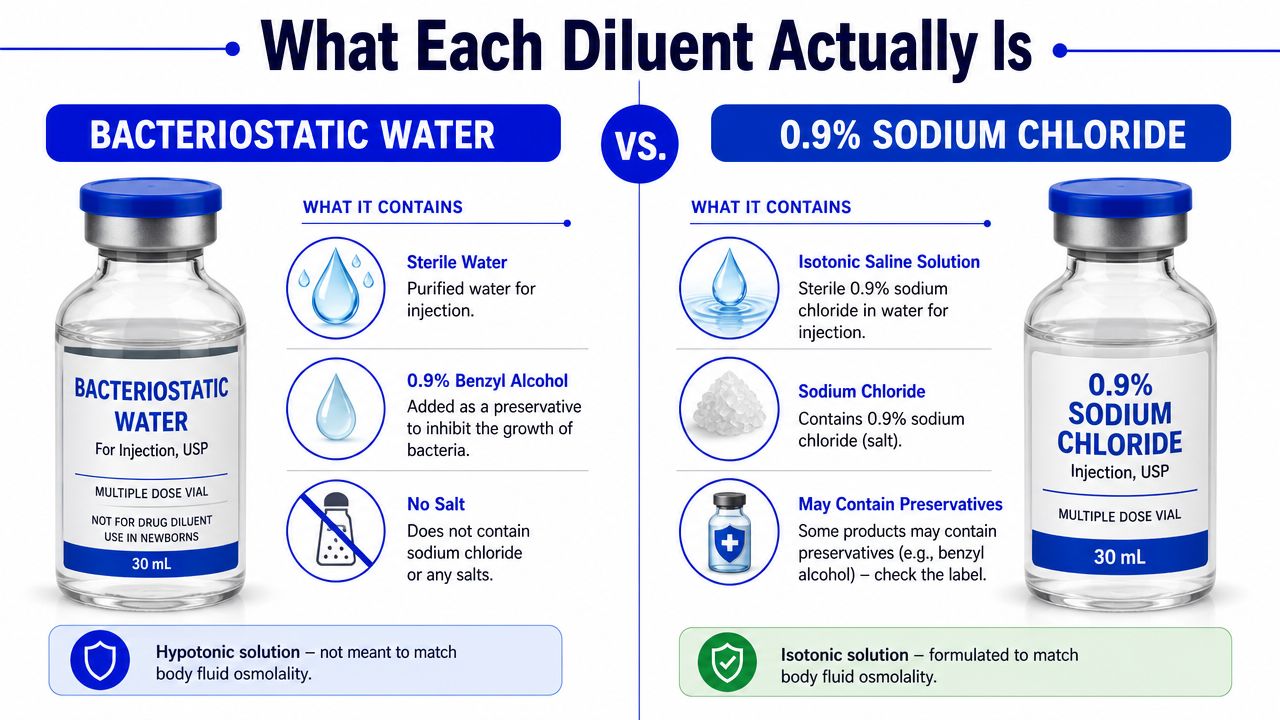
Bacteriostatic water is plain sterile water with 0.9% benzyl alcohol added and no sodium chloride. That means it is preserved, but it is not saline. The absence of salt is exactly why it sits outside the isotonic bucket and why it behaves differently in reconstitution work.
The preserved-water side of the comparison
The historic benchmark in this category is the 0.9% benzyl alcohol preservative level used in injectable diluents. Contemporary guidance for bacteriostatic water also describes a pH range of 4.5 to 7.0 and an in-use window of up to 28 days after first puncture when stored correctly, which makes it a standard reference product for repeated withdrawals in research workflows. Those features are not decorative, they are what make the vial useful across multiple accesses rather than just one.
By contrast, 0.9% sodium chloride is saline. The key point is not just that it contains salt, it is that it is isotonic, so it contributes sodium and chloride in a way plain bacteriostatic water does not. Depending on the format, sodium chloride injection may be preserved or preservative-free, which is why the label has to be read carefully rather than assumed.
A practical way to think about the difference is simple. Bacteriostatic water is a preserved water base with no salt. Sodium chloride injection is a saline base with different osmolality characteristics, and preserved versions keep the bacteriostatic function by adding a preservative system to that saline base. They are both sterile diluents, but they are not the same tool.
For a concise technical overview that stays close to the bench, Celonyx Labs' bacteriostatic water peptide guide is a helpful companion read when the user wants to see how the diluent choice intersects with peptide use.
Herbilabs' sterile diluents for research overview aligns with that same practical distinction, especially where the user needs to match vial format to repeated access.
Composition and Tonicity Compared Side by Side
The fastest way to separate the two products is to compare them against the criteria that change bench outcomes. Composition, tonicity, preservative system, pH behavior, and multi-dose status are the decision points that matter most. Once those are clear, the non-interchangeable nature of the products becomes obvious.
| Criterion | Bacteriostatic Water | 0.9% Sodium Chloride |
|---|---|---|
| Active base | Sterile water | Saline |
| Sodium chloride content | None | 0.9% sodium chloride |
| Tonicity | Hypotonic | Isotonic |
| Preservative | 0.9% benzyl alcohol | May be preserved or preservative-free |
| Multi-dose use | Commonly used for repeated puncture | Depends on product format |
Why tonicity changes the workflow
The tonicity difference is the part many bench users underestimate. Bacteriostatic water is hypotonic because it has no salt, while 0.9% sodium chloride is isotonic. That means the saline product adds sodium and chloride load, and it changes the osmolality of the final solution in a way bacteriostatic water does not.
That distinction matters in protocols that assume a specific osmotic environment. A peptide or protein that behaves well in one medium can behave differently in the other, even if the same amount of lyophilized material is used. The vial is not just a carrier, it is part of the final formulation environment.
Use the label as a formulation cue, not just a sterility cue.
Non-interchangeability shows up in practice. A protocol written around isotonic saline does not automatically translate to bacteriostatic water, and a preserved water workflow does not automatically replace a saline workflow. The dilution medium shapes the result, especially when the target material is sensitive to osmotic shift or preservative exposure.
For a broader operations angle that sits alongside this chemistry, MSP Packaging's page on cooler bags for pharmaceuticals is relevant for teams that need to think about storage discipline as part of the diluent decision. Temperature control doesn't change tonicity, but it does affect how preserved products are managed once they leave the supplier.
Peptide and Protein Compatibility Considerations
Compatibility questions usually start after the first reconstitution attempt. A peptide dissolves cleanly in one diluent, clouds in another, or leaves a ring at the glass line. A protein solution looks fine at the bench and then shows aggregation later. Those are not random failures. They usually point to a mismatch between the diluent and the material's tolerance for osmotic change or preservative exposure.
Where bacteriostatic water helps, and where it can complicate things
Bacteriostatic water works well when the workflow values multi-session use and a preserved vial matters more than strict isotonicity. That is common in peptide work where the same vial is accessed over time and the user wants to avoid opening a fresh sterile container for every withdrawal. The preservative is the point, not a side effect.
The trade-off is that benzyl alcohol is still present, so the diluent is not neutral in every compatibility scenario. Some peptide protocols call specifically for non-bacteriostatic sterile water because they want to exclude that preservative entirely. In those cases, the safest move is to follow the product guidance rather than assume all sterile water formats behave the same way.
Where saline becomes the better fit
0.9% sodium chloride is the more natural match when the reconstituted material is better handled in an isotonic environment. That matters for delicate proteins, some antibodies, and other biologics that are more comfortable with physiological salinity than with plain hypotonic water. The point is not that saline is universally better, it is that it changes the environment in a way some materials prefer.
The bench signals are usually practical. If a material shows visible stress after dilution, forms particulates, or does not hold its appearance across storage, the incompatibility is often in the medium, not the powder. A vendor protocol that is silent on diluent choice should not be treated as permission to swap casually.
The safest discipline is to treat the diluent as part of the product. If the compound is saline-compatible, saline may reduce formulation stress. If the compound is intended for preserved multi-use handling, bacteriostatic water may be the operationally cleaner choice.
Multi-Dose Handling and the 28-Day Reality
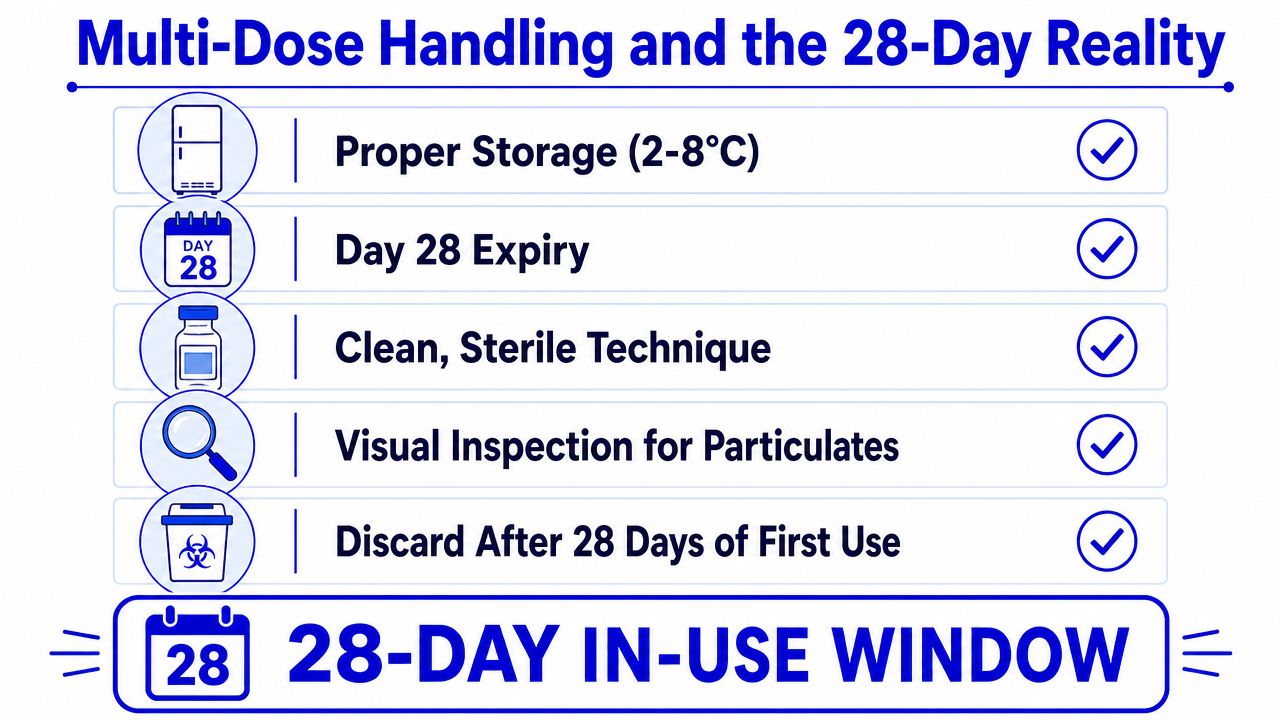
A preserved vial only earns its keep if the handling discipline is real. The 28-day in-use window is not a magic shield against poor technique, it is a controlled-use allowance that depends on asepsis, storage, and common sense at the bench. If the vial is handled carelessly, the theoretical benefit disappears long before the date on the label.
What keeps the multi-dose advantage intact
A punctured bacteriostatic vial is meant for repeated withdrawals, but repeated access only makes sense when the user keeps the closure clean and limits unnecessary exposure. The preserved system is intended to suppress bacterial growth after puncture, not to excuse sloppy technique. Visual inspection before every withdrawal still matters, because particulates, cloudiness, or any sign of contamination should end the vial's use immediately.
The operational checklist is straightforward:
- Sterile access: use clean, aseptic withdrawal every time.
- Controlled storage: keep the vial in the condition specified by the product guidance.
- Inspection discipline: stop if the solution looks altered in any way.
- Access restraint: don't puncture the vial more often than the workflow requires.
Non-preserved sodium chloride is different. Once opened, it is generally treated as single-use, which changes both waste behavior and planning. A single-use saline vial may be the safer answer for a one-off prep, but it also means the lab has to accept more vial turnover and less flexibility across multiple sessions.
Herbilabs' bacteriostatic water for peptide reconstitution page is useful for teams that need to connect that 28-day logic to routine peptide workflows without overcomplicating the bench decision.
Bottom line: preserved does not mean forgiving. It means the workflow can support repeated access if the user earns that flexibility every time the cap is punctured.
Matching the Diluent to Real Lab Workflows
A high-throughput peptide bench often wants fewer interruptions, fewer fresh vials, and a diluent that can survive repeated withdrawals. That is where bacteriostatic water usually fits best, because the preserved format supports multi-session use without forcing the user to open a new single-use container every time. The primary benefit is workflow continuity, not chemistry for its own sake.
Single-use preparations push the decision the other way. If the material needs to be used immediately, or if the protocol calls for preserving the narrowest possible formulation footprint, preservative-free saline or another single-use sterile option is often the safer path. That choice is especially sensible when benzyl alcohol needs to be excluded from the final solution.
Antibody and protein work sits in the middle. Some biologics tolerate saline well and prefer an isotonic medium, while others are more comfortable in preserved workflows or require a specific manufacturer's diluent. In those cases, the user should treat the label as a compatibility requirement, not a suggestion.
A reseller or small lab has a different constraint set. Vial format, packaging, and shipping discipline matter because a multi-dose product can only function properly if it arrives intact and is stored properly after receipt. Herbilabs is one supplier in that space, offering bacteriostatic water in multiple vial formats for RUO use, but the practical point remains the same across suppliers. The product has to fit the workflow, not just the shelf.
Practical Selection Guidance and Common Questions
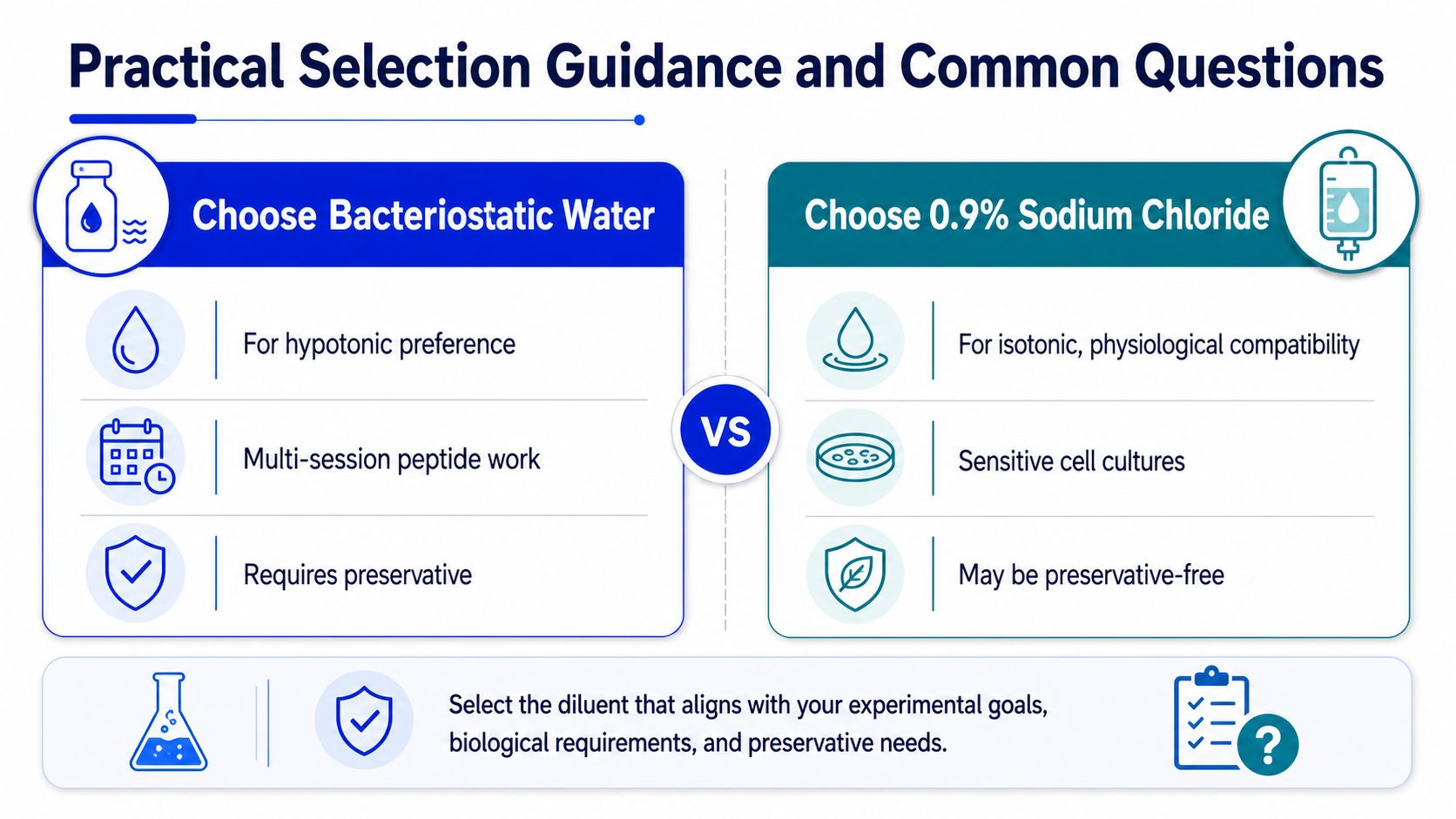
A fast decision rule works better than memorizing chemistry terms. Choose bacteriostatic water when the workflow benefits from a preserved, hypotonic diluent and repeated access. Choose 0.9% sodium chloride when isotonicity matters or the material is saline-compatible. Choose preservative-free sterile saline when the prep is single-use or benzyl alcohol should be excluded.
Quick pros and cons
- Bacteriostatic water, strengths: supports repeated withdrawals, preserved with 0.9% benzyl alcohol, useful for multi-session peptide work.
- Bacteriostatic water, limits: hypotonic, not interchangeable with isotonic saline, preservative may be undesirable for some compounds.
- 0.9% sodium chloride, strengths: isotonic, familiar physiological fit, good match for saline-compatible biologics.
- 0.9% sodium chloride, limits: non-preserved versions are generally single-use, and the sodium/chloride content changes the final formulation environment.
Common questions that bench users ask
Can one be switched for the other mid-protocol? Usually not without checking compatibility. The composition difference changes the final environment, so a blind swap is a risk.
Can preserved diluents be frozen to stretch use? Freezing does not solve contamination discipline. The vial still depends on clean technique and proper storage, so freezing is not a shortcut around handling rules.
Does repeated puncture frequency matter? Yes. Every extra access adds handling risk, and the value of the preserved format depends on whether the user keeps the vial clean and controlled between withdrawals.
For labs that want a supplier relationship built around RUO sterile diluents, documentation, and multiple vial formats, Herbilabs can be a practical place to start. Visit Herbilabs to review the available bacteriostatic water formats, compare workflow fit, and see whether the product line matches the way the bench runs.