Private Label, White Label, Wholesale partnerships available - EU, USA and UK - Free shipping from €75

Bacteriostatic Water Shelf Life: Complete 2026 Guide
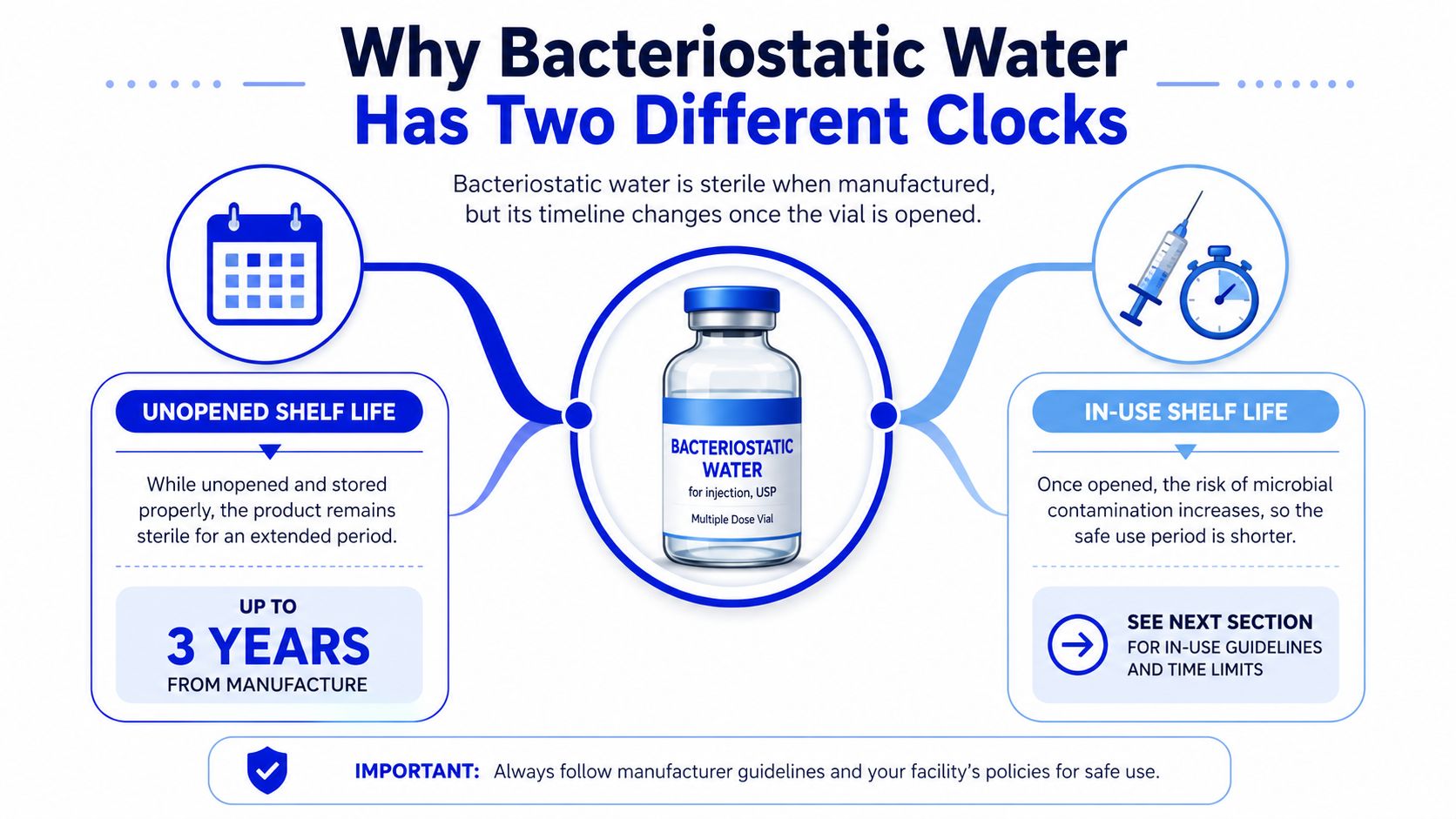
You're standing at the bench with a sealed vial in one hand and a fresh syringe in the other, trying to answer a question that sounds simple until the clock starts moving. Bacteriostatic water shelf life is not one number. It's a sealed-vial expiration date, a post-puncture in-use window, and a handling risk that changes the moment the stopper is pierced.
That's why so many researchers get tripped up. A vial can look clear, sit in storage, and still be on a completely different timeline depending on whether it has ever been opened. If the work involves peptides, proteins, or antibodies, that distinction matters even more, because the water is part of the workflow, not just the package.
Table of Contents
- Why Bacteriostatic Water Has Two Different Clocks
- What Benzyl Alcohol Actually Does Inside the Vial
- How Long an Unopened Vial Really Stays Usable
- The 28-Day In-Use Window After First Puncture
- Storage Conditions That Actually Move the Needle
- Reading the COA and Lot Data Like a Pro
- Common Misconceptions That Shorten Real Shelf Life
- Putting It All Together at the Bench
Why Bacteriostatic Water Has Two Different Clocks
A vial can sit on a shelf and still be usable, then become a different kind of material after the first puncture. That shift is why research buyers often talk about “shelf life” as if it were one date, even though bacteriostatic water is governed by several separate clocks.
The first clock is chemical stability. It asks whether the sealed product still matches the manufacturer's intended condition, which is why unopened vials are judged by the printed expiration date and by storage conditions before use (bacteriostatic water shelf life overview, unopened stability guidance). The second clock is sterility assurance, which changes once the septum has been pierced and the vial is no longer a closed system.
The third clock is contamination risk. It starts ticking faster with every withdrawal, especially in high-frequency peptide workflows where the same vial may be handled repeatedly across a bench day. That is why a bottle can still look clear and still be outside its safe in-use window.
A sealed vial follows the manufacturer's expiry, but an opened vial follows the time since first entry. After puncture, the usual benchmark is a 28-day in-use window under aseptic handling, and that applies even if liquid remains in the vial (post-puncture guidance). The logic is simple, a sealed vial is like a wrapped sterile kit, while an opened vial is a working container that depends on the user's technique every time the needle goes in.
Practical rule: unopened means read the label date, opened means count from the first puncture.
Sterile water can confuse this conversation because it is often handled as a single-use product, so the buyer sees one vial type and assumes one shelf-life rule. Bacteriostatic water is built for repeated access within a controlled window, which is why the unopened expiry and the post-puncture limit must be read separately. For a plain comparison of single-use and multi-use handling, learn from Peptide Warehouse USA and this lab guide on sterile water handling.
Research use only labeling adds one more layer. A vial marked research use only belongs inside a lab workflow, so the buyer needs to track both the sealed shelf life and the in-use period with the same care used for other RUO materials.
What Benzyl Alcohol Actually Does Inside the Vial
Bacteriostatic water works because the preservative helps suppress growth, not because it sterilizes anything. That distinction sounds technical, but it's the whole reason the vial can be accessed more than once without turning into a contamination magnet.
Benzyl alcohol slows growth, it does not erase contamination
The finished solution contains 0.9% benzyl alcohol, and that preservative is bacteriostatic, not sterilizing (composition and handling background). It acts as a barrier, making it harder for bacteria to establish themselves, but it does not repair a broken gate or remove anything that already got inside.
That's why aseptic technique matters on every puncture. Benzyl alcohol can inhibit bacterial growth introduced during repeated withdrawals, but it cannot undo contamination caused by a dirty needle, a poorly swabbed septum, or repeated handling that bypasses clean technique (handling and preservative limits). The vial's safety depends on both the formulation and the behavior of the person using it.
The finished product is also manufactured through filtration and controlled formulation. Herbilabs describes aseptic filling with 0.22 µm filtration and a typical pH of 4.5 to 7.0, which fits the kind of neutral-to-slightly acidic solution researchers expect for reconstitution work. That profile helps explain why bacteriostatic water is commonly used for peptides, proteins, and antibodies, while preservative-free sterile water is preferred when any additive could interfere with the assay.
Why multi-dose use is possible without being careless
The key point is simple. A multi-dose vial isn't safe because nothing can ever enter it. It's safer because the preservative raises the margin for error when the vial is entered correctly and tracked tightly.
Benzyl alcohol buys time. It does not buy immunity from poor technique.
A researcher can explain the logic in one sentence: the preservative keeps new bacteria from multiplying easily, but the user still has to avoid introducing contamination in the first place. That is the difference between a stable research tool and a vial that should be discarded early.
For a deeper product-specific discussion of why benzyl alcohol matters in lab solutions, see this lab-focused explanation.
How Long an Unopened Vial Really Stays Usable
An unopened vial follows the manufacturer's clock, not the bench clock. That difference matters in procurement and inventory work, because a vial can be perfectly acceptable on paper and still become dead stock if it sits beyond its labeled window.
Trust the printed date before first puncture
Before first use, unopened bacteriostatic water is normally judged by the manufacturer's printed expiration date, which commonly falls in the 1 to 3 year range from manufacture when the vial stays sealed and protected from heat, light, and contamination (sealed stability guidance). That label date is the benchmark until the stopper is punctured. The preservative does not extend the printed expiry, and room temperature storage does not create a new one.
The reason is packaging validation. Manufacturers set expiry from stability data, package integrity, and conservative dating practices, then release each lot with documentation that supports that dating. A lot-specific Certificate of Analysis, or COA, connects the batch to its tested status and shows that the vial was released within specification.
Research buyers often miss the practical side of this. A 10×10 mL kit can look efficient on a purchase order, but if the team cannot use the volume before the printed expiry, the savings disappear. Unit price matters less than usable time on the shelf, especially in high-frequency peptide workflows where small withdrawals and frequent restocking can make overbuying easy.
What sealed storage really means in practice
Sealed storage is active protection, not passive neglect. The box stays closed, the cap stays intact, and the vial is kept away from avoidable stress until the first entry. The unopened vial's shelf life is already defined by the release data, so the lab's job is to prevent unnecessary degradation while the product is in transit or warehoused.
Temperature-controlled storage and proper carton protection matter before the product ever reaches the bench. The vial is not open yet, but it is still exposed to handling conditions that can affect whether it arrives in usable condition.
Bench rule: before the stopper is punctured, the label date overrides every guess, memory, or informal storage habit.
For a plain-language summary of how that sealed window is handled after purchase, this unopened-vial guide gives a useful reference point.
The 28-Day In-Use Window After First Puncture
A vial of bacteriostatic water can sit on a shelf for a long time, then its handling clock changes the moment the stopper is punctured. That is where confusion starts. Buyers often use “shelf life” for three different things at once, chemical stability, sterility assurance, and contamination risk. Those clocks do not run together.
Chemical stability asks whether the solution still matches its release condition. Sterility assurance asks whether the product was protected before the first entry and through the first opening. Contamination risk asks what happens after repeated withdrawals, when each needle pass adds a new chance for a lapse. In a peptide workflow that pulls from the vial often, the third clock is usually the one that matters most at the bench.
The clock starts on day zero
After the first puncture, the working rule is a 28-day in-use window, with refrigeration at 2 to 8°C commonly recommended by technical guides to limit microbial growth and keep the vial usable after repeated access (opened-vial handling guidance). The reason is simple. Benzyl alcohol is bacteriostatic, so it slows growth, but it does not reset the vial after a handling mistake.
The logic is easier to see if you separate it into bench steps:
- Limit access to trained personnel who can keep aseptic technique consistent.
- Use a new sterile needle and syringe for every withdrawal.
- Swab the septum with alcohol before each entry.
- Mark the first puncture date on the vial or in a tracker.
- Discard the vial at 28 days, even if liquid remains.
That schedule is about repeatability. A vial that is handled carefully on day 1 and carelessly on day 17 still belongs to the same in-use window. The opening date does not move because the liquid looks clear or the volume seems high.
Refrigeration helps, but it does not reset the vial
Cold storage slows microbial proliferation, so refrigeration is the safer habit between uses. That matters because a multi-dose vial used in a high-frequency peptide routine may be entered many times before it is empty, and each entry adds exposure. Some technical sources allow for warmer handling windows, while others stay with the 28-day discard rule and treat refrigeration as the better practice. The disagreement is about practical risk, not about whether contamination can happen.
A vial can look clean after opening and still be past its safe repeated-use window.
That is why the 28-day benchmark carries more weight than appearance. The vial should be discarded when that window closes, even if there is liquid left and even if the contents still look unchanged.
For a concise post-opening reference, this guide on how long bac water lasts after opening follows the same practical rule set.
Storage Conditions That Actually Move the Needle
Storage gets overcomplicated fast because people treat temperature, light, packaging, and handling as separate problems. They're not separate in practice. They combine into one question, which is whether the vial stays in a condition that supports the clock it is currently on.
Unopened stock and opened stock need different habits
Unopened bacteriostatic water should be stored at controlled room temperature, away from direct sunlight and heat sources, while opened vials belong in the 2 to 8°C range between uses, with the septum swabbed before each access (storage guidance background). Original carton packaging matters because it helps protect the vial from UV exposure and gives the product extra shielding during warehousing and shipping.
Repeated temperature excursions during transit can complicate the picture before the vial even reaches the lab. That's one reason temperature-controlled warehousing matters. A bottle that has been bounced through hot loading docks and cold vehicles may still look fine, but the purchaser has no reason to assume its practical shelf life is the same as a vial that stayed within the intended range.
Bench reality versus fridge reality
An opened vial left at the bench is exposed to a larger contamination window than one returned to the lab fridge between withdrawals. The difference is not magic, it's exposure time. Less time warm and accessible means less opportunity for microbes and handling mistakes to accumulate.
Herbilabs describes temperature-controlled storage as part of its logistics and fulfillment model, and that matters because storage discipline begins before the product is opened. The same logic applies to multi-pack kits. Opening a 10×3 mL box doesn't create one timer, it creates ten separate 28-day clocks, each of which needs to be tracked on its own.
| Storage choice | Practical effect |
|---|---|
| Kept sealed in original carton | Better protection from light and handling |
| Opened and returned to fridge | Smaller contamination window between uses |
| Opened and left at the bench | More exposure, tighter discipline needed |
The smartest routine is boring, and that's a compliment. Keep the unopened stock protected, move opened stock back to cold storage promptly, and treat each vial as a separate record.
Reading the COA and Lot Data Like a Pro
A COA is not marketing material. It's the paper trail that tells a buyer what lot was released, what the batch was tested against, and where the manufacturer drew the line between acceptable and unacceptable product.
The fields that matter most
A useful COA for bacteriostatic water normally includes the lot number, manufacture or test date, expiration date, and the testing results tied to release specifications. Herbilabs says its quality system includes lot-specific Certificates of Analysis and QA review prior to product release, which is exactly the kind of documentation researchers should want when reproducibility matters.
The most useful fields are the ones a lab can verify later:
- Lot number: This ties the bottle in hand to the specific batch that was released.
- Manufacture or test date: This shows when the batch entered the quality pipeline.
- Expiration date: This confirms the sealed-vial clock.
- Test methods and results: These support confidence in parameters such as sterility, endotoxin, pH, and benzyl alcohol concentration.
- Release status: This tells the buyer whether the product passed QA review.
Once the vial is in the lab, the lot number should be copied into experimental records. That way, if a result is questioned later, the COA can be retrieved without guessing which box was opened.
Why buyers should care before they place an order
Lot data protects reproducibility in peptide and protein workflows because it reduces ambiguity. Two vials that look identical on a shelf can still represent different batches, different dates, and different release documentation. The COA is what bridges that gap.
If the lot can't be matched to the COA, the batch history is already weaker than it should be.
That matters in regulated R&D environments, where documentation is part of the material's value. It also matters for buyers comparing suppliers. A product that ships with traceable paperwork gives the lab something concrete to inspect, rather than forcing staff to rely on label memory alone.
Common Misconceptions That Shorten Real Shelf Life
The biggest shelf-life mistakes are usually not dramatic. They're small habits that feel harmless until they shorten the usable window or weaken documentation.
A clear vial is not automatically a safe vial
Clarity only tells a user what can be seen with the naked eye. It doesn't tell anyone whether contamination has started below the threshold of visible change. Microbial issues can exist before the liquid turns cloudy or particles appear, which is why date control matters even when the solution looks pristine.
Another common mistake is assuming more benzyl alcohol would solve the problem. It won't. The 0.9% concentration is a validated formulation choice, not a user-adjustable protection level, and adding more would not be part of a controlled lab workflow. The preservative is there to support repeated access, not to justify ignoring the clock.
A third mistake is topping off a nearly empty vial with fresh bacteriostatic water from a new bottle. That practice mixes two separate handling histories into one container, and it creates more uncertainty, not less. The safer practice is simpler, keep each vial on its own timeline.
High-frequency peptide use creates a different risk pattern
Peptide workflows often involve small-dose, high-frequency puncturing. That pattern feels low-risk because each withdrawal is tiny, but the cumulative exposure is what matters. Every extra entry is another chance for septum wear, handling error, or contamination from a lapse in technique.
- Small aliquots still count: Tiny draws do not reset the 28-day clock.
- Repeated entries add risk: Each puncture is another handling event.
- Clear solution can still be out of window: Visual appearance does not override date control.
That's why researchers keep searching for an accurate shelf life instead of relying on a label slogan. The answer depends on which clock is being asked about: the sealed one, the in-use one, or the contamination risk sitting underneath both.
Putting It All Together at the Bench
A researcher can turn bacteriostatic water handling into a simple bench check by separating the two clocks before each use. If the vial is unopened, follow the sealed expiry. If it has already been punctured, the first-entry date becomes the controlling record, and the vial should be treated as in-use stock, not as fresh inventory. Once opened, refrigeration at 2 to 8°C, septum cleaning before each withdrawal, a new sterile needle and syringe for every draw, and disposal at 28 days all belong to the same handling routine.
That routine matters because each clock tracks something different. Chemical stability asks whether the formulation is still intact. Sterility assurance asks whether the preservative and sealed container have done their job. Contamination risk asks what has happened since the first puncture, especially in labs that pull small volumes over and over for peptide work. The vial can still look clear while one of those clocks has already run out.
Keep the lot number in the experiment log as well. That lets the COA be pulled later if a result needs to be traced back to the batch that was used, which helps when a clean-looking vial and a questionable outcome do not match. High-frequency peptide workflows make this even more important, because repeated access increases handling exposure even when each withdrawal is small. The open vial rule is the practical boundary, and it should be tracked in the same way every time.
Shelf life is not one number on a label. It is a set of separate controls for chemical stability, sterility assurance, and contamination control, and research buyers often blur those together. Keeping the unopened expiry, the first-puncture date, and the in-use window separate is what keeps a vial useful across its real working life.