Private Label, White Label, Wholesale partnerships available - EU, USA and UK - Free shipping from €75
What Is GMP Compliance? A Guide for Pharma Professionals
Discover what is GMP compliance and how it ensures safe, effective pharmaceutical products. Enhance your understanding for better practices!
TL;DR:
- GMP compliance ensures manufacturing processes systematically produce safe, effective, and high-quality products. Regulatory agencies like the FDA, WHO, and EMA enforce these standards through evolving frameworks focused on process control and quality management. Maintaining GMP requires comprehensive systems, documentation, personnel training, and continuous validation to safeguard product integrity and patient safety.
GMP compliance is defined as the systematic adherence to Good Manufacturing Practice standards that guarantee pharmaceutical, biotechnological, and research-grade products are consistently safe, effective, and of verified quality. In the United States, the FDA enforces these requirements through Current Good Manufacturing Practice (CGMP) regulations, specifically 21 CFR Parts 210 and 211, which set minimum standards for manufacturing methods, facilities, and controls. Globally, the World Health Organization (WHO) and the European Medicines Agency (EMA) maintain parallel frameworks that align with these principles. GMP compliance is not a single checklist but a formal quality management system that governs every stage of production, from raw material sourcing to final product release.
What is GMP compliance and why does it matter?
GMP compliance is the operational framework through which manufacturers demonstrate that their processes, personnel, and facilities consistently produce products meeting defined quality standards. The term “Current Good Manufacturing Practice” (CGMP) reflects the expectation that manufacturers adopt up-to-date technologies and systems, not merely satisfy static historical requirements. This distinction matters because regulatory agencies assess whether a manufacturer’s quality system is genuinely effective, not just formally documented.
The FDA requires systems that assure proper design, monitoring, and control of manufacturing processes, with the explicit principle that quality must be built into the process rather than verified solely through end-product testing. This is a foundational concept that separates GMP-compliant operations from those relying on inspection alone. A manufacturer producing injectable reconstitution solutions, for example, cannot rely on testing a handful of vials from a large batch to confirm sterility across the entire lot. Quality must be embedded at every step.
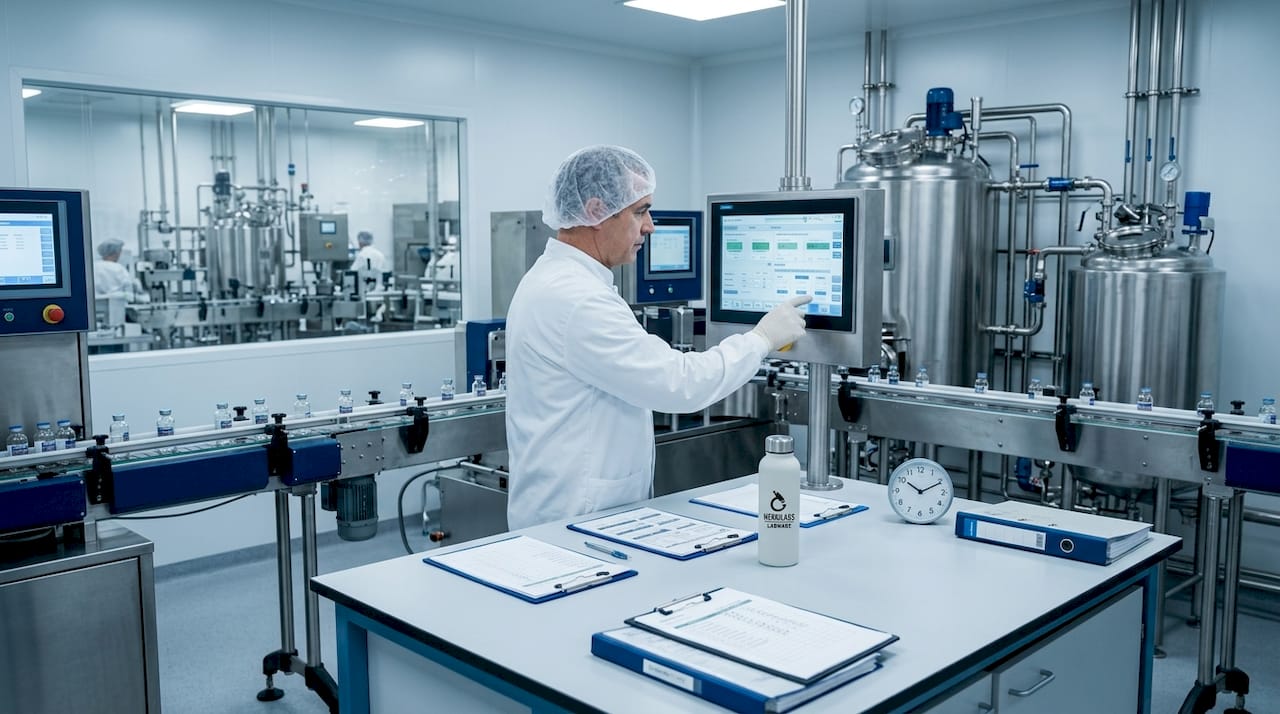
The importance of GMP compliance extends beyond regulatory obligation. It directly determines whether a product is fit for its intended use, whether that product is a licensed pharmaceutical, a research reagent, or a sterile diluent used in laboratory settings. For professionals in pharmaceutical development and biotechnology research, understanding GMP compliance is foundational to designing reliable studies and interpreting product specifications accurately.
What are the core requirements and components of GMP compliance?
GMP compliance requirements span six interconnected operational domains, each of which must function as part of a coherent system rather than as isolated procedures.
- Quality management systems (QMS): A documented QMS defines how manufacturing processes are designed, monitored, and controlled. It includes standard operating procedures (SOPs), change control protocols, and deviation management workflows.
- Personnel qualifications and training: All staff involved in manufacturing, testing, and quality oversight must hold documented qualifications and receive ongoing training relevant to their roles. Unqualified personnel operating critical equipment is a direct GMP violation.
- Facility and equipment standards: Manufacturing environments must be designed to prevent contamination and cross-contamination. Equipment requires validation, calibration, and preventive maintenance schedules with full documentation.
- Raw material controls: Incoming materials must be tested or verified against defined specifications before use. Supplier qualification programs form part of this requirement.
- Process validation and deviation management: Manufacturing processes must be validated to demonstrate consistent output. Deviations from validated processes trigger formal investigation and corrective and preventive action (CAPA) procedures.
- Laboratory testing and product release: Analytical methods must be validated, and results must meet pre-defined release criteria before any product enters distribution or use.
The term “cGMP” (current GMP) signals that compliance is a moving standard. Regulatory agencies expect manufacturers to incorporate advances in technology, analytical methods, and quality systems as they become available. A facility operating on procedures written in 2010 without review may be technically non-compliant even if those procedures were once acceptable.
Pro Tip: Document every deviation, no matter how minor it appears. Inspectors assess the coherence of your deviation and CAPA records as a direct indicator of quality system maturity. Disjointed or incomplete records are a common finding during FDA and EMA inspections.
How does GMP compliance impact product quality and patient safety?
CGMP controls prevent contamination, mix-ups, deviations, failures, and errors, directly ensuring that drug products meet their labeled identity, strength, quality, and purity. This is not an abstract regulatory goal. A product that fails to meet identity specifications may deliver no therapeutic effect; one that fails purity standards may cause direct harm.
“Testing is done on only a small sample of a batch, so the potential for some non-compliant product to reach the consumer without being detected is possible if the manufacturer relies on testing alone to ensure quality.” — FDA, Facts About CGMP
This FDA statement captures the central logic of GMP compliance: relying solely on testing is structurally insufficient. Testing 100 tablets from a batch of 2 million provides no statistical assurance about the remaining 1,999,900 units. This means quality must be designed into the manufacturing process at every stage, from equipment qualification through environmental monitoring to final release testing.
Non-compliance carries consequences that extend well beyond regulatory warnings. FDA inspections assess manufacturing facilities, equipment, and a manufacturer’s demonstrated ability to produce compliant products, including review during marketing application approvals. Firms found deficient face warning letters, import alerts, consent decrees, or product recalls. For research institutions and contract manufacturers supplying reagents, non-compliance can invalidate entire study datasets and disrupt supply chains for dependent researchers.
The benefits of GMP compliance, therefore, are both protective and operational. A facility with a mature GMP system experiences fewer batch failures, lower rates of out-of-specification results, and greater predictability in production timelines. These outcomes translate directly into cost efficiency and scientific reliability.
How do GMP compliance standards and inspections differ internationally?
GMP compliance standards share common principles across jurisdictions but differ in regulatory structure, inspection methodology, and evolving emphasis. The table below summarizes the three primary frameworks relevant to pharmaceutical and biotechnology professionals.
| Framework | Governing Body | Key Focus | Inspection Approach |
|---|---|---|---|
| CGMP (21 CFR 210/211) | U.S. FDA | Drug safety, identity, strength, purity | Facility inspections, marketing application reviews |
| WHO GMP | World Health Organization | Global quality harmonization for medicines | Consensus-based guidelines, prequalification assessments |
| EU GMP / PQS Pilot | European Medicines Agency (EMA) | Quality system effectiveness, risk-based change management | Risk-based audits, PQS effectiveness assessments from 2026 |
The FDA’s CGMP framework is prescriptive and legally binding for any manufacturer supplying the U.S. market. WHO develops guidelines through international consensus, supporting quality assurance across pharmaceutical manufacturing systems in member states, particularly in lower-resource settings where national regulatory capacity may be limited.
The EMA’s approach is undergoing a significant evolution. The PQS effectiveness pilot launched in EU/EEA jurisdictions assesses risk-based change management as a key component of GMP compliance starting in 2026. This means inspectors evaluate whether a site’s quality system actually functions effectively, particularly in managing change control, rather than simply confirming that procedures exist on paper. This shift reflects a broader regulatory trend: documentation completeness is no longer sufficient evidence of compliance.
For professionals working across multiple markets, this divergence in inspection philosophy has practical implications. A facility that satisfies FDA documentation requirements may still face findings under EMA’s effectiveness-focused assessment if its change control processes cannot demonstrate real-world risk management outcomes.
What practical steps do manufacturers and labs take to maintain GMP compliance?
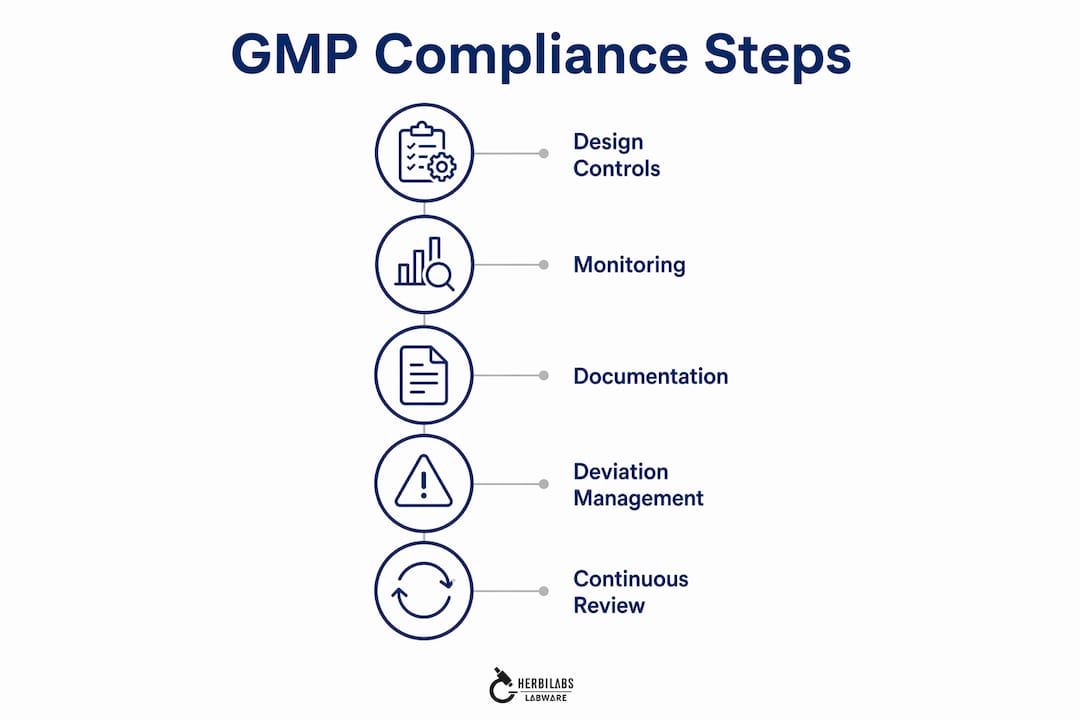
Achieving and maintaining GMP compliance requires structured implementation across quality systems, data management, personnel, and physical infrastructure. The following steps represent the operational sequence most commonly applied in pharmaceutical and research laboratory settings.
- Establish a documented quality management system. Define SOPs for all critical processes, including manufacturing, testing, deviation management, and change control. The QMS must be reviewed and updated on a defined schedule.
- Implement a Laboratory Information Management System (LIMS). Modern labs move beyond physical inspections to data interrogation ensuring complete audit trails and product lifecycle traceability. LIMS tools embed data integrity and traceability features that support regulatory requirements directly.
- Qualify and train all personnel. Maintain training records linked to specific SOPs and equipment. Personnel qualification must be documented before individuals perform critical tasks independently.
- Validate equipment and analytical methods. Equipment qualification (IQ/OQ/PQ) and analytical method validation are prerequisites for reliable manufacturing and testing data. Calibration schedules must be maintained with documented records.
- Manage deviations and CAPAs systematically. Every deviation from a validated process must be investigated, root-caused, and resolved through a formal CAPA. Inspectors assess the coherence of these records as a direct measure of quality system maturity.
- Control raw materials and labware quality. Supplier qualification programs and incoming material testing prevent non-conforming inputs from entering the manufacturing process. For laboratory reagents and reconstitution solutions, purity specifications and certificates of analysis are the minimum documentation standard.
- Conduct internal audits and management reviews. Scheduled internal audits identify gaps before regulatory inspections. Management review meetings close the loop between quality data and operational decisions.
For GMP manufacturing of specialized products such as peptides, the requirements for peptide manufacturing add layers of specificity around synthesis purity, impurity profiling, and sterility assurance that go beyond general pharmaceutical GMP.
Pro Tip: When selecting reagents and reconstitution solutions for GMP-adjacent research, request certificates of analysis that specify endotoxin levels, pH, osmolality, and sterility test results. These parameters directly affect the validity of downstream assays and are the minimum documentation standard for any GMP-compliant laboratory environment.
Key takeaways
GMP compliance requires quality to be built into every manufacturing and laboratory process, not verified through end-product testing alone.
| Point | Details |
|---|---|
| Quality must be designed in | Testing alone cannot assure batch quality; controls must be embedded at every production stage. |
| Regulatory frameworks differ by region | FDA CGMP, WHO GMP, and EMA PQS each carry distinct requirements and inspection methodologies. |
| EMA is shifting to effectiveness assessment | From 2026, EU/EEA inspectors evaluate whether quality systems actually function, not just whether documentation exists. |
| LIMS and data integrity are compliance tools | Digital traceability systems are now a practical requirement for maintaining audit-ready records in regulated labs. |
| Non-compliance carries operational consequences | Warning letters, import alerts, and batch recalls are direct outcomes of GMP failures, affecting supply chains and research validity. |
Why GMP compliance deserves more than procedural respect
Most professionals in pharmaceutical and biotech settings understand GMP compliance as a regulatory obligation. What I have observed over years of working with research-grade manufacturing is that the organizations with the fewest compliance problems are not those with the thickest procedure manuals. They are the ones that have genuinely internalized the principle that quality cannot be inspected into a product after the fact.
The misconception that end-product testing provides adequate assurance is remarkably persistent. I have seen well-resourced laboratories invest heavily in analytical instrumentation while underinvesting in process controls and raw material qualification. The FDA’s own framing of this problem, using the example of testing 100 tablets from a batch of 2 million, should be sufficient to settle the argument. It rarely is.
The EMA’s 2026 PQS effectiveness pilot is, in my view, the most significant regulatory development in quality systems in recent years. It signals that regulators are no longer satisfied with documentation as a proxy for compliance. They want to see evidence that quality systems detect problems, manage change effectively, and improve over time. That is a fundamentally different standard, and many facilities are not yet prepared for it.
For those working in research environments rather than licensed manufacturing, the principles apply with equal force. A reagent prepared without documented process controls, or a reconstitution solution sourced without a certificate of analysis, introduces uncontrolled variables that can invalidate experimental results. GMP compliance guidelines exist because the alternative, relying on assumption and post-hoc testing, has a documented history of failure. Adopting a compliance mindset proactively, rather than reactively, is the single most effective investment a laboratory can make in the reliability of its outputs.
— Ragnar
How Herbilabs supports GMP-aligned laboratory practice
Herbilabs manufactures bacteriostatic water and sterile reconstitution solutions to strict purity standards, with each product batch supported by full documentation including certificates of analysis covering sterility, endotoxin levels, pH, and osmolality. These specifications are not incidental. They reflect the GMP compliance standards that research institutions and pharmaceutical professionals require when sourcing reagents for validated workflows.
For laboratories building or maintaining GMP-aligned quality systems, Herbilabs offers a range of high-purity reconstitution solutions designed to meet the documentation and purity requirements of demanding research environments. The Herbilabs reagent selection guide provides practical criteria for evaluating reconstitution solutions against GMP-relevant quality parameters. For broader quality control frameworks applicable to laboratory settings, the quality control tips resource covers the operational controls that support compliant, reproducible research.
FAQ
What is GMP compliance in simple terms?
GMP compliance means following Good Manufacturing Practice regulations that require manufacturers to control every stage of production to guarantee product safety, identity, strength, quality, and purity. In the U.S., the FDA enforces these requirements through 21 CFR Parts 210 and 211.
What is the difference between GMP and CGMP?
GMP refers to the general principles of Good Manufacturing Practice, while CGMP (Current Good Manufacturing Practice) specifies that manufacturers must adopt up-to-date methods and technologies. The “current” designation reflects the FDA’s expectation that compliance standards evolve with advances in science and manufacturing.
Why is end-product testing not enough for GMP compliance?
Testing a small sample from a large batch provides no statistical assurance about the untested units. The FDA explicitly states that quality must be built into the process at every stage, making process controls and validated manufacturing methods the foundation of compliance rather than final testing alone.
How do FDA and EMA GMP inspections differ?
FDA inspections assess facilities, equipment, and manufacturing processes against prescriptive CGMP requirements in 21 CFR Parts 210 and 211. The EMA, through its PQS effectiveness pilot from 2026, evaluates whether quality systems actively function and manage risk effectively, rather than simply confirming documentation completeness.
Does GMP compliance apply to research laboratories?
GMP compliance in its full regulatory form applies to licensed pharmaceutical manufacturers, but the underlying principles of process control, data integrity, raw material qualification, and traceability apply directly to any laboratory producing materials used in validated research or clinical applications. Research labs sourcing reagents and reconstitution solutions should verify that suppliers meet GMP-equivalent purity and documentation standards.