Private Label, White Label, Wholesale partnerships available - EU, USA and UK - Free shipping from €75

Bacteriostatic Water for Peptide Reconstitution
You've got a peptide vial on the bench, a bacteriostatic water vial in one hand, and a decision to make before the first puncture. The choice looks routine until the downstream mix starts clouding, the cake breaks apart, or the vial gets accessed more than once and contamination becomes the primary problem. The right diluent and the right technique matter because bacteriostatic water for peptide reconstitution is not just “sterile water with a preservative,” it's a formulation with a specific job, and sometimes it's the wrong tool for the peptide in front of you.
Table of Contents
- What Happens When You Mix Bacteriostatic Water with a Peptide
- How Benzyl Alcohol Protects Your Reconstituted Solution
- Preparing Vials and Calculating Reconstitution Volumes
- The Actual Reconstitution Technique Step by Step
- When Bacteriostatic Water Is the Wrong Choice
- Multi-Dose Handling, Storage, and the 28-Day Rule
- Quality Signals That Matter When Buying Bacteriostatic Water
What Happens When You Mix Bacteriostatic Water with a Peptide
A researcher opens a lyophilized peptide vial and sees a dry cake at the bottom, not a liquid ready for use. The next choice is usually whether to reach for bacteriostatic water, sterile water, saline, or the supplier's own vehicle, and that choice changes more than convenience. It affects how the peptide dissolves, how often the vial can be punctured, and how much confidence the team can place in the result.
What the formulation actually is
Bacteriostatic water is purified water with 0.9% benzyl alcohol, or 9 mg/mL, and that preservative is the feature that separates it from plain sterile water understanding bacteriostatic water uses. The point of that benzyl alcohol is not to rescue a contaminated vial, it is to inhibit microbial growth after repeated withdrawals from the same container. That is why it fits multi-dose peptide work better than simple sterile water, which has no preservative and is meant for single-use preparations.
Why that matters at the bench
The first few seconds after the diluent touches the peptide cake tell the whole story. If the stream hits the powder directly, the cake can fracture, foam can form, and dissolution can slow down or become uneven. If the compound is sensitive, the wrong vehicle can also change how the peptide behaves in solution, so “default to bac water” is a habit worth questioning rather than repeating.
Practical rule: If the peptide supplier gives a vehicle recommendation, that instruction beats the habit of using bacteriostatic water by default.
A good bench habit is to treat the vial like a formulation problem, not a simple dilution task. Some peptides tolerate bacteriostatic water well, others do better in a different vehicle, and the reconstitution choice should follow the molecule, not the convenience of the bottle closest to the rack. The rest of the process only works when that first choice is deliberate.
How Benzyl Alcohol Protects Your Reconstituted Solution
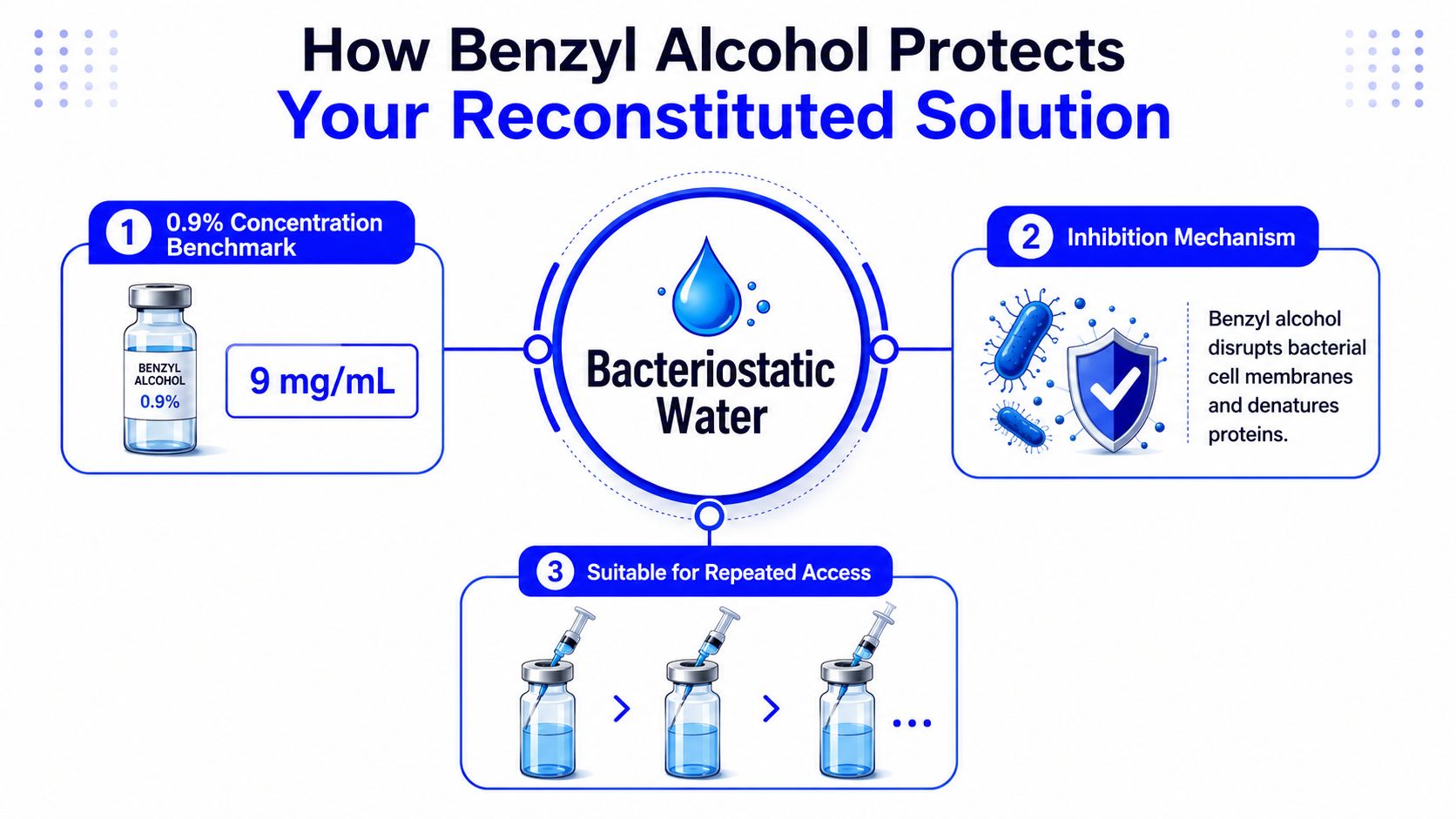
Benzyl alcohol is what makes the vial usable after the first puncture. In bacteriostatic water for peptide reconstitution, the preservative load is 0.9% benzyl alcohol, or 9 mg/mL, and that concentration is the core reason the solution supports multi-puncture access for up to 28 days when handled aseptically Peptide Effect guide.
What the preservative does and does not do
Benzyl alcohol doesn't sterilize a contaminated solution. If microbes are already in the vial, the preservative is not a cleanup tool, it's a growth inhibitor. That distinction matters because people sometimes assume the word “bacteriostatic” means the liquid can correct sloppy handling, and it can't.
Sterile water is different in a way that matters on day two, not just on day one. It has no preservative, so repeated punctures turn every access into a contamination risk with nothing in the vehicle to slow microbial growth. Bacteriostatic water gives the lab a wider working window, but only if the septum is still swabbed, the syringe is new, and the vial is treated as a preserved multi-dose container rather than a disposable bottle.
Why the 28-day ceiling exists
The common up to 28 days benchmark shows up because the preservative buys time, not immunity. Aseptically handled, refrigerated or properly stored multi-dose vials can stay usable in that window, but the clock still starts ticking after opening HerbiLabs benzyl alcohol guide. Once punctures become sloppy, the period becomes a ceiling rather than a guarantee.
The preservative extends usability, but sterile technique still decides whether the vial stays clean.
That's the core chemistry-to-workflow link. Benzyl alcohol helps protect the solution after access, but it doesn't replace the habits that keep the peptide and the container clean in the first place.
Preparing Vials and Calculating Reconstitution Volumes
A bench mistake usually starts before the needle goes anywhere near the peptide. Cold vials, rushed math, and the wrong container size create avoidable problems that look like “bad peptide” later, when the actual issue was preparation.
Temperature and container choice
Both the peptide vial and the diluent should sit until they're at room temperature before reconstitution. Cold diluent hitting a lyophilized cake can cause condensation and uneven wetting, and that tends to show up as slow dissolution or patchy clumps instead of a clean solution. The goal is simple, let the vial contents and the diluent settle before mixing.
Container format matters too. A 3 mL, 10 mL, 20 mL, or 30 mL vial should match the total volume the workflow needs, not whatever happened to be in stock. Headspace helps with accurate withdrawal and reduces the feeling that the vial is already too full before the first draw.
Do the math before puncture
The concentration target should be decided before any septum is pierced. For example, a 5 mg peptide vial reconstituted to 2 mg/mL needs 2.5 mL of diluent, and a 3 mL vial gives enough room for that volume without turning the transfer into a cramped handling problem. That math is the difference between a clean setup and a vial that gets overfilled or awkwardly handled halfway through the process.
For a clear dilution workflow and concentration planning, a practical calculator-style reference like HerbiLabs' compound reconstitution guide is more useful than guessing from memory. The important part is not the tool itself, it's that the target concentration gets fixed before the syringe comes out of the package.
Bench habit: write the intended concentration on the vial label before the first puncture, not after the solution is already mixed.
That one detail saves a lot of ambiguity later when multiple vials look similar and the original dry mass is no longer obvious.
The Actual Reconstitution Technique Step by Step
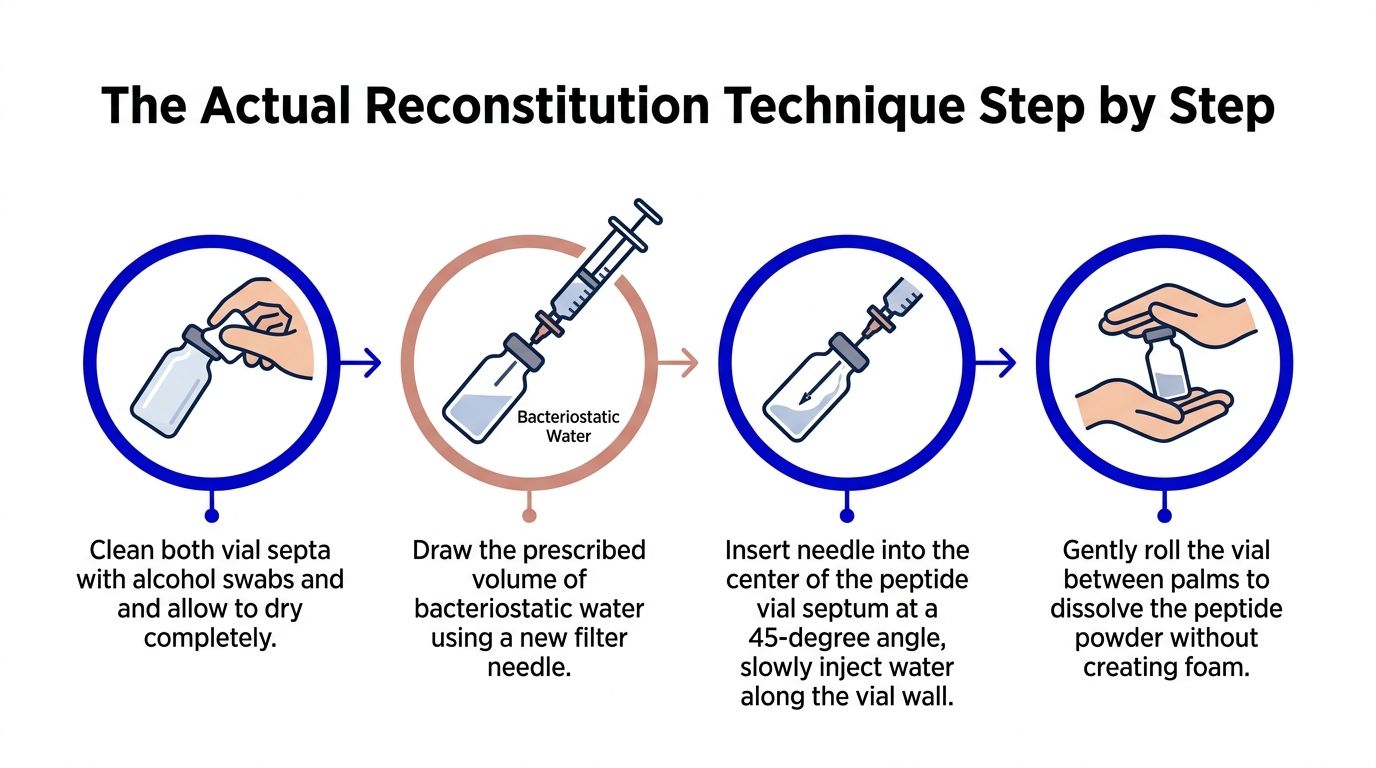
The cleanest results come from a slow, controlled transfer rather than a forceful injection. That matters because the liquid path determines whether the peptide cake stays intact or gets blasted apart, and the difference shows up immediately in clarity and dissolution time.
The process starts with the stoppers. Both vial septa should be wiped with alcohol swabs and left to dry fully before puncture, because wet alcohol can interfere with handling and leaves no reason to rush. A new sterile syringe is then used to draw the calculated volume of bacteriostatic water, and the needle goes into the peptide vial at an angle so the stream can be directed down the inner wall, not straight into the cake.
Why wall-directed flow matters
The wall gives the liquid a surface to run along, so the cake absorbs the diluent more gradually. A direct stream can crater the powder, create foam, and make the solution look like it's “mixing” when it's being mechanically disrupted. Sensitive sequences are especially unforgiving when the first few milliliters hit them too hard.
The vial should then sit undisturbed long enough for passive dissolution. Gentle swirling is fine once the liquid is distributed, but shaking or vortexing is a bad habit for fragile peptides because it adds unnecessary shear and foam. The goal is a clear solution, not a frothy one.
Practical rule: If the vial still shows undissolved material, wait and swirl lightly. Do not try to force the peptide into solution with agitation.
A short video reference can help junior staff match the motion to the method:
The best technique often looks boring, and that's a good sign. Quiet handling usually beats dramatic movement when the peptide has to survive the whole workflow intact.
When Bacteriostatic Water Is the Wrong Choice
Not every peptide wants the same vehicle, and that's where a lot of lab habits go wrong. Bacteriostatic water is useful, but it isn't universal, and some compounds behave better in saline, sterile water, or a manufacturer-specified solution instead Durham Peptides FAQ.
Read the peptide, not the default
Certain cyclic, hydrophobic, or aggregation-prone peptides can respond poorly to benzyl alcohol. The issue isn't that the preservative is “bad,” it's that the chemical environment can alter stability, aggregation, or downstream assay behavior across different peptide classes. A preserved diluent is a formulation choice, not a law.
That's why the supplier's own reconstitution guidance should be checked first. If the product sheet specifies saline or another vehicle, that instruction usually reflects the chemistry of the molecule, not a preference for paperwork. A lab that ignores that guidance and uses bacteriostatic water by habit can end up chasing a solubility problem that was predictable from the start.
A practical comparison mindset
A cautious approach is to prepare a small test aliquot in the recommended vehicle and, if needed, compare it with a small aliquot in bacteriostatic water. The aim is to check clarity, dissolution behavior, and whether the solution stays consistent long enough for the assay or workflow planned. That kind of side-by-side check is especially useful when a peptide is known to be finicky.
- Use bacteriostatic water when repeated withdrawals are needed and the peptide is compatible with benzyl alcohol.
- Use sterile water when the full vial will be used in one session and no preservative is needed.
- Use saline or a specified vehicle when the supplier indicates the peptide is more stable or more soluble there.
The main mistake is treating the diluent as interchangeable. It isn't. The peptide decides the chemistry, and the vial format and withdrawal pattern should follow that decision.
Multi-Dose Handling, Storage, and the 28-Day Rule
Once the vial is mixed, the handling rules become just as important as the mixing itself. Multi-dose access only stays clean when every withdrawal is treated like a fresh sterile event, not a casual repeat of the first one.
Accessing the vial without inviting contamination
Each withdrawal should use a new sterile syringe, the septum should be alcohol-swabbed and dried, and the vial should stay open only as long as the draw takes. The goal is to keep puncture time short and the stopper clean. A vial that gets left uncapped or handled loosely between draws drifts toward contamination fast, even if the solution looked fine on day one.
The 28-day in-use window assumes aseptic handling and consistent cold storage between uses HerbiLabs storage guidance. That window is a working benchmark, not permission to ignore what the solution looks like. Cloudiness, visible particulates, or precipitation are reasons to discard the vial regardless of the date.
Storage and discard decisions
The in-use vial should stay refrigerated when the peptide calls for it, and leaving it at room temperature should be treated as a short work-session event, not a storage plan. Freezing is peptide-dependent, so the molecule and its stability profile should decide that question, not habit. If a solution changes appearance, the date on the label stops mattering.
| Condition | Guideline | Notes |
|---|---|---|
| Refrigerated between uses | Keep cold and sealed | Best fit for repeated access in routine workflows |
| Room temperature during a session | Limit exposure | Treat as temporary handling, not storage |
| Visible cloudiness or particles | Discard | Appearance overrides the calendar |
| Precipitation after storage | Discard or investigate per protocol | May reflect stability or formulation mismatch |
The date label helps, but it doesn't outrank the vial itself. A clean-looking solution stored correctly is usable within the window, while a compromised one should go even if the clock says there's time left.
Quality Signals That Matter When Buying Bacteriostatic Water
Buying bacteriostatic water is not just a paperwork decision. Procurement quality affects whether the reconstitution workflow starts with a clean, traceable diluent or with an unknown variable that shows up later as inconsistency.
What to ask for before purchase
For research use, the supplier should be able to show lot-specific Certificates of Analysis, sterility documentation, endotoxin and particulate matter expectations, and evidence of controlled manufacturing. Those are the practical signals that the vial is more than just a bottle with the right label. They matter because batch-to-batch variation is a problem only after the experiment is underway.
One independent quality note points out that BWFI should meet sterility, particulate matter, and endotoxin expectations before release, yet consumer-facing content often leaves that out of the purchasing decision Formblends quality overview. That gap matters for RUO buyers, especially when batch traceability and documented release criteria are part of internal quality review.
Why documentation beats assumption
If two vials behave differently, the team needs a paper trail that helps explain why. A lot of procurement problems start with the assumption that “bacteriostatic water is bacteriostatic water,” when the issue is whether the supplier can prove consistent release and controlled filling. Quality documentation protects the bench from guessing.
For buyers comparing suppliers, premium Bac Water products are the kind of listing that should prompt questions about release data and batch traceability, not just packaging. The right purchase decision is the one that supports the same standard every time the vial is opened.
Herbilabs supplies bacteriostatic water and related RUO labware built for peptide reconstitution workflows that need clean handling, consistent documentation, and practical vial formats. If a lab needs reliable diluents, batch-aware sourcing, and support for multi-dose peptide preparation, visit Herbilabs and review the options before the next reconstitution run.