Private Label, White Label, Wholesale partnerships available - EU, USA and UK - Free shipping from €75
Research Water Specifications Explained for Labs 2026
Learn how to explain research water specifications for labs in 2026. Discover critical purity standards essential for accurate experiments.
TL;DR:
- Research water specifications define purity parameters critical for scientific accuracy, including resistivity, TOC, bacteria, endotoxins, and silica levels. Proper understanding of these standards ensures selection of suitable water grades like Type I, II, or III for specific applications, preventing experimental failures and regulatory issues. Continuous monitoring, accurate documentation, and matching water quality to task sensitivity are essential practices to maintain reliable research outcomes.
Research water specifications are defined as the standardized purity parameters that determine whether laboratory-grade water is suitable for a given scientific application. These parameters include resistivity, Total Organic Carbon (TOC), bacterial colony counts, endotoxin levels, and silica concentration. The governing frameworks are ASTM D1193-24, CLSI Clinical Laboratory Reagent Water (CLRW), and USP <1231>. Each framework assigns numerical thresholds to these parameters, and selecting the wrong water grade against those thresholds directly compromises experimental accuracy, reproducibility, and regulatory compliance.
How to explain research water specifications and their standards
To explain research water specifications accurately, you must first understand that they are not a single universal standard. ASTM D1193-24, CLSI, and USP <1231> each approach water purity from a different regulatory perspective, yet all three converge on the same core parameters. ASTM D1193-24 is the most widely cited framework in general laboratory settings, while USP <1231> governs pharmaceutical and biopharmaceutical applications, and CLSI CLRW is the benchmark for clinical diagnostics.
The term “research water specifications” is the informal, descriptive phrase researchers use when searching for this information. The recognized industry vocabulary covers “laboratory water grades” and “purified water standards,” and both terms appear throughout ASTM, CLSI, and USP documentation. Understanding water specifications means knowing which framework applies to your workflow before you select a purification system or order reagent-grade water.
Resistivity, measured in megaohm-centimeters (MΩ·cm), quantifies ionic purity. TOC, measured in parts per billion (ppb), captures dissolved organic contamination. Bacterial load, measured in colony-forming units per milliliter (CFU/mL), reflects microbial contamination risk. Together, these three metrics form the foundation of every water specification guideline in use today.
What are the main types of laboratory water and their specifications?
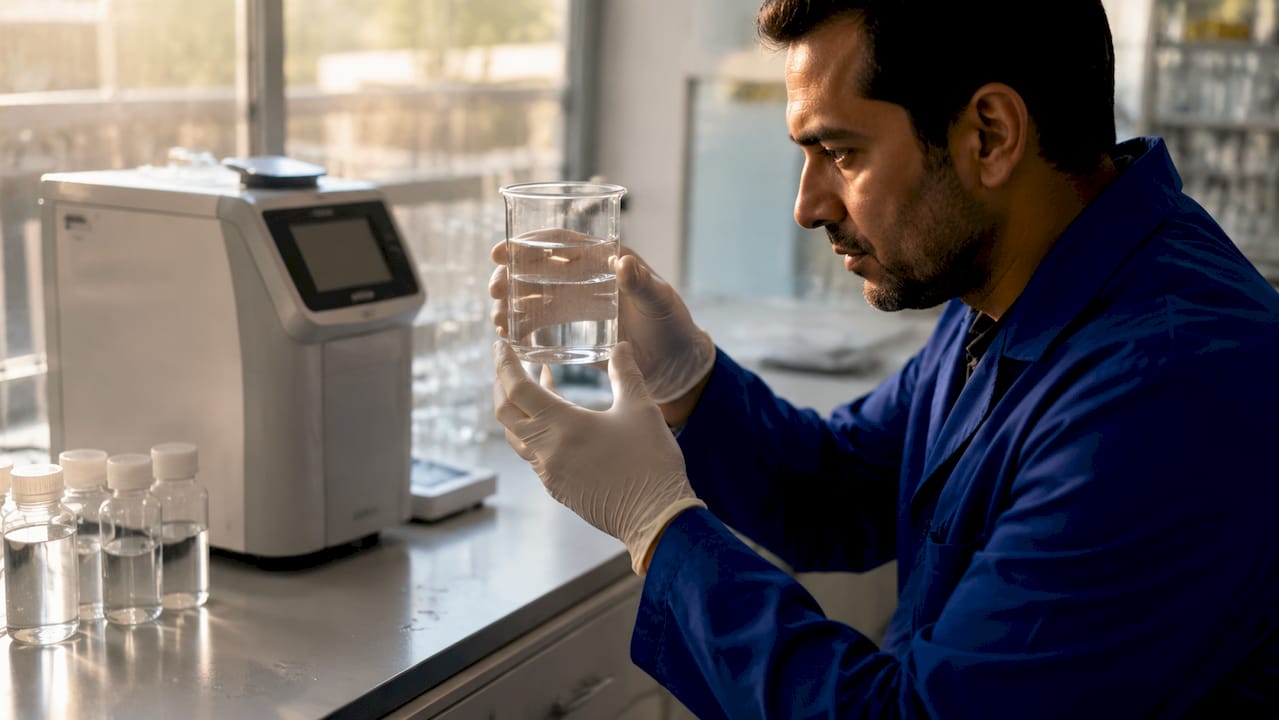
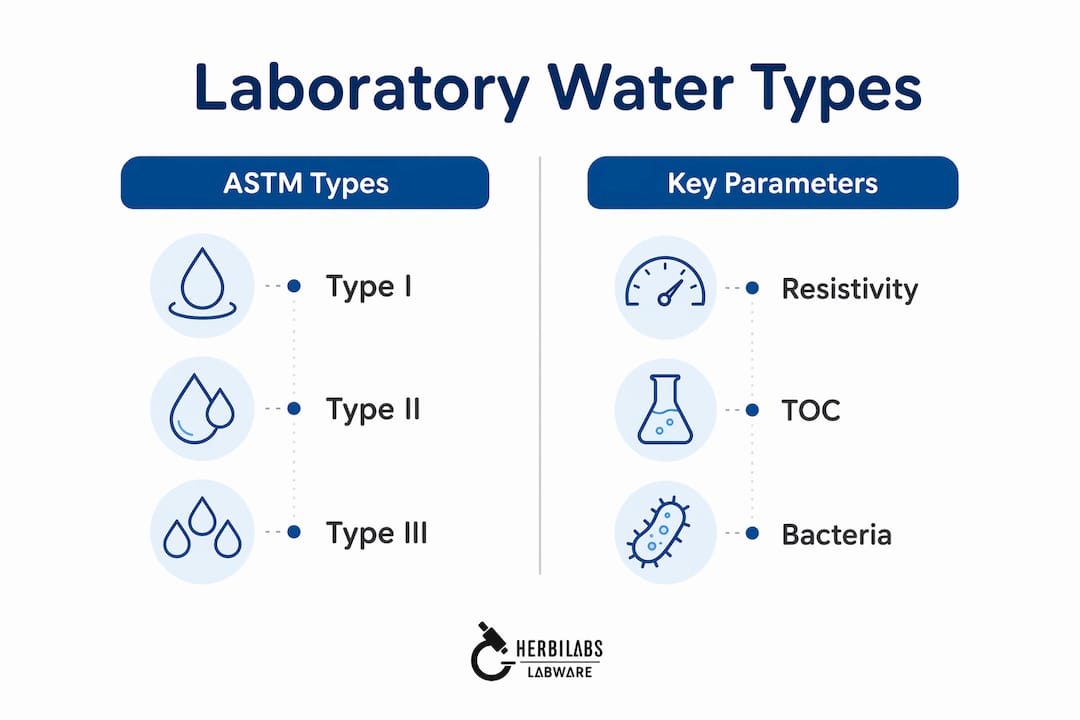
Laboratory water is categorized into Type I (Ultrapure), Type II, and Type III under ASTM D1193-24, with CLSI CLRW serving as a parallel standard for clinical environments. Each type carries distinct numerical thresholds that define its appropriate use.
| Water Type | Resistivity | TOC | Bacteria | Primary Applications |
|---|---|---|---|---|
| ASTM Type I | 18.2 MΩ·cm | < 5–10 ppb | < 10 CFU/mL | LC-MS, ICP-MS, PCR, cell culture |
| ASTM Type II | > 1.0 MΩ·cm | < 50 ppb | < 100 CFU/mL | Buffer preparation, general reagent use |
| ASTM Type III | > 0.05 MΩ·cm | < 200 ppb | < 1,000 CFU/mL | Glassware rinsing, feed water for Type I systems |
| CLSI CLRW | > 10 MΩ·cm | < 500 ppb | < 10 CFU/mL | Clinical analyzers, immunoassays |
Type I water represents the highest purity grade. Its resistivity of 18.2 MΩ·cm is the theoretical maximum for pure water at 25°C. Beyond resistivity, Type I endotoxin limits are set below 0.03 EU/mL for critical analytical applications, which requires advanced purification technologies including UV oxidation and ultrafiltration. This grade is the standard for LC-MS, ICP-MS, PCR, and mammalian cell culture.
Type II water covers the broad middle ground of laboratory use. With resistivity above 1.0 MΩ·cm and TOC below 50 ppb, it is appropriate for preparing buffers, stock solutions, and media where trace ionic or organic contamination will not interfere with the assay. Type III water is the lowest grade under ASTM D1193-24, used primarily for rinsing glassware and feeding upstream purification systems that produce Type I output.
CLSI CLRW deserves specific attention for clinical laboratory professionals. CLRW requires resistivity above 10 MΩ·cm, TOC below 500 ppb, bacteria below 10 CFU/mL, and silica below 0.05 mg/L. The silica limit exists because dissolved silica interferes with photometric and ion-selective electrode sensors in high-throughput clinical analyzers.
Pro Tip: Match the water grade to the sensitivity of the assay, not to the highest available purity. Using Type I water for routine buffer preparation wastes resources and adds unnecessary cost without improving results.
Which water quality parameters are critical for research?
Water quality assessment requires monitoring multiple parameters simultaneously, because no single metric captures the full contamination profile of a water sample.
-
Resistivity and conductivity. Resistivity measures ionic purity directly. At 18.2 MΩ·cm, water contains virtually no dissolved ions. Conductivity is the inverse measurement and is used for online, continuous monitoring. A drop in resistivity signals ionic contamination from dissolved salts, CO2 absorption, or system degradation.
-
Total Organic Carbon (TOC). Ionic purity alone is insufficient for analytical workflows like LC-MS and ICP-MS. TOC monitoring detects dissolved organic molecules that conductivity measurements cannot identify. Sources of organic contamination include plasticizers leaching from tubing, microbial metabolites, and residual cleaning agents. For Type I water, TOC must remain below 5–10 ppb.
-
Microbial contamination and endotoxins. Bacteria produce endotoxins (lipopolysaccharides) even after the cells themselves are removed by filtration. For Type I water, the endotoxin limit is below 0.03 EU/mL. Endotoxin contamination at concentrations above this threshold invalidates cell-based assays and cytotoxicity studies. CFU limits define the viable bacterial load, while endotoxin limits address the biochemical residues those bacteria leave behind.
-
Silica. Dissolved silica is a common interferent in ion chromatography and clinical analyzers. CLSI CLRW sets the silica threshold at 0.05 mg/L. Silica originates from glass components in older purification systems and from feedwater sources with high mineral content.
-
Particles and colloids. Submicron particles are not captured by resistivity or TOC measurements. They are relevant for HPLC column protection and for any application where particulate matter would clog frits or interfere with optical detection.
Pro Tip: Never rely on a single parameter to qualify water for a sensitive application. A water sample can display near-perfect resistivity while carrying significant organic or microbial contamination. Run resistivity, TOC, and microbial checks concurrently on a scheduled basis.
How do water specifications impact experimental outcomes and compliance?
The practical consequences of mismatched water quality fall into two categories: scientific failure and regulatory exposure. Both carry real costs.
-
Assay interference and data loss. Organic contaminants in water used for LC-MS preparation introduce background noise that obscures low-abundance analytes. In PCR workflows, trace nuclease contamination from inadequately purified water degrades template DNA, producing false negatives. A single compromised water batch can invalidate an entire experimental run.
-
Reproducibility failure. Using the correct water grade for specific tasks directly improves experiment reproducibility. When water quality varies between runs because the source is not consistently monitored, inter-assay variability increases. This is a particular problem in pharmaceutical development, where reproducibility data feeds directly into regulatory submissions.
-
Regulatory audit exposure. USP <1231> emphasizes documentation and continuous monitoring over spot checks. During a GMP audit, inspectors review maintenance logs, sensor calibration records, and trending data. A laboratory that achieves correct numerical values on the day of testing but lacks historical documentation will fail the audit regardless of current water quality.
-
Storage-related degradation. Type I water rapidly degrades once stored, absorbing CO2 from the atmosphere and leaching organics from container walls. Resistivity drops measurably within hours of collection. The correct practice is point-of-use dispensing, not batch collection into storage vessels.
-
Cost misallocation. Using Type I water for low-demand tasks wastes purification capacity and consumable life. Conversely, using Type III water in a workflow that requires Type I introduces contamination that may not be detected until results are reviewed. Both errors carry financial consequences, one through unnecessary operating cost and the other through repeated experiments.
The high-purity water benefits for research extend beyond clean data. Consistent water quality reduces instrument maintenance frequency, extends column and sensor life, and supports the documentation trail that regulatory agencies require.
Best practices for maintaining and validating research water quality
Maintaining water specifications is an ongoing operational discipline, not a one-time qualification event. The following practices reflect current ASTM D1193-24 and USP <1231> guidance as updated through 2026.
-
Use Type I water immediately at the point of use. Storing ultrapure water leads to rapid degradation. Install point-of-use dispensing directly at the instrument or workstation. Avoid collecting Type I water into open containers for later use.
-
Calibrate sensors with NIST-traceable standards. Sensor calibration using NIST-traceable standards and detailed maintenance logs is the baseline requirement for audit acceptance of water quality data. Resistivity and TOC sensors drift over time. Scheduled calibration intervals should be defined in the laboratory’s quality management system.
-
Implement continuous online monitoring. Spot checks provide a snapshot; online TOC and conductivity monitoring provides a trend. Online monitoring paired with maintenance documentation is the standard that pharmaceutical water quality compliance requires. Alarms should be configured to flag deviations before they affect production batches or experimental runs.
-
Account for feedwater variability. Water quality standards alone cannot guarantee purity. The performance of any purification system depends on the quality of its feedwater, the volume processed, and the design of the distribution loop. Seasonal variation in municipal water quality, for example, can shift the ionic and organic load entering the system and require adjustments to purification parameters.
-
Schedule microbial sampling at defined intervals. Microbial contamination builds in distribution loops and storage tanks. Maintaining storage tank hygiene through regular sanitization cycles and monitoring prevents biofilm formation that would otherwise continuously seed the water supply with bacteria and endotoxins.
-
Document everything. Maintenance logs, calibration certificates, sampling results, and corrective action records form the evidence base for regulatory compliance. The lab water quality control discipline requires that records be traceable, timestamped, and retained according to the applicable regulatory framework.
| Validation Activity | Frequency | Standard Reference |
|---|---|---|
| Resistivity / conductivity check | Continuous (online) | ASTM D1193-24 |
| TOC monitoring | Continuous (online) | USP <1231> |
| Microbial sampling | Weekly to monthly | CLSI CLRW, USP <1231> |
| Sensor calibration | Per manufacturer schedule | NIST-traceable |
| Full system sanitization | Quarterly or as indicated | Site-specific SOP |
The specification gap most labs overlook
The most consistent error I see in laboratory water management is treating specifications as a pass/fail gate rather than a continuous quality indicator. A laboratory installs a purification system, qualifies it against ASTM D1193-24 at commissioning, and then assumes the water remains compliant indefinitely. That assumption is wrong, and it is expensive when it fails.
Water quality is dynamic. Feedwater composition shifts with seasons and municipal treatment changes. Purification membranes and ion exchange resins degrade gradually, not suddenly. TOC can climb for weeks before resistivity shows any deviation, which means a lab relying solely on conductivity monitoring is operating blind to organic contamination. I have seen LC-MS datasets rendered unusable by this exact scenario, where resistivity looked fine but TOC had drifted above 50 ppb for an extended period.
The second error is over-specifying. Researchers sometimes default to Type I water for every application because it feels like the safe choice. It is not. Type I water used in applications that do not require it still degrades in the container, still costs more to produce, and still consumes purification capacity. The correct approach is to map each workflow to its minimum required specification and then monitor that specification continuously.
The third error is treating documentation as administrative overhead rather than scientific infrastructure. Regulatory agencies do not accept verbal assurances of water quality. They accept calibration records, trend charts, and corrective action logs. Building that documentation habit from the start of a project costs far less than reconstructing it during an audit.
The research-grade water reliability argument is not abstract. It shows up directly in data quality, instrument longevity, and audit outcomes.
— Ragnar
High-purity water products for your research workflow
Selecting the right water grade is only part of the equation. The reconstitution solutions and sterile diluents you use to prepare research samples must meet the same purity standards as the water itself.
Herbilabs supplies research-grade high-purity reconstitution solutions manufactured to strict purity standards in a dedicated facility, with rigorous quality control at every production stage. Whether you need sterile diluents for peptide reconstitution or bacteriostatic water for extended sample stability, Herbilabs products are designed to meet the contamination thresholds that ASTM, CLSI, and USP specifications require. Explore the full catalog to find the right solution for your application, with wholesale pricing available for research institutions and resellers across the UK and Europe.
FAQ
What is the difference between ASTM type i and CLSI CLRW?
ASTM Type I water requires resistivity of 18.2 MΩ·cm and TOC below 5–10 ppb, making it the highest purity grade for analytical applications. CLSI CLRW requires resistivity above 10 MΩ·cm and TOC below 500 ppb, with an additional silica limit of 0.05 mg/L specific to clinical analyzer performance.
Why does type i water degrade so quickly after collection?
Type I water absorbs atmospheric CO2 and leaches organics from container walls within hours of collection, causing resistivity to drop and TOC to rise. Point-of-use dispensing is the only reliable method for maintaining Type I purity at the moment of use.
How often should laboratory water quality be tested?
Resistivity and TOC should be monitored continuously using online sensors, while microbial sampling should occur weekly to monthly depending on the application and regulatory framework. USP <1231> requires documentation of continuous monitoring rather than periodic spot checks alone.
What causes TOC to rise even when resistivity remains acceptable?
Organic contamination from plasticizer leaching, microbial metabolites, and residual cleaning agents raises TOC without affecting ionic content. Resistivity and TOC measure different contamination classes, so both must be monitored independently to characterize water quality fully.
Which water specification standard applies to pharmaceutical research?
USP <1231> governs water quality in pharmaceutical and biopharmaceutical research environments. It specifies purified water and water for injection (WFI) standards, with compliance demonstrated through continuous online monitoring and complete documentation of system maintenance and validation activities.
Key takeaways
Accurate research water specifications require matching the water grade to the application, monitoring multiple parameters continuously, and maintaining complete documentation for regulatory compliance.
| Point | Details |
|---|---|
| Match grade to application | Use Type I for LC-MS and PCR; use Type II or III for buffers and glassware rinsing to avoid waste. |
| Monitor TOC alongside resistivity | Resistivity alone misses organic contamination; concurrent TOC monitoring is required for analytical accuracy. |
| Use Type I at point of use | Type I water degrades within hours of collection; dispense directly at the instrument to maintain purity. |
| Document continuously | USP <1231> and ASTM D1193-24 require trend data and calibration records, not just passing spot-check values. |
| Account for system variables | Feedwater quality, distribution loop design, and seasonal variation all affect final water purity beyond what standards alone specify. |