Private Label, White Label, Wholesale partnerships available - EU, USA and UK - Free shipping from €75
Why Use Research-Grade Water for Reliable Lab Results
Discover why use research-grade water for lab results. Ensure accuracy and reliability in your experiments with ultrapure water standards.
TL;DR:
- Research-grade water, typically ASTM Type I ultrapure, is essential for ensuring accurate and reproducible laboratory data by minimizing ionic, organic, and microbial contamination. Impurities in water actively interfere with sensitive analytical techniques, compromising validity and confidence in results across platforms like ICP-MS and PCR. Using appropriately purified water and maintaining rigorous handling practices are crucial for reliable scientific outcomes.
Research-grade water is defined as ultrapure water purified to meet stringent specifications for resistivity, total organic carbon (TOC), and microbiological content, making it the foundational reagent in any credible laboratory workflow. Understanding why use research-grade water begins with recognizing that water is not merely a solvent. It is a variable that directly determines whether your analytical data reflects biological or chemical reality, or an artifact of contamination. The ASTM International classification system and Clinical Laboratory Reagent Water (CLRW) standards exist precisely because the consequences of using substandard water range from calibration drift to complete assay failure.
Why use research-grade water: purity standards that define it
Research-grade water, formally classified as ASTM Type I ultrapure water, is characterized by a resistivity of 18.2 MΩ·cm at 25°C and a TOC below 50 ppb. These two parameters are not arbitrary thresholds. They represent the point at which ionic and organic contamination drops below the detection interference threshold for the most sensitive analytical instruments in use today, including ICP-MS, HPLC, and qPCR platforms.
Clinical Laboratory Reagent Water (CLRW) adds a microbiological dimension to this definition. CLRW standards require bacterial counts below 10 CFU/mL and silica concentrations below 0.05 mg/L, preventing sensor fouling and false-positive interferences in high-throughput diagnostic analyzers. These specifications are not interchangeable with general Type I parameters, and laboratories running clinical diagnostics must verify compliance with both frameworks.
Achieving these purity levels requires a multi-stage purification train. Common technologies include:
- Reverse osmosis (RO): Removes dissolved salts, particulates, and a significant fraction of organic compounds as a primary treatment stage.
- Electrodeionization (EDI): Provides continuous, chemical-free ion removal without the periodic resin regeneration cycles that introduce contamination risk in traditional ion exchange systems.
- UV photo-oxidation: Degrades trace organic molecules and inactivates microorganisms; 185 nm UV lamps are specifically required for molecular biology applications.
- Ultrafiltration: Removes nucleases, endotoxins, and colloidal particles that pass through earlier stages, critical for DNA sequencing and cell culture work.
Pro Tip: For molecular biology methods such as PCR and DNA sequencing, standard Type I water requires additional UV irradiation and ultrafiltration steps to remove nucleases and reduce TOC to levels appropriate for nucleic acid work. Confirm your purification system includes these stages before use.
How do impurities affect experimental accuracy and reproducibility?
Water purity is fundamentally a data quality decision. Trace ionic, organic, and microbial contaminants do not simply dilute your sample. They actively interfere with instrument signals, compete with analytes at detection surfaces, and introduce biological activity that alters cell-based assay outcomes. The result is data that cannot be trusted, replicated, or published with confidence.
“Water is the base quality pillar in laboratories, often underestimated despite its universal influence on reproducibility and data integrity.” (Pharma Advancement)
The specific failure modes vary by technique, but the pattern is consistent across platforms:
- HPLC and LC-MS: Ionic contaminants shift baseline noise and suppress ionization efficiency. PFAS contamination at single-digit parts-per-trillion levels generates false positives in sensitive LC-MS analyses, a finding with direct implications for environmental and pharmaceutical testing laboratories in 2026.
- ICP-MS: Trace metal contamination in water directly elevates background counts for target analytes, compressing the dynamic range and raising detection limits. A water source with even 1 ppb of sodium or calcium introduces measurable interference in sub-ppb metal quantification.
- PCR and qPCR: Nucleases present in insufficiently purified water degrade template DNA and primers, producing inconsistent amplification curves and false-negative results that are frequently misattributed to reagent failure.
- Cell culture: Endotoxins and microbial contaminants at sub-visible concentrations trigger inflammatory responses in mammalian cell lines, altering gene expression profiles and invalidating phenotypic assays.
Inconsistent water quality across research sites is a documented driver of experimental drift in multi-site pharmaceutical R&D programs, with investigations lasting months and costing millions before water variability is identified as the root cause. This is the practical argument for treating water purity as a controlled variable, not an assumption.
How do research-grade water types compare across laboratory applications?
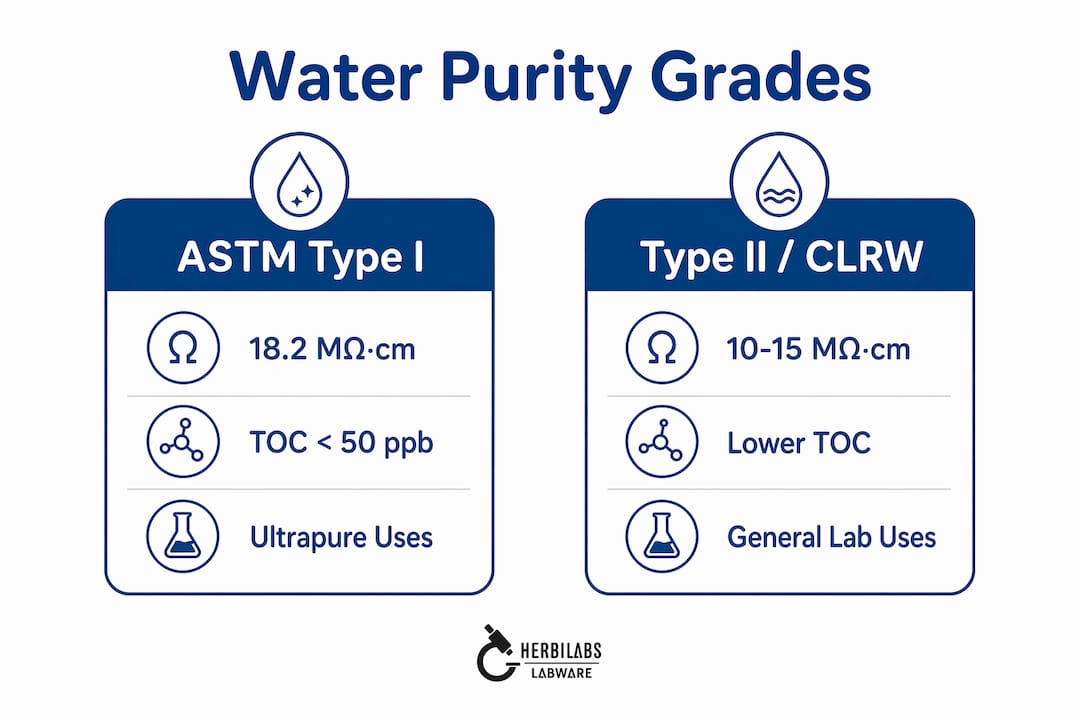
Not every laboratory application requires Type I ultrapure water, and over-specifying water grade adds unnecessary cost. The ASTM classification system provides a structured framework for matching water purity to application requirements.
| Water grade | Resistivity | TOC | Typical applications |
|---|---|---|---|
| ASTM Type I (ultrapure) | 18.2 MΩ·cm at 25°C | < 50 ppb | Trace metal analysis, ICP-MS, HPLC, PCR, cell culture, DNA sequencing |
| ASTM Type II | 1.0 MΩ·cm | < 50 ppb | Reagent preparation, microbiological culture media, general chemistry |
| ASTM Type III | 0.05 MΩ·cm | Not specified | Feed water for Type I/II systems, glassware rinsing |
| CLRW | 10 MΩ·cm | < 500 ppb | Clinical diagnostic analyzers, immunoassay platforms |
Type II water is appropriate for reagent preparation and microbiological media where trace-level ionic interference is not a concern. Type III water, typically produced by reverse osmosis alone, lacks the purity for any analytical or cell-based application and functions correctly only as feed water for downstream polishing systems.
CLRW occupies a distinct position in this hierarchy. Its resistivity specification of 10 MΩ·cm is lower than Type I, but its microbiological and silica requirements are specifically calibrated to protect the optical and electrochemical sensors in clinical chemistry analyzers. Using Type III or tap-derived water in a clinical analyzer is not merely a quality compromise. It causes measurable sensor fouling within weeks, leading to instrument downtime and diagnostic errors.
Pro Tip: When specifying water for a new analytical platform, consult the instrument manufacturer’s water quality requirements before selecting a purification system. Many modern mass spectrometers and sequencing platforms specify purity parameters that exceed standard ASTM Type I, requiring additional polishing stages.
Best practices for selecting, producing, and handling high-purity water
Selecting the right purification system and managing water correctly after production are equally important. A correctly specified system operated with poor handling discipline will still deliver contaminated water to your experiments.
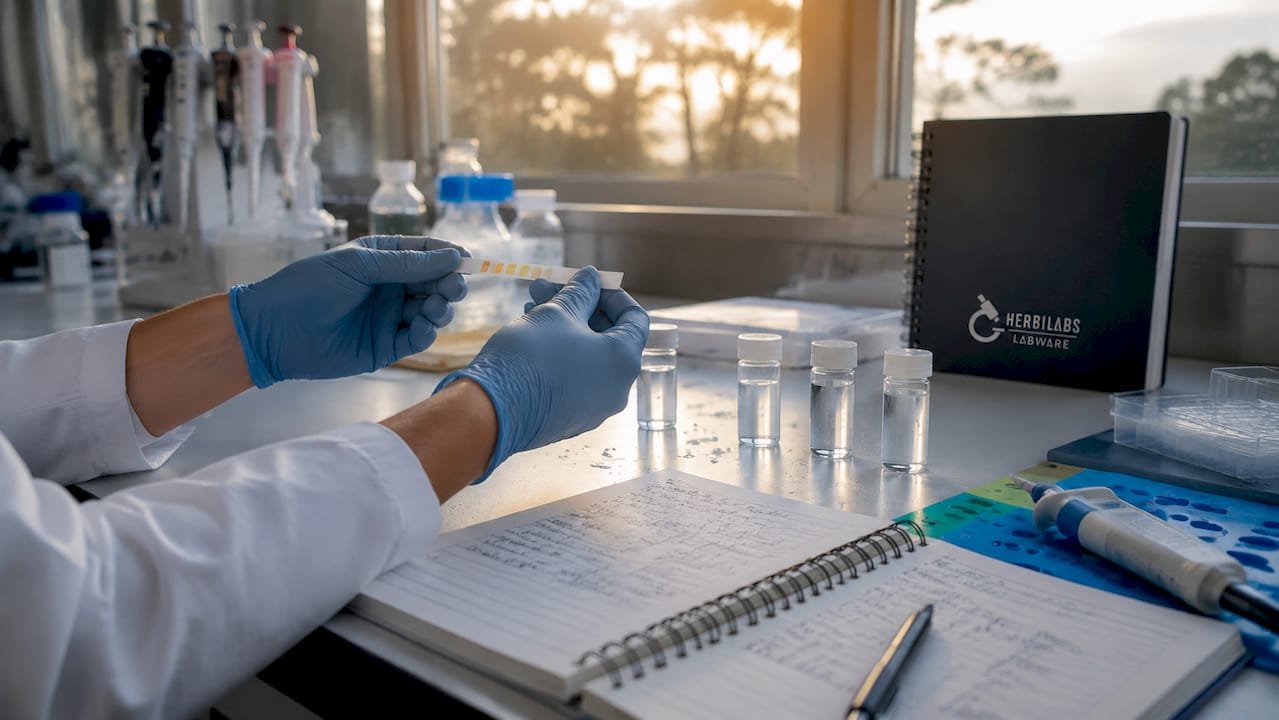
The most consequential handling rule for ultrapure water is immediate use after dispensing. Type I water degrades rapidly upon exposure to atmosphere, absorbing CO₂ to form carbonic acid and leaching plasticizers and ions from container walls. This degradation begins within minutes, which is why ultrapure water must never be stored in open containers or pre-filled reservoirs. The practical implication is that point-of-use dispensing systems are not a convenience feature. They are a purity requirement.
Key considerations for system selection and maintenance include:
- Match system output to application volume. A centralized RO/EDI system suits high-throughput environments, while decentralized polishing units at individual workstations reduce distribution line contamination risk for trace-sensitive work.
- Prioritize real-time quality monitoring. Systems equipped with inline resistivity and TOC sensors provide continuous verification of water quality. Bottled ultrapure water carries batch certificates that may be up to two months old and does not reflect purity at the point of use, making in-house generation superior for any trace-sensitive application.
- Implement biofilm control protocols. Biofilms form on internal surfaces of distribution lines and storage tanks, continuously shedding bacteria and endotoxins into the water stream. Sanitization schedules, UV recirculation loops, and hydrophilic tubing materials all reduce this risk.
- Monitor resin exhaustion. Ion exchange resins in polishing cartridges release ions as they approach exhaustion, causing resistivity to drop below specification. Establish cartridge replacement schedules based on actual water consumption, not calendar intervals.
- Evaluate EDI over traditional ion exchange for high-volume labs. EDI eliminates the chemical regeneration cycle entirely, reducing both operational cost and the contamination events associated with resin handling.
The shift toward on-demand ultrapure water production also addresses emerging contaminant concerns. PFAS compounds, which interfere with LC-MS analyses at parts-per-trillion concentrations, are not removed by standard RO alone and require activated carbon or specialized membrane stages. Laboratories conducting PFAS analysis or working with PFAS-sensitive matrices should verify that their purification train includes these stages and that their system is validated for PFAS-free output.
For laboratories evaluating the benefits of high-purity water against the cost of in-house generation, the calculation consistently favors on-site systems at any meaningful throughput. Bottled ultrapure water carries a significant per-liter premium, introduces handling and storage contamination risk, and provides no real-time quality assurance.
Key takeaways
Research-grade water is the single most universal reagent in laboratory science, and its purity directly determines the validity of every measurement made with it.
| Point | Details |
|---|---|
| Type I defines the gold standard | ASTM Type I water at 18.2 MΩ·cm and TOC below 50 ppb is required for trace analysis, PCR, and cell culture. |
| Impurities cause measurable data errors | Trace contaminants suppress signals or generate false positives, invalidating analytical results across HPLC, ICP-MS, and qPCR. |
| Water grade must match application | Type II suits reagent preparation; Type III is feed water only; CLRW is calibrated for clinical diagnostic analyzers. |
| Ultrapure water cannot be stored | Type I water degrades within minutes of dispensing, requiring point-of-use production and immediate use. |
| On-site generation outperforms bottled water | Real-time monitoring and on-demand production eliminate the purity uncertainty inherent in bottled ultrapure water. |
Water quality as the variable most laboratories underestimate
I have reviewed laboratory investigation reports where months of troubleshooting pointed to reagent lots, operator technique, and instrument calibration before anyone tested the water. The water failed. It almost always does when it has not been actively managed. The uncomfortable reality is that water quality is treated as a background condition in most laboratory quality systems, when it should be treated as a primary controlled variable with its own specification, monitoring schedule, and deviation protocol.
The trend I find most significant in 2026 is the convergence of PFAS monitoring requirements with ultrapure water production. Laboratories that have not updated their purification systems in the past five years are almost certainly producing water that would fail a PFAS-specific validation, even if resistivity and TOC readings appear acceptable. Resistivity measures ionic content. It tells you nothing about PFAS, endocrine-disrupting compounds, or pharmaceutical residues that pass through standard polishing stages.
My practical advice is to treat your water purification system as an analytical instrument, not as infrastructure. Validate it on installation, qualify it periodically, and monitor it continuously. The cost of a failed assay, a retracted dataset, or a regulatory deviation far exceeds the cost of a properly maintained purification system. For laboratories working with water quality control as a formal quality parameter, the documentation discipline alone reduces investigation time significantly when problems do arise.
— Ragnar
High-purity water solutions from Herbilabs for demanding research
Herbilabs supplies research-grade reconstitution solutions and high-purity water products manufactured to strict purity standards, with rigorous quality control at every production stage. Whether you are reconstituting lyophilized peptides, preparing sterile diluents, or sourcing bacteriostatic water for sensitive research applications, Herbilabs provides contaminant-free products with verified specifications.
Herbilabs’ product range is designed for researchers, laboratory professionals, and independent scientists who cannot afford purity uncertainty in their workflows. Explore the top high-purity reconstitution solutions available for 2026, including bacteriostatic water and sterile diluents optimized for peptide research and molecular biology applications across the UK and Europe.
FAQ
What is research-grade water and why does it matter?
Research-grade water is ultrapure water meeting ASTM Type I specifications of 18.2 MΩ·cm resistivity and TOC below 50 ppb. It matters because trace ionic, organic, and microbial contaminants in lower-grade water directly cause false positives, signal suppression, and irreproducible results in sensitive analytical techniques.
When should you use Type I versus Type II water?
Type I ultrapure water is required for trace metal analysis, HPLC, ICP-MS, PCR, and cell culture. Type II water is appropriate for general reagent preparation and microbiological media where sub-ppb ionic interference is not a concern.
Can you store ultrapure water for later use?
Ultrapure water cannot be stored effectively. It absorbs atmospheric CO₂ and leaches ions from container walls within minutes of dispensing, degrading below specification. Point-of-use production and immediate use are required to maintain Type I purity.
Why is bottled ultrapure water less reliable than in-house generation?
Bottled ultrapure water carries quality certificates that may be up to two months old and does not reflect purity at the point of use. In-house systems with real-time resistivity and TOC monitoring provide continuous, verified quality assurance that bottled water cannot match.
What is CLRW and how does it differ from ASTM Type I?
Clinical Laboratory Reagent Water (CLRW) is a standard specifically calibrated for clinical diagnostic analyzers, requiring resistivity of at least 10 MΩ·cm, bacterial counts below 10 CFU/mL, and silica below 0.05 mg/L. Unlike ASTM Type I, CLRW prioritizes microbiological and silica control to protect sensitive analyzer sensors rather than achieving maximum ionic purity.