Private Label, White Label, Wholesale partnerships available - EU, USA and UK - Free shipping from €75

ISO Standards for Labs Explained: 2026 Guide
Discover the essential ISO standards for labs explained in this comprehensive 2026 guide. Ensure accuracy and reliability in your laboratory results.
TL;DR:
- ISO standards for laboratories establish international frameworks ensuring accurate, reliable results through management and technical requirements. ISO/IEC 17025 applies to testing labs, emphasizing measurement uncertainty, traceability, and competence, while ISO 15189 targets medical labs with additional patient safety protocols. Achieving accreditation takes 12 to 24 months of structured implementation, continuous improvement, and thorough documentation.
ISO standards for laboratories are defined as the internationally recognized frameworks that establish the technical and management requirements a laboratory must meet to produce accurate, reliable, and defensible results. The two most critical standards are ISO/IEC 17025, which governs testing and calibration laboratories, and ISO 15189, which applies specifically to medical and clinical labs. Understanding ISO lab standards is no longer optional for research institutions, contract testing facilities, or compliance officers. These frameworks define what “competent” means in practice, and they determine whether your results are accepted by regulators, clients, and peer reviewers alike. This article covers iso standards for labs explained from the ground up, including accreditation processes, technical requirements, and how to implement them effectively.
What are ISO standards for labs and why do they matter?
ISO standards for laboratories are formal documents published by the International Organization for Standardization that specify minimum requirements for quality, competence, and operational consistency. They are not voluntary best practices. ISO accreditation is now a baseline regulatory requirement for market access in many sectors, meaning suppliers and testing labs must hold recognized accreditation simply to qualify for contracts or regulatory submissions. That shift from competitive advantage to entry requirement changes how labs should approach compliance entirely.

The importance of ISO standards lies in what they actually verify. A certified lab is not just an organized lab. It is a lab that has demonstrated technical validity through documented evidence, third-party audits, and ongoing quality management. For researchers supplying data to regulatory bodies or publishing in peer-reviewed journals, ISO compliance for laboratories provides the credibility infrastructure that makes results defensible. For compliance officers, it defines the audit trail that protects the organization.
ISO standards in scientific research also serve a coordination function. When labs across different countries operate under the same standard, their results become mutually comparable. This is critical for multi-site clinical trials, international supply chain testing, and cross-border regulatory submissions.
What is iso/iec 17025 and why is it critical for testing labs?
ISO/IEC 17025:2017 is the global benchmark for testing and calibration laboratories, covering every facility that generates technical data as its primary output. The standard is structured around two core requirement categories: management requirements and technical requirements. Both must be satisfied for accreditation.
Management requirements under ISO 17025 include:
- A documented quality management system (QMS) with defined policies and procedures
- Internal audit programs with corrective action protocols
- Document control and records management
- Impartiality and confidentiality obligations
- Complaint handling and nonconforming work procedures
Technical requirements go further and are where most labs encounter difficulty:
- Personnel competence, including documented training records and competency assessments
- Equipment calibration with traceable reference standards
- Measurement traceability to national or international standards
- Documented uncertainty of measurement for every test method
- Validation or verification of all test and calibration methods
The measurement uncertainty documentation requirement is the single most common differentiator between labs that achieve accreditation and those that do not. Many labs can demonstrate organized processes, but proving that their numerical results carry a quantified, defensible uncertainty margin requires a different level of technical rigor.
Accreditation under ISO 17025 is granted by national bodies. In the United States, the American Association for Laboratory Accreditation (A2LA) is the primary body. In the United Kingdom, UKAS performs this function. Both conduct third-party on-site assessments as part of the accreditation process.
Pro Tip: Sector-specific interpretation documents, such as the AOAC ALACC guidelines, translate ISO 17025’s abstract clauses into auditable laboratory procedures. Labs working in food testing, environmental analysis, or agricultural chemistry should consult AOAC guidance before drafting their QMS documentation.
How does ISO 15189 apply to medical and clinical laboratories?
ISO 15189 is the international standard for quality and competence in medical laboratories, including diagnostic, therapeutic, and public health service labs. It builds on the quality management principles of ISO 9001 but adds five requirement categories specific to the medical lab environment. General quality management frameworks do not address the patient safety dimensions that ISO 15189 covers.
The five additional requirements under ISO 15189 that go beyond general ISO quality management are:
- Pre-examination processes: Sample collection, transport, and handling procedures that affect result integrity before any analysis begins
- Examination processes: Validated methods with documented performance characteristics specific to clinical use
- Post-examination processes: Result reporting, interpretation guidance, and critical value notification protocols
- Biological reference intervals: Documented reference ranges appropriate for the patient population served
- Laboratory advisory services: Mechanisms for clinical staff to consult with laboratory professionals on result interpretation
The certification process for ISO 15189 follows a defined sequence. The lab conducts a self-audit against the standard, implements required changes, applies to a recognized certification body, and undergoes a compliance audit. ISO 15189 certification is valid for three years, after which a re-certification audit is required to maintain status. This three-year cycle reinforces the standard’s expectation of continuous improvement rather than one-time compliance.
For clinical labs, ISO 15189 accreditation directly affects diagnostic service quality. It provides the documented framework that ensures a result generated in one accredited lab carries the same reliability as one generated in another, regardless of geography or equipment brand.
What are the practical steps to achieve ISO lab accreditation?
The ISO 17025 accreditation process takes 12–24 months for most laboratories undertaking it for the first time. That timeline assumes structured implementation and genuine organizational commitment. Labs that treat accreditation as a documentation exercise rather than a quality transformation consistently exceed this timeline or fail their initial assessment.
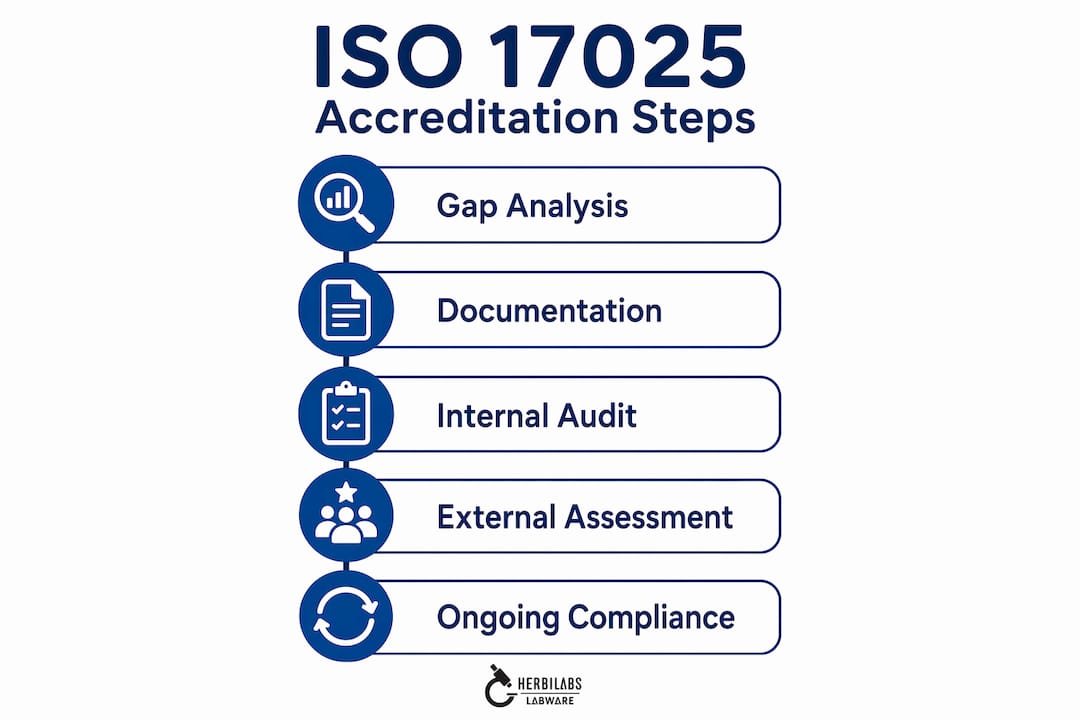
The practical implementation sequence follows these steps:
- Gap analysis: Compare current lab practices against the full requirements of the relevant standard. Identify deficiencies in documentation, equipment records, personnel training, and method validation.
- QMS development: Draft and implement a quality management system that covers all management requirement clauses. This includes a quality manual, standard operating procedures (SOPs), and controlled document registers.
- Staff training: Train all personnel on the QMS, their specific procedural responsibilities, and the technical requirements relevant to their roles. Document all training with competency assessments.
- Equipment calibration and traceability: Establish calibration schedules for all measurement equipment. Obtain calibration certificates from accredited providers and document traceability chains to national standards.
- Method validation or verification: Validate new methods or verify existing methods against published performance criteria. Document all validation data, including precision, accuracy, linearity, and measurement uncertainty.
- Internal audits: Conduct at least one full internal audit cycle before applying for external assessment. Address all nonconformities with documented corrective actions and effectiveness reviews.
- Application to accreditation body: Submit the application to A2LA, UKAS, or the relevant national body. Provide documentation packages as requested.
- Third-party assessment: Host the on-site assessment team. Assessors will review documentation, interview staff, and witness testing activities.
- Corrective action and approval: Address any nonconformities identified during the assessment. Accreditation is granted once all findings are resolved to the assessor’s satisfaction.
The most common failure point is step five. Labs frequently underestimate the rigor required to document measurement uncertainty across all test methods. This is not a calculation that can be retrofitted after the fact. It must be built into method development from the start.
Pro Tip: Sector-specific guidelines from AOAC convert high-level standard clauses into precise, auditable protocols. Using these documents during QMS development reduces interpretation errors and significantly improves first-assessment pass rates.
Maintaining accreditation after initial approval requires the same discipline as achieving it. Internal audits, management reviews, proficiency testing participation, and equipment recalibration must continue on schedule. Labs that relax their quality programs between surveillance visits routinely discover significant nonconformities at renewal.
ISO 17025 vs. ISO 9001: what is the difference for labs?
ISO 9001 and ISO 17025 are both quality management standards, but they serve fundamentally different purposes in a laboratory context. Understanding the distinction is critical for compliance officers deciding which standard applies to their facility.
ISO 9001 is a general quality management standard applicable to any organization that produces products or services. It focuses on process consistency, customer satisfaction, and continual improvement. ISO 9001 certification does not verify that a lab’s technical results are accurate or that its measurement methods are valid.
ISO 17025 includes all the management system elements found in ISO 9001 and adds a complete technical competence layer. This layer covers measurement traceability, method validation, uncertainty of measurement, and equipment calibration. A lab can hold ISO 9001 certification and still produce technically invalid results. ISO 17025 accreditation closes that gap.
| Criterion | ISO 9001 | ISO/IEC 17025 |
|---|---|---|
| Scope | Any organization | Testing and calibration labs only |
| Focus | Process quality management | Technical competence and result validity |
| Technical requirements | Not included | Measurement traceability, uncertainty, method validation |
| Third-party verification | Certification audit | Accreditation assessment by national body |
| Regulatory acceptance | General business use | Required for regulatory submissions and contract testing |
| Accreditation body | Commercial certification bodies | A2LA, UKAS, national accreditation bodies |
For ISO quality management in labs that generate data used in regulatory filings, contract testing, or clinical decisions, ISO 17025 is the required standard. ISO 9001 alone does not satisfy the technical validity requirements that regulators, clients, and accreditation bodies expect.
Key takeaways
ISO standards for laboratories define technical competence through documented evidence, third-party verification, and continuous quality management, with ISO/IEC 17025 and ISO 15189 as the two primary frameworks governing testing and clinical labs respectively.
| Point | Details |
|---|---|
| ISO 17025 is the core testing standard | It covers both management and technical requirements, including measurement uncertainty and equipment traceability. |
| ISO 15189 applies to medical labs | It adds five clinical-specific requirements beyond general quality management, with three-year certification cycles. |
| Accreditation takes 12–24 months | Structured implementation, staff training, and internal audits are required before third-party assessment. |
| Measurement uncertainty is the critical differentiator | Labs that cannot document uncertainty for each test method consistently fail initial accreditation assessments. |
| ISO 9001 does not replace ISO 17025 | ISO 9001 lacks the technical competence requirements that regulators and accreditation bodies require from testing labs. |
ISO standards in 2026: what i’ve learned about getting them right
The conversation around ISO accreditation has shifted considerably. When I first worked through ISO 17025 implementation with a mid-size environmental testing lab, the common assumption was that accreditation was a documentation project. Build the manual, train the staff, pass the audit. That framing is wrong, and it costs labs significant time and money when they discover it during the assessment.
What I have observed consistently is that the labs which succeed on their first attempt treat the standard as a technical competence framework, not a paperwork exercise. They invest in measurement uncertainty training before they write a single SOP. They run internal audits with the same rigor an external assessor would apply. They use resources like the AOAC ALACC guidelines to translate abstract clauses into specific, testable procedures rather than writing generic policies that satisfy the letter of the standard but not its intent.
The other shift worth noting is that ISO accreditation is now a baseline market expectation, not a differentiator. Regulatory bodies, procurement teams, and research partners increasingly require it as a precondition for engagement. Labs that have not started their accreditation process are not behind the curve. They are outside the market. The practical advice I give every compliance officer is this: start the gap analysis now, engage your accreditation body early for pre-assessment guidance, and build measurement uncertainty documentation into your method development process from day one. The labs that treat continuous improvement as a genuine operating principle, rather than a phrase in their quality manual, are the ones that maintain accreditation without crisis.
— Ragnar
How Herbilabs supports iso-compliant laboratory operations
Laboratories operating under ISO/IEC 17025 or ISO 15189 require reagents and reconstitution solutions that meet documented purity standards and come with traceable manufacturing records. Herbilabs manufactures research-grade bacteriostatic water, sterile diluents, and reconstitution solutions in a dedicated facility under rigorous quality control protocols, supplying research institutions, universities, and independent researchers across the UK and Europe.
For labs where reagent purity directly affects measurement validity and accreditation compliance, Herbilabs provides high-purity reconstitution solutions manufactured to strict contaminant-free standards. Each product is designed to support the traceability and documentation requirements that ISO-accredited labs depend on. Explore the full product range at Herbilabs to source reagents that align with your quality management obligations and support reliable, defensible results.
FAQ
What is iso/iec 17025 in simple terms?
ISO/IEC 17025 is the international standard that defines the technical and management requirements a testing or calibration laboratory must meet to produce valid, reliable results. Accreditation under this standard is granted by national bodies such as A2LA or UKAS following a third-party assessment.
How long does ISO lab accreditation take?
The ISO 17025 accreditation process typically takes 12–24 months from initial gap analysis to accreditation approval. This timeline depends on the lab’s starting point, the complexity of its test methods, and the speed of corrective action implementation.
What is the difference between ISO 17025 and ISO 15189?
ISO 17025 applies to testing and calibration laboratories across all sectors, while ISO 15189 is specifically designed for medical and clinical laboratories. ISO 15189 adds five clinical-specific requirements, including pre-examination processes and biological reference intervals, that ISO 17025 does not address.
Is ISO 9001 sufficient for a testing laboratory?
ISO 9001 is not sufficient for laboratories that generate technical data for regulatory or contractual purposes. It covers process quality management but does not include the technical competence requirements, such as measurement uncertainty and method validation, that ISO 17025 mandates.
What is the most common reason labs fail ISO 17025 accreditation?
The most common failure point is inadequate documentation of measurement uncertainty across all test methods. Labs that cannot provide a quantified, defensible uncertainty estimate for each method they offer consistently receive nonconformities during their initial third-party assessment.