Private Label, White Label, Wholesale partnerships available - EU, USA and UK - Free shipping from €75

Labware Selection Tips for Lab Professionals in 2026
Discover essential labware selection tips to enhance research integrity, avoid costly mistakes, and ensure optimal performance in 2026.
TL;DR:
- Choosing appropriate labware requires defining criteria such as chemical compatibility, purity, and size before evaluation to prevent procurement errors. Selecting materials like borosilicate glass or polypropylene depends on their performance under specific research conditions, considering factors like chemical resistance and thermal stability. A systematic vendor evaluation and analysis of total ownership costs ensure reliable, cost-effective labware choices tailored to your scientific application.
Choosing the wrong labware is rarely obvious until the damage is done. A polypropylene tube that leaches trace contaminants into a reconstitution solution, a glass vial sized incorrectly for automated pipetting, or a storage vessel chemically incompatible with your solvent — each of these errors can invalidate weeks of data and inflate costs significantly. These labware selection tips are designed to move researchers and laboratory professionals past generic catalog-browsing and toward a systematic, application-driven approach that protects both experimental integrity and procurement budgets.
Table of Contents
- Key takeaways
- 1. Establish selection criteria before browsing options
- 2. Understand the major labware types and their trade-offs
- 3. Use a side-by-side material comparison for rapid evaluation
- 4. Match labware to your specific scientific application
- 5. Apply a structured vendor evaluation process
- 6. Account for total cost of ownership, not purchase price
- 7. Maintain labware integrity through proper handling and storage
- My perspective on labware selection mistakes
- Herbilabs supports your labware and reagent decisions
- FAQ
Key takeaways
| Point | Details |
|---|---|
| Define criteria before browsing | Establish chemical compatibility, purity standards, and size requirements before evaluating any labware option. |
| Material choice determines purity | High-quality plastic resins and minimized additives reduce leachables and extractables that compromise sample integrity. |
| Total cost exceeds purchase price | Factor in calibration, maintenance, and facility requirements to understand the true cost of labware decisions. |
| Vendor scoring prevents poor sourcing | Evaluate suppliers on experience, support, reputation, quality, pricing, and lead time before committing. |
| Application alignment is non-negotiable | Match labware properties to your specific chemical procedures, sample volumes, and workflow design. |
1. Establish selection criteria before browsing options
The most reliable labware selection tips start not with a product catalog but with a criteria framework built around your specific workflows. Researchers who define requirements before evaluating options consistently make fewer procurement errors and experience fewer mid-experiment disruptions. Before any comparison begins, the following parameters deserve written specification.
- Chemical compatibility: Confirm that the labware material resists the solvents, acids, bases, or organic compounds present in your procedures without degrading or releasing contaminants.
- Thermal resistance: Identify the temperature ranges your labware will experience, including autoclaving, freeze-thaw cycling, or incubation, and select materials rated accordingly.
- Purity standards: Research-grade applications, particularly those involving peptide reconstitution or injectable preparations, require labware produced from resins with minimal additives and colorants.
- Size and capacity: Volume requirements and dimensional tolerances must fit both your sample quantities and the instrumentation or racks in your workflow.
- Regulatory compliance: For GLP, GMP, or ISO-governed environments, labware must meet documented certification standards and come with appropriate traceability documentation.
- Vendor reliability: Assess the supplier’s track record for delivery consistency, batch-to-batch uniformity, and responsiveness to technical inquiries.
Operational factors like equipment footprint, maintenance access, and energy use strongly influence long-term lab efficiency beyond compliance alone. Writing criteria down before evaluating options protects against catalog-driven impulse purchasing.
Pro Tip: Create a one-page specification sheet for each labware category in your lab. List the chemical environment, temperature range, required certifications, and acceptable volume tolerances. Use this sheet every time a reorder or replacement decision arises.
2. Understand the major labware types and their trade-offs
Choosing labware wisely means understanding not just what each material is made from, but how it performs under the specific conditions of your research. Each material category carries defined advantages and practical limitations that affect suitability at the bench level.
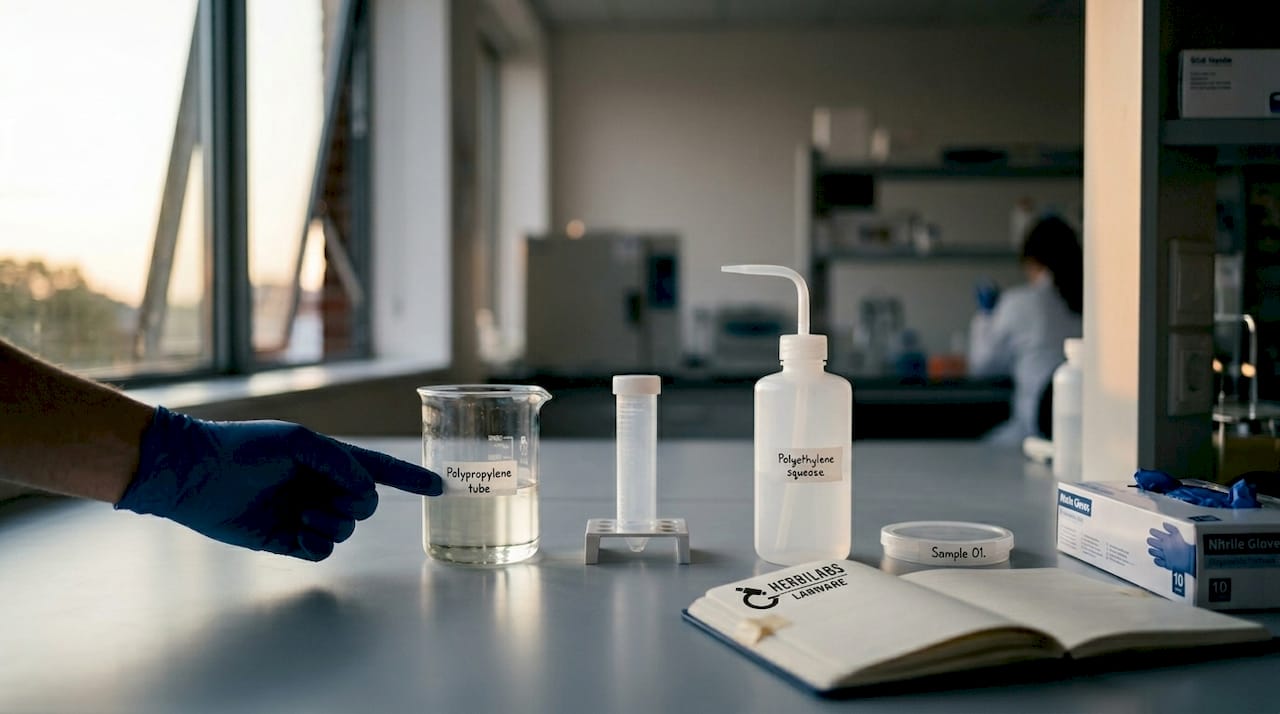
Borosilicate glass is thermally stable, chemically inert to most solvents, and optically clear, making it the default choice for spectrophotometric work, high-temperature applications, and long-term storage of reactive compounds. Its limitations are fragility and the absorption of certain compounds, particularly proteins, onto the surface at low concentrations.
Polypropylene (PP) offers excellent chemical resistance to many acids and bases, good thermal tolerance up to approximately 135°C, and a low cost-per-unit that makes it suitable for high-volume consumable use. However, minimizing additives in resins is critical because standard-grade polypropylene can introduce leachables that compromise sensitive assays.
Polyethylene (PE) is flexible and highly resistant to most aqueous solutions, but it absorbs certain organic solvents and is generally limited to lower-temperature applications.
PTFE (polytetrafluoroethylene) provides the broadest chemical resistance of any common labware material and tolerates extreme pH and temperature ranges. It is the correct choice for highly corrosive reagents but carries a significantly higher purchase cost and may not be necessary for routine applications.
Low-density polyethylene (LDPE) is preferred for wash bottles and general storage where flexibility is a priority and chemical demands are moderate.
Key considerations when selecting by type include:
- Sterilization method compatibility (autoclave, gamma irradiation, or chemical disinfection)
- Surface adsorption characteristics relative to your analyte type
- Optical clarity requirements for photometric or visual inspection
- Physical durability under the handling conditions of your specific lab environment
Consulting a detailed labware vs. glassware comparison before committing to material choices for new workflows will help researchers avoid misapplication.
3. Use a side-by-side material comparison for rapid evaluation
When time or budget constraints require a quick decision between labware materials, a structured comparison table eliminates subjective reasoning and replaces it with documented criteria. The table below summarizes the most commonly used materials in research settings, mapped against the attributes that matter most in practical selection.
| Material | Chemical resistance | Thermal range | Leachables risk | Typical application | Relative cost |
|---|---|---|---|---|---|
| Borosilicate glass | Very high | Up to 500°C | Very low | Spectrophotometry, storage, heating | Medium |
| Polypropylene | High | Up to 135°C | Low to medium | Tubes, centrifuge vials, general use | Low |
| Polyethylene (LDPE) | Medium | Up to 80°C | Low | Wash bottles, general storage | Very low |
| PTFE | Excellent | Up to 260°C | Negligible | Corrosive reagents, extreme pH | High |
| Polycarbonate (PC) | Low to medium | Up to 135°C | Medium | Centrifuge tubes, optical applications | Medium |
The purchase price shown in any catalog represents only part of the total expenditure. Hidden costs include preventive maintenance contracts, calibration requirements, and facility retrofitting that do not appear on a per-unit basis. Researchers who calculate total cost of ownership rather than unit price consistently make more defensible procurement decisions.
Pro Tip: When comparing two materials that appear equivalent on paper, request a Certificate of Analysis from the supplier and look specifically for extractables testing data. This one document often reveals quality differences that catalog specifications obscure.
4. Match labware to your specific scientific application
A lab equipment selection guide that omits application specificity is only marginally useful. Labware compatibility tips become precise and useful only when they are grounded in the actual chemical environment, sample type, and procedural demands of your work.
Consider the following guidance for common research contexts:
- Peptide reconstitution and storage: Glass vials with inert stoppers or polypropylene low-binding tubes are preferred to minimize surface adsorption of hydrophobic peptide sequences. For injectable preparations, sterile, depyrogenated glass is often required. Researchers focused on this area will benefit from reviewing labware guidance for peptide research before finalizing selection.
- Enzymatic and cell-based assays: Polystyrene plates are the conventional choice, but PP or glass may be necessary when organic solvent additions are involved, since polystyrene degrades rapidly in contact with many solvents.
- High-throughput automation: Labware dimensions must conform exactly to ANSI/SBS standard footprints to prevent robotic handling errors. Even minor dimensional deviations cause system failures in liquid-handling platforms.
- Cold storage and cryogenic applications: Polypropylene tubes designed for cryogenic storage must carry a manufacturer certification for stability at liquid nitrogen temperatures. Standard PP tubes will fail at these ranges.
- Reagent preparation and dilution: Volumetric accuracy requirements determine whether graduated cylinders, volumetric flasks, or calibrated plastic serological pipettes are appropriate. Calibration class (A vs. B) should be selected based on the molarity precision your procedure demands.
The chemical reactivity profile of your reagents, combined with your thermal cycle parameters, defines a fairly narrow set of suitable materials. Laboratories that approach this selection systematically avoid the recurring costs of replacing incompatible consumables mid-study.
5. Apply a structured vendor evaluation process
Procurement best practices in lab supply selection have shifted away from lowest-unit-cost purchasing and toward weighted scoring models that account for multiple supplier attributes. Vendor evaluation that scores suppliers on experience (25%), technical support (25%), reputation (20%), product quality (20%), pricing (20%), and lead time (15%) provides a transparent and reproducible basis for sourcing decisions, with a minimum score of 70% required for procurement eligibility.
The rationale for this approach is straightforward. A supplier offering the lowest per-unit cost but lacking in batch traceability documentation, technical support, or delivery consistency can generate far greater costs through failed experiments, regulatory non-compliance, and reordering delays than a mid-priced supplier with documented quality systems.
- Experience: How long has the vendor operated in laboratory supply? Do they demonstrate familiarity with the regulatory requirements of your sector?
- Technical support: Can the vendor provide application-specific guidance, resolve compatibility questions, and supply documentation like SDS sheets, Certificates of Analysis, and extractables data on request?
- Reputation: What is the supplier’s standing with peer institutions or research communities? Verified reviews and reference contacts matter more than marketing materials.
- Product quality: Does the supplier operate under ISO certification or equivalent quality management standards? Are products batch-tested?
- Pricing: Assess total cost across consumable volume projections, not per-unit price alone.
- Lead time: Confirm standard and expedited delivery timelines, particularly for critical consumables that cannot be substituted.
| Evaluation criterion | Weight | Minimum acceptable score |
|---|---|---|
| Experience | 25% | 70% |
| Technical support | 25% | 70% |
| Reputation | 20% | 70% |
| Product quality | 20% | 70% |
| Pricing | 20% | 70% |
| Lead time | 15% | 70% |
A well-constructed lab consumables checklist integrated into your procurement workflow formalizes this process and prevents common sourcing errors under deadline pressure.
6. Account for total cost of ownership, not purchase price
The purchase price of labware is the most visible cost and, in many labs, the only figure formally tracked. This is a significant operational error. Total cost of ownership includes calibration, utility requirements, and unexpected facility retrofitting that do not appear in any catalog listing.
For consumables, the hidden costs manifest differently. Low-cost tubes with inadequate purity specifications may require additional sample cleanup steps, adding reagent and technician time costs per run. Glass labware may carry a lower per-unit cost but require dedicated breakage budgets and autoclaving program time. PTFE labware eliminates many contamination concerns but demands specialized cleaning protocols and longer drying cycles.
For reusable equipment, the calculation extends further. Maintenance contracts, recalibration schedules, and the risk of unplanned downtime affecting sample integrity all belong in a full cost analysis. Redundancy features that prevent workflow interruption during equipment failure have measurable value that catalog comparisons never capture.
Laboratories that calculate cost per reliable run, rather than cost per unit, consistently make more sustainable procurement decisions.
7. Maintain labware integrity through proper handling and storage
Selecting appropriate labware is only the first step. The practical value of that selection depends on how labware is handled, cleaned, stored, and monitored throughout its lifecycle. Contamination events traced back to improper storage or reuse of single-use consumables are preventable and represent unnecessary experimental risk.
Key practices for maintaining labware integrity include labeling storage containers with the date of first use, confirming that reusable glassware cleaning protocols remove all detergent residues before use with biological samples, and storing plastic consumables away from direct UV exposure, which can degrade polymer integrity over time. Autoclaved glass should be used within validated timeframes and not left in storage indefinitely after sterilization.
Equally important is the segregation of labware by application. Tubes and containers used for organic solvent work should never be repurposed for aqueous biological samples, regardless of how thoroughly they have been cleaned. Cross-contamination risks from residual solvent absorption into polymer matrices are not eliminated by standard washing procedures.
My perspective on labware selection mistakes
I’ve spent considerable time reviewing how research teams approach labware selection, and one pattern stands out consistently. Compliance with regulatory specifications is treated as sufficient, when in practice it is only the floor of an acceptable decision, not the ceiling.
Teams that select labware based on certification status alone often discover, months into a study, that the selected material technically passed every relevant standard but created workflow problems that those standards were never designed to catch. An autoclavable tube rated for 135°C is not the same as a tube that retains dimensional stability across fifty autoclave cycles. A glass vial certified as depyrogenated addresses endotoxin risk but says nothing about surface chemistry interactions with your specific peptide sequence at low concentrations.
My consistent recommendation is to pilot test labware selections at small scale before committing to bulk procurement, particularly for novel assays or reconstitution workflows. The cost of a pilot is trivial relative to the cost of repeating weeks of work with a corrected material. I’ve also found that informatics integration with ELN and LIMS platforms increasingly influences which labware formats are practical, since automated logging and sample tracking often impose specific container format requirements that are worth verifying before ordering.
Prioritize vendor relationships, not just vendor pricing. Suppliers who understand your application and communicate proactively about material changes or batch variations are operationally more valuable than those offering a marginally lower unit cost.
— Ragnar
Herbilabs supports your labware and reagent decisions
Herbilabs supplies research-grade reagents and reconstitution solutions manufactured to strict purity standards, serving independent researchers, universities, and scientific institutions across the UK and Europe. For researchers working with peptide compounds, bacteriostatic water, or sterile diluents, the quality of the labware and reagents used together determines the reliability of the outcome. Herbilabs’s product range is built around that principle, with rigorous quality control and documented manufacturing standards at every stage.
Researchers looking to align their labware sourcing with their reagent quality standards can start with Herbilabs’s guidance on selecting laboratory reagents for peptide research. For a systematic view of consumable requirements, the 2026 lab consumables checklist provides a structured reference for procurement planning. Contact Herbilabs directly for wholesale pricing, consultation support, and access to high-purity reconstitution solutions suited to demanding research environments.
FAQ
What are the most important criteria for labware selection?
Chemical compatibility, material purity, thermal resistance, and dimensional fit to your workflow are the foundational criteria. Vendor reliability and total cost of ownership complete the evaluation framework.
How do I choose between plastic and glass labware?
Glass offers superior chemical inertness and thermal stability, while plastic provides flexibility, lower cost, and resistance to breakage. The correct choice depends on your solvent environment, temperature requirements, and any surface adsorption concerns specific to your analyte.
Why do leachables and extractables matter in labware selection?
High-quality plastic resins with minimized additives reduce the risk of chemical contamination that can compromise sensitive assays or biological preparations. Requesting extractables data from suppliers is one of the most reliable ways to verify material suitability before use.
How should vendors be scored during labware procurement?
A structured vendor evaluation weights experience and technical support at 25% each, reputation and product quality at 20% each, pricing at 20%, and lead time at 15%. Suppliers scoring below 70% overall should not advance in the procurement process.
What is total cost of ownership in the context of labware?
Total cost of ownership accounts for the purchase price plus all downstream costs, including cleaning, sterilization, calibration, breakage replacement, and any additional sample preparation steps made necessary by suboptimal material selection.