Private Label, White Label, Wholesale partnerships available - EU, USA and UK - Free shipping from €75

Labware for Peptide Research: What Researchers Must Know
Discover what is labware for peptide research and how the right choices enhance data accuracy, minimize errors, and ensure reproducibility.
TL;DR:
- Choosing appropriate labware is crucial for peptide research because material compatibility influences peptide recovery, adsorption, and reproducibility. Using low-bind plastics, validated cleaning protocols, and advanced surface technologies like MaxPeak HPS enhances data accuracy and reduces experimental errors. Proper labware selection and documentation throughout the workflow ensure integrity, consistency, and regulatory compliance in peptide synthesis, storage, and analysis.
Choosing the wrong labware in peptide research is not a minor inconvenience. It is a direct source of experimental error, reduced recovery, and failed reproducibility. Understanding what is labware for peptide research, and specifically which materials and formats belong at each stage of your workflow, determines whether your data reflects the peptide or the container it spent time in. This article covers the full spectrum of labware types, synthesis equipment, storage considerations, and advanced surface technologies that define high-quality peptide research in academic and professional settings today.
Table of Contents
- Key takeaways
- What is labware for peptide research
- Lab equipment for peptide synthesis
- Best practices for selecting and using labware
- Advanced labware technologies for peptide analysis
- Integrating labware choice into the peptide research workflow
- My perspective on what most labs get wrong
- Herbilabs labware and reagents for peptide research
- FAQ
Key takeaways
| Point | Details |
|---|---|
| Labware type directly affects outcomes | Material composition and surface chemistry alter peptide adsorption, recovery, and experimental accuracy. |
| Low-bind plastics are non-negotiable | Polypropylene low-protein-binding tubes protect peptides during handling, storage, and freeze-thaw cycles. |
| Solvent selection depends on peptide chemistry | Reconstitution solvent must match peptide solubility profile; bacteriostatic water suits aqueous peptides, DMSO suits hydrophobic ones. |
| Advanced surface tech improves LC-MS results | MaxPeak High Performance Surfaces reduce analyte loss and improve reproducibility for metal-sensitive peptides. |
| Labware traceability supports data integrity | Lot-labeled, date-tracked aliquot systems in compliant labware reduce degradation and improve experimental reproducibility. |
What is labware for peptide research
Labware for peptide research refers to the complete set of physical vessels, containers, analytical hardware, and consumables that come into direct contact with peptides or the solvents used to prepare, store, synthesize, or analyze them. The category spans a wider range than most researchers initially assume. It includes not just the familiar Eppendorf tubes on your bench, but also specialized resin cartridges, chromatography columns, reaction vessels, low-bind microvials, and the column hardware used in LC-MS workflows.
What distinguishes peptide-specific labware from general laboratory plasticware is chemical compatibility and surface behavior. Peptides are notoriously prone to non-specific adsorption, aggregation, and oxidative degradation when they encounter incompatible surfaces. A standard polystyrene microplate, for example, will bind hydrophobic peptides at concentrations that matter. The result is concentration loss before you even begin the assay.
The types of labware for peptides fall into three broad categories: containment vessels for reconstitution and storage, synthesis-specific hardware, and analytical consumables for characterization and quality control. Each category carries distinct material and specification requirements, and selecting appropriately across all three is what separates reliable peptide research from data that cannot be reproduced.
Core containment labware
The most commonly used containment labware includes borosilicate glass vials for lyophilized peptide storage, low-protein-binding polypropylene microcentrifuge tubes for solution-phase handling, and deep-well 96-well plates for high-throughput reconstitution workflows. Glass vials minimize moisture ingress during lyophilized storage and are chemically inert across a broad pH range. Low-binding polypropylene, by contrast, is preferable when working with peptides in solution, as it reduces surface adsorption compared to standard plastics.
Key containment and synthesis labware includes:
- Borosilicate glass vials with crimp or screw caps for lyophilized peptide storage under inert atmosphere
- Low-protein-binding polypropylene tubes (0.5 mL to 15 mL) for reconstituted peptide aliquoting and freeze-thaw handling
- Resin cartridges and fritted reaction vessels used in solid-phase peptide synthesis (SPPS) workflows
- Polypropylene 96-deep-well plates for parallel reconstitution in high-throughput screening environments
- Glass amber vials for light-sensitive peptide analogs requiring UV protection during storage
- MaxPeak HPS vials and column hardware for LC-MS sample loading with metal-sensitive analytes
Lab equipment for peptide synthesis
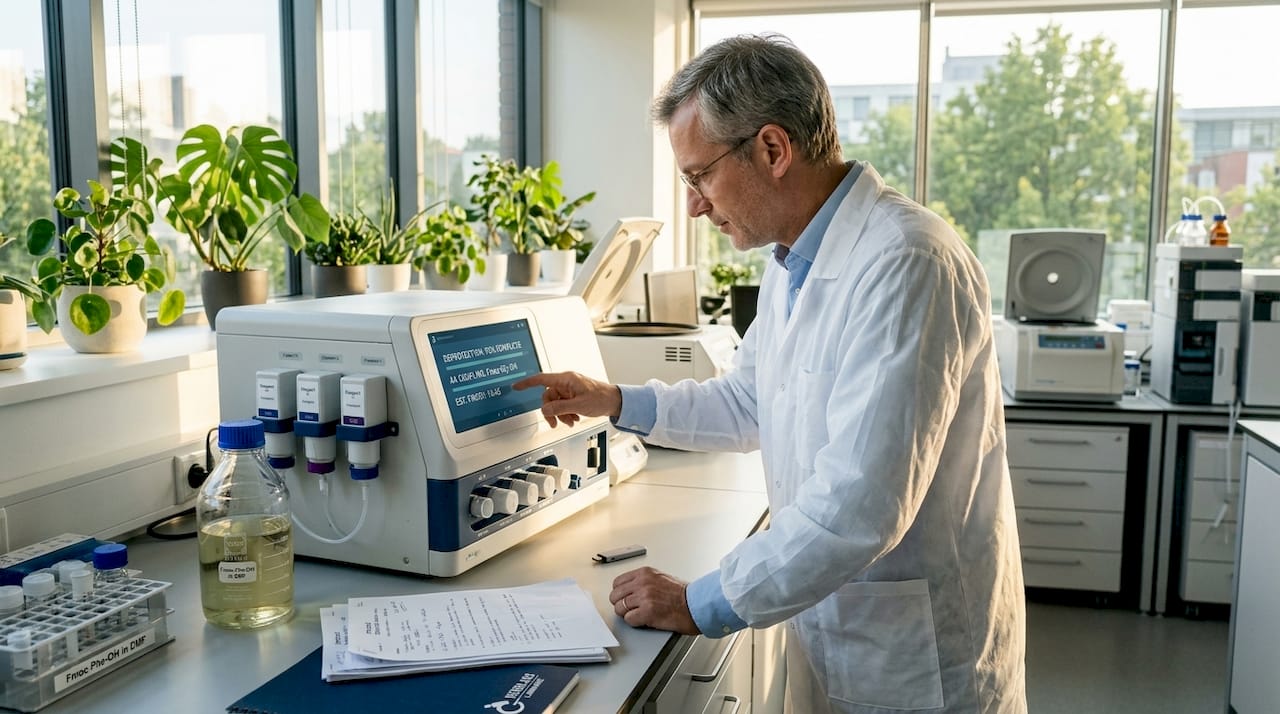
The lab equipment for peptide synthesis extends well beyond simple benchtop containers. The quality and specification of synthesis hardware directly governs peptide purity, yield, and scalability.
Automated and microwave-assisted synthesizers
Modern SPPS workflows rely on automated peptide synthesizers that control coupling cycles, solvent delivery, and resin washing with precision that manual methods cannot replicate. Cycle times as short as 12 minutes per coupling and scale ranges spanning from 0.005 mmol to 20 grams are achievable with current synthesizer platforms, which means the labware requirements, specifically resin vessel geometry, frit porosity, and solvent reservoir capacity, must be matched precisely to the synthesizer specification.
Microwave-assisted synthesizers add a thermal dimension to labware requirements. Reaction vessels used in these systems must tolerate rapid temperature cycling without releasing plasticizers or contaminants into the reaction mixture. Specialized microwave-transparent polypropylene or PTFE vessels are the standard, not optional accessories.
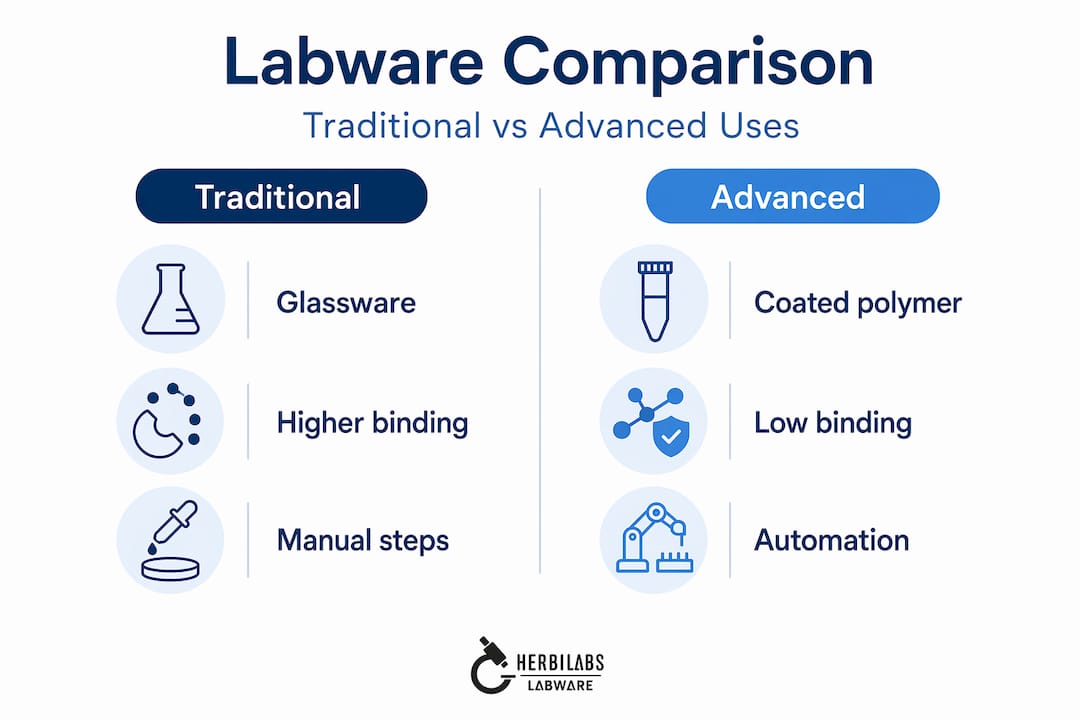
Comparison of traditional versus advanced synthesis labware
| Parameter | Traditional glassware | Advanced polymer/coated labware |
|---|---|---|
| Surface binding risk | Moderate to high | Low to negligible |
| Thermal resistance | High | Variable (PTFE: excellent) |
| Compatibility with automated systems | Limited | Purpose-built for integration |
| Scalability | Limited to bench volumes | Supports 5 to 500 liters |
| cGMP suitability | Requires validation | Designed with compliance in mind |
For researchers considering the transition from bench to production scale, scalable reactor systems that support volumes from 5 to 500 liters provide batch-to-batch consistency while supporting cGMP compliance requirements. The labware architecture at this scale, including jacketed glass reactors with PTFE-coated internals, is a substantially different engineering problem from standard bench synthesis.
Pro Tip: When selecting resin vessels for automated SPPS, confirm the frit pore size is optimized for your resin bead diameter. An oversized frit causes resin loss into the filtrate; an undersized frit clogs under vacuum and slows cycle times.
Best practices for selecting and using labware
Selecting the best labware for research in a peptide science context requires evaluating material compatibility, surface chemistry, and functional purpose simultaneously. This section outlines a structured approach to labware selection and handling that most lab protocols omit entirely.
-
Verify low-bind certification before purchase. Not all polypropylene is equal. Look explicitly for “low-protein-binding” or “low-bind” designations backed by manufacturer data showing reduced adsorption for peptide analogs at sub-micromolar concentrations.
-
Match solvent to peptide chemistry before selecting the reconstitution vessel. Reconstitution solvent choice depends on solubility and assay compatibility. Water-soluble peptides are typically reconstituted in bacteriostatic water or sterile water. Hydrophobic peptides often require an initial co-solvent such as DMSO or dilute acetic acid before aqueous dilution. The vessel material must be compatible with whichever solvent is used.
-
Aliquot into single-use volumes immediately after reconstitution. Splitting peptides into single-use aliquots in low-bind labware, with clear labeling including date, lot number, and concentration, prevents repeated freeze-thaw cycles that accelerate degradation. Each thaw event introduces oxidative stress.
-
Store aliquots at the correct temperature for the peptide class. The guidance to aliquot in low-protein-binding tubes and freeze at -20°C or -80°C is well established. Thaw only once on ice. Bacteriostatic water is appropriate for short-term 2 to 8°C storage but is not suitable for freeze-thaw cycling.
-
Clean and qualify reusable labware to GLP standards. For non-disposable synthesis vessels, establish a validated cleaning protocol using appropriate solvents (typically acetonitrile, methanol, or dilute acid washes) and document each cycle. Residual peptide carryover is a significant source of false positives in sequential experiments.
-
Consult the labware purity standards relevant to your regulatory context. Research-use-only applications have different thresholds than GMP-adjacent workflows, but purity documentation protects data integrity in both settings.
Pro Tip: Avoid centrifuge tubes with integral rubber gaskets when working with hydrophobic peptides. Rubber compounds leach organic contaminants that are detectable at low nanomolar concentrations in LC-MS analysis.
Advanced labware technologies for peptide analysis
The most consequential advances in peptide research tools over the last five years have occurred at the interface of analytical labware and chromatographic surface chemistry. Two developments stand out for researchers working with metal-sensitive or low-abundance peptides.
The first is MaxPeak High Performance Surfaces technology. These hybrid organic/inorganic surfaces applied to column hardware and sample vials minimize analyte adsorption that occurs when acidic peptides contact bare stainless steel. The practical result is improved recovery and peak shape for peptides that would otherwise be partially retained by metal surfaces, causing both quantitative loss and distorted chromatographic profiles.
The second is laboratory information management system integration. LabWare LIMS software connects physical labware inventory, instrument outputs, and sample tracking into a unified data layer with automatic report generation, KPI monitoring, and batch release functions. For academic labs running multi-compound peptide screens, this level of data integration reduces transcription errors and supports audit-ready documentation.
Key specifications researchers should evaluate when selecting advanced analytical labware:
- Surface chemistry designation: inert polymer-coated, PEEK, or MaxPeak HPS, depending on peptide class and sensitivity requirements
- Volume range: vials from 150 µL to 2 mL to accommodate both nano-scale and preparative LC workflows
- Septa compatibility: pre-slit PTFE-lined septa for autosampler vials minimize cross-contamination between injections
- Column hardware material: confirm inner-wall coating specification to avoid undocumented stainless steel exposure zones
- Regulatory documentation: Certificates of Analysis and material data sheets should be available for every labware component used in GMP-adjacent studies
Integrating labware choice into the peptide research workflow
Applying labware knowledge to a complete peptide research workflow requires thinking about each phase sequentially and selecting labware specifications before the experiment begins, not as an afterthought. A phase-by-phase approach reduces the most common sources of experimental failure.
-
Synthesis phase. Select resin cartridges, reaction vessels, and solvent reservoirs matched to your synthesizer model and scale. Confirm material compatibility with all coupling reagents and solvents used in the cycle, including DMF, DCM, piperidine, and HATU where applicable.
-
Purification phase. Use prepacked reversed-phase HPLC cartridges or columns with documented lot-to-lot reproducibility. Collect fractions in low-bind polypropylene tubes rather than glass if the peptide has demonstrated surface affinity in prior runs.
-
Reconstitution and dilution phase. Select the reconstitution solvent based on peptide solubility data, and use the essential labware checklist relevant to your application to verify vessel material, volume, and labeling requirements are satisfied before beginning.
-
Analytical phase. Load samples into autosampler vials with appropriate surface treatment for your analyte. For phosphopeptides, glycopeptides, and other metal-sensitive species, MaxPeak HPS vials and column hardware are the specification of choice. Confirm injection volume and sample concentration are within the validated range of your LC-MS method.
-
Storage phase. Transfer residual peptide solution into pre-labeled, single-use low-bind aliquots. Document lot numbers, reconstitution date, solvent system, concentration, and storage temperature. Discard any aliquot that has been thawed and refrozen.
The regulatory dimension of this workflow matters even in purely academic settings. Selecting laboratory reagents that carry appropriate documentation, whether Certificates of Analysis, sterility testing data, or USP-grade designations, protects your research from downstream challenges during manuscript review or technology transfer.
My perspective on what most labs get wrong
I have reviewed a considerable number of peptide research protocols where labware is treated as a fixed, interchangeable input rather than a variable with real experimental weight. The most common failure pattern is this: a researcher obtains high-quality lyophilized peptide, reconstitutes it correctly, then transfers it into a standard polystyrene plate for storage before the assay. By the time the assay runs, 30 to 40 percent of the peptide may have adsorbed to the plate surface. The assay still “works.” The dose-response curve still appears. But every data point is shifted, and the researcher never knows.
What advanced labs do differently is treat labware specification as part of method validation, not as logistics. They document which tubes, which vials, and which column hardware were used, and they perform recovery tests when switching to a new product lot. This is not excessive caution. It is the correct application of analytical rigor to a material variable that directly affects quantitative results.
The second pattern I see is inadequate attention to cleaning validation in reusable synthesis vessels. Peptide carryover between synthesis runs is almost never zero without a validated cleaning cycle, and in academic labs that share synthesizer hardware across multiple projects, this creates a genuine contamination risk that flow-through data can obscure for months.
My recommendation is to build labware specifications into your standard operating procedures at the same level of formality as solvent grades and instrument calibration schedules. The lab supply quality standards that underpin reproducibility in biotech research apply equally to the containers your peptides live in. Treating them as an afterthought is where many otherwise rigorous protocols quietly fall apart.
— Ragnar
Herbilabs labware and reagents for peptide research
For researchers who need reliable, documentation-backed reconstitution solutions and reagents to complement their labware workflow, Herbilabs supplies research-grade bacteriostatic water, sterile diluents, and reconstitution solutions manufactured under strict purity standards.
Whether you are reconstituting a lyophilized peptide for the first time or managing a multi-compound screening program across multiple vials and freeze-thaw cycles, the quality of your reconstitution solvent matters as much as the vessel you use. Herbilabs’ high-purity reconstitution solutions are produced with full Certificate of Analysis documentation, contaminant testing, and sterility data, giving you a dependable foundation for consistent peptide preparation. For researchers comparing solvent options for aqueous peptide storage, the bacteriostatic vs sterile water guide provides a structured comparison of both options relative to your specific application. Herbilabs also offers laboratory consumables comparison resources to help you match the right tools to your research protocol.
FAQ
What does labware mean in the context of peptide research?
Labware for peptide research refers to all physical vessels, consumables, and hardware that contact peptides or their preparation solvents, including storage vials, synthesis reaction vessels, chromatography columns, and analytical sample containers.
What types of labware are most critical for peptide storage?
Low-protein-binding polypropylene tubes and borosilicate glass vials are the primary storage formats, with freeze storage at -20°C or -80°C in single-use aliquots recommended to prevent degradation and oxidation.
Why does surface material matter for peptide LC-MS analysis?
Metal-sensitive peptides adsorb onto stainless steel surfaces in standard column hardware, causing quantitative loss and distorted peaks. MaxPeak HPS surfaces use a hybrid organic/inorganic coating that significantly reduces this adsorption.
What solvent should be used to reconstitute a lyophilized peptide?
Solvent selection depends on peptide solubility. Water-soluble peptides are typically reconstituted in bacteriostatic water or sterile water, while hydrophobic peptides may require DMSO or dilute acetic acid as an initial co-solvent before aqueous dilution.
How does labware affect cGMP compliance in peptide production?
Labware documentation, including material composition, lot traceability, and cleaning validation records, forms part of the process control evidence required for cGMP-compliant peptide manufacturing, particularly when transitioning from research to production scale.