Private Label, White Label, Wholesale partnerships available - EU, USA and UK - Free shipping from €75

Labware vs glassware explained: a scientist’s guide
Discover the key differences in our guide, "labware vs glassware explained." Make informed choices for better results in your research!
TL;DR:
- Choosing the correct labware category—glassware versus broader labware—is essential for ensuring compatibility, accuracy, and safety in laboratory workflows. Glassware, made from borosilicate glass, offers high chemical resistance and thermal stability, while plastic labware varies in polymer properties, affecting chemical compatibility and heat tolerance. Material selection should be based on the specific protocol requirements, considering factors like accuracy classes, chemical exposure, contamination risks, and operational safety.
Researchers across the UK and Europe routinely conflate labware and glassware as though they describe the same thing, but this labware vs glassware explained guide will show precisely why that assumption carries real risk. Material choice is not a minor procurement detail; it directly shapes volumetric accuracy, chemical compatibility, contamination profiles, and regulatory compliance in ways that can invalidate experimental data or create safety incidents. Whether you are selecting vessels for trace-level peptide reconstitution, high-temperature digestions, or sterile single-use workflows, the distinctions between labware categories matter. This article will clarify definitions, material properties, accuracy classifications, and decision criteria so you can make informed selections for your specific research context.
Table of Contents
- Understanding labware and glassware definitions
- Key materials in scientific labware: borosilicate glass and plastics
- Volumetric accuracy and chemical compatibility in labware selection
- Practical considerations: durability, safety, and lab method impact
- Summary comparison: labware vs glassware strengths and ideal use cases
- Why labware vs glassware decisions require materials science awareness, not just habit
- Explore Herbilabs’ expert resources and high-purity solutions for labware needs
- Frequently asked questions
Key Takeaways
| Point | Details |
|---|---|
| Material choice matters | Choosing between labware and glassware affects experiment accuracy, safety, and compliance. |
| Borosilicate glass benefits | Borosilicate glass offers superior thermal resistance and chemical durability for lab applications. |
| Plastic vs glass use cases | Plastic is preferred for sterility and safety; glass for heat, solvents, and precision. |
| Volumetric accuracy standards | Class A glassware meets tighter tolerances required for analytical work compared to Class B. |
| Method drives selection | Material selection should be determined by your specific workflow and chemical environment, not habit. |
Understanding labware and glassware definitions
Labware is the broader category. It covers every physical component used to conduct, support, or contain laboratory procedures, including racks, reagent bottles, microplates, centrifuge tubes, and volumetric vessels. These items may be reusable or disposable, made from glass, polymer, ceramic, or metal, and engineered to specific tolerances for precision and durability. As explained in lab consumables terminology, labware covers a broad set of physical components such as plates, tubes, racks, and reservoirs that are reusable or disposable and engineered for precision and durability, unlike consumables which emphasize sterility and disposability.
Glassware, by contrast, is a subset of labware. It refers specifically to items manufactured from laboratory-grade glass, most commonly borosilicate glass, that provide chemical resistance, optical clarity, and thermal tolerance unavailable from commodity soda-lime glass. Beakers, Erlenmeyer flasks, graduated cylinders, volumetric flasks, and condensers are all glassware, but they belong within the wider labware universe. Conflating the two leads to procurement errors and protocol mismatches.
The table below places each category in context:
| Feature | Labware (broad category) | Glassware (glass subset) |
|---|---|---|
| Materials | Glass, plastic, metal, ceramic | Borosilicate or laboratory glass |
| Scope | All lab vessels and support items | Chemically resistant glass vessels |
| Reusability | Reusable or disposable | Typically reusable |
| Primary advantage | Versatility across workflows | Chemical inertness and thermal stability |
| Common examples | Microplates, racks, reagent bottles | Beakers, flasks, burettes, condensers |
Common labware types beyond glassware include:
- Polypropylene (PP) tubes and conicals for centrifugation and cold storage
- Microplates and deep-well plates for high-throughput assays
- PTFE (polytetrafluoroethylene) containers for aggressive chemical workflows
- Borosilicate glassware for volumetric analysis and high-temperature applications
- Polyethylene reagent bottles for solvent and buffer storage
Understanding this distinction is critical to avoiding procurement errors, where ordering “labware” without specifying material type or function can result in delivery of components incompatible with your protocol.
Key materials in scientific labware: borosilicate glass and plastics
The choice between glass and plastic is at the core of most labware vs glassware decisions, and it comes down to material properties rather than convention. Borosilicate glass is engineered with silica and boron oxide for excellent thermal shock resistance and chemical durability, making it the benchmark material for laboratory glassware. This composition gives it a low coefficient of thermal expansion, meaning it resists cracking when moved rapidly between temperature extremes, such as from an ice bath to a hot plate.
Plastic labware materials vary considerably in their capabilities, and treating them as a uniform group is a significant error. Each polymer occupies a defined performance envelope:
- Polypropylene (PP): resistant to many acids, bases, and alcohols; autoclavable to 121°C; common for centrifuge tubes and sample storage
- Polyethylene (PE): excellent chemical resistance to a broad range of solvents; not suitable for high temperatures; used for reagent bottles and wash bottles
- PTFE (polytetrafluoroethylene): outstanding chemical inertness, including resistance to most concentrated acids; upper continuous use temperature around 260°C; selected for aggressive chemistry and HF workflows
- Polycarbonate (PC): optical clarity, rigid; not compatible with strong bases or certain organic solvents; used in centrifuge tubes for ultracentrifugation
- Polymethylpentene (PMP): near-glass optical clarity; autoclavable; good chemical resistance; used in graduated cylinders as a glass alternative
Glass is preferred for high heat and chemical inertness workflows; plastics are used when sterility, disposability, or drop safety are priorities, but polymer compatibility must always be verified against your specific reagent list and process temperatures.
As part of any best materials for labware evaluation, checking your labware materials checklist before finalizing vendor orders prevents costly compatibility failures mid-protocol. Equally, confirming that materials meet appropriate labware purity standards is essential when working with sensitive biological or chemical analytes.
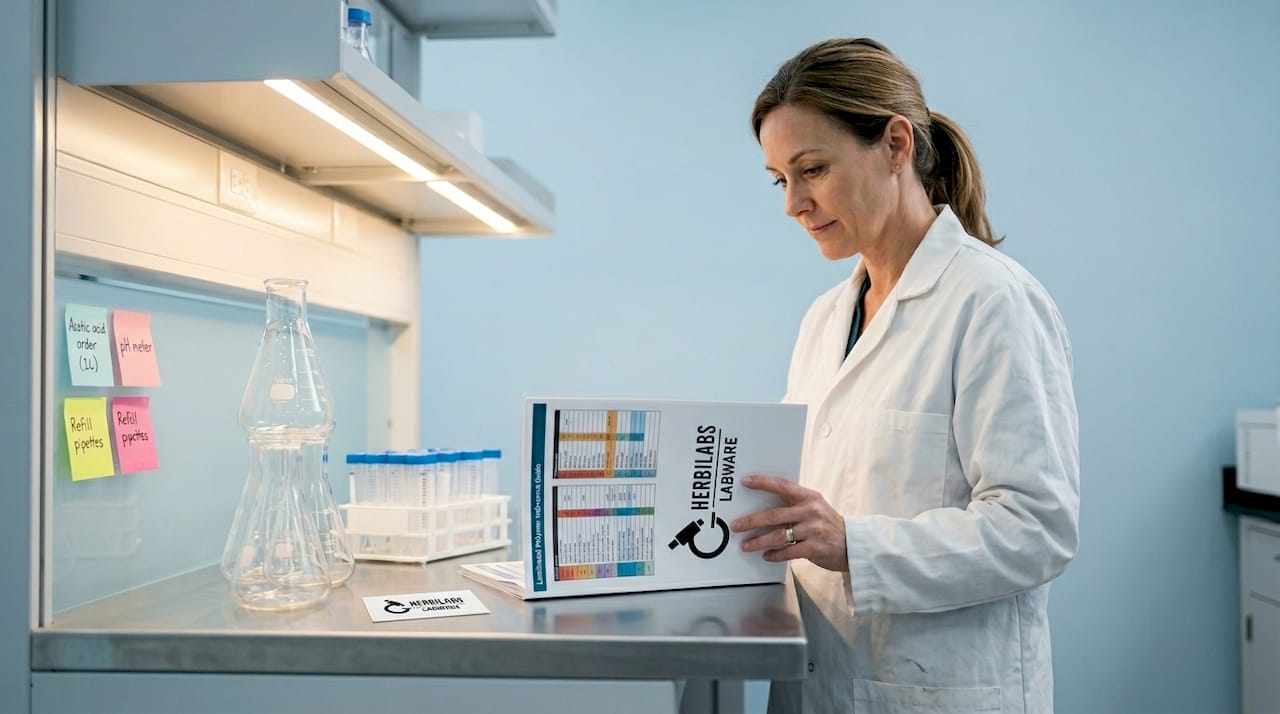
Pro Tip: Always cross-reference polymer compatibility charts specific to the chemical family and concentration you are using, not just the chemical name alone. Concentrated nitric acid and dilute nitric acid can behave differently toward the same polymer.
Volumetric accuracy and chemical compatibility in labware selection
Volumetric accuracy represents one of the most consequential distinctions within glassware itself, particularly for quantitative analytical work subject to European regulatory oversight. ISO standards divide volumetric glassware into two accuracy classes. Class A volumetric glassware provides tighter tolerance for quantitative work than Class B, which matters for traceability and regulatory compliance in European labs. The difference is not trivial: for a 100 mL volumetric flask, Class A tolerance is ±0.10 mL while Class B doubles that to ±0.20 mL.
Beyond class designation, volumetric labware carries one of two calibration marks:
- TC (to contain): the vessel holds the stated volume, but a residual film remains on the walls when emptied; pipettes and flasks used for solution preparation are often TC-marked
- TD (to deliver): the vessel delivers the stated volume into another container; burettes and transfer pipettes are typically TD-marked
Using a TD-marked pipette as though it were TC-marked, or vice versa, introduces systematic volume errors that compound across dilution series.
The comparison below illustrates Class A versus Class B differences and their appropriate applications:
| Parameter | Class A | Class B |
|---|---|---|
| Tolerance | Tighter (e.g., ±0.10 mL for 100 mL) | Wider (e.g., ±0.20 mL for 100 mL) |
| Certification | Individual batch certificate available | Standard production batch |
| Typical use | Quantitative analysis, regulatory compliance | Routine work, teaching labs |
| Traceability | Traceable to national standards | Not required |
| Cost | Higher | Lower |
Chemical compatibility restricts glassware use in certain workflows, and hydrofluoric acid attacks glass, requiring HF-compatible polymers like PTFE to avoid container damage or cross-contamination. Key compatibility rules to observe when selecting between glass and plastic include:
- Use glass for concentrated sulfuric acid, phosphoric acid, and most organic solvents
- Avoid glass for hydrofluoric acid, hot concentrated alkalis, and some fluorinated compounds
- Use PTFE or PP for HF digestions and fluoride-containing sample preparation
- Verify PP and PE compatibility limits with concentrated oxidizing acids before use
- Consult the labware purity and standards documentation for your specific workflow when trace-level work is involved
Practical considerations: durability, safety, and lab method impact
Material choice also has immediate operational consequences for lab safety and ongoing costs. Glassware breakage is a documented risk in active laboratory environments: borosilicate glass carries a 10 to 15% annual breakage rate, which requires procurement teams to maintain buffer stock and implement handling protocols including safety gloves, correct storage orientation, and scheduled inspection of chipped or starred items.
Contamination is a subtler concern, and one that disproportionately affects high-sensitivity analytical work. Trace analysts must evaluate whether glass ion leaching or polymer extraction from plastic labware affects detection limits under their specific method conditions. Glass can release silica, sodium, or boron ions at meaningful concentrations under acidic or high-temperature conditions, while plastics can leach plasticizers or surface-active compounds depending on solvent exposure.
“The decision between glass and plastic labware in analytical chemistry is not a one-time choice but a method-specific evaluation: the same plastic that performs flawlessly in a pH 7 buffer workflow can introduce detectable background contamination in a low-pH organic extraction.” This principle, widely acknowledged in trace analysis, underscores why material selection must be tied to method chemistry rather than general preference.
Key practical factors to address before finalizing labware for any protocol include:
- Breakage risk: High-traffic benches and teaching environments may favor plastic to reduce incident frequency
- Contamination source: Identify whether glass leaching or polymer extraction poses the greater risk for your analyte
- SOP and regulatory mandates: Pharmacopoeial methods and accredited analytical procedures often specify glassware type and class; deviation requires method revalidation
- Autoclavability: Confirm that chosen materials survive sterilization cycles without leaching or deforming
- Calibration records: Maintain item-level traceability for volumetric glassware to satisfy audit requirements
Maintaining labware integrity through documented inspection and calibration schedules is not optional in GLP or ISO 17025-accredited environments; it is a compliance requirement.
Pro Tip: Label volumetric glassware individually, not by batch, and record each item’s calibration date and condition in your equipment register. Auditors routinely check this, and individual records protect the traceability chain.
Summary comparison: labware vs glassware strengths and ideal use cases
Pulling the preceding analysis together, the lab equipment comparison below shows how glassware and plastic labware stack up across the decision factors most relevant to independent researchers and institutional labs in the UK and Europe.
| Decision factor | Glassware | Plastic labware |
|---|---|---|
| Heat resistance | High (borosilicate to ~500°C) | Moderate (PP to ~121°C autoclave) |
| Chemical compatibility | Broad; not HF or hot alkali | Polymer-dependent; HF safe with PTFE |
| Volumetric accuracy | Class A: very high | Moderate; not used for precision volumetrics |
| Sterility/single use | Reusable after cleaning | Disposable options available |
| Drop safety | Breakage risk present | High impact resistance |
| Contamination profile | Ion leaching under acid/heat | Polymer extraction risk with solvents |
| Waste profile | Low (reusable) | High if single-use |
| Cost over time | Lower per use if maintained | Higher cumulative cost if disposable |
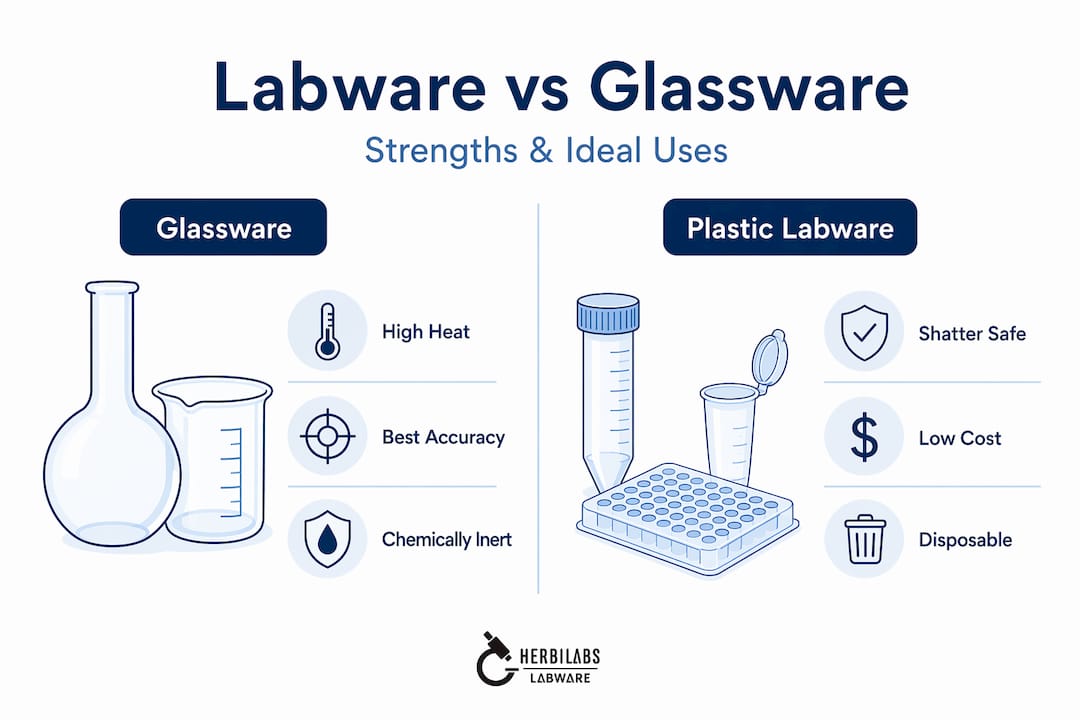
As experts describe it, the guiding principle is to use glass when heat, solvents, accuracy, or low contamination are key, and plastic when sterility, speed, and drop safety matter more. Applying this principle requires a structured decision process rather than defaulting to whichever material type you have used previously. Browse lab consumables examples to see how material selection translates into specific product categories.
The decision steps below translate this framework into a repeatable workflow:
- Define the primary constraint of your protocol: is it temperature, chemical exposure, required accuracy, or sterility?
- Identify whether a pharmacopoeial or accredited method mandates a specific material or accuracy class.
- Check chemical compatibility for every reagent in the workflow against the candidate material.
- Evaluate contamination sensitivity: does your analyte require ultra-low-background labware?
- Assess operational context: high throughput, breakage-prone environment, or single-use mandate?
- Select the material that satisfies all binding constraints, then apply cost and waste criteria to finalize.
Why labware vs glassware decisions require materials science awareness, not just habit
The persistent assumption that glass is always the “safe default” for laboratory work is one of the more consequential habits in bench science, and it does not hold up under scrutiny. Glass is a manufactured material with a specific composition, and its performance is tied to that composition in ways that matter. Experts treat glass as a materials-science choice because ion release and thermal and chemical stability are tied to composition and use case, not merely to the container type being glass. A borosilicate flask and an aluminosilicate flask behave differently under the same acid exposure. Treating them as equivalent is an analytical error.
The same depth of reasoning applies to plastic selection. Choosing “plastic” without specifying the polymer is as imprecise as choosing “metal” without specifying stainless steel versus aluminum. Polypropylene and PTFE are both “plastic” but differ by hundreds of degrees in upper service temperature and by entire chemical families in their compatibility profiles. Researchers who default to plastic for safety or convenience without identifying the specific polymer create risks that are less visible but equally real.
“Materials selection in the laboratory is not a procurement convenience. It is a scientific decision that affects data integrity, analyst safety, and method defensibility. The container is part of the analytical system.”
Understanding labware purity risks at the compositional level, rather than relying on categorical assumptions, is what separates method-driven selection from habit-driven selection. This is particularly important for researchers conducting trace analysis, peptide reconstitution, or any workflow where background contamination at the part-per-billion level can obscure results.
Pro Tip: Before purchasing any labware for a new method, build a one-page material specification sheet: list the chemicals, concentrations, temperatures, accuracy requirements, and sterility needs. Use that document to evaluate candidates rather than working from memory or historical orders.
Explore Herbilabs’ expert resources and high-purity solutions for labware needs
Now that you have the knowledge to distinguish labware and glassware, Herbilabs can support your procurement and research with proven quality and trusted guidance.
Herbilabs provides researchers and laboratory professionals across the UK and Europe with access to detailed labware purity explained resources, covering standards, contamination risks, and best practices relevant to demanding research environments. The essential labware checklist is designed to guide material selection decisions from initial protocol design through procurement. For workflows requiring reconstitution or dilution of research compounds, Herbilabs’ range of high-purity reconstitution solutions is manufactured to strict purity standards, ensuring your labware and reagents work together without introducing background contamination that undermines your results.
Frequently asked questions
What is the main difference between labware and glassware?
Labware includes a broad range of reusable or disposable lab tools made from various materials, while glassware specifically refers to items made mainly of borosilicate or other laboratory-grade glass. As lab consumables terminology clarifies, labware covers a broad set of components while glassware is a subset made from specialized glass materials.
When should I choose glassware instead of plastic labware?
Choose glassware when you require high heat tolerance, chemical inertness, volumetric accuracy, or minimal contamination in trace analysis; plastic is better for sterility, single-use workflows, and impact resistance but requires careful chemical compatibility verification. The selection principle is to use glass for heat, solvents, accuracy, and low contamination, and plastic for sterile, single-use, and drop-safe needs.
Why is borosilicate glass preferred in laboratories?
Borosilicate glass has a low coefficient of thermal expansion and high chemical resistance, allowing it to withstand rapid temperature changes and exposure to many chemicals without degrading. Its thermal and chemical properties make it the benchmark glass material for laboratory use.
What are the limitations of using glassware with hydrofluoric acid (HF)?
Hydrofluoric acid attacks and degrades glass, causing container damage and introducing fluoride contamination into the sample. HF-compatible polymers such as PTFE must be used instead for any workflow involving HF.
How do Class A and Class B volumetric glassware differ?
Class A volumetric glassware meets tighter tolerances and is appropriate for quantitative analytical work subject to regulatory traceability requirements, while Class B carries wider tolerances suitable for routine or preparative use. Class A vs Class B differences mean Class A is the correct choice when data must be defensible under audit or pharmacopoeial compliance.