Private Label, White Label, Wholesale partnerships available - EU, USA and UK - Free shipping from €75
Lab Consumables Checklist for Researchers in 2026
Ensure your research success with our essential lab consumables checklist for 2026. Streamline your inventory and boost experiment reliability!
TL;DR:
- Having a comprehensive lab consumables checklist helps prevent shortages, errors, and experiment failure. Selecting high-quality, compatible items based on total cost of ownership and safety standards improves research reliability and operational efficiency. Proper inventory management and waste segregation ensure regulatory compliance and support sustainable laboratory practices.
Efficient laboratory work depends on more than sound experimental design. It depends on having the right supplies available, in the right condition, at precisely the right moment. A structured lab consumables checklist is the single most reliable tool for preventing the errors, delays, and failed experiments that stem from missing or substandard materials. Essential lab consumables span five high-priority categories, each directly affecting reagent integrity and sample outcomes. This article provides a detailed, category-organized checklist alongside selection criteria, comparison data, and inventory management guidance designed specifically for active laboratory environments.
Table of Contents
- Key Takeaways
- 1. What belongs on a lab consumables checklist
- 2. Key criteria for selecting lab consumables
- 3. Liquid handling consumables
- 4. Sample preparation consumables
- 5. Safety and PPE consumables
- 6. Filtration consumables
- 7. Cleaning and waste management supplies
- 8. Consumables comparison: making informed selections
- 9. Best practices for inventory management and compliance
- My perspective on what most labs get wrong
- How Herbilabs supports your laboratory consumables needs
- FAQ
Key Takeaways
| Point | Details |
|---|---|
| Use a structured checklist | A laboratory consumables checklist organized by category prevents shortages and reduces experimental errors. |
| Evaluate total cost of ownership | Upfront price savings on consumables often lead to higher long-term costs from failures and repeat purchases. |
| Match PPE to hazard risk | PPE selection should be based on formal hazard assessments, not generic lab-wide standards. |
| Segregate waste at generation | Waste must be categorized and separated at the point of generation to meet OSHA and CLIA requirements. |
| Treat sustainability as lifecycle analysis | Effective sustainability goes beyond purchasing recycled products; it accounts for packaging, transport, and disposal. |
1. What belongs on a lab consumables checklist
Before building or auditing your laboratory consumables checklist, you need a clear framework for what counts as a consumable versus durable equipment. Consumables are single-use or limited-use items that are depleted during experimental workflows. They include everything from pipette tips and microcentrifuge tubes to nitrile gloves and syringe filters. According to a structured laboratory consumables guide, these items fall into five primary categories with the highest monthly usage rates: liquid handling, sample preparation, personal protective equipment, filtration, and cleaning and waste management.
The distinction matters for procurement planning because consumables require continuous replenishment on a schedule that durable equipment does not. Treating them informally, ordering ad hoc when a shortage is discovered, leads to workflow interruptions and unnecessary rush-order costs.
2. Key criteria for selecting lab consumables
A well-executed lab supply checklist is not simply a catalog of items. It reflects deliberate selection decisions based on the following criteria.
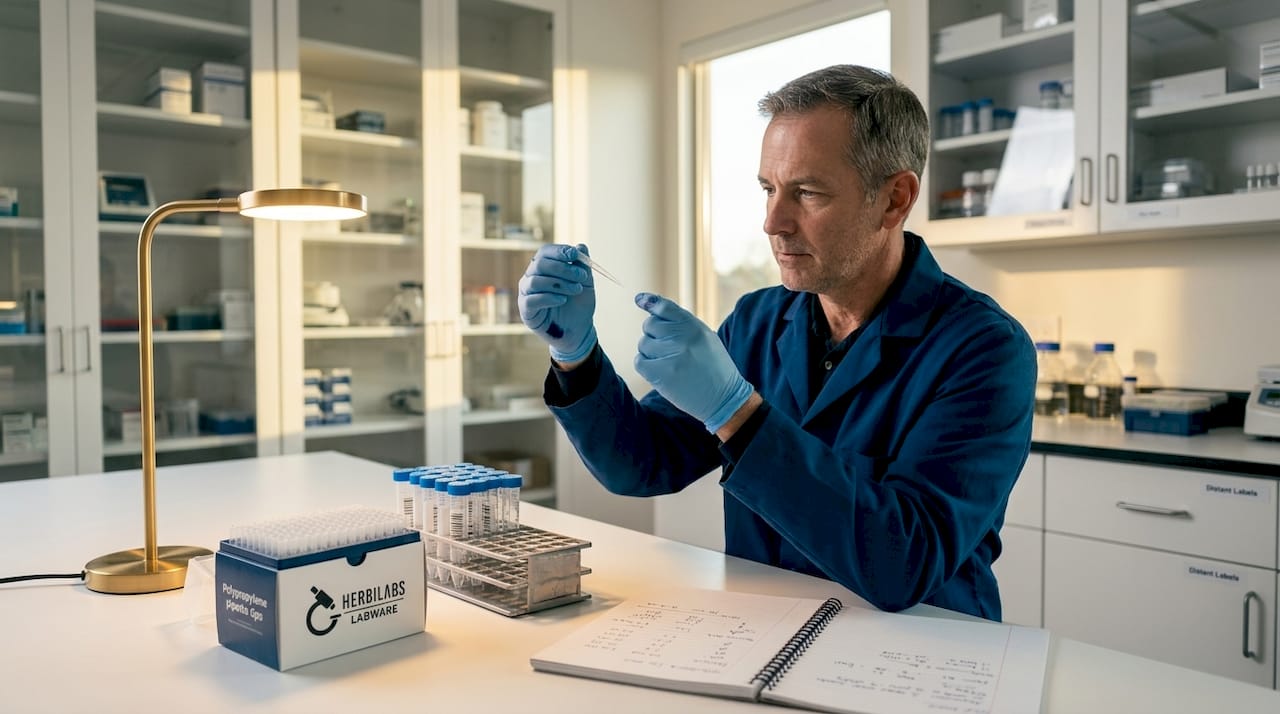
Quality and reliability. Consumable quality directly determines data integrity. Higher-quality materials such as polypropylene copolymers in microcentrifuge tubes offer measurably better chemical resistance and dimensional consistency than commodity-grade alternatives.
Equipment and protocol compatibility. A pipette tip that does not seat correctly introduces systematic volume errors. Filtration media that is incompatible with your solvent will leach contaminants or clog prematurely. Compatibility must be verified against both instrument specifications and the chemical environment of the assay.
Total cost of ownership. The TCO approach to procurement accounts for the indirect costs of poor-quality consumables, including failed experiments, repeat runs, and wasted reagents. An item priced 20% lower than a competitor’s may generate costs that are three times higher over a research cycle.
Safety and regulatory compliance. PPE must meet applicable OSHA standards, and waste containers must comply with color-coding requirements specific to waste type. Compliance is not optional or aspirational. It is a baseline requirement.
Sustainability. Lifecycle analysis of lab consumables includes evaluating packaging volume, transport emissions, and downstream disposal costs, not just whether an item is labeled recyclable.
Inventory control. Usage tracking by experiment type allows labs to forecast reorder points accurately and avoid both stockouts and excessive holding inventory.
Pro Tip: When building your scientific supply checklist for the first time, record actual consumption rates for each item over 60 days before setting reorder quantities. Estimated usage and actual usage frequently diverge by 30% or more.
3. Liquid handling consumables
Liquid handling represents the highest-frequency consumable category in most research labs. Every sample transfer, dilution series, and reagent addition depends on this category.
- Pipette tips. Available in standard, filtered, wide-bore, and low-retention formats. Filtered tips with hydrophobic barriers prevent aerosol contamination in PCR and cell culture work. Low-retention tips improve accuracy when working with viscous reagents or small volumes below 10 microliters.
- Serological pipettes. Used for larger volume transfers in cell culture and liquid media preparation. Available in sizes from 1 mL to 50 mL. Polystyrene construction is standard, though specialized applications may require tissue-culture-treated surfaces.
- Reagent reservoirs. Single-use reservoirs prevent cross-contamination between reagents during multichannel pipetting. Sterile options are required for cell culture workflows.
Pro Tip: Store unused filtered tips away from UV light sources. The hydrophobic membrane can degrade under prolonged UV exposure, compromising aerosol protection without any visible indicator of failure.
4. Sample preparation consumables
This category encompasses the physical vessels in which samples are processed, stored, and centrifuged. Selection errors here compromise sample integrity before any measurement is taken.
- Microcentrifuge tubes. Available in 0.5 mL, 1.5 mL, and 2 mL formats. Tube wall thickness and polymer composition determine maximum centrifugation speed. Standard polypropylene tubes are rated for 16,000 x g; specialty tubes with reinforced walls handle up to 30,000 x g for ultracentrifugation steps.
- Conical tubes. The 15 mL and 50 mL formats are ubiquitous in cell culture and sample dilution workflows. Confirm that the cap sealing mechanism is leakproof if tubes will be used in refrigerated centrifuges.
- PCR tubes and plates. Thin-walled construction for thermal conductivity is critical. Incompatible tube geometry with your thermocycler block introduces temperature uniformity errors across the plate.
- Glass vials. Preferred for long-term sample storage, particularly for chemical or protein samples where polymer leaching is a concern. For reconstitution workflows involving lyophilized compounds, high-quality sterile glass vials are the standard.
- Petri dishes. Used for agar plating, cell culture, and sterility testing. Tissue-culture-treated surfaces are required for adherent mammalian cell lines.
5. Safety and PPE consumables
PPE selection based on hazard risk is a regulatory and ethical obligation. A formal hazard walkthrough survey, rather than a generic glove-and-goggles default, is the correct basis for PPE specification.
- Nitrile gloves. The current standard for general chemical and biological work due to a strong balance of chemical resistance, puncture resistance, and tactile sensitivity. Available in multiple thicknesses; 4 mil is standard, while 6 mil or higher is appropriate for extended chemical contact.
- Lab coats. 100% cotton provides fire resistance; polypropylene disposable coats suit cleanroom or single-use biological workflows. The choice depends on the primary hazard class.
- Safety goggles and face shields. Chemical splash goggles with indirect ventilation are required for work with corrosive liquids. Face shields are supplementary, not substitutes for goggles.
- Shoe covers and hair nets. Required in ISO-classified cleanroom environments and good manufacturing practice settings.
6. Filtration consumables
Filtration consumables are often an afterthought in lab equipment inventory planning, yet they directly affect sample purity and instrument longevity.
- Syringe filters. Membrane material determines chemical compatibility. Polyethersulfone (PES) is appropriate for aqueous samples and cell culture media. Polytetrafluoroethylene (PTFE) is used for aggressive organic solvents. Cellulose acetate is suited for protein solutions where low protein binding is required.
- Bottle-top filters. Used for sterile filtration of large volumes of media or buffer solutions. Confirm pore size (0.22 micron is standard for sterilization) and membrane compatibility with your solvent.
- Membrane filters. Used in vacuum filtration setups for environmental monitoring, particle analysis, and sample concentration steps.
The selection of pore size is not a generic decision. Using a 0.45-micron filter where 0.22 microns is required for sterility assurance is a protocol violation, not a minor deviation.
7. Cleaning and waste management supplies
Waste segregation at the point of generation is an OSHA requirement, not a post-experiment cleanup task. Incorrect segregation creates legal liability for the laboratory and can result in immediate citation.
- Biohazard bags. Red or orange for infectious waste per US medical waste color-coding standards. Must display the universal biohazard symbol and include compliant labeling.
- Sharps containers. White containers are designated for sharps. Overfilling sharps containers beyond the indicated fill line is a violation and a needle-stick risk.
- Chemical waste containers. Secondary containment is required for any liquid chemical waste. Containers must be labeled with contents, hazard class, and accumulation start date.
- Wash bottles. Used for rinsing equipment and dispensing solvents. Label clearly by contents. Using an unlabeled wash bottle is a common source of cross-contamination incidents.
- Disinfectants. 70% ethanol and 1:10 bleach solution are standard. For biosafety cabinet surface decontamination, a daily wipe protocol with appropriate contact times is required before and after every session.
8. Consumables comparison: making informed selections
The following table summarizes key selection criteria across the most frequently compared consumable categories.
| Category | Option A | Option B | Best for |
|---|---|---|---|
| Pipette tips | Standard polypropylene | Filtered with hydrophobic barrier | PCR and RNA work: filtered; general transfers: standard |
| Microcentrifuge tubes | Standard PP, 16,000 x g rated | Reinforced wall, 30,000 x g rated | High-speed centrifugation: reinforced; routine use: standard |
| Gloves | Nitrile 4 mil | Nitrile 6 mil or laminated | Extended chemical exposure: 6 mil; general lab work: 4 mil |
| Syringe filter membrane | PES (aqueous) | PTFE (organic solvents) | Media and buffers: PES; organic solvents: PTFE |
| Waste containers | Red biohazard bags | White sharps containers | Biological waste: red bags; sharps: white containers |
Choosing between options in each category requires knowledge of your specific protocols. A consumables comparison guide that includes feature and pricing data for 2026 can support purchasing decisions at scale.
Pro Tip: Do not default to the lowest-cost syringe filter. An incompatible membrane can leach plasticizers into your sample, generating false peaks in HPLC chromatograms that are difficult to trace back to the filtration step.
9. Best practices for inventory management and compliance
Maintaining an accurate lab equipment inventory is as operationally critical as the experimental work it supports. The following practices reduce the risk of shortages, compliance failures, and audit findings.
- Assign minimum stock levels to all consumables based on 60 to 90-day usage data, with automatic reorder triggers set at the 30-day remaining quantity mark.
- Conduct a physical inventory count at least quarterly and reconcile against purchase records to identify discrepancies, which frequently indicate improper disposal or untracked usage.
- Maintain a consumables log that records lot numbers for items used in regulated research. This supports traceability during inspections and allows rapid response if a vendor issues a quality notice.
- For biosafety cabinet workflows, follow recommended blower purge cycles of at least five minutes before and after use. This step is frequently skipped under time pressure and is a primary driver of cross-contamination incidents.
- Replace UV-C lamps in biosafety cabinets based on accumulated operating hours rather than visual condition. Output degrades significantly before the lamp fails visually, and shadowed areas remain unsterilized regardless of lamp condition.
- Train all laboratory staff on proper waste segregation before they begin work. Regulatory waste standards use color-coded systems for a reason: compliance depends on every person in the lab, not just the lab manager.
Documentation of training completion, inventory audits, and equipment maintenance cycles should be retained in a dedicated lab compliance file accessible during inspections.
My perspective on what most labs get wrong
I’ve spent considerable time reviewing how research labs approach consumables procurement, and the most persistent problem is not a lack of information. It is the tendency to treat consumables as a logistics afterthought rather than a scientific variable.
When a lab purchases cheap microcentrifuge tubes because the budget is tight, the assumption is that the savings are real. In my experience, they rarely are. A tube that fails at 15,000 x g mid-run does not just waste the sample. It wastes the reagents, the instrument time, and frequently the researcher’s time across an entire experimental series. The lifecycle cost evaluation framework exists precisely to make these indirect costs visible, yet most labs never apply it.
I’ve also seen labs with excellent protocols and well-trained staff produce inconsistent data because their syringe filters were not matched to their solvents, or because their pipette tips were not certified for the RNA work they were doing. These are not edge cases. They are the kinds of problems that appear in the gap between a written protocol and an actual procurement decision.
The sustainability dimension is worth addressing directly. Most labs approach it as a purchasing checkbox: buy tips with recycled packaging, done. The more accurate framing, and the one that produces real benefits, is a lifecycle analysis that covers packaging volume, shipping frequency, and how waste is ultimately processed. Labs that consolidate orders, reduce packaging, and invest in regional suppliers often find that their environmental and cost outcomes both improve.
My advice is straightforward: build your lab supply checklist from actual usage data, evaluate every category against total cost of ownership rather than unit price, and treat compliance documentation as an operational asset rather than an administrative burden.
— Ragnar
How Herbilabs supports your laboratory consumables needs
When your laboratory consumables checklist includes reconstitution solutions, sterile diluents, or high-purity reagents, the quality of those products determines the validity of your results. Herbilabs manufactures bacteriostatic water and sterile reconstitution solutions to strict purity standards in a dedicated facility, supplying research institutions, universities, and independent researchers across the UK and Europe.
Herbilabs products are manufactured under rigorous quality control protocols designed for demanding research environments. Whether you require a sterile reconstitution solution for lyophilized peptides or need guidance on selecting research-grade reagents for your specific protocols, Herbilabs provides the product documentation, purity specifications, and delivery reliability that serious research requires. Wholesale pricing and secure ordering are available for professional and institutional buyers.
FAQ
What are the five main categories of lab consumables?
The five primary categories are liquid handling, sample preparation, personal protective equipment, filtration, and cleaning and waste management. Each category contains items with the highest monthly usage rates and the most direct impact on experimental outcomes.
How often should a lab equipment inventory be audited?
Physical inventory counts should be conducted at least quarterly and reconciled against purchase records. More frequent audits are advisable in high-throughput research environments or facilities subject to regulatory inspections.
What is the correct way to segregate laboratory biohazard waste?
Waste must be segregated at the point of generation following OSHA and CLIA requirements. Red or orange bags are used for infectious waste, white containers for sharps, and yellow containers for chemotherapy waste, as specified in US medical waste color-coding standards.
Why does PPE selection need to be hazard-specific?
Generic PPE assignments lead to both over-protection, which reduces efficiency, and under-protection, which creates safety risks. A formal hazard walkthrough survey tailored to specific tasks and chemicals is the correct basis for PPE specification in any research lab.
When should filtered pipette tips be used instead of standard tips?
Filtered pipette tips with hydrophobic aerosol barriers are required for PCR, RNA work, and any application where cross-contamination via aerosol would compromise results. Standard tips are appropriate for general liquid handling where contamination risk is low.