Private Label, White Label, Wholesale partnerships available - EU, USA and UK - Free shipping from €75
Laboratory Safety Checklist for Researchers in 2026
Enhance your lab's productivity with a comprehensive laboratory safety checklist. Learn key strategies for effective safety and compliance in 2026!
TL;DR:
- A well-maintained laboratory safety checklist is essential for preventing accidents, ensuring compliance, and protecting personnel. It must be specific, regularly updated, and integrated into daily workflows to improve productivity and safety culture.
A well-constructed laboratory safety checklist is not a bureaucratic formality. It is the operational backbone of accident prevention, regulatory compliance, and personnel protection in any working lab. According to a 2026 EcoOnline report, 92% of workers in the US and Canada directly link safer workplaces to higher productivity, and 78% report better retention where positive safety records exist. For laboratory personnel, researchers, and safety officers, this translates to a clear operational imperative: your checklist needs to be specific, maintained, and genuinely integrated into daily practice.
Table of Contents
- Key takeaways
- 1. Personal protective equipment verification
- 2. Chemical storage, labeling, and SDS access
- 3. Emergency equipment functionality
- 4. Equipment safety and maintenance records
- 5. Housekeeping and environmental organization
- 6. Hazardous waste management procedures
- 7. Maintenance schedules and inspection routines
- 8. Risk-based PPE selection and formal hazard assessment
- 9. Customizing and continuously improving your safety checklists
- My perspective on what actually makes lab safety checklists work
- Supporting your lab safety with quality-controlled supplies from Herbilabs
- FAQ
Key takeaways
| Point | Details |
|---|---|
| Safety culture drives performance | Labs with documented safety programs report higher productivity and reduced staff turnover. |
| Checklists require task-level specificity | Generic templates create false confidence; tailor every checklist item to actual lab hazards. |
| Maintenance schedules are non-negotiable | Eyewash stations, fume hoods, and fire suppression equipment each require defined inspection intervals. |
| Risk-based PPE selection matters | Match protective equipment to specific chemical exposure scenarios, not blanket lab-wide mandates. |
| Living documents outperform static ones | Periodic review and staff involvement keep safety checklists relevant as lab operations evolve. |
1. Personal protective equipment verification
The PPE section of any research lab safety checklist should go beyond confirming that gloves and goggles are present in the lab. Verification must confirm that the correct category of PPE is available for the tasks being performed that day, that equipment is undamaged and within service life, and that sizing options are accessible to all personnel.
At minimum, this category should include:
- Gloves: Confirm material compatibility with chemicals in use. Nitrile is not universally protective, as chemical breakthrough times vary significantly by substance.
- Eye and face protection: Safety glasses, splash goggles, and face shields each address different hazard profiles. Ensure the correct type is accessible at each workstation.
- Laboratory coats and aprons: Check for flame resistance requirements, contamination status, and proper fit.
- Respiratory protection: Verify that respirators, where required, are properly fitted, stored, and within certification dates.
Pro Tip: Post a task-specific PPE reference card at each primary workstation rather than a single generic lab-wide list. This reduces the cognitive burden on personnel and minimizes selection errors during high-pressure workflows.
2. Chemical storage, labeling, and SDS access
Chemical safety guidelines universally require that all substances in a lab are correctly stored, clearly labeled, and accompanied by accessible Safety Data Sheets. In practice, this category is one of the most frequently cited compliance failures during audits.
Your checklist should confirm that all chemical containers carry GHS-compliant labels, including hazard pictograms, signal words, and precautionary statements. Segregation by chemical compatibility class — not merely alphabetical order — must be verified. Acids and bases, oxidizers and flammables, and reactive compounds require physical separation, often in dedicated ventilated storage cabinets.
SDS access deserves specific attention. Both digital and printed SDS catalogs should be current, and personnel must know exactly how to locate them during an incident. For labs handling sensitive chemical reagents, routine verification of storage temperature compliance and secondary containment integrity is equally critical.
3. Emergency equipment functionality
A safety equipment checklist that does not verify the operational status of emergency response infrastructure is incomplete by definition. Eyewash stations and safety showers must be tested weekly to flush stagnant water and confirm activation mechanisms function correctly. Fire extinguishers require monthly visual checks and annual professional servicing.
Emergency lighting, exit signage, and evacuation route postings must be inspected on a recurring schedule. Exit paths should be physically walked to confirm they are unobstructed. First aid kits need quarterly inventory reviews to replace expired or depleted items.
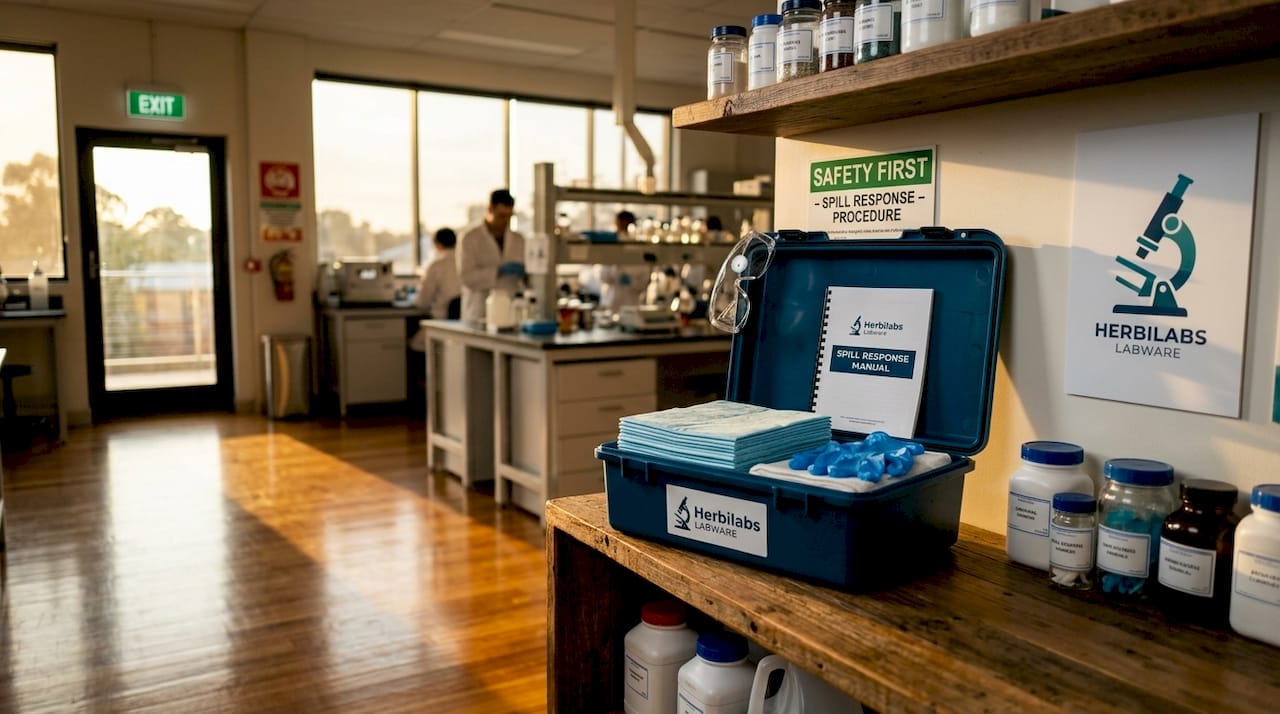
One frequently overlooked element is the accessibility of spill response kits. These should be located at or near chemical storage and handling areas, fully stocked, and labeled to indicate their contents are appropriate for the chemical classes present in that zone.
4. Equipment safety and maintenance records
Every instrument in a laboratory setting carries its own risk profile, and your laboratory risk assessment should account for each piece of equipment individually. Autoclaves, centrifuges, UV lamps, and high-voltage power supplies each require documented inspection histories.
The checklist at this level should confirm that:
- All equipment carries a visible calibration or service sticker indicating the last and next inspection date.
- Instruments with moving or pressurized components have functioning safety interlocks.
- Electrical equipment shows no visible damage to cords, plugs, or casings.
- Fume hoods and biological safety cabinets are within their annual professional certification cycle.
Assigning named responsibility for each piece of equipment to a specific lab member or safety officer closes the accountability gap that generic “shared responsibility” arrangements consistently fail to address.
5. Housekeeping and environmental organization
Clutter is a direct contributor to laboratory accidents, and a research lab safety checklist must address the physical state of the workspace in explicit terms. Bench surfaces should be cleared of materials unrelated to the current procedure. Aisles must remain unobstructed to a minimum clearance width sufficient for emergency egress.
Biohazard and chemical waste containers should be properly labeled, covered when not in active use, and positioned away from high-traffic corridors. Refrigerators and freezers used for chemical or biological storage require regular defrost and decontamination cycles and must never contain food or beverages.
The condition of flooring, particularly in areas where liquid chemicals are handled, deserves specific line items. Anti-slip mats, drainage features, and secondary containment trays should all be checked for condition and placement. For labs focused on contamination prevention, housekeeping verification overlaps directly with data integrity requirements.
6. Hazardous waste management procedures
Proper hazardous material handling procedures must be reflected in the checklist as a dedicated category, not a footnote under housekeeping. This section should confirm that waste streams are segregated correctly by chemical classification, that containers are dated from the point of generation, and that accumulation start dates comply with regulatory holding time limits.
Personnel responsible for waste collection and disposal should be identified by name, and their training certificates should be current. The checklist should also confirm that waste labels meet the specific requirements of applicable regulations such as RCRA in the United States or relevant EU waste framework directives.
Disposal documentation, including manifests and vendor chain-of-custody records, should be filed and retrievable within the lab itself, not only at an institutional level. Documented maintenance records of this kind serve dual purposes: they provide compliance proof and generate the trend data needed to identify recurring issues before they escalate.
7. Maintenance schedules and inspection routines
One of the most critical distinctions in lab safety practice is the difference between routine functional tests performed by in-house personnel and formal professional certification that requires an external qualified technician. Conflating the two produces compliance gaps that audits will expose.
The following table outlines recommended inspection intervals for primary safety equipment categories:
| Equipment | In-house frequency | Professional certification |
|---|---|---|
| Eyewash stations and safety showers | Weekly | Annual |
| Fire extinguishers | Monthly visual check | Annual service |
| Emergency lighting | Monthly test | As required by local code |
| Fume hoods | Monthly airflow visual check | Annual certification |
| Biological safety cabinets | Monthly visual inspection | Annual certification |
| First aid kits | Quarterly inventory | N/A |
Maintaining this schedule requires explicit assignment. The shared maintenance responsibilities model works only when roles are named and recorded, not assumed. Each completed inspection should generate a dated entry in a maintenance log that can be produced on demand during regulatory audits.
Pro Tip: Use a digital maintenance log linked to calendar alerts rather than a paper binder. This eliminates missed intervals and creates an automatically timestamped audit trail.
8. Risk-based PPE selection and formal hazard assessment
Broad, lab-wide PPE mandates are a starting point, not a solution. A granular hazard assessment based on formal walkthrough surveys is required to match protective equipment to actual task-level exposure scenarios. This process should categorize hazards by type: impact, chemical splash, biological exposure, thermal, and physical hazard sources each require independent evaluation.
The hierarchy of controls is the correct analytical framework here. Elimination and substitution of hazardous materials should be evaluated before engineering controls such as fume hoods and interlocks, which should be exhausted before administrative controls and PPE are introduced. Progressive lab safety programs reduce PPE reliance as the first line of defense precisely because PPE is the layer most susceptible to human error in selection and use.
When PPE is required, selection criteria must be specific. For glove selection in chemical handling, the checklist should reference the actual compounds being used and their documented breakthrough times for candidate glove materials. A formal risk-based approach also builds staff engagement: when personnel understand the reasoning behind PPE requirements, laboratory safety training translates into active personal accountability rather than passive compliance.
9. Customizing and continuously improving your safety checklists
A laboratory safety checklist modeled on a generic template provides the appearance of compliance without addressing lab-specific hazard profiles. Checklists function as living documents that must be updated to reflect changes in chemicals in use, equipment configurations, personnel roles, and regulatory requirements.
The table below compares static and dynamic checklist approaches across key operational dimensions:
| Dimension | Static generic checklist | Dynamic lab-specific checklist |
|---|---|---|
| Hazard coverage | Broad, category-level | Task-specific, reviewed periodically |
| Update frequency | Rarely revised | Reviewed after incidents and at set intervals |
| Staff involvement | Distributed for signature | Co-developed with bench-level staff |
| Compliance reliability | Moderate, audit-focused | High, operationally embedded |
| Technology integration | Paper or static PDF | Digital tools with sensor and incident data |
Incorporating digital platforms and, where resources permit, wearable sensor data allows safety officers to move from reactive inspections toward predictive interventions. When incident data is integrated into EHS workflows, patterns in near-miss events or equipment performance trends become visible before they contribute to reportable accidents.
Addressing mental health and digital security as components of a comprehensive safety culture reflects how modern lab safety management has broadened beyond traditional chemical and biological hazards. A checklist that integrates these dimensions signals genuine institutional commitment to personnel wellbeing. For labs building or auditing their supply frameworks, a lab quality control checklist aligned to 2026 regulatory expectations provides a practical reference structure.
My perspective on what actually makes lab safety checklists work
I’ve reviewed enough safety audits to have a clear view on where checklists succeed and where they quietly fail. The most common failure mode is not negligence. It is over-reliance on a document that was built once, filed, and never substantively revisited. A checklist that doesn’t reflect the current chemicals in use, the current equipment configuration, or the current personnel responsibilities is not a safety tool. It is a liability.
What I’ve found makes a measurable difference is involving bench-level staff in the development and periodic review of the checklist itself. When researchers understand why a specific item is on the list — for example, why a particular glove material is specified for a reagent they use daily — they treat that requirement as technically justified rather than administratively imposed. That shift in perception converts compliance from a checkbox exercise into operational habit.
The maintenance schedule section is where I consistently see safety officers underinvest. Assigning eyewash station testing to “the lab” without a named person means it will happen irregularly at best. Named accountability, with a dated log entry as evidence, is what turns a maintenance schedule from a policy statement into a practice.
Technology integration is the next frontier, and the gap between labs using paper binders and those using digital platforms with automated inspection reminders is already significant and widening. Moving to a digital system is not a large investment relative to the cost of a single lab accident prevention failure, whether measured in personnel injury, regulatory penalty, or research interruption.
— Ragnar
Supporting your lab safety with quality-controlled supplies from Herbilabs
A complete laboratory safety checklist accounts for the quality of the materials being used, not only the procedures surrounding them. Research grade reagents and reconstitution solutions that fail purity standards introduce contamination and handling risks that no PPE protocol can fully offset.
Herbilabs supplies high-purity bacteriostatic water and reagents manufactured to strict contaminant-free standards, serving research institutions, universities, and independent researchers across the UK and Europe. Every product in the Herbilabs catalog is produced under rigorous quality control protocols designed to meet the demands of sensitive research environments. For labs building a complete safety and supply framework, the essential labware checklist provides a practical starting point for aligning reagent selection with safety requirements.
FAQ
What should a laboratory safety checklist include?
A laboratory safety checklist should cover PPE availability and task-specific selection, chemical storage and labeling, emergency equipment functionality, equipment maintenance records, housekeeping standards, and hazardous waste management procedures. Each category requires line items specific to the actual hazards present in that lab.
How often should lab safety equipment be inspected?
Eyewash stations and safety showers require weekly testing, fire extinguishers need monthly visual checks and annual professional servicing, and fume hoods and biological safety cabinets require annual professional certification in addition to routine in-house monitoring.
Why are generic safety checklists insufficient for lab environments?
Generic templates address broad hazard categories but cannot account for lab-specific chemical inventories, equipment configurations, or procedural workflows. Tailored living documents that are reviewed and updated regularly provide materially better protection and more defensible compliance records.
How does risk-based PPE selection differ from standard PPE requirements?
Risk-based PPE selection involves formal hazard walkthrough surveys that match protective equipment to specific tasks, chemical exposures, and breakthrough time data, rather than applying a single standard set of PPE to all lab activities. This approach reduces both under-protection and unnecessary equipment burden on personnel.
What records should a laboratory maintain for safety compliance?
Labs should maintain dated maintenance logs for all safety equipment, SDS catalogs current to the chemical inventory, PPE inspection records, hazardous waste disposal manifests, and laboratory safety training certificates for all personnel. These records must be retrievable on-site for regulatory audit purposes.