Private Label, White Label, Wholesale partnerships available - EU, USA and UK - Free shipping from €75

The Role of Sterile Diluents in Research Labs
Discover the vital role of sterile diluents in research and how they impact compound stability and reproducibility. Enhance your experiments today!
TL;DR:
- Sterile diluents play a crucial role in research by affecting compound stability, bioavailability, and experimental reproducibility. Selecting appropriate types and following proper reconstitution protocols are essential to prevent contamination and ensure valid results. Emerging evidence shows some diluents can actively modulate physiological targets, requiring deliberate, data-driven use in biologics research.
Sterile diluents are frequently dismissed as inert carriers, little more than a vehicle to reconstitute a lyophilized peptide or adjust solution volume. That assumption is incorrect, and it costs researchers reproducibility. The role of sterile diluents in research extends well beyond passive dilution: they directly affect compound stability, bioavailability, sterility maintenance, and ultimately the validity of experimental results. This article examines the types of sterile diluents used in scientific research, their functional distinctions, the protocols that govern their correct use, and the emerging evidence that some diluents interact with physiological targets in ways researchers must account for.
Table of Contents
- Key Takeaways
- Role of sterile diluents in research: definitions and core functions
- Comparing sterile diluent types
- Protocols for sterile handling and reconstitution
- Quality standards and their impact on research reliability
- Emerging roles of diluents in biologics and immunotherapy research
- My perspective on how researchers underestimate diluent integrity
- Research-grade sterile diluents from Herbilabs
- FAQ
Key Takeaways
| Point | Details |
|---|---|
| Diluents are not passive fillers | Sterile diluents affect compound stability, bioavailability, and research reproducibility in measurable ways. |
| Diluent selection determines multi-dose safety | Bacteriostatic water supports multi-dose use for up to 28 days; sterile water for injection must be discarded immediately after opening. |
| Reconstitution technique is as critical as diluent choice | Improper mixing can reduce peptide bioavailability by 30 to 60%, directly compromising assay data. |
| USP compliance is non-negotiable | Particulate contamination linked to substandard diluents accounts for a significant portion of FDA recalls. |
| Emerging research demands data-driven selection | Some diluents modulate physiological targets in biologics, requiring deliberate, evidence-based formulation decisions. |
Role of sterile diluents in research: definitions and core functions
A sterile diluent is any sterile liquid used to dissolve, dilute, or reconstitute a pharmaceutical or research compound without introducing microbial or chemical contamination. The term covers several distinct product types, each with specific properties that make it suited or unsuited to a given research context.
More than 40% of injectable therapies require sterile diluent preparation prior to administration, which reflects how deeply integrated these solutions are in both pharmaceutical manufacturing and bench research. For researchers working with lyophilized peptides, growth factors, or biologics, the diluent is not a passive ingredient. It is the medium through which the active compound achieves its soluble, bioavailable form.
The primary functional roles of sterile diluents in research settings include:
- Volume adjustment: Achieving a precise target concentration by adding a defined volume of diluent to a lyophilized or concentrated compound.
- Solubility enhancement: Many peptides and biologics have poor aqueous solubility; the diluent composition (pH, ionic strength, preservative content) can significantly affect dissolution.
- Sterility maintenance: The diluent itself must remain free of microbial, particulate, and pyrogen contamination throughout its use period.
- Preservation in multi-dose applications: Certain diluents contain preservative agents that inhibit bacterial proliferation, extending the safe use window for reconstituted solutions.
- Stabilization of sensitive compounds: Temperature, pH, and the chemical environment created by the diluent all influence degradation rates of the active ingredient.
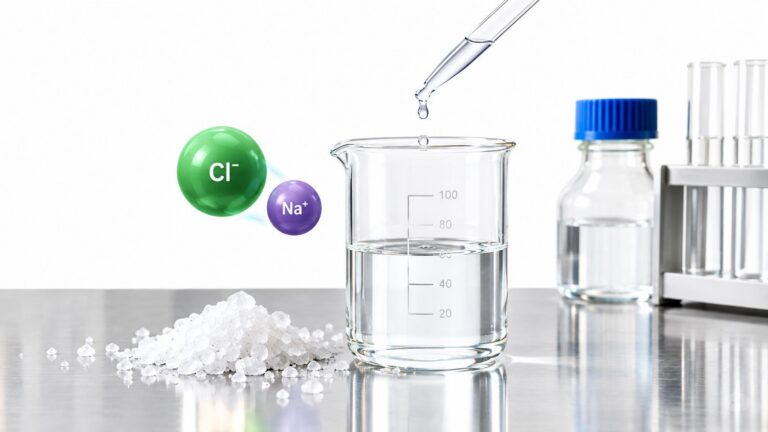
The three most frequently used sterile diluents in research are sterile water for injection (WFI), bacteriostatic water, and sterile saline (0.9% sodium chloride). Each has a distinct composition profile and a defined scope of appropriate use, and selecting the wrong one can compromise an entire experimental series.
Comparing sterile diluent types
| Diluent | Preservative | Use Duration | Best Suited For |
|---|---|---|---|
| Sterile water for injection (WFI) | None | Single use only | Sensitive compounds; single-dose protocols |
| Bacteriostatic water | 0.9% benzyl alcohol | Up to 28 days | Multi-dose peptide and biologic research |
| Sterile saline (0.9% NaCl) | None | Single use | Isotonic formulations; cell-based assays |
| Sterile PBS (pH 7.4) | None | Single use | Protein reconstitution; immunoassays |
Sterile water for injection is preservative-free and must be used immediately after opening. Any leftover solution presents a contamination risk and must be discarded, making it cost-inefficient for protocols requiring repeated withdrawals from the same vial.
Bacteriostatic water, by contrast, contains 0.9% benzyl alcohol, which prevents bacterial proliferation and permits multiple withdrawals over a 28-day period. The mechanism is specific: benzyl alcohol disrupts bacterial cell membranes, making it bacteriostatic rather than bactericidal. It halts replication without necessarily destroying all viable organisms, which means sterile technique remains mandatory even when using bacteriostatic water.
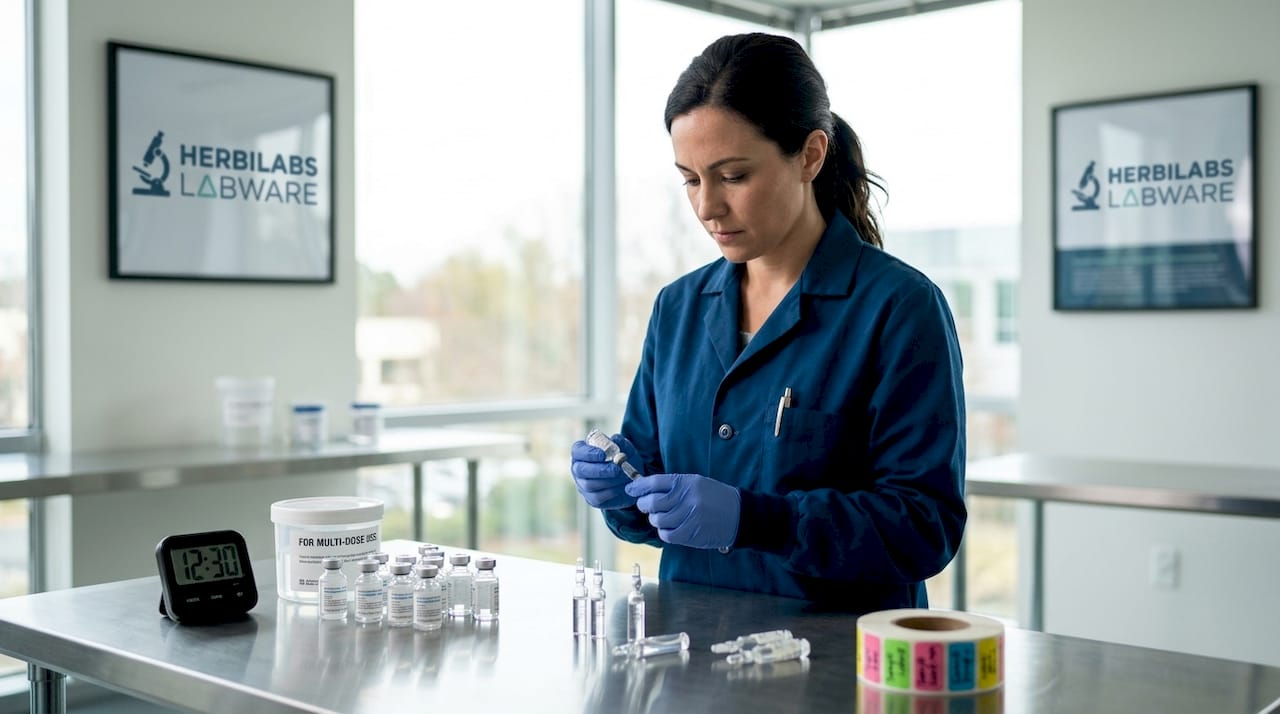
Compatibility between the diluent and the target compound is a factor researchers often overlook until a protocol fails. Benzyl alcohol can denature certain proteins and interfere with sensitive receptor-binding assays. Saline introduces ionic content that may alter electrostatic interactions in protein folding studies. Matching the diluent to the compound’s biochemical requirements is a prerequisite for experimental validity, not an afterthought.
Pro Tip: When working with novel peptide sequences for the first time, reconstitute a small pilot aliquot in each candidate diluent and assess solubility and turbidity before committing the full batch to one option.
Protocols for sterile handling and reconstitution
Correct reconstitution technique is the single most underinvested skill in peptide and biologic research. Improper mixing causes 30 to 60% bioavailability loss in assays, a margin that can render dose-response data entirely uninterpretable. The following sequence reflects established aseptic best practice for reconstituting lyophilized research compounds.
- Equilibrate to room temperature. Remove both the lyophilized vial and the diluent from refrigerated storage and allow them to reach room temperature before opening. Temperature differentials accelerate degradation and can cause moisture ingress.
- Wipe all septum surfaces. Use a 70% isopropyl alcohol swab on the stoppers of both vials and allow them to dry completely before needle insertion. Wet alcohol on the needle tip can carry surface contaminants into the solution.
- Draw the calculated diluent volume. Determine your target concentration before touching either vial. Account for the 3 to 5% overfill that manufacturers include in lyophilized peptide vials to compensate for adhesion losses during the freeze-drying process. Failing to account for this systematically inflates your calculated concentration.
- Add diluent slowly along the vial wall. Insert the needle at an angle so the liquid runs down the glass interior rather than directly onto the lyophilized cake. Direct impact can shear fragile peptide bonds and disrupt secondary structure.
- Allow dissolution without agitation. Gentle swirling is acceptable once the liquid has dispersed across the powder. Vortexing or shaking introduces microbubbles, increases oxidative stress on the compound, and risks foaming, which denatures proteins.
- Avoid air injection into multi-dose vials. Injecting air creates positive pressure that, on withdrawal, can draw environmental contaminants back through the needle track into the vial. Use negative-pressure technique or a filtered vent needle when required.
- Label and store correctly. Record the reconstitution date, diluent used, and resulting concentration on the vial. Store reconstituted solutions at 2 to 8°C unless the compound-specific data sheet specifies otherwise.
Pro Tip: When calculating dilution volumes for lyophilized peptides, always reference the manufacturer’s certificate of analysis for the stated overfill percentage rather than assuming a standard figure. Batch-to-batch variation is real and consequential.
For laboratories seeking a structured framework for contamination prevention at the reagent preparation stage, Herbilabs provides a researcher’s aseptic protocol checklist that covers each step of the handling sequence in detail.
Quality standards and their impact on research reliability
The importance of sterile diluents in research cannot be separated from the quality systems that govern their production. Substandard diluents introduce variables that no statistical method can fully control for: particulate matter, endotoxins, and trace chemical contaminants alter cellular responses, distort dose calculations, and create irreproducible data sets.
The scale of the problem is documented. Approximately 11% of FDA recalls from 2022 to 2024 were attributable to visible particulate contamination, a category directly linked to failures in sterile component manufacturing. Each recall represents not only a regulatory failure but also a cascade of invalidated research that depended on those materials.
The following table places the sterile diluent market in its broader manufacturing context, illustrating the scale of the sector and the growth trajectory driven by increasing demand for reliably sterile components.
| Metric | Value |
|---|---|
| Fill-finish market value (2025) | USD 16.86 billion |
| Projected market value (2030) | USD 28.14 billion |
| Compound annual growth rate | 8.9% |
| Recalls due to particulate contamination (2022-2024) | ~11% of total FDA recalls |
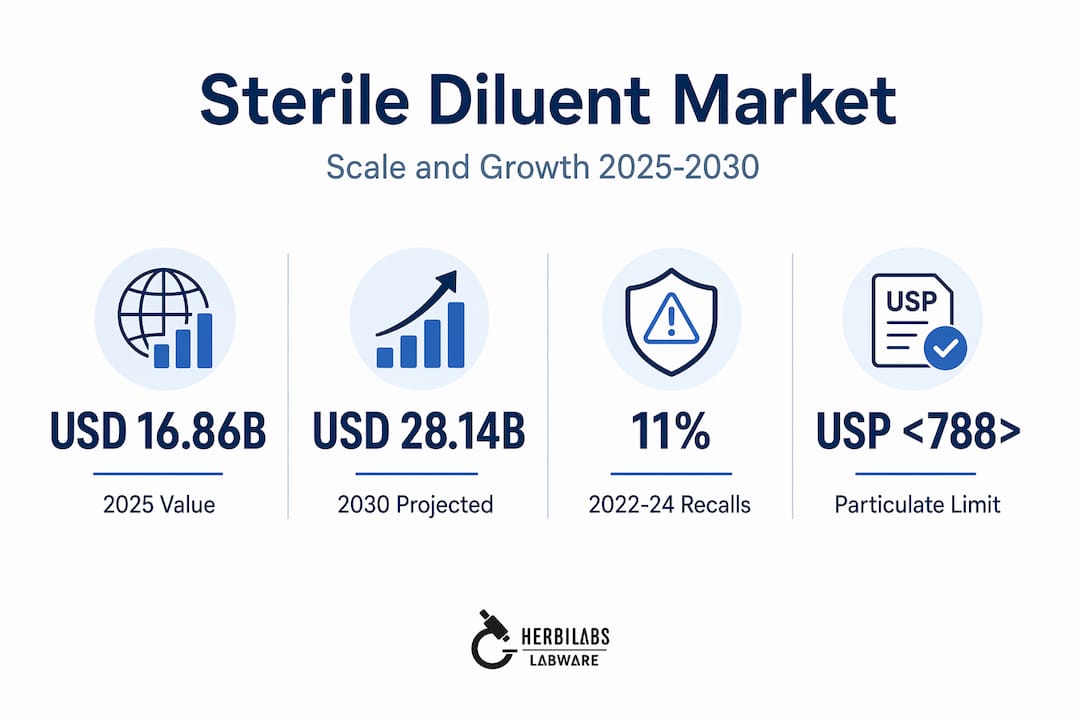
The fill-finish market growth to USD 28.14 billion by 2030 reflects accelerating demand for sterile drug products across biologics, gene therapies, and peptide-based compounds, all of which require high-purity diluents at multiple stages of development and testing.
USP standards, specifically USP <1> and USP <788>, establish the permissible limits for particulate matter in injectable preparations and the purity requirements for water for injection. Laboratories procuring diluents should verify that supplier documentation includes USP compliance certification, endotoxin testing results (typically expressed in EU/mL), and batch-specific certificates of analysis. For a structured review of compliance requirements, Herbilabs maintains a USP standards compliance guide tailored to laboratory procurement decisions.
Emerging roles of diluents in biologics and immunotherapy research
The scientific consensus on sterile diluents has historically positioned them as inert carriers, substances that do not participate in the biological activity of the formulation. That view is being revised as researchers in advanced biologics and immunotherapy discover that some diluents directly modulate physiological targets, demanding deliberate and data-driven selection rather than default choices based on availability.
The mechanisms involved are context-specific. Ionic diluents like saline can alter the conformational stability of membrane-bound receptor ligands. Diluents with specific pH profiles affect the ionization state of small peptides, which in turn changes receptor binding affinity in cell-based assays. In mRNA vaccine and lipid nanoparticle research, the buffer composition of the diluent has been shown to affect encapsulation efficiency and particle size distribution, both of which are critical to immunological response modeling.
For researchers working with complex biologics, these findings have a direct practical implication: diluents impact on research is not limited to contamination risk or volume accuracy. The chemical identity of the diluent must be treated as an experimental variable and controlled accordingly. This means predefining the diluent as part of the protocol, documenting it in method sections, and validating results across diluent batches when long-running studies span multiple procurement cycles.
Anticipated best practices moving forward include formulation-specific diluent validation, systematic diluent controls in assay panels, and greater transparency in publication methods sections about diluent composition. The era of treating the diluent as a footnote in a reconstitution protocol is ending.
My perspective on how researchers underestimate diluent integrity
I have reviewed a substantial number of failed peptide research protocols, and the pattern is consistent. The compound is sourced carefully, the assay is designed with precision, and the diluent is ordered from whatever supplier offered fast delivery. That asymmetry is where experiments break down.
In my view, the single most common mistake I see is using sterile water for injection in multi-dose protocols because it was already on the shelf. Researchers assume that if the vial looks clear and the stopper is intact, the solution is safe to reuse. It is not. Once the septum is punctured, the sterility guarantee is void without a preservative system in place. The resulting microbial contamination rarely presents as obvious turbidity. It presents as unexplained assay variance.
The second pattern I observe is the failure to account for overfill volumes. When a researcher calculates a 1 mg/mL concentration without adjusting for the manufacturer’s overfill, every subsequent dilution in the series is miscalculated. The error compounds across experimental sessions and is virtually invisible until someone runs a mass spectrometry verification.
My practical recommendation is to treat the diluent selection step with the same rigor applied to the active compound. Define it in the protocol, justify it in the methods section, and use aseptic technique consistently throughout the handling workflow. The researchers who do this produce data that holds up. The ones who do not spend considerable time troubleshooting results that cannot be replicated.
— Ragnar
Research-grade sterile diluents from Herbilabs
Herbilabs supplies USP-compliant sterile reconstitution solutions and bacteriostatic water products manufactured under strict quality control conditions for research applications across the UK and Europe. Each batch includes full documentation, endotoxin test results, and certificates of analysis to support traceability requirements in institutional and independent research settings.

For researchers who prioritize reproducibility and compliance, Herbilabs offers a curated selection of high-purity reconstitution solutions in 10 mL and 20 mL glass vials, as well as bulk multi-vial formats suited to extended peptide research programs. To understand the practical differences between bacteriostatic and sterile water before placing an order, the bacteriostatic vs sterile water guide on the Herbilabs site provides a direct, protocol-referenced comparison to support your selection. Quality materials do not guarantee good research, but substandard ones reliably compromise it.
FAQ
What is the role of sterile diluents in research?
Sterile diluents dissolve, dilute, and reconstitute research compounds while maintaining sterility and chemical compatibility. They directly influence compound stability, bioavailability, and the reproducibility of experimental results.
What is the difference between bacteriostatic water and sterile water for injection?
Bacteriostatic water contains 0.9% benzyl alcohol, permitting multi-dose use for up to 28 days. Sterile water for injection is preservative-free and must be discarded immediately after opening to avoid contamination risk.
How does improper reconstitution affect research outcomes?
Incorrect reconstitution technique, including direct diluent impact on the lyophilized cake or vortex mixing, can reduce peptide bioavailability by 30 to 60%, directly compromising dose-response data validity.
Why do overfill volumes matter in dilution calculations?
Manufacturers add 3 to 5% overfill to lyophilized vials to compensate for adhesion loss during freeze-drying. Ignoring this figure inflates the calculated concentration and introduces systematic dosing errors across an experimental series.
How do USP standards apply to sterile diluents used in the laboratory?
USP standards such as USP <1> and USP <788> define permissible particulate limits and purity requirements for injectable solutions. Procuring USP-compliant diluents with documented endotoxin testing is necessary for regulatory compliance and reliable research data.