Private Label, White Label, Wholesale partnerships available - EU, USA and UK - Free shipping from €75
What Is Laboratory Accreditation: A Guide for Lab Professionals
Discover what is laboratory accreditation and its vital benefits for lab professionals. Understand the principles and enhance your lab’s credibility!
TL;DR:
- Laboratory accreditation is a third-party validation of a lab’s technical competence within a specific scope. It relies on standards like ISO/IEC 17025, requiring continuous improvement and precise scope definition. Achieving and maintaining accreditation enhances result reliability, regulatory acceptance, and organizational quality culture.
Laboratory accreditation is one of those terms that gets used frequently across scientific and regulatory contexts, yet it remains misunderstood by many working professionals in the field. At its core, what is laboratory accreditation if not a formal, third-party confirmation that a laboratory is technically competent to perform specific testing or calibration activities within a precisely defined scope? It is not a certificate of good intentions, nor is it equivalent to obtaining an ISO 9001 quality management certification. This article clarifies the principles, processes, standards, and benefits of laboratory accreditation for professionals who need to understand it accurately and apply that understanding practically.
Table of Contents
- Key Takeaways
- What laboratory accreditation actually means
- The laboratory accreditation process and timeline
- Benefits of laboratory accreditation
- Common challenges when pursuing accreditation
- Specialized accreditation programs and 2026 regulatory context
- My perspective on what accreditation really builds
- How Herbilabs supports accredited lab operations
- FAQ
Key Takeaways
| Point | Details |
|---|---|
| Accreditation vs. certification | Accreditation confirms technical competence; certification confirms a management system exists. |
| ISO/IEC 17025 is the benchmark | Most testing and calibration labs pursue accreditation against ISO/IEC 17025 as the primary standard. |
| Timeline is 14–18 months | First-time accreditation typically requires over a year of documentation, audits, and corrective actions. |
| Scope precision is critical | Labs must align their declared scope exactly with activities actually performed to maintain compliance. |
| Accreditation is an ongoing cycle | Maintaining accreditation requires continuous improvement, periodic reassessment, and documented corrective actions. |
What laboratory accreditation actually means
Laboratory accreditation is formal, third-party recognition that a laboratory has demonstrated competence to carry out specific testing or calibration activities within a defined scope. An independent accreditation body evaluates the laboratory against established technical requirements before granting recognition. The result is a publicly verifiable statement of confidence in that laboratory’s results.
The most widely applied standard for testing and calibration laboratories is ISO/IEC 17025. This standard governs both the management and technical requirements a laboratory must satisfy, covering everything from personnel competency and equipment traceability to method validation and measurement uncertainty. For medical laboratories specifically, ISO 15189 serves an equivalent role, addressing the particular demands of clinical testing environments.
A distinction that matters significantly in practice is the difference between accreditation and certification. ISO 9001 certification, for example, confirms that an organization has implemented a structured quality management system. It says nothing about whether the lab can actually perform a specific analytical method correctly. Accreditation goes further by assessing technical competence directly, including the actual methods performed, the instrumentation used, staff qualifications, and real results from proficiency testing programs.
The accreditation scope is a foundational concept. It defines precisely which tests, matrices, methods, and measurement ranges the laboratory is recognized to perform competently. Operating outside that declared scope, or claiming accredited status for activities not covered, represents a compliance failure with direct regulatory and legal consequences.
Key technical and organizational elements assessed during accreditation include:
- Personnel competency: Records of training, qualifications, and demonstrated proficiency for each analyst performing accredited methods
- Equipment traceability: Calibration records linking all measurement instruments to national or international measurement standards
- Method validation: Documented evidence that methods produce accurate, reproducible results under the lab’s specific conditions
- Measurement uncertainty: Calculated uncertainty budgets for each accredited test or calibration
- Proficiency testing: Participation in external programs to benchmark performance against other laboratories
- Internal audits and management reviews: Structured mechanisms for identifying and resolving nonconformities before external assessments
The laboratory accreditation process and timeline
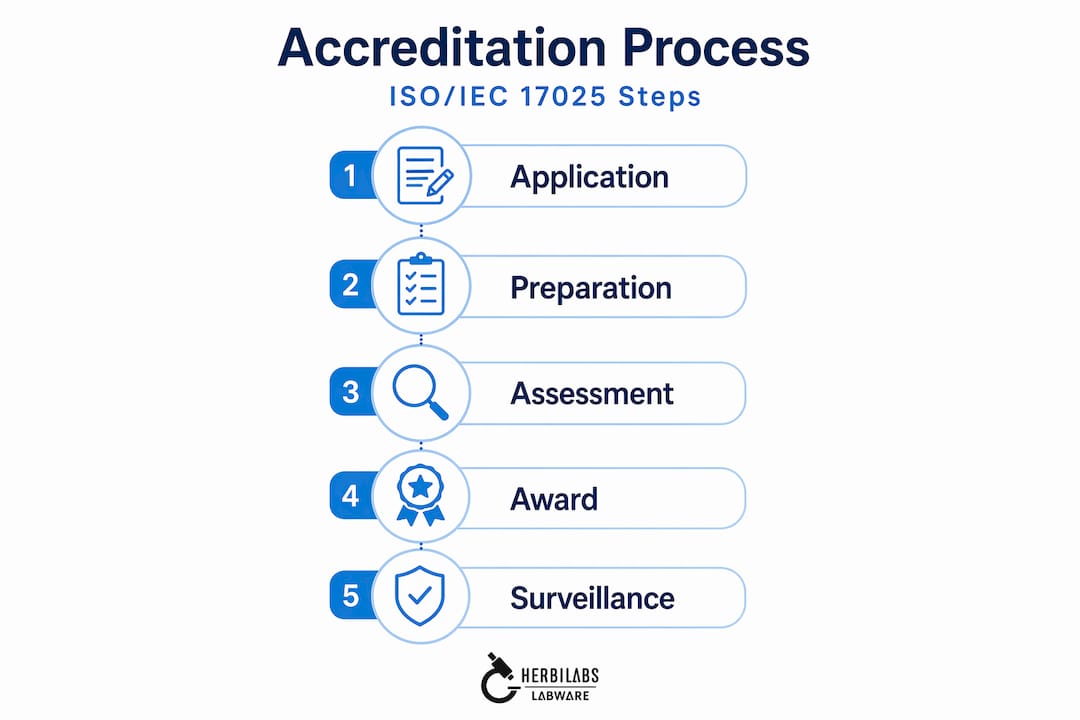
Understanding the laboratory certification process in advance prevents the most common mistake: underestimating the preparation required. The typical ISO/IEC 17025 accreditation timeline spans 14 to 18 months from initiation to final decision, and that assumes disciplined execution throughout.
The stages of achieving accreditation follow a structured sequence:
- Gap analysis and scoping: The laboratory identifies which activities it wants included in the accreditation scope and compares its current practices against ISO/IEC 17025 requirements to map deficiencies.
- Documentation development: Quality manuals, procedures, work instructions, and forms are developed or revised to align with standard requirements. This phase typically takes 2 to 4 months.
- Implementation and training: Staff are trained on revised procedures, equipment is calibrated and verified, and the documented system is put into practice. A minimum of several months of operation under the new system is required before audit.
- Internal audit: A formal internal audit identifies remaining nonconformities. Corrective actions are implemented and verified before proceeding.
- Application to an accreditation body: The laboratory submits its application and supporting documentation to a recognized accreditation body such as A2LA, UKAS, or ILAC-member bodies.
- On-site assessment: Assessors visit the laboratory, typically for 2 to 5 days, reviewing records, observing testing activities, interviewing staff, and verifying equipment traceability.
- Corrective action phase: Nonconformities identified during the assessment must be addressed with documented corrective actions. Verification that actions are effective can take additional months.
- Accreditation decision: Once the accreditation body is satisfied that all requirements are met, the laboratory receives its accreditation certificate and scope document.
Pro Tip: Begin proficiency testing participation at least 12 months before your planned assessment date. Assessors want to see a track record of satisfactory performance, not a single data point obtained just before the visit.
The cycle does not end at the initial award. Accreditation is an ongoing cycle of periodic surveillance assessments, full reassessments, and continuous internal improvement activity. Nonconformities raised at any stage must be corrected with demonstrated effectiveness before the accreditation body is satisfied. This perpetual improvement cycle is by design, not bureaucratic burden.

Benefits of laboratory accreditation
The importance of lab accreditation extends well beyond the certificate itself. For regulators and customers receiving test reports, accreditation serves as a reliable signal that both management and technical controls are in place to produce valid, reliable results. That confidence matters in contexts where decisions about human health, environmental compliance, or product safety depend on analytical data.
The practical benefits for a laboratory pursuing accreditation include:
- Market access: Many regulatory frameworks and procurement requirements specify that only accredited laboratories are acceptable sources of test data.
- Reduced customer audits: Accreditation replaces the need for individual customers to conduct their own technical audits of the laboratory, reducing the administrative burden on both sides.
- Internal quality culture: The structured requirements of accreditation force organizations to formalize competency, traceability, and process control in ways that improve day-to-day performance, not just audit performance.
- Risk reduction: Systematic documentation and verification processes catch errors before they affect reported results.
- Staff development: The competency requirements for accreditation drive investment in staff training and qualifications that benefit the organization across all its activities.
“Accreditation programs provide formal recognition of competence, which strengthens trust between laboratories and the stakeholders who rely on their data.” (ISO/IEC 17025 principles as applied by ILAC-member accreditation bodies)
For laboratories operating in regulated environments, the compliance benefits are increasingly concrete. Organizations that understand quality control in labs as a living system, not a static checklist, tend to find that accreditation reinforces rather than duplicates their existing quality efforts.
Common challenges when pursuing accreditation
The path to accreditation is well-defined in principle, but specific technical and organizational challenges trip up laboratories that are otherwise well-run.
Scope alignment is where many laboratories encounter their first serious difficulty. Accreditation scope must match actual activities precisely. A laboratory that declares a broad scope encompassing methods it has not fully validated, or matrices it does not routinely process, will face scope reduction or nonconformities during assessment. The discipline required is to be conservative when declaring scope initially and expand it once competence is fully demonstrated.
Corrective action management is a second area where laboratories frequently underperform. Effective corrective action requires documented ownership, defined completion deadlines, root cause analysis, and objective evidence of effectiveness verification. Closing a nonconformity with a brief written statement that the procedure was updated is rarely sufficient. Assessors look for evidence that the root cause was identified, addressed, and that recurrence has been prevented.
Recordkeeping is the third persistent challenge. During assessments, labs must produce objective evidence covering equipment traceability, validation data, staff competency records, and proficiency testing results. Laboratories that maintain comprehensive, retrievable records throughout the year rather than assembling them reactively before assessments consistently perform better. Building an evidence-based lab quality control checklist that aligns with accreditation requirements is a practical way to maintain readiness continuously.
Pro Tip: Assign a dedicated accreditation coordinator who owns the corrective action register and reports status at every management review. Treating corrective actions as a project with milestones, rather than as informal follow-up items, substantially reduces the risk of repeat nonconformities at reassessment.
Specialized accreditation programs and 2026 regulatory context
Not all accreditation is generic. Domain-specific programs impose requirements and timelines beyond ISO/IEC 17025 baseline standards, and understanding the distinction between voluntary and mandatory accreditation is relevant for laboratories in certain sectors.
| Program | Scope | Mandatory or voluntary | Key requirement |
|---|---|---|---|
| FDA LAAF (2026) | Food testing laboratories | Mandatory for regulated contexts | Labs must use LAAF-recognized bodies |
| Washington State ELAP | Environmental labs (drinking water, wastewater) | Mandatory for state-regulated testing | Annual renewal required |
| ISO/IEC 17025 General | Testing and calibration labs | Voluntary unless sector-mandated | Competence within declared scope |
| ISO 15189 | Medical/clinical laboratories | Varies by jurisdiction | Clinical-specific technical requirements |
The FDA’s Laboratory Accreditation for Analyses of Foods program, active in 2026, exemplifies how regulatory bodies are integrating accreditation directly into compliance frameworks. Owners and consignees in regulated food import and sampling scenarios are required to use laboratories accredited under the LAAF program, and the FDA maintains a public registry of recognized accreditation bodies and accredited laboratories. This integration means that for food testing laboratories, accreditation has moved from a competitive differentiator to a regulatory prerequisite.
Environmental laboratories face similar mandatory requirements at the state level. Washington State’s environmental laboratory accreditation program requires annual renewal for laboratories performing testing on drinking water, wastewater, and surface water. These sector-specific mandates reflect a broader trend: regulators increasingly specify accreditation as the minimum credibility threshold for accepted data.
My perspective on what accreditation really builds
I have worked with laboratories at various stages of the accreditation process, and the most consistent observation I can offer is this: the labs that treat accreditation as a compliance exercise gain accreditation. The labs that treat it as an organizational discipline gain something considerably more valuable.
The documentation rigor required by ISO/IEC 17025 forces clarity about what a laboratory actually does versus what it believes it does. That gap, when identified through the accreditation process, is almost always revealing. I have seen laboratories discover during internal audits that validated methods had drifted from documented procedures through informal adaptation by staff, that equipment calibration intervals had been informally extended, or that analyst competency records existed only nominally. Accreditation creates the formal mechanism to surface and correct these gaps before they produce unreliable results.
What I find genuinely underappreciated is the leadership dimension. The management review process required under ISO/IEC 17025 creates structured accountability at the organizational level that many laboratory environments lack by default. When leadership is regularly reviewing audit findings, proficiency testing trends, and corrective action status, the organization develops a quality culture that extends beyond the accredited scope. The ISO standards in research framework, when internalized rather than merely satisfied, becomes a genuine quality infrastructure. That infrastructure is what separates laboratories whose results are trusted from those whose results are merely available.
— Ragnar
How Herbilabs supports accredited lab operations
Accredited laboratories operate under strict requirements for the quality and traceability of every input into their analytical processes, including the reagents and reconstitution solutions used in sample preparation. Substandard consumables introduce variability that even excellent analytical methods cannot fully compensate for. Herbilabs manufactures research-grade bacteriostatic water and sterile reconstitution solutions in a dedicated facility under rigorous quality controls designed to meet the purity expectations of demanding laboratory environments.
For researchers and laboratory managers seeking supplies that align with the traceability and purity standards expected under accreditation frameworks, Herbilabs offers a curated selection of high-purity reconstitution solutions and premium laboratory reagents produced to strict specifications. The lab consumables guide on the Herbilabs site provides detailed guidance on selecting appropriate materials for specific research applications. Wholesale pricing is available for resellers and institutions requiring consistent, high-volume supply.
FAQ
What is the difference between lab accreditation and certification?
Accreditation confirms a laboratory’s technical competence to perform specific tests within a defined scope, assessed by a third-party accreditation body. Certification, such as ISO 9001, confirms that a quality management system exists but does not evaluate technical performance directly.
How long does it take to get a lab accredited?
The typical accreditation timeline for ISO/IEC 17025 spans 14 to 18 months, covering documentation, implementation, internal audits, on-site assessment, and corrective action phases.
Which standard applies to most testing and calibration labs?
ISO/IEC 17025 is the internationally recognized standard for testing and calibration laboratories and is the basis for laboratory accreditation in most sectors worldwide. ISO 15189 applies specifically to medical laboratories.
Is laboratory accreditation mandatory?
Accreditation is voluntary in many sectors but becomes mandatory when regulatory frameworks require it, such as the FDA’s LAAF program for food testing or state environmental laboratory programs requiring annual renewal.
What agencies provide laboratory accreditation?
Laboratory accreditation agencies include A2LA, UKAS, ILAC-member national accreditation bodies, and sector-specific bodies recognized under programs such as the FDA’s LAAF framework. Each operates within a defined scope of recognized accreditation activities.