Private Label, White Label, Wholesale partnerships available - EU, USA and UK - Free shipping from €75
Laboratory consumables: essential guide for reliable research
Learn what laboratory consumables are, key types, regulatory standards for UK and European labs, and best practices for selection and management in research workflows.
TL;DR:
- Laboratory consumables are single-use items essential for sterility and accurate experimental results.
- Proper certification, quality standards, and supplier qualification are vital for reproducible research.
- Strategic management of consumables enhances reliability, reduces waste, and ensures compliance in labs.
Laboratory consumables are frequently treated as an afterthought in research planning, yet their selection and handling directly determine whether experimental results are reproducible, compliant, and scientifically valid. The assumption that any tube, tip, or reagent bottle will perform identically is one of the most persistent and costly misconceptions in laboratory practice. Single-use lab items exist specifically to ensure sterility, accuracy, and cross-contamination prevention across every experimental cycle. This guide addresses what laboratory consumables actually are, how they are categorized, what regulatory standards apply in the UK and Europe, and how to select and manage them with the rigor that reproducible research demands.
Table of Contents
- What are laboratory consumables?
- Key types of laboratory consumables and their uses
- Regulatory and quality standards for laboratory consumables
- Best practices for selecting and managing lab consumables
- A practitioner’s perspective: Why consumables are the hidden driver of lab success
- Need reliable lab consumables and reagents?
- Frequently asked questions
Key Takeaways
| Point | Details |
|---|---|
| Consumables defined | Laboratory consumables are single-use or limited-use items that support safe, accurate experimental workflows. |
| Categories and uses | Consumables range from tubes and tips to specialized reagents, each critical for specific research applications. |
| Quality and compliance | Choosing certified consumables ensures repeatable results and simplifies regulatory compliance in UK/Europe labs. |
| Best practice management | Efficient sourcing and management minimize waste and operational cost without compromising scientific rigor. |
What are laboratory consumables?
Having set the stage, we will now clarify what qualifies as a laboratory consumable and why this distinction matters for day-to-day laboratory operations. At the most precise level, laboratory consumables are expendable, single-use or limited-reuse items employed in experiments, analyses, and testing to ensure sterility, accuracy, and prevention of cross-contamination. They are not designed for indefinite use. They are designed for controlled, traceable, and disposable application within a defined experimental context.
The boundary between consumables and durable equipment is clear and operationally significant. Consumables are depleted or discarded after use, while instruments such as centrifuges, spectrophotometers, and analytical balances are engineered for repeated, long-term deployment. Conflating the two categories leads to procurement errors, compliance gaps, and avoidable contamination events.
Laboratory consumables fall into three primary categories:
- Sample containers: Microtubes, cryovials, culture flasks, and reagent bottles used to hold, store, or transport biological and chemical materials.
- Transfer tools: Pipette tips, syringes, transfer pipettes, and filter units used to move or manipulate volumes with precision.
- Research reagents and solutions: Buffers, diluents, bacteriostatic water, and specialty reconstitution solutions that directly participate in experimental reactions.
| Feature | Consumables | Durable equipment |
|---|---|---|
| Lifespan | Single-use or limited | Years of repeated use |
| Post-use fate | Discarded or decontaminated | Cleaned and reused |
| Sterility requirement | Critical, batch-certified | Maintained by cleaning protocols |
| Regulatory traceability | Lot number, CoA required | Calibration records required |
For a broader overview of lab consumables examples relevant to modern research workflows, it is worth reviewing category-specific breakdowns before placing procurement orders.
Key types of laboratory consumables and their uses
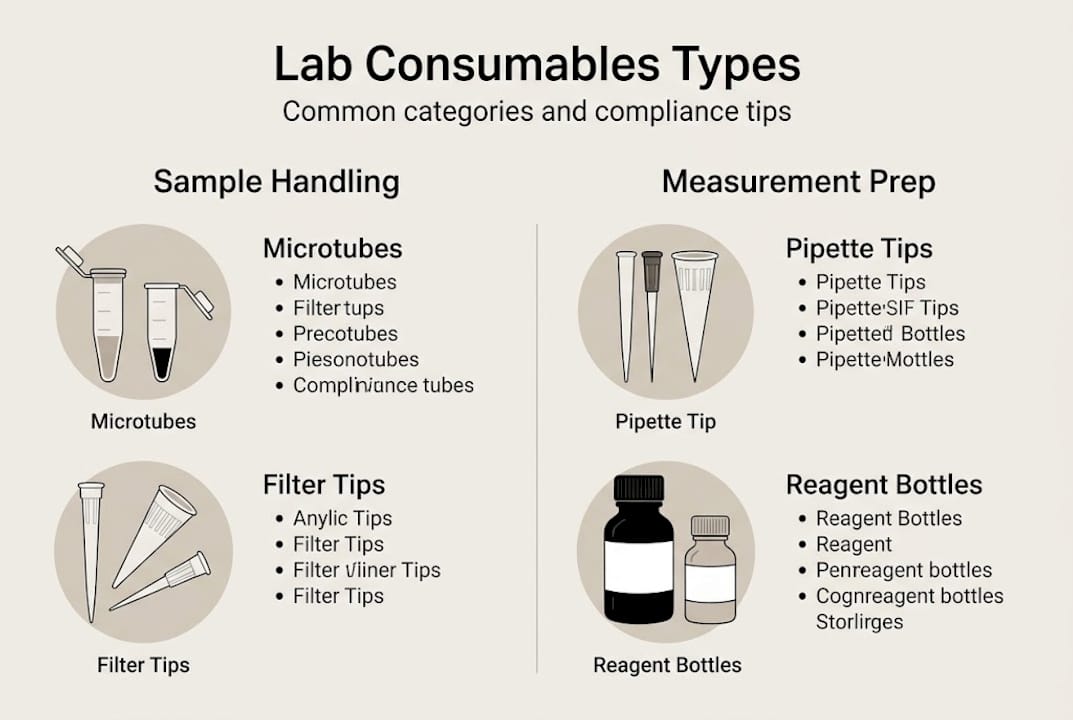
With the basics established, let us look closer at the essential types laboratories rely on and how usage requirements vary across research disciplines. The most frequently encountered consumables in chemical and biological research settings include microtubes, multiwell culture plates, filter pipette tips, reagent bottles, and research-grade water such as bacteriostatic water (bac water), which is water preserved with 0.9% benzyl alcohol to inhibit microbial growth during repeated access.
Each category carries specific sterility and compatibility requirements:
- Microtubes and cryovials: Used for sample storage, centrifugation, and reaction setup. Must be DNase-free and RNase-free for nucleic acid work.
- Culture plates: Multiwell formats (6, 24, 96-well) used in cell-based assays. Require consistent surface treatment and sterile packaging.
- Filter pipette tips: Prevent aerosol contamination between samples. Essential in PCR workflows and any assay sensitive to carryover.
- Reagent bottles and vials: Used to store and dispense buffers, diluents, and reconstitution solutions. Must be chemically compatible with contents.
- Bacteriostatic water and sterile diluents: Used to reconstitute lyophilized peptides and proteins. Sterility and endotoxin levels are critical quality parameters.
| Consumable type | Primary use | Key compliance requirement |
|---|---|---|
| Microtubes | Sample storage, centrifugation | DNase/RNase-free, endotoxin-free |
| Culture plates | Cell assays, growth studies | Sterile, surface-treated |
| Filter pipette tips | Volume transfer, PCR | Aerosol-barrier certified |
| Bacteriostatic water | Peptide reconstitution | Sterile, 0.9% benzyl alcohol, low endotoxin |
| Reagent bottles | Buffer and solution storage | Chemical compatibility, lot traceability |
For optimizing consumable workflows in high-throughput environments, standardizing on certified formats reduces variability between runs. In lab automation, consumables must meet standards for consistency, sterility, and precise dimensional tolerances to avoid workflow failures that compromise entire plate runs or sample batches.

Pro Tip: Always specify DNase-free, RNase-free, and endotoxin-free certification when ordering consumables for molecular biology or peptide research workflows. A single non-certified batch can invalidate an entire experimental series, and the cost of repeat experiments far exceeds any savings from unverified suppliers. Reviewing common lab consumables before procurement helps align specifications with experimental needs.
Regulatory and quality standards for laboratory consumables
Grasping the consumables landscape, it is crucial to understand which standards guarantee quality for your laboratory and ensure compliance within the UK and European regulatory environment. Quality certification is not a formality. It is the mechanism by which consumable performance is verified, documented, and traceable across production batches.
For UK and European laboratories, the primary standards framework includes:
- ISO 9001 and ISO 13485: Quality management system standards applicable to manufacturers of laboratory consumables and medical devices.
- European Pharmacopeia (EP): Defines purity, sterility, and quality standards for pharmaceutical-grade reagents and solutions, including water for injection and bacteriostatic preparations.
- Good Laboratory Practice (GLP) and Good Manufacturing Practice (GMP): Operational frameworks that govern how consumables are used, documented, and disposed of within regulated research environments.
- CE marking: Indicates conformity with EU health, safety, and environmental protection standards for applicable product categories.
For UK and European labs, prioritizing certified consumables from suppliers meeting ISO and EP standards is essential to ensure reproducibility. Single-use formats reduce cleaning costs but require structured disposal protocols to manage waste volumes.
A frequently misunderstood area is the scope of the EU In Vitro Diagnostic Regulation (IVDR). General lab consumables such as tubes and plates are exempt from IVDR unless they are specifically intended for in vitro diagnostic use. This distinction matters when procuring reagents labeled for research use only (RUO), as RUO items carry different documentation and liability requirements than IVD-designated products.
Pro Tip: Before ordering any consumable lot, request the Certificate of Analysis (CoA) and confirm the lot number matches the documentation. Traceability at the lot level is a non-negotiable requirement in GLP environments and is increasingly expected even in academic research settings. Reviewing certified lab supplies and reagent standards documentation before procurement prevents compliance gaps. For broader quality assurance frameworks, lab quality control guidance provides structured checkpoints applicable across consumable categories.
Regulatory compliance for laboratory consumables is not a single certification event. It is an ongoing documentation and verification process that spans supplier qualification, incoming inspection, storage, use, and disposal.
Best practices for selecting and managing lab consumables
Understanding regulations leads naturally to how you select and manage these essential laboratory resources with operational precision. Procurement decisions made without systematic criteria introduce variability at the most fundamental level of experimental design. The following five-step process provides a structured framework for consumable selection and lifecycle management.
- Define experimental requirements first. Identify sterility grade, chemical compatibility, volume range, and certification requirements before evaluating suppliers. Specifications must be set by the experimental protocol, not by catalog availability.
- Qualify suppliers against documented criteria. Assess whether the supplier holds relevant ISO or EP certifications, provides CoAs with each lot, and maintains consistent manufacturing standards. Supplier audits or third-party verification reports strengthen this step.
- Conduct incoming inspection and batch verification. Upon receipt, verify lot numbers against CoAs, check packaging integrity, and confirm expiration dates. Consumables are depleted or discarded after use, making incoming quality the last checkpoint before experimental deployment.
- Implement structured storage and inventory rotation. Store consumables according to manufacturer specifications, apply first-in-first-out (FIFO) rotation, and track expiration dates in a centralized inventory system. Temperature-sensitive items such as sterile diluents require monitored storage conditions.
- Manage disposal in compliance with applicable regulations. Separate hazardous from non-hazardous waste streams, follow local authority guidelines for sharps and biological waste, and document disposal for audit purposes.
Additional management considerations include:
- Avoiding mixed-lot usage within a single experiment to eliminate inter-lot variability.
- Maintaining a minimum safety stock level to prevent substitution under supply pressure.
- Reviewing lab supply chain tips to build resilience against supplier disruptions.
Pro Tip: Bulk purchasing reduces per-unit cost, but it requires stringent inventory management. Overstocking consumables with short shelf lives, particularly sterile reagents and research water, leads to expiration losses that negate any procurement savings. Pairing bulk orders with structured rotation schedules and reviewing minimize lab waste strategies ensures cost efficiency without compromising quality.
A practitioner’s perspective: Why consumables are the hidden driver of lab success
Most guides on laboratory consumables focus on definitions and procurement checklists. What they rarely address is the disproportionate influence that consumable quality exerts on research outcomes relative to the attention it typically receives during study design.
In practice, a single supplier change for a seemingly equivalent microtube or filter tip can introduce dimensional inconsistencies, altered surface chemistry, or undetected endotoxin loads that produce anomalous results across weeks of experimental work. By the time the root cause is identified, the cost in time, reagents, and researcher credibility far exceeds any savings from switching to a lower-cost alternative.
The environmental trade-off is real and worth acknowledging. Single-use consumables generate significant plastic waste, and the tension between sterility requirements and sustainability is not resolved by simple substitution. The answer lies in selecting consumables that are certified for their intended use, not over-specified, and managed through disposal protocols that minimize environmental impact without compromising experimental integrity. Maintaining labware integrity through proper selection and handling is, in this sense, both a scientific and an operational discipline. The laboratories that treat consumable selection as a strategic decision, rather than a routine purchasing task, consistently produce more reproducible and defensible data.
Need reliable lab consumables and reagents?
Sourceing quality consumables from a credentialed supplier is the final step in translating this knowledge into reliable research outcomes.

Herbilabs provides research-grade bacteriostatic water, sterile diluents, and specialty reagents manufactured to strict purity standards for UK and European research institutions, universities, and independent researchers. Every product is supported by full lot traceability and quality documentation. Whether you are reviewing essential lab consumables for your next procurement cycle, evaluating criteria for selecting research reagents, or working through the 2026 lab consumables guide to benchmark your current supplier, Herbilabs offers the technical support and product range your research requires.
Frequently asked questions
What exactly are laboratory consumables?
Laboratory consumables are single-use or limited-reuse items, including tubes, pipette tips, and reagent bottles, used in experiments and discarded after use to maintain sterility and prevent cross-contamination.
How do consumables differ from laboratory equipment?
Consumables are depleted or discarded after use, while durable equipment such as centrifuges and spectrophotometers is engineered for repeated, long-term operation across many experimental cycles.
What certifications should lab consumables have in the UK or Europe?
Prioritize consumables certified to ISO or European Pharmacopeia standards, as these certifications verify quality, sterility, and regulatory compliance for research and diagnostic applications.
Are all lab consumables regulated under IVDR in the EU?
General lab consumables such as tubes and culture plates are exempt from IVDR unless they are specifically intended and labeled for in vitro diagnostic use.
Why is sterility so important for laboratory consumables?
Sterility standards including DNase-free, RNase-free, and endotoxin-free certification prevent cross-contamination and ensure that experimental results reflect biological reality rather than introduced artifacts.