Private Label, White Label, Wholesale partnerships available - EU, USA and UK - Free shipping from €75
Industry Standards for Research Solutions: 2026 Guide
Explore the essential industry standards for research solutions in 2026. Ensure compliance and boost your research credibility with key frameworks.
TL;DR:
- Industry standards for research solutions establish principles like FAIR, EQUATOR, NIH Rigor, TOP, CRediT, and ISO/IEC 17025 to ensure transparency and reproducibility across scientific investigations. Implementing these standards as integrated, continuous processes enhances data quality, methodology transparency, and institutional credibility in research practices. Recognizing evolving requirements, institutions must proactively embed these frameworks from the earliest stages of grant design through long-term data and process validation.
Industry standards for research solutions are the agreed sets of principles, guidelines, and benchmarks that define quality, transparency, and reproducibility across scientific investigations. Recognized frameworks such as the FAIR principles, the EQUATOR Network reporting guidelines, and the NIH Rigor and Reproducibility Policy form the operational backbone of credible research in 2026. For research professionals and decision-makers, understanding these standards is not optional. Funding bodies, journal editors, and institutional review boards increasingly require documented compliance, making fluency in these frameworks a prerequisite for competitive grant applications and publishable science.
What are the core frameworks defining industry standards for research solutions?

The recognized term for this body of guidance is research quality standards, and it encompasses data management, reporting transparency, software stewardship, and laboratory compliance. Each framework addresses a distinct layer of the research process.
The primary frameworks research professionals rely on include:
-
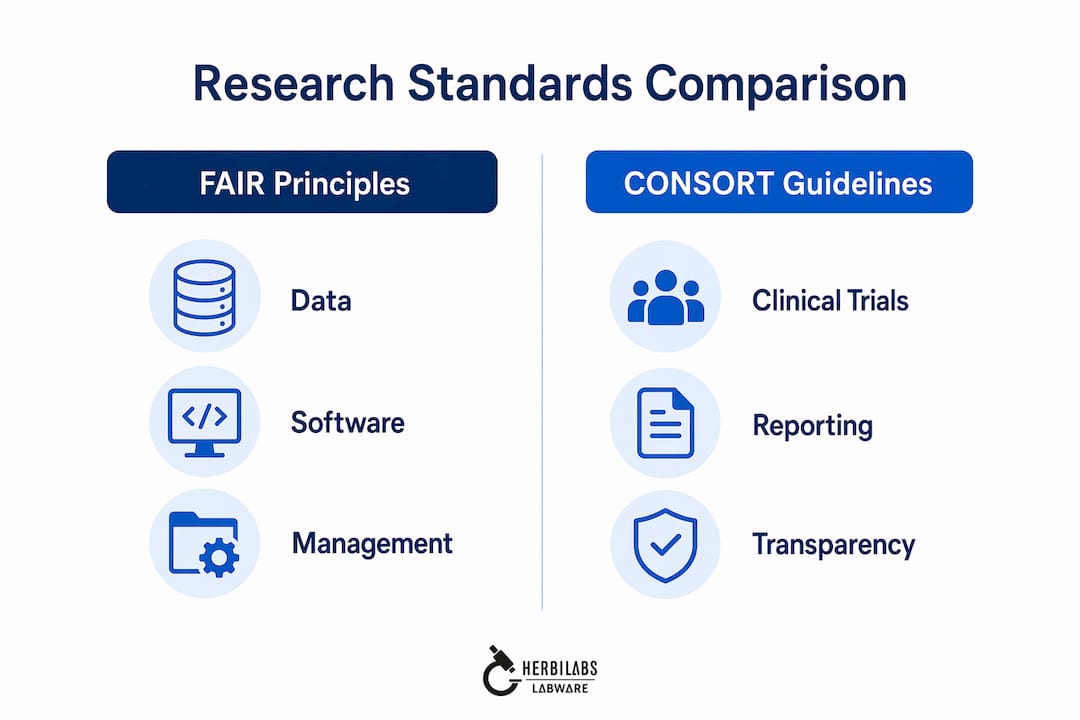
FAIR Principles (Findable, Accessible, Interoperable, Reusable): First published in 2016, FAIR defines how research data must be structured and shared to maximize reuse. The extension FAIR4RS applies these same principles to research software, requiring persistent identifiers such as DOIs and community metadata standards like CodeMeta. Depositing code on GitHub alone does not satisfy FAIR4RS. Archiving to stable repositories with persistent identifiers is the recognized best practice.
-
EQUATOR Network Reporting Guidelines: The EQUATOR Network provides over 600 reporting checklists covering discipline-specific methodology disclosure. CONSORT governs randomized controlled trials, PRISMA governs systematic reviews, and STROBE governs observational studies. Major funders now enforce adherence to these checklists as a condition of grant approval.
-
NIH Rigor and Reproducibility Policy: The National Institutes of Health requires grant applicants to address scientific rigor, authentication of key biological resources, and consideration of relevant biological variables. This policy directly shapes how research proposals are written and evaluated in the United States.
-
Transparency and Openness Promotion (TOP) Guidelines: Developed by the Center for Open Science, TOP provides eight modular standards covering citation, data transparency, analytic code sharing, and preregistration. Journals adopt TOP at varying levels, giving institutions a scalable framework to align with publication requirements.
-
CRediT (Contributor Roles Taxonomy): CRediT standardizes how author contributions are documented across 14 defined roles, from conceptualization to data curation. This reduces ambiguity in authorship disputes and supports accountability in multi-institutional projects.
-
ISO/IEC 17025: For laboratory environments, ISO/IEC 17025 sets competence requirements for testing and calibration. Critically, ISO certification alone is insufficient unless the internal quality management system also validates external data sources such as electronic health record (EHR) systems, a requirement regulators now enforce explicitly.
How do these standards improve research quality and reproducibility?
Quality assurance in research is a continuous, integrated process, not a terminal checklist applied before submission. This distinction matters because errors introduced during data collection or analysis cannot be reliably corrected at the reporting stage. The following steps illustrate how standards translate into measurable quality gains:
-
Embed FAIR compliance at data collection. Assigning persistent identifiers and applying controlled vocabularies at the point of data entry prevents downstream interoperability failures. Researchers who retrofit metadata after analysis consistently produce incomplete records.
-
Apply EQUATOR checklists during protocol design. Using CONSORT or PRISMA checklists before data collection begins forces researchers to specify primary outcomes, randomization procedures, and blinding methods in advance. This eliminates post-hoc outcome switching, one of the most common sources of irreproducible results.
-
Preregister study designs. Platforms such as OSF Registries and ClinicalTrials.gov allow researchers to lock hypotheses and analytic plans before data collection. Preregistration reduces confirmation bias and provides a verifiable record that distinguishes confirmatory from exploratory findings.
-
Archive analysis code with each submission. Archiving analysis scripts and performing robustness checks are practices rarely enforced at the proposal stage but critical for long-term credibility. A finding that does not survive alternative analytical choices is not a reliable finding.
-
Conduct continuous feedback loops within QA systems. Active corrective actions throughout all research phases, rather than end-stage audits, preserve institutional credibility and public trust in published outputs.
A persistent misconception is that methodological rigor matters only at publication. Herman Aguinis, a recognized authority on research methodology, argues that 360-degree rigor requires deliberate coherence from topic selection through final reporting. This means aligning the research question, design, data collection instrument, and interpretive framework before a single data point is collected.
Pro Tip: When archiving analysis code, include a README file specifying the software version, package dependencies, and the order in which scripts must be executed. Reviewers and replication teams consistently cite missing execution instructions as the primary barrier to code reuse.
Comparing popular research standards by application context
Selecting the right framework depends on research type, funding source, and publication target. The table below maps each standard to its primary domain and key compliance trigger.
| Standard | Primary domain | Key compliance trigger |
|---|---|---|
| FAIR / FAIR4RS | Data and software management | Funder data sharing mandates, open science policies |
| EQUATOR (CONSORT, PRISMA, STROBE) | Reporting and methodology disclosure | Journal submission requirements, grant review |
| NIH Rigor and Reproducibility | Biomedical research design | NIH grant applications |
| TOP Guidelines | Publication transparency | Journal-level adoption, open science commitments |
| CRediT | Authorship and contribution | Multi-author manuscripts, institutional accountability |
| ISO/IEC 17025 | Laboratory testing and calibration | Regulatory audits, accreditation bodies |
These frameworks are complementary rather than competing. A clinical trial team, for example, would apply CONSORT for reporting, FAIR for data deposition, NIH Rigor guidelines for grant design, and ISO/IEC 17025 for laboratory quality management. Overlap exists in areas such as data documentation, where FAIR, TOP, and NIH Rigor all require structured metadata, but this overlap reinforces compliance rather than creating redundancy. Understanding quality control in research at each phase helps teams identify which standard governs each decision point.
How to implement and maintain research standards in your organization
Institutionalizing research solution benchmarks requires coordination across grant management, data infrastructure, and staff training. The following practices define an effective implementation program:
-
Coordinate Data Management Plans with grant documents from day one. DMPs that are drafted independently of grant applications create auditing conflicts when funders request compliance documentation. Tools like RDMO (Research Data Management Organiser) allow institutions to tailor DMPs to specific funder templates and maintain audit-ready records throughout the project lifecycle.
-
Extend quality management systems to external data sources. Internal QMS validation must cover EHR systems, third-party datasets, and any eSource used in analysis. Regulatory expectations in 2026 make this extension mandatory for clinical and translational research environments.
-
Build documentation protocols that do not overburden researchers. Standardized templates for metadata entry, version control for analysis scripts, and automated repository submission reduce the manual overhead that causes documentation to be skipped under deadline pressure.
-
Establish continuous QA feedback loops. Assign a data steward or quality officer to review data integrity at defined milestones, not only at project close. This mirrors the continuous QA model that laboratory accreditation bodies require.
-
Invest in staff training on reporting standards. Researchers who understand why EQUATOR checklists exist, rather than treating them as bureaucratic requirements, produce more complete and reproducible methodology sections. Training sessions tied to specific upcoming submissions are more effective than generic annual workshops.
Pro Tip: The most frequent failure in standards adherence is neglecting metadata standards and failing to archive analysis code. Build a project close-out checklist that explicitly requires code archiving to a stable repository, metadata validation against a community schema, and a final DMP update before any manuscript is submitted.
Common challenges when adopting research standards
Adoption of effective research frameworks consistently encounters the same categories of resistance and resource strain. Recognizing these in advance allows decision-makers to address them structurally.
-
Resource constraints: Compliance activities require dedicated time and personnel. Institutions that treat standards adoption as an add-on to existing workloads see lower adherence rates. Allocating explicit budget lines for data management and QA in grant proposals normalizes these costs and makes them fundable.
-
Researcher resistance to procedural change: Experienced researchers who have published successfully without formal standards often perceive new requirements as bureaucratic overhead. Demonstrating concrete examples where standards prevented retraction or enabled high-impact replication studies shifts this perception more effectively than policy mandates alone.
-
Evolving funder mandates: Funding bodies update their data sharing and rigor requirements regularly. Institutional research offices must monitor NIH, Wellcome Trust, and European Research Council policy updates and translate changes into updated internal guidance within one grant cycle.
-
Leadership buy-in: Standards adoption stalls without visible commitment from department heads and principal investigators. Institutions where senior researchers publicly model compliance, by preregistering their own studies and sharing data openly, see measurably faster adoption across junior staff.
Key takeaways
Effective implementation of research quality standards requires embedding compliance into every phase of the research lifecycle, from grant design through data archiving, rather than treating it as a submission-stage requirement.
| Point | Details |
|---|---|
| FAIR and FAIR4RS are foundational | Apply persistent identifiers and community metadata standards to both data and software from the start. |
| EQUATOR checklists prevent bias | Use CONSORT, PRISMA, or STROBE during protocol design, not after data collection, to lock methodology. |
| QA is continuous, not terminal | Assign data stewards and conduct milestone reviews throughout the project, not only at close-out. |
| DMPs must align with grant documents | Use tools like RDMO to coordinate data management plans with funder templates and avoid audit conflicts. |
| ISO/IEC 17025 requires EHR validation | Internal quality systems must extend to external data sources to satisfy 2026 regulatory expectations. |
Standards are evolving faster than most institutions realize
My observation, after working closely with research supply chains and laboratory quality systems, is that most institutions are running approximately one policy cycle behind current funder expectations. They have adopted FAIR for data but have not yet extended those principles to software under FAIR4RS. They use EQUATOR checklists at submission but have not embedded them at protocol design. The gap is not one of awareness. It is one of process architecture.
The more consequential shift I see coming is the convergence of reporting standards with software and data stewardship requirements. Funders are beginning to treat code archiving and metadata completeness with the same scrutiny previously reserved for statistical methodology. Institutions that build infrastructure for this now, rather than retrofitting after a failed audit or a retraction, will have a structural advantage in competitive grant environments.
There is also a practical argument for treating rigorous quality testing as a supply chain issue, not just a documentation issue. The reagents, diluents, and reconstitution solutions used in experiments must meet the same purity and traceability standards that the data they generate is expected to meet. A reproducibility failure that originates in an undocumented reagent batch is as damaging as one that originates in an undisclosed analytical decision.
The institutions that will lead in research quality over the next decade are those that treat standards not as compliance obligations but as design principles embedded from the first grant conversation.
— Ragnar
Supporting your research standards with quality-assured lab solutions
Meeting industry guidelines for research requires more than documented protocols. The physical inputs to your experiments, including reconstitution solutions, sterile diluents, and research reagents, must meet the same traceability and purity standards your data is held to. Herbilabs manufactures bacteriostatic water and high-purity reconstitution solutions to strict quality control specifications, with full documentation supporting audit-ready research environments. For laboratories building compliance-aligned supply chains in 2026, Herbilabs also provides a laboratory consumables checklist to help research teams verify that every input meets current regulatory and institutional standards.
FAQ
What are the main industry standards for research solutions?
The primary frameworks are the FAIR principles for data and software, EQUATOR Network reporting guidelines including CONSORT and PRISMA, the NIH Rigor and Reproducibility Policy, TOP Guidelines, and ISO/IEC 17025 for laboratory environments. Each addresses a distinct phase of the research process and many funders now require documented compliance with multiple frameworks simultaneously.
How does FAIR4RS differ from the original FAIR principles?
FAIR4RS extends the original FAIR data principles specifically to research software, requiring persistent identifiers such as DOIs, community metadata standards like CodeMeta, and archiving to stable repositories rather than code-sharing platforms alone. Depositing code only on GitHub does not satisfy FAIR4RS requirements as of 2026.
Why is quality assurance in research considered a continuous process?
Quality assurance must be embedded across all research phases, from topic selection through final reporting, because errors introduced during data collection or analysis cannot be reliably corrected at the submission stage. Active feedback loops and milestone reviews, rather than end-stage audits, are the recognized best practice for maintaining scientific rigor and institutional credibility.
What is the most common failure in research standards adherence?
The most frequent failure is inadequate data validation documentation, specifically the absence of archived analysis code and robustness checks. This gap is rarely flagged during initial grant review but becomes critical during replication attempts and long-term credibility assessments.
Do ISO/IEC 17025 certified labs automatically meet 2026 compliance requirements?
ISO/IEC 17025 certification is necessary but not sufficient. Regulatory expectations now require that internal quality management systems also validate external data sources such as EHR systems. Institutions that hold ISO certification without extending their QMS to cover these external inputs do not meet current compliance standards.