Private Label, White Label, Wholesale partnerships available - EU, USA and UK - Free shipping from €75

Mixing Peptides with Bacteriostatic Water: A Step-by-Step
You're at the bench with a peptide vial in one hand and bacteriostatic water in the other, and the next move matters more than it looks. The difference between a clean reconstitution and a wasted vial usually comes down to volume choice, sterile handling, and whether the solution stays usable for the full in-use window. Most mistakes happen before the first puncture, not after it.
If the process is handled well, the peptide dissolves cleanly, the concentration is predictable, and the vial can stay in rotation for short-term work under refrigeration. If it's handled carelessly, the result is foam, contamination risk, or a concentration that no longer matches the assay plan. That's why mixing peptides with bacteriostatic water is less about routine and more about bench discipline.
Table of Contents
- Why Mixing Peptides With Bacteriostatic Water Requires Real Technique
- Calculating the Right Volume and Target Concentration
- Aseptic Reconstitution Step by Step
- When Bacteriostatic Water Is the Wrong Choice
- Labeling, Storage, and the 28-Day In-Use Window
- Troubleshooting the Most Common Reconstitution Mistakes
- Pre-Run Checklist and Common Questions
Why Mixing Peptides With Bacteriostatic Water Requires Real Technique
A researcher at the bench often starts with a familiar pair of vials, a 5 mg peptide and a bacteriostatic water vial, then stops at the point where technique starts to matter. The question is not whether water goes into the peptide vial. It is how much to add, which diluent fits the workflow, what concentration the vial should end up at, and how long the reconstituted material can stay usable.
The bench moment that decides the result
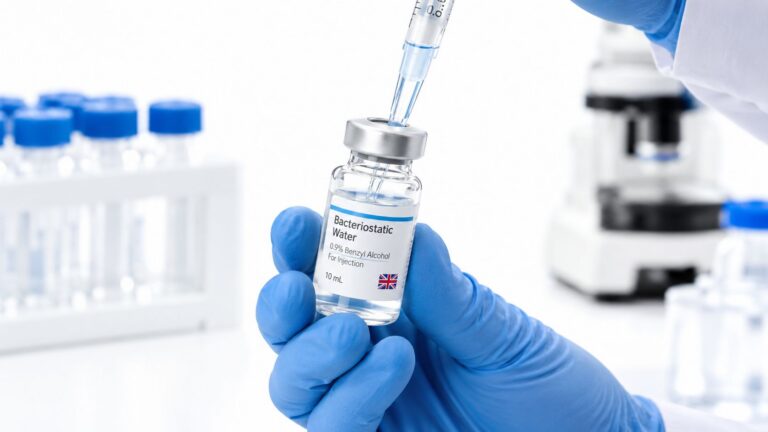
Bacteriostatic water used for peptide reconstitution is typically sterile water with 0.9% benzyl alcohol, or 9 mg/mL, and that preservative is what makes repeated punctures workable in a multi-dose research vial mixing bacteriostatic water with peptides. That is why preservative-free sterile water is usually treated as a single-use option, while bacteriostatic water is the standard default for repeated withdrawals.
Practical rule: The vial's lifespan depends on the preservative, aseptic technique, and storage discipline together. None of those can rescue a sloppy puncture.
The successful result looks boring in the best way. The liquid stays clear, the volume is known, the label matches the math, and the vial can be kept under refrigeration at 2–8°C for short-term use. What gets people into trouble is treating the process like a kitchen dilution instead of a controlled lab preparation.
Aseptic handling matters because every entry point is another chance for contamination. The preservative slows microbial growth, but it does not make contamination impossible, and it does not fix a wrong solvent choice or a poor concentration target how to mix peptides with bacteriostatic water safely. A clean reconstitution comes from the full sequence, not from one careful motion at the end.
What has to be decided before the first puncture
The vial should already have a target concentration in mind before any liquid is drawn. A careless “add some water” approach forces the researcher to guess later, and guessing is where dose mismatch and repeat punctures begin.
For a practical workflow, the four questions are simple:
- How much diluent? Calculated from peptide mass and target concentration.
- Which diluent? Bacteriostatic water for multi-dose work, or another sterile diluent when the workflow calls for it.
- What concentration? Chosen for assay needs and handling, not habit.
- How long will it last? Determined by storage, aseptic access, and visible condition.
That is the frame for the bench work. The peptide does not care what is common on forums. It responds to volume, sterility, temperature, and handling.
Calculating the Right Volume and Target Concentration
A vial can only be prepared cleanly when the target concentration is set first. Peptide mass divided by target concentration equals diluent volume, and that relationship gives the bench the starting point for every reconstitution decision.
The formula that should be used every time
A 5 mg vial of peptide prepared to 1 mg/mL needs 5 mL of diluent. The same 5 mg vial prepared to 2 mg/mL needs 2.5 mL. Once the target concentration is chosen, the required volume follows directly.
That choice affects how the vial behaves later. A more concentrated solution can cut down on withdrawal steps, which helps when the workflow needs fewer entries, but it can also be less forgiving if the peptide tends to aggregate or if the dosing volume becomes difficult to measure accurately. A lower concentration can make measurement easier and give a wider working range, though it also means more total liquid and a bigger handling load in storage and transfer.
Herbilabs' peptide calculator and reconstitution guide reflects the same calculation, and it is only as sound as the concentration entered into it. The calculator helps with the arithmetic, but the bench still has to decide what the vial should be prepared to hold.
Common reconstitution volumes for a 5 mg peptide vial
| Target concentration | Diluent volume for 5 mg vial | Typical use case |
|---|---|---|
| 1 mg/mL | 5 mL | Larger working volume, easier visual confirmation |
| 2 mg/mL | 2.5 mL | Balanced choice for many RUO workflows |
| 5 mg/mL | 1 mL | Compact storage, fewer withdrawal needs |
Use the table as a reference point, not a default order. A 5 mg vial does not come with one fixed volume just because a guide lists a few common options, it needs the volume that fits the target concentration and the way the solution will be handled afterward. Some peptide instructions favor 1–2 mL for a 5 mg vial, while other guidance treats 1–3 mL as common, but those ranges only help when they match the actual workflow.
Decision rule: Set the concentration first, then calculate the volume. Start with the volume and the final concentration becomes an afterthought.
Choosing a syringe size and letting that drive the final concentration is the wrong habit. Write the target concentration on the worksheet, calculate the exact volume from that target, and confirm that the draw can be done cleanly with the syringe on hand.
Aseptic Reconstitution Step by Step
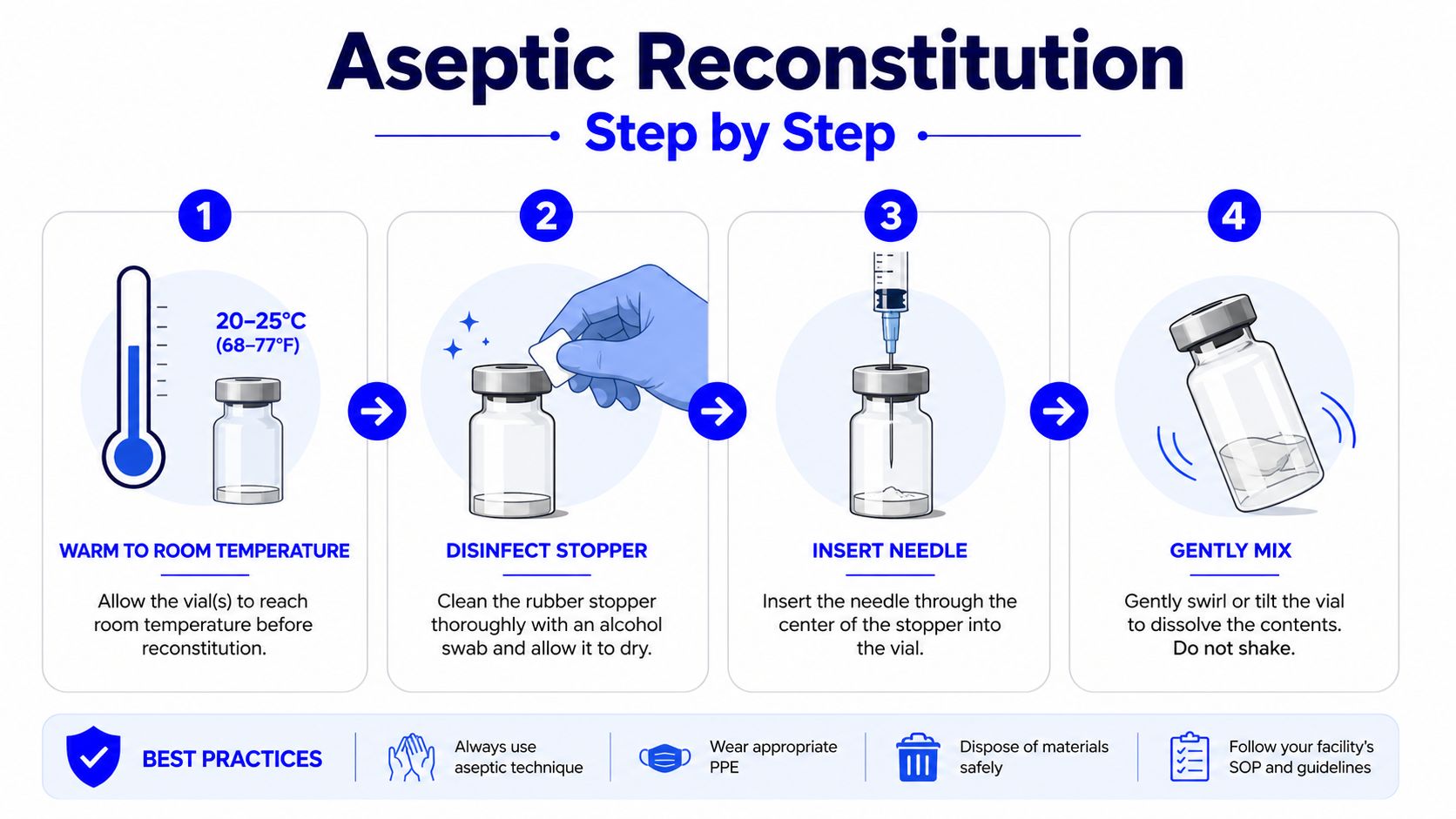
A clean reconstitution starts before the syringe is opened. Let both vials reach room temperature first, because cold glass can collect condensation and make the workflow harder to control.
Swab each stopper with 70% isopropyl alcohol and let it air dry fully. That pause matters because wet alcohol leaves a slick surface and gives you less control at the point of entry. Use fresh needles, keep the vials capped until needed, and work in a quiet area with minimal traffic.
How the liquid should enter the vial
Pull the calculated volume of bacteriostatic water into the syringe slowly. Then place the needle so the liquid runs down the inside wall of the peptide vial, rather than directly onto the lyophilized cake. That angle reduces the force hitting the powder, which helps limit foaming and keeps the material from clumping at the bottom.
Beginners often miss this part. They push the liquid straight onto the cake because it seems faster, then spend extra time trying to recover from froth or stubborn lumps. They also shake the vial, usually because they want the mix to look finished right away, but that habit creates more stress for a fragile preparation.
A steadier approach works better:
- Draw slowly, so bubbles stay out of the syringe.
- Touch the stopper only as long as needed, then withdraw cleanly.
- Let the liquid run along the wall, so dissolution starts gently.
- Roll or gently tilt the vial, instead of shaking it.
If the peptide needs a little time to clear, let it stand briefly and check it again under good light. Patience protects the vial, while forceful mixing often makes the sample look busy without improving the result. The same sterile habits described in Herbilabs' aseptic technique guide for reagent preparation fit this workflow well, because bench discipline matters at every contact point.
Use this visual rule: liquid down the wall, gentle movement only, then clear solution under good light.
When Bacteriostatic Water Is the Wrong Choice
A fresh vial can still be the wrong vial if the diluent does not fit the work. Bacteriostatic water is a practical default for many multi-dose, short-term peptide workflows, but the better choice depends on how the material will be used after reconstitution. If the vial will be entered again and again over a short period, and the preservative will not interfere with the next step, bacteriostatic water usually makes sense. If the preparation is single-use, or the assay is sensitive to benzyl alcohol, a different sterile diluent is the cleaner choice.
The simple choice point
The benzyl alcohol in bacteriostatic water is what makes repeated withdrawals workable. That same preservative creates problems in workflows where even a small formulation difference can change the result, especially in cell-based or assay-driven settings. In those cases, preservative-free sterile water is often the safer fit.
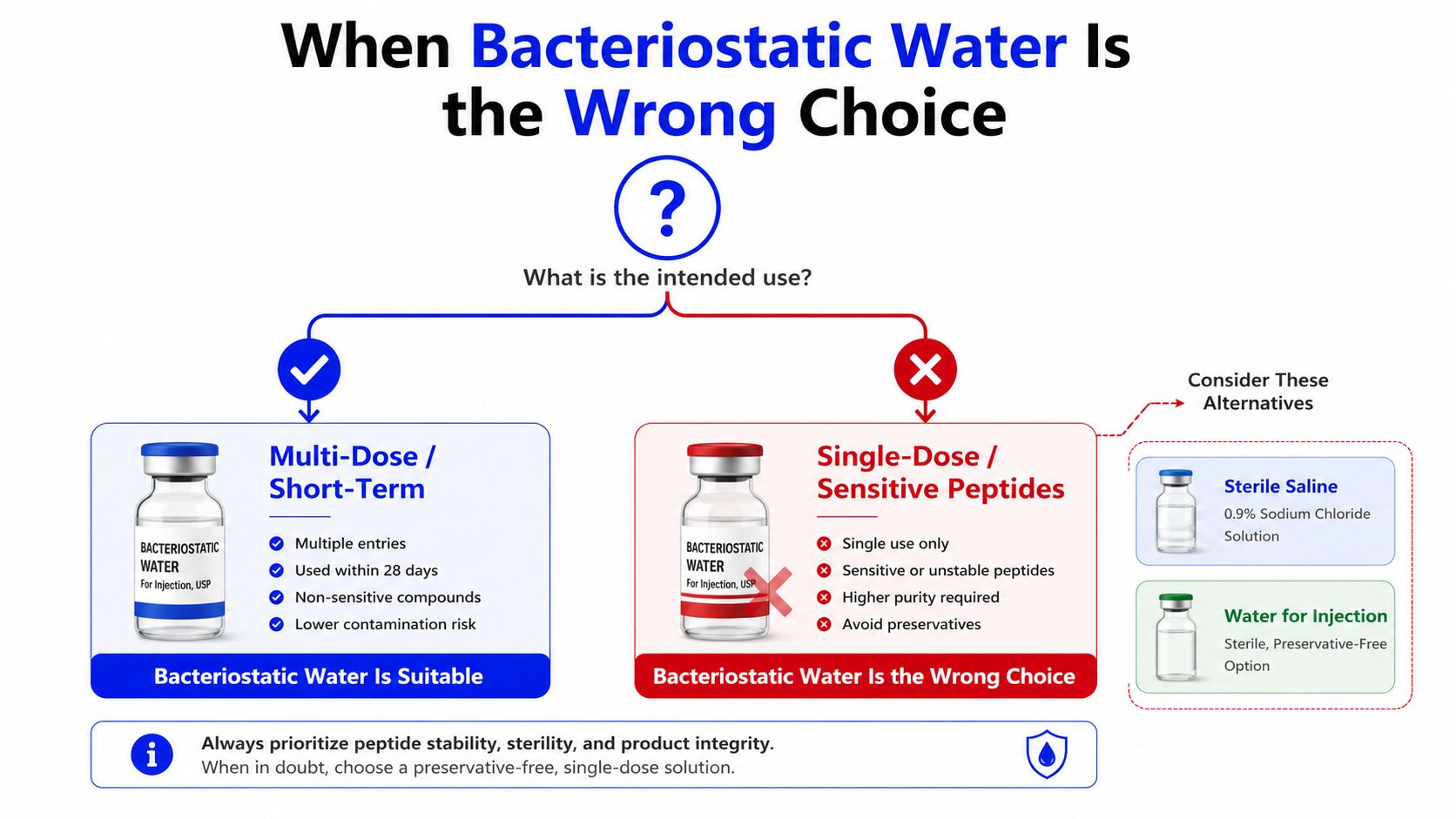
A practical comparison is straightforward:
- Bacteriostatic water: Suited to repeated access, multi-dose handling, and short-term refrigerated storage.
- Sterile water: Suited to single-use preparation, very short handling windows, or workflows where the preservative is undesirable.
- Assay-sensitive systems: Use the diluent that will not interfere with the readout, even if that means skipping the familiar default.
There is a better way to decide than assuming one diluent works for every peptide. Match the diluent to the workflow requirements rather than forcing every peptide into the same diluent choice.
What that means at the bench
If a peptide is being prepared for one quick session, preservative-free sterile water can avoid unnecessary exposure to benzyl alcohol. If the vial will be entered several times over several days, bacteriostatic water gives the handling routine more room, as long as the downstream use tolerates it. BAC water vs sterile water for peptides
The decision belongs before the first puncture. After the vial is open, the diluent choice becomes part of the sample's identity and storage behavior.
Labeling, Storage, and the 28-Day In-Use Window
A reconstituted vial needs a label the moment it is prepared. Write the peptide name, concentration, date of reconstitution, and the diluent used. Incomplete labels force researchers to speculate later, and speculation has no place among identical-looking vials in a refrigerator.
Storage conditions that protect the vial
The usual storage target for reconstituted bacteriostatic preparations is 2–8°C, in a dedicated research refrigerator, away from food and away from the freezer compartment. Freezing is generally avoided for reconstituted peptide solutions because the goal is steady refrigeration, not repeated temperature stress. The vial should also be kept out of unnecessary light.
The in-use window is a guideline, not a guarantee. A commonly repeated operational benchmark is 28 days after reconstitution with bacteriostatic water, assuming aseptic technique and refrigerated storage water to mix with peptides. Other references describe a 14 to 28 day range at 2–8°C, and some users stretch the window a little longer, but the practical habit is to treat the earlier end as the safer boundary when the sample matters. A vial that sits longer than expected is not improved by optimism.
An external reference on medical device labeling requirements is useful for anyone who wants a broader sense of why clear labels matter in controlled lab environments. The details differ by context, but the principle is the same, a vial that cannot be identified cleanly cannot be managed cleanly.
When the vial should be discarded
Visible condition overrides the calendar. Cloudiness, particles, or unusual color are reasons to discard the vial, regardless of how many days have passed. The preservative helps, but it does not make a compromised vial safe again.
Entry count matters too. Fewer punctures are better, because each access adds contamination opportunity and handling stress. Once a vial is nearing the end of its in-use window, plan the remaining draws carefully instead of opening it casually and hoping the date on the label will carry it through.
Troubleshooting the Most Common Reconstitution Mistakes
The three failures that show up most often are also the easiest to prevent. Shaking, leaving the vial out too long, and using the solution after it has clearly gone bad each create a different kind of problem, but they all point back to the same habit. The sample was handled as if the preservative could make up for rough technique.
Why the common mistakes happen
Shaking introduces foam and mechanical stress. That does more than make the vial look messy, because it can reduce usable yield and make later clarity checks harder to trust. Gentle rolling or tilting is enough for dissolution, and anything stronger starts to work against the peptide.
Leaving the vial at room temperature while working shortens the usable window. Bacteriostatic water helps with repeated access, but it does not cancel time, contamination exposure, or poor bench hygiene. Return the sample to refrigeration promptly after use, and keep the vial out only as long as the actual task requires.
The 28-day in-use window still matters, and a vial that has turned cloudy belongs out of service. Once contamination or visible instability appears, the vial should be treated as compromised immediately. Preservative can slow trouble, but it cannot restore a vial that already shows signs of failure.
Failure modes and what they mean
| What you see | Likely cause | Action |
|---|---|---|
| Foam | Vial was shaken or the diluent entered too aggressively | Let it rest, then use gentler handling next time |
| Cloudiness | Contamination, poor dissolution, or stability loss | Discard the vial |
| Visible particles | Incomplete dissolution or contamination | Discard the vial |
| Unusual color | Sample instability or contamination | Discard the vial |
| Warm vial during use | Too much time at room temperature | Return to refrigeration and tighten handling |
The video below reinforces the sterile handling rhythm and the visual cues that keep a prep from drifting into bad habits.
The useful habit is to connect the visible sign to the action immediately. Foam means stop shaking. Cloudiness means do not use it. Particles mean the vial is no longer a candidate for convenience.
Pre-Run Checklist and Common Questions
Before the bench work starts, the safest version of the process is the one that can be checked in one glance.
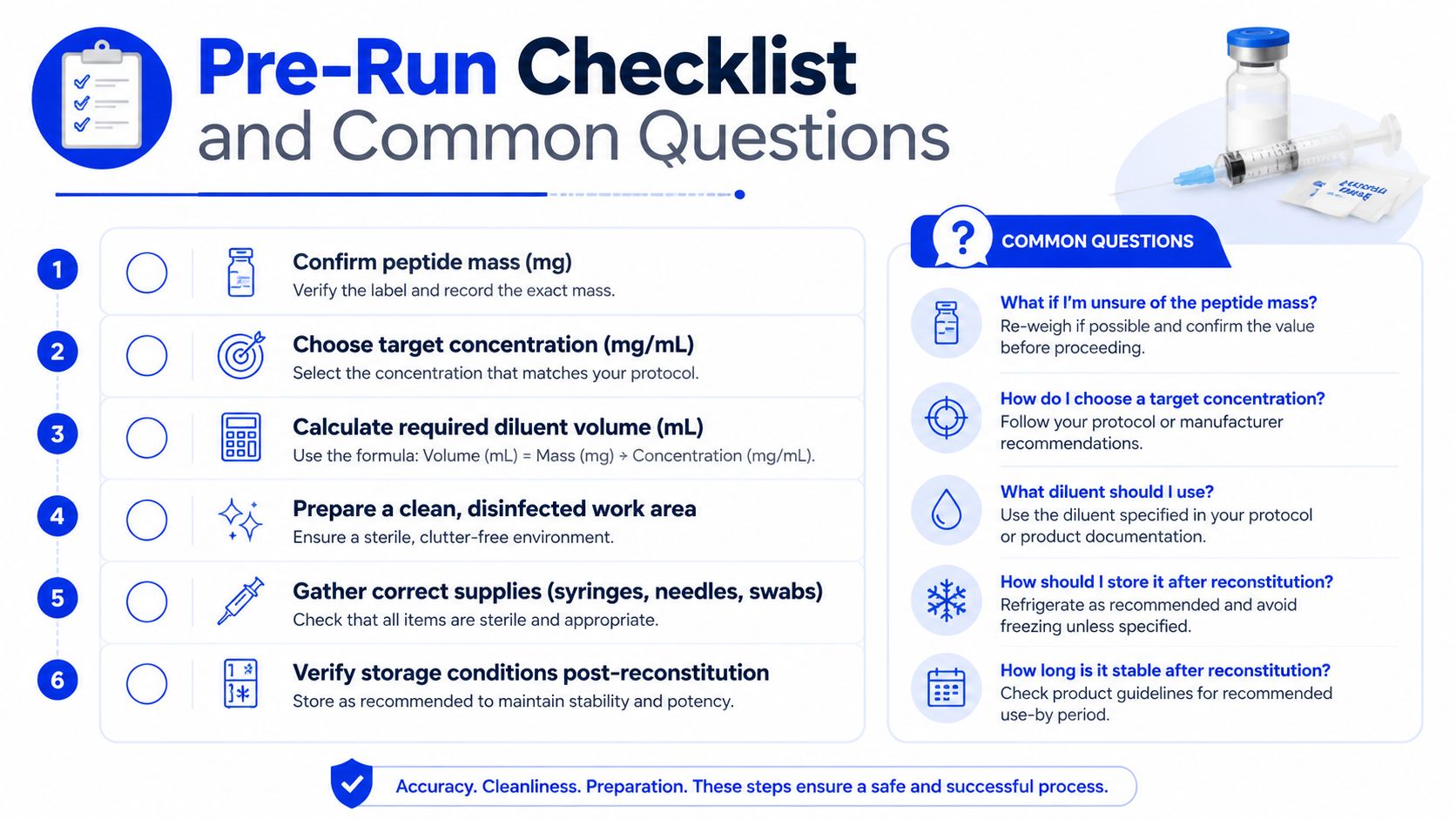
Bench checklist that keeps the prep clean
- Confirm peptide mass. Use the actual vial content, not a guess based on habit.
- Choose target concentration. Decide this before drawing any diluent.
- Calculate required volume. Peptide mass divided by target concentration gives the volume.
- Prepare a clean work area. Clutter adds mistakes.
- Swab both stoppers. Let the alcohol dry before puncturing.
- Gather correct supplies. Fresh syringes, correct needles, and clean swabs.
- Inject down the vial wall. Avoid blasting the cake directly.
- Swirl gently. Don't shake the vial.
- Label immediately. Include name, concentration, date, and diluent.
- Store at 2–8°C. Keep it in a dedicated research refrigerator.
- Discard on cloudiness or at the end of the in-use window.
Common questions that come up at the bench
If a vial foams, the first response is to stop agitating it and let it sit. Foam usually points to rough handling, not a failed chemistry problem, and the corrective habit is gentler motion next time.
If unused reconstituted peptide is frozen for later use, that's generally the wrong direction for this workflow. Reconstituted solutions are managed by refrigeration and careful access, not by turning them into freeze-thaw stock.
If reliable bacteriostatic water is being sourced for RUO work, the question is documentation, sterility, and fit for repeated withdrawal, not packaging alone. Herbilabs supplies bacteriostatic water and related RUO labware in multi-dose vial formats with lot-specific documentation, so the workflow stays tied to a controlled diluent rather than an improvised substitute.
For peptide reconstitution work that needs consistent diluent, clean vial formats, and clear documentation, Herbilabs offers bacteriostatic water and related labware built for RUO workflows. If your bench routine depends on accurate volume selection and short-term refrigerated handling, visit Herbilabs to review the available vial formats and product details.