Private Label, White Label, Wholesale partnerships available - EU, USA and UK - Free shipping from €75

Reconstitution Kit for Peptides: What to Look for in 2026
A researcher at the bench can hold two reconstitution kits that look almost identical and still pick the wrong one. One vial says bacteriostatic water, the other says sterile water, and both sound reasonable until the workflow starts asking harder questions about storage, withdrawals, and whether the peptide behaves well in that solvent. That is the decision point with a reconstitution kit for peptides, because the label only helps if it matches the peptide, the assay, and the way the vial will be used.
For independent labs, biotech R&D groups, peptide resellers, and RUO end users, the kit is not just a convenience bundle. It is a small decision system that forces choices about diluent chemistry, vial size, included hardware, and documentation depth. The rest of this guide treats those choices the way a senior lab tech would, with the trade-offs spelled out plainly.
Table of Contents
- Why the Right Reconstitution Kit Changes Everything
- What a Reconstitution Kit Actually Contains
- The Four Decisions That Define Any Reconstitution Kit
- Matching Vial Size to Peptide Mass and Workflow
- When Bacteriostatic Water Is the Wrong Choice
- Reading the Quality and Documentation Signals
- Matching a Kit to Your Buyer Profile
- A Five-Minute Reconstitution Kit Checklist
Why the Right Reconstitution Kit Changes Everything
A common bench moment goes like this. A researcher has two kits open, both with the right peptide on the order sheet, both with a sterile diluent vial, and both with enough accessories to get started. The difference only becomes visible when one kit is built for repeated access and the other is better suited to a single-use or highly specific workflow.
That distinction matters because peptide reconstitution is not only about getting powder into solution. It is about preserving the sample, reducing contamination risk, and keeping the concentration useful for the next step. The reconstitution guide from National Peptide Library describes the common working pattern clearly, bacteriostatic water is used for short-period multi-dose access, while preservative-free sterile water is treated as a single-dose option that should be used immediately or discarded.
Practical rule: if repeated vial access is part of the plan, the kit has to support aseptic withdrawals, not just initial mixing.
That is why this topic matters for more than one audience. Independent labs need predictable handling. Biotech R&D groups need consistency across batches and operators. Peptide resellers need packaging that fits repeat fulfillment. RUO end users need instructions that are hard to misread.
A good kit answers four questions before anyone touches the vial. What is the diluent chemistry. What vial size fits the mass and the withdrawal pattern. What hardware is included for transfer and measurement. What documentation proves the supplier controls the batch. If those four pieces do not line up, the kit may look complete and still create avoidable problems at the bench.
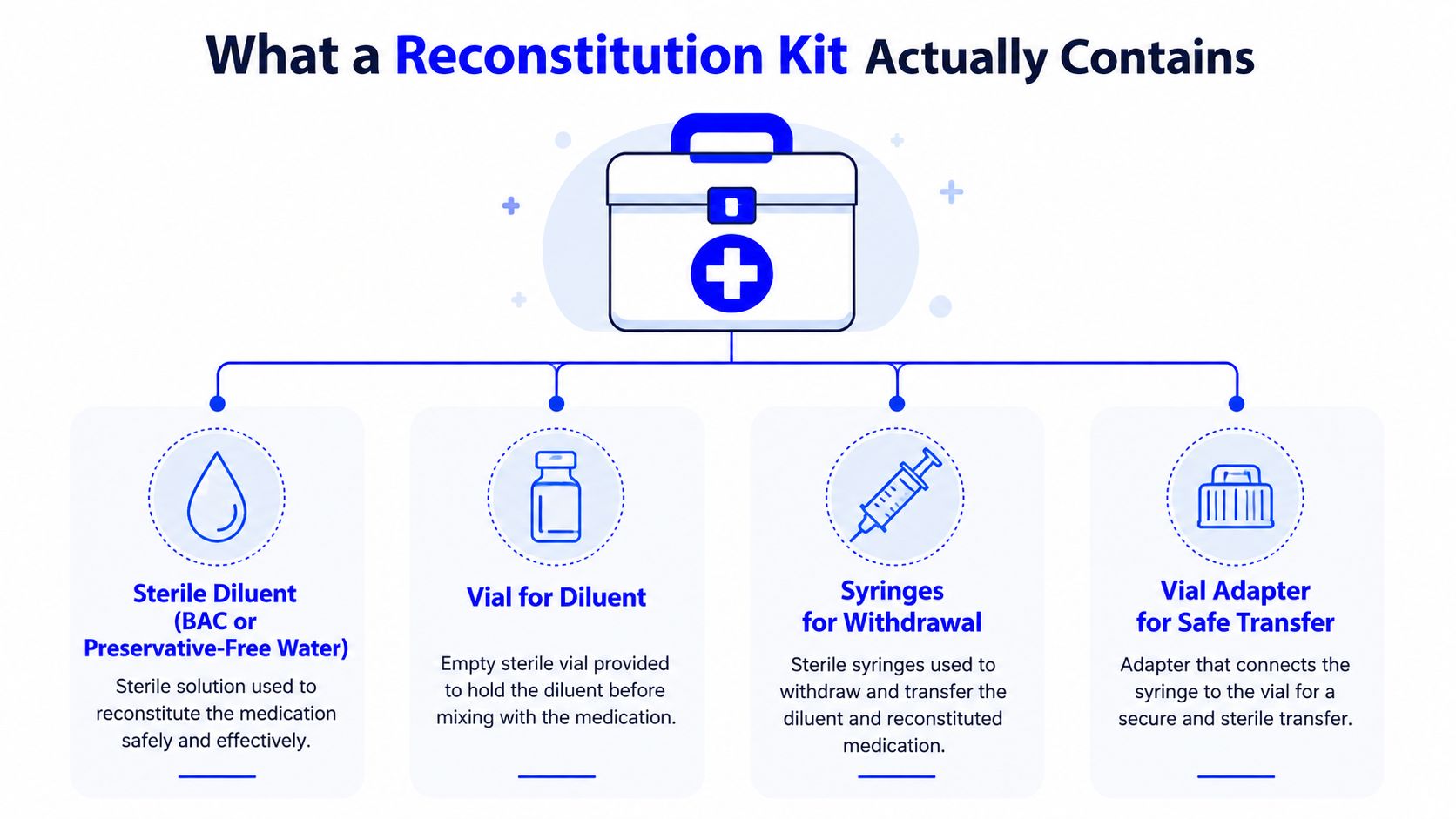
What a Reconstitution Kit Actually Contains
A peptide kit is easiest to understand when it is treated like a coffee starter set. Beans, grinder, filter, and brewer all have to match the drink being made. A reconstitution kit works the same way, because the diluent, the container, the transfer hardware, and the paperwork all serve one workflow, not four unrelated tasks.
The core parts are straightforward. There is a sterile diluent, usually bacteriostatic water or preservative-free water. There is a vial that holds that diluent, often a multi-dose glass vial when repeated withdrawals are expected. There are syringes and needles for measured transfer, plus alcohol prep pads or sterile wipes to clean stoppers before access. Some kits also include lot-specific documentation, which matters just as much as the physical supplies when the workflow needs traceability.
The internal logic of the kit is the same as a kitchen recipe. The powder is one ingredient, the solvent is another, and the solvent volume determines the working concentration. That is why a kit can't be judged by the contents alone. It has to be judged by whether the parts are tuned to each other and to the peptide being handled. For readers who need the upstream context, the basics of lyophilized peptide handling are covered in HerbiLabs' lyophilized peptide overview.
One more detail often gets missed. RUO labeling means the kit is sold for research use only, so the buyer has to treat that designation seriously in procurement and documentation. That label does not make the kit interchangeable with clinical supplies, and it does not remove the need to match the diluent to the workflow. It tells the buyer what the product is authorized for.
A kit is not “complete” because it has more items in the box. It is complete when every item supports the same reconstitution decision.
The Four Decisions That Define Any Reconstitution Kit
Diluent chemistry comes first
The first decision is whether the kit uses bacteriostatic water or preservative-free sterile water. The difference is not cosmetic. Bacteriostatic water includes 0.9% benzyl alcohol, which is why it can support multi-dose access for a short period, while preservative-free water is generally treated as single-dose only. The preserved option is built around repeated withdrawals, and the plain sterile option is built around immediate use.
Vial format changes the workflow
The second decision is vial size. Common formats such as 3 mL, 10 mL, 20 mL, and 30 mL map to different peptide masses and different withdrawal patterns. A small vial can be easier to manage for modest use, while a larger vial may better support repeated access or larger batches. The wrong match creates either unnecessary re-preparation or excessive leftover volume.
Hardware is not a throw-in
The third decision is the included hardware. Syringe size, needle gauge, alcohol wipes, and transfer accessories all affect how accurately the liquid can be measured and how cleanly the stopper can be accessed. A kit that ships with the wrong transfer tools may technically work, but it increases handling friction and the chance of operator error.
Documentation is part of the product
The fourth decision is documentation depth. A serious supplier can provide a lot-specific Certificate of Analysis, batch traceability, and quality system signals such as ISO 13485, GMP, or structured ISO 9001 procedures. The reconstitution calculator and workflow guidance from Pepedhub reflects how standardized this category has become, with buyers now expecting calculated fill volumes and repeatable packaging rather than improvised prep.
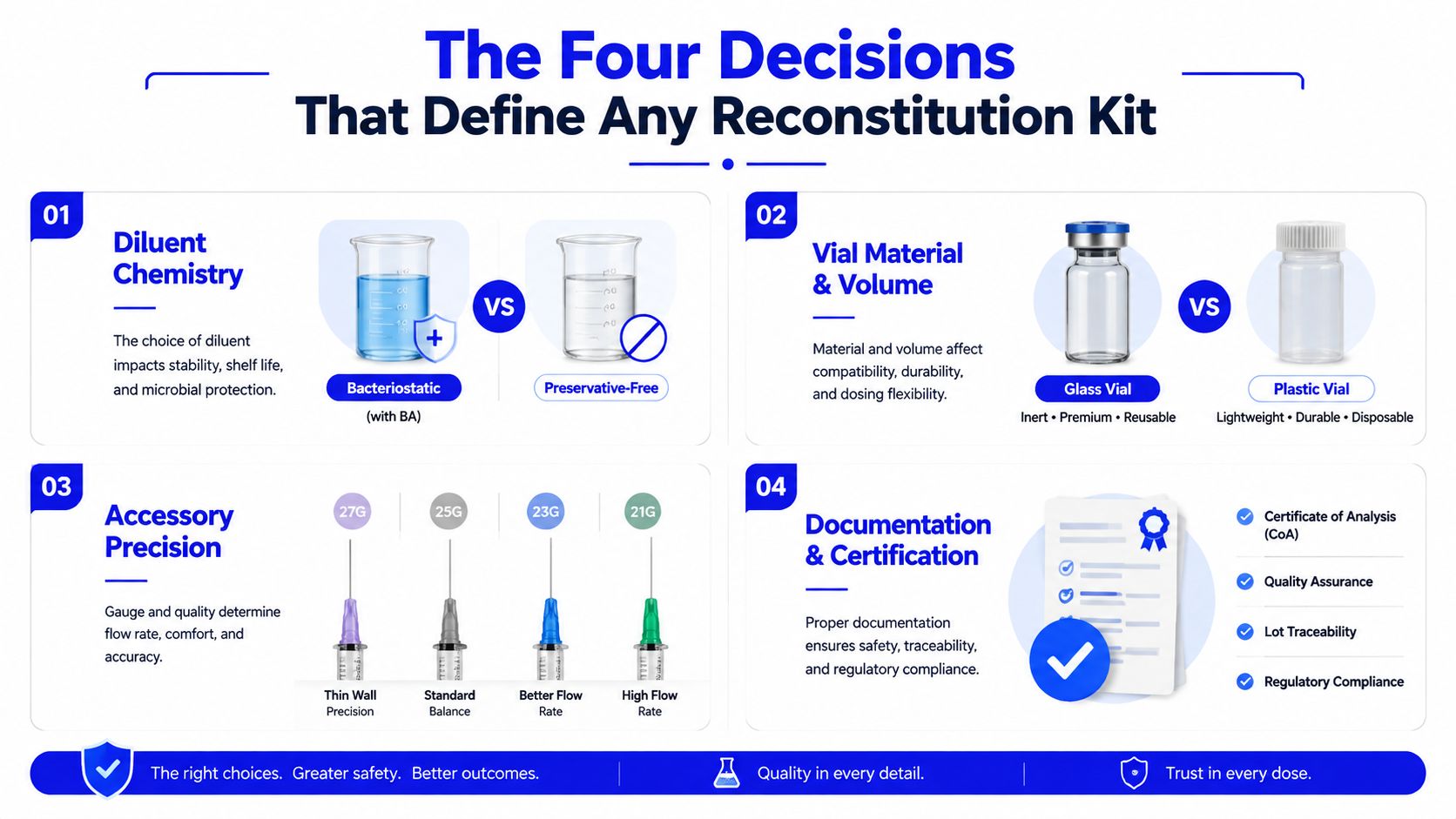
A buyer can score any kit by asking four questions. Does the diluent match the peptide. Does the vial size fit the expected withdrawals. Does the hardware support clean transfer. Does the paperwork support traceability. If any answer is weak, the kit is a compromise, not a fit.
Matching Vial Size to Peptide Mass and Workflow
Start with the simple math
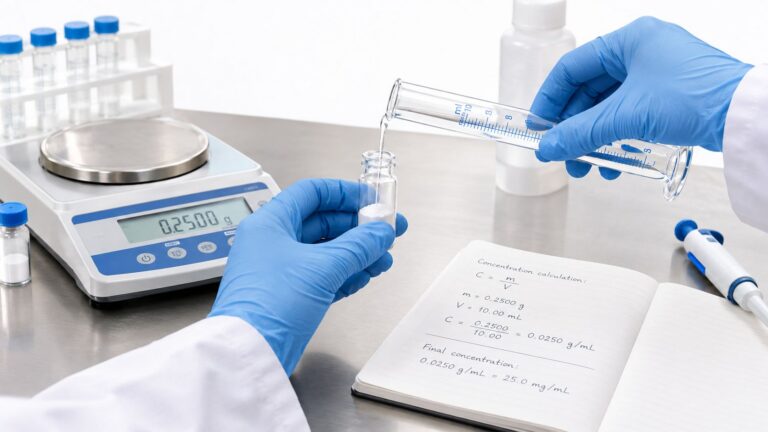
Reconstitution boils down to one relationship, concentration equals peptide mass divided by solvent volume. That is why vial size is never just packaging. The same peptide mass can become a very different working solution depending on how much diluent is added, and that choice changes how the sample will be handled later.
Take a 10 mg peptide vial. If the lab adds a smaller diluent volume, the solution becomes more concentrated. If the lab adds a larger volume, the solution becomes easier to measure in some workflows but less concentrated overall. The sterile water vial guidance from HerbiLabs fits into this decision because vial format and diluent volume have to be chosen together, not one after the other.
Why withdrawal behavior changes with vial size
A smaller diluent vial can make the working concentration more manageable for modest use, but it may force the lab to prepare fresh solution sooner. A larger vial can support more draws, yet it can also introduce more dead-space concerns and more opportunities for handling loss if the workflow is sloppy. The practical question is not “what size is biggest,” it is “what size gives enough usable withdrawals without wasting material or forcing unnecessary rework.”
| Common Vial Formats and Typical Use Cases | Best For | Typical Withdrawal Count |
|---|---|---|
| 3 mL | Small workflows, tighter concentration control | Fewer withdrawals, shorter use pattern |
| 10 mL | Standard research handling, balanced repeat access | Moderate withdrawal count |
| 20 mL | Larger batch prep, more repeated access | Higher withdrawal count |
| 30 mL | Heavier multi-dose workflows, packaged supply chains | Highest repeat access among common formats |
The market has matured around practical buying patterns, not one-off consumer behavior. That is why multi-pack kits such as 10×3 mL and 10×10 mL show up in serious lab purchasing. They signal that the supplier is thinking about replenishment, storage, and repeat handling, not just the first draw.
Operational rule: the best vial size is the one that fits the expected number of withdrawals without forcing the lab to over-dilute or reconstitute too often.
When Bacteriostatic Water Is the Wrong Choice
The default assumption says bacteriostatic water belongs in every reconstitution kit. That is too simple. Some peptides are hydrophobic, some are pH-sensitive, and some analytical workflows are sensitive enough that benzyl alcohol is not the diluent a lab wants near the sample.
That is why the solvent choice has to follow the peptide, not the marketing label. Certain cases need pH adjustment, filtration, or a different handling strategy to achieve full dissolution. The point is not that bacteriostatic water is bad. The point is that it is only one solvent strategy, and a useful kit has to support the right one for the target material.
The newer 2025 to 2026 handling guidance has also widened the playbook. It now includes room-temperature equilibration, low-binding aliquots, and even brief sonication for stubborn peptides. That shift tells the buyer something important. The field is moving away from one-size-fits-all instructions and toward workflow design that respects peptide behavior.
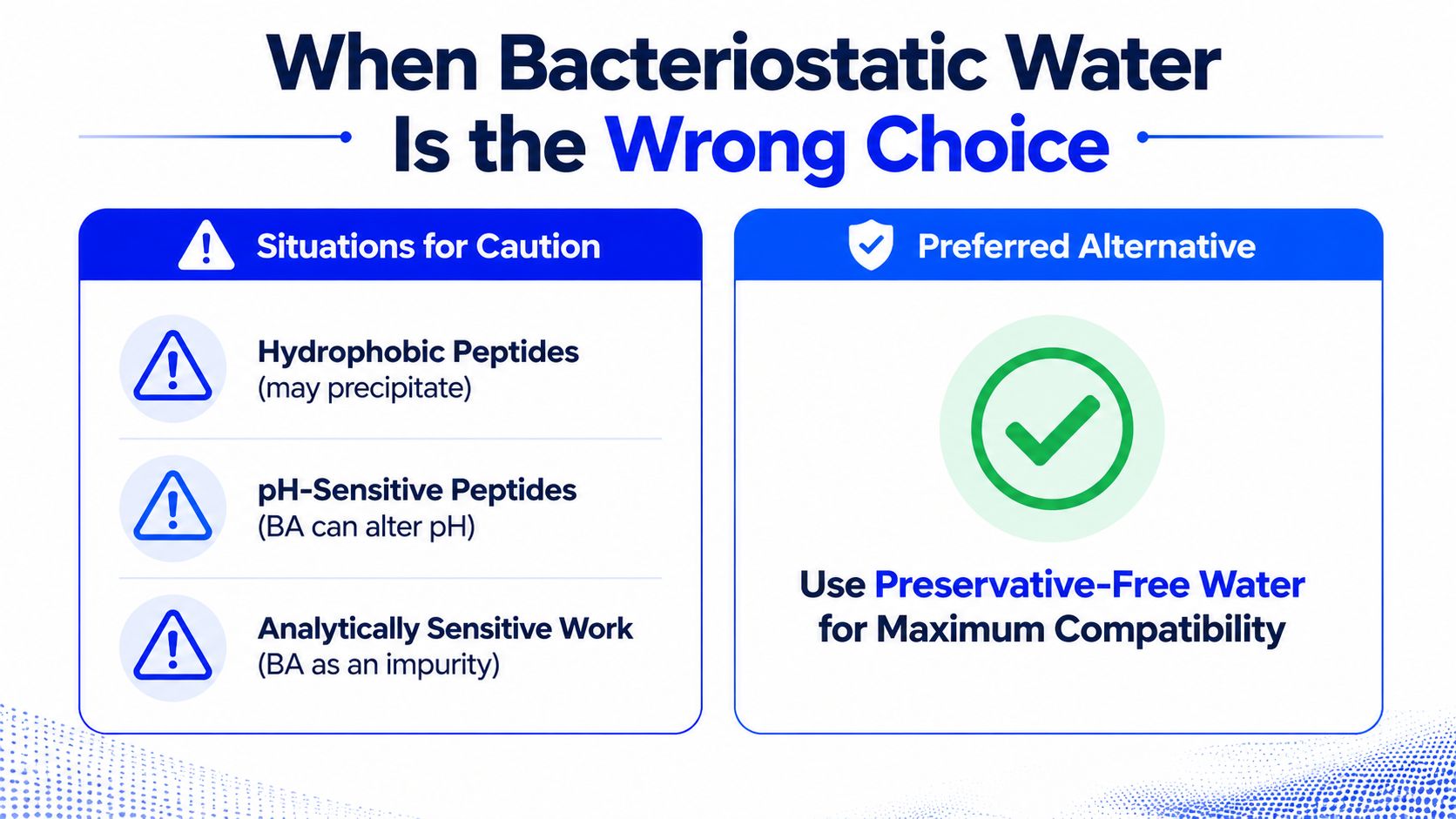
If a supplier only talks about “BAC water” and never discusses alternative solvent fit, that is a warning sign. The buyer should ask for documentation that explains the solvent choice, not just a sales sheet that repeats the same default. For a simple comparison of solvent selection, the HerbiLabs sterile water versus bacteriostatic water guide is a useful companion resource.
A thoughtful kit does not force every peptide into the same diluent. It gives the researcher a way to choose the safer solvent strategy for the job at hand, even if that means skipping the preserved option.
Reading the Quality and Documentation Signals
A supplier can use polished packaging and still leave the buyer guessing about batch quality. That is why the paperwork matters. A lot-specific Certificate of Analysis should tell the buyer what was tested, what result was observed, what specification was used, and which lot number the result belongs to. Without that, the kit may be easy to order but hard to defend in a lab record.
What the certifications actually signal
ISO 13485:2016 points to a medical-device-grade quality management system, which means the supplier is operating with defined controls around production and review. GMP signals a production environment built around batch discipline and release oversight. ISO 9001:2016 procedures fit into the larger quality picture by formalizing process management, even when the product itself is not a device.
What buyers can ask to see
A buyer does not need to decode a factory floor, but the questions should be concrete. Was the product 0.22 µm sterile filtered. Was it aseptically filled into premium glass multi-dose vials. Is the stated pH within the typical 4.5 to 7.0 range. Was storage kept under temperature-controlled conditions through fulfillment. Those cues do not prove every aspect of performance, but they do show whether the supplier is using controlled methods rather than improvised handling.
Bench-side test: if the supplier cannot explain how the product was filtered, filled, labeled, and released, the buyer is left trusting a brand story instead of a quality system.
HerbiLabs is one example of a supplier that publishes this kind of operational detail for its reconstitution solution products, including lot-specific COAs, QA review prior to release, same-day dispatch, and temperature-controlled storage. That kind of transparency matters because it gives the buyer something usable during procurement review, not just a product name.
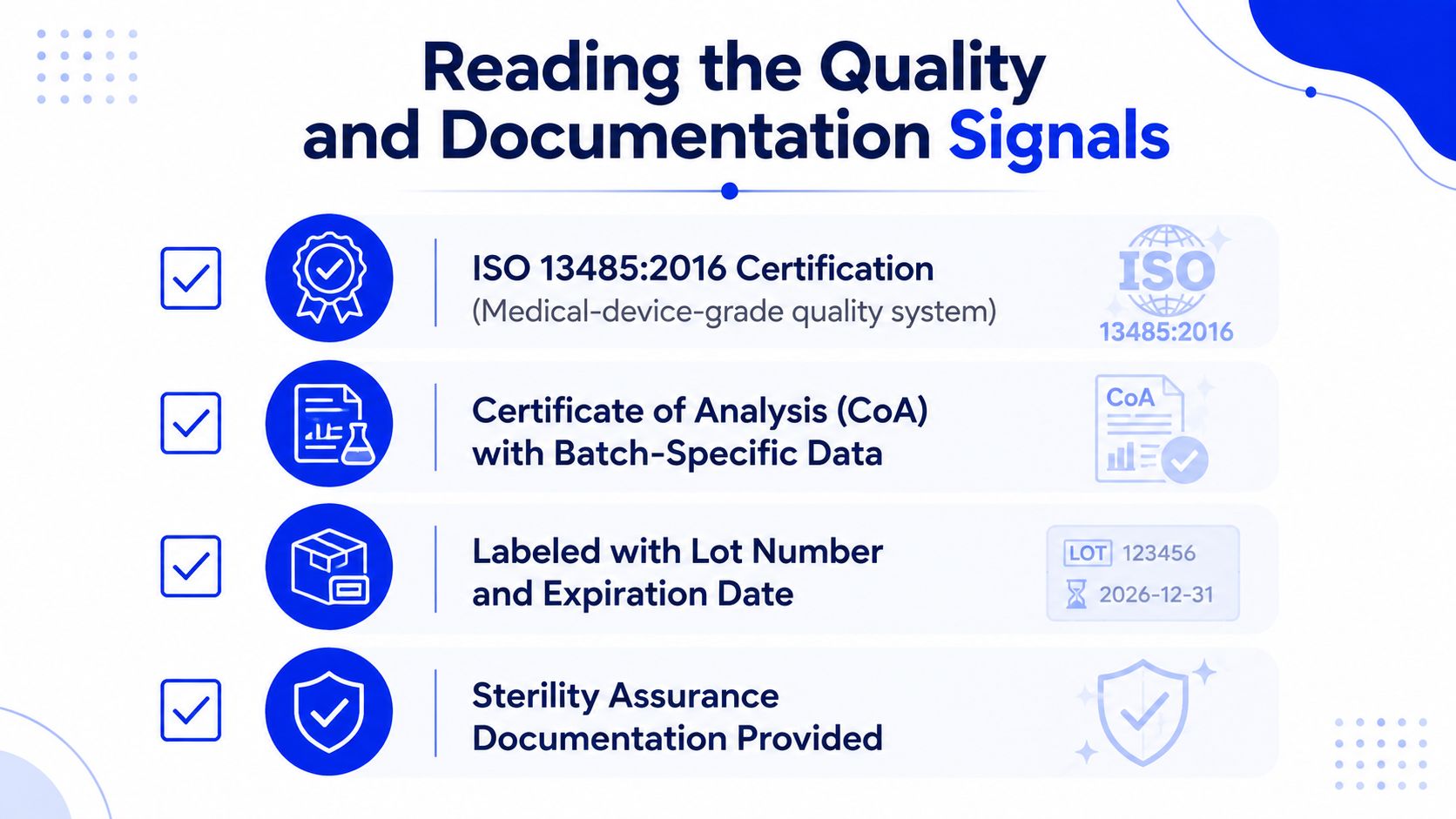
A good rule is simple. Packaging says what is inside the box. Documentation says how much confidence the buyer can place in the box.
Matching a Kit to Your Buyer Profile
Independent researchers and small labs
Small labs usually need the least drama and the most clarity. They tend to benefit from predictable diluent choice, modest vial sizes, and a clear COA that does not require a quality engineer to interpret. Extra branding and oversized kit bundles are less useful than a kit that arrives ready for a small, repeatable workflow.
Biotech and pharma R&D groups
R&D groups usually care about process control first. They need ISO/GMP-anchored documentation, batch traceability, and vial formats that fit more than one experiment or operator. Their timeline risk is usually less about the first reconstitution and more about whether the next batch arrives on time and documents cleanly.
Peptide resellers and white-label partners
Resellers think in systems, not single purchases. They often need private-label flexibility, multi-pack configurations, and distribution coverage that reaches the EU, UK, and USA without turning procurement into a logistics puzzle. For teams reviewing catalog structure, the real-world catalog lookbook examples from NanoPIM are a useful reference for how product presentation can support buyer decision-making.
RUO end users and individual buyers
Individual RUO users usually want the cleanest possible setup. Simple instructions, straightforward multi-pack options, and a kit that does not overcomplicate the first use are more valuable than a dense spec sheet. They also benefit from suppliers that ship consistently and explain the solvent choice in plain language.
The cleanest buying logic is to match the profile to the priority. Small labs prioritize predictability. R&D groups prioritize documentation and repeatability. Resellers prioritize packaging and distribution. End users prioritize simplicity. The wrong kit is often the one that solved someone else's problem very well.
A Five-Minute Reconstitution Kit Checklist
A buyer can screen most kits in a few minutes by checking five things in order.
- Confirm the diluent type: Match bacteriostatic water or preservative-free water to the peptide and the intended workflow, not to habit.
- Match the vial format: Pick a size that fits the planned withdrawal count without forcing excess re-preparation or unnecessary dilution.
- Check the hardware: Make sure the syringe, needle, and wipe setup fits the transfer and measurement steps the lab uses.
- Review the paperwork: Look for a lot-specific COA, batch traceability, and quality signals that explain how the product was made and released.
- Verify shipping terms: Confirm temperature-controlled storage, same-day dispatch where needed, and service coverage for the relevant region.
This checklist turns kit shopping into a fast decision instead of a label comparison exercise. It works because it asks the same questions every time, whether the buyer is handling one vial or building a repeat purchase workflow. Revisit it whenever the peptide portfolio changes, because the right kit for one peptide may be the wrong kit for the next.
HerbiLabs supplies research-use-only bacteriostatic water and reconstitution solutions, multi-dose vial formats, and batch documentation for peptide workflows that depend on sterile handling and repeatable preparation. For buyers comparing kit structure, logistics, and quality signals, HerbiLabs is a practical place to review the available formats and documentation before placing the next order.