Private Label, White Label, Wholesale partnerships available - EU, USA and UK - Free shipping from €75

Sterile Water for Reconstitution of Dry Syrup: A Lab Guide
A bench run starts clean, the powder vial looks stable, and the label on the bottle says only sterile water for reconstitution. Then the suspension turns cloudy, the dose settles unevenly, or the replicate values drift in a way that doesn't fit the hypothesis. In RUO work, that kind of problem usually isn't a dramatic failure, it's a small reconstitution decision that changed the material before the experiment ever began.
The hard part is that sterile water looks simple. It's not. Once a dry syrup or lyophilized reagent is mixed, the diluent choice affects sterility, concentration, storage, and whether the result can be repeated tomorrow with the same outcome. Poor communication around product instructions creates the same kind of downstream risk that shows up in impact of communication barriers in healthcare, where a small misunderstanding can change the entire result.
Table of Contents
- Why Precision in Reconstitution is Non-Negotiable
- Choosing Your Diluent Sterile vs Bacteriostatic Water
- Ensuring Accuracy Volume and Compatibility Factors
- Mastering Aseptic Technique for Reconstitution
- Labeling and Storing Reconstituted Solutions
- Advanced Considerations for RUO Labs
Why Precision in Reconstitution is Non-Negotiable
A common failure pattern in RUO labs starts with a routine prep. A technician adds diluent too quickly, skips the staged addition, or assumes any clean liquid will do. The vial looks fine, but the finished material no longer behaves like the one the protocol was built around.
Reconstitution is part of the experimental design
Sterile water for reconstitution of dry syrup is not a generic convenience fluid. The FDA/DailyMed label for sterile water for injection identifies it as a sterile, nonpyrogenic, preservative-free diluent with no bacteriostat, antimicrobial agent, or added buffer, supplied in single-dose containers for dissolving drugs (DailyMed label). That label language matters because it defines how the product behaves once opened and how much handling it can tolerate.
In a dry powder workflow, the reconstitution step sets the final composition. If the powder is not fully wetted, or if the wrong diluent is introduced, the sample can become an inconsistent mixture rather than a reproducible solution. In a lab context, that means the preparation itself can become the source of the anomaly, not the assay.
Practical rule: Treat reconstitution like a controlled preparation step, not a prelude to the real experiment.
This is also where product instructions carry real weight. Some oral suspension inserts specify measured sterile-water volumes and a short in-use period after mixing, which shows that the finished product's usable life starts the moment water touches the powder. A useful reference on the general handling mindset is choosing sterile water vials, because vial format and entry pattern shape the risk profile from the outset.
Why the wrong assumption breaks reproducibility
Reconstituted materials often look stable long before they are. That visual confidence is dangerous, because appearance doesn't tell a researcher whether the concentration is exact, whether the suspension is homogeneous, or whether microbial protection exists after opening. The result can be a run that appears technically valid but can't be reproduced cleanly.
Reproducibility depends on controlled inputs, and the diluent is one of the earliest ones. If the lab treats that step casually, the downstream data gets harder to interpret, even when every later stage is executed well.
Choosing Your Diluent Sterile vs Bacteriostatic Water
A dry syrup that is reconstituted with the wrong diluent can still look acceptable at first glance. In a RUO setting, that is a problem for experimental integrity, because the choice of water affects whether the preparation matches the label, how the vial is handled, and how reproducible the result will be. The decision should start with the material's intended use, not with what is already on the bench.
What sterile water is
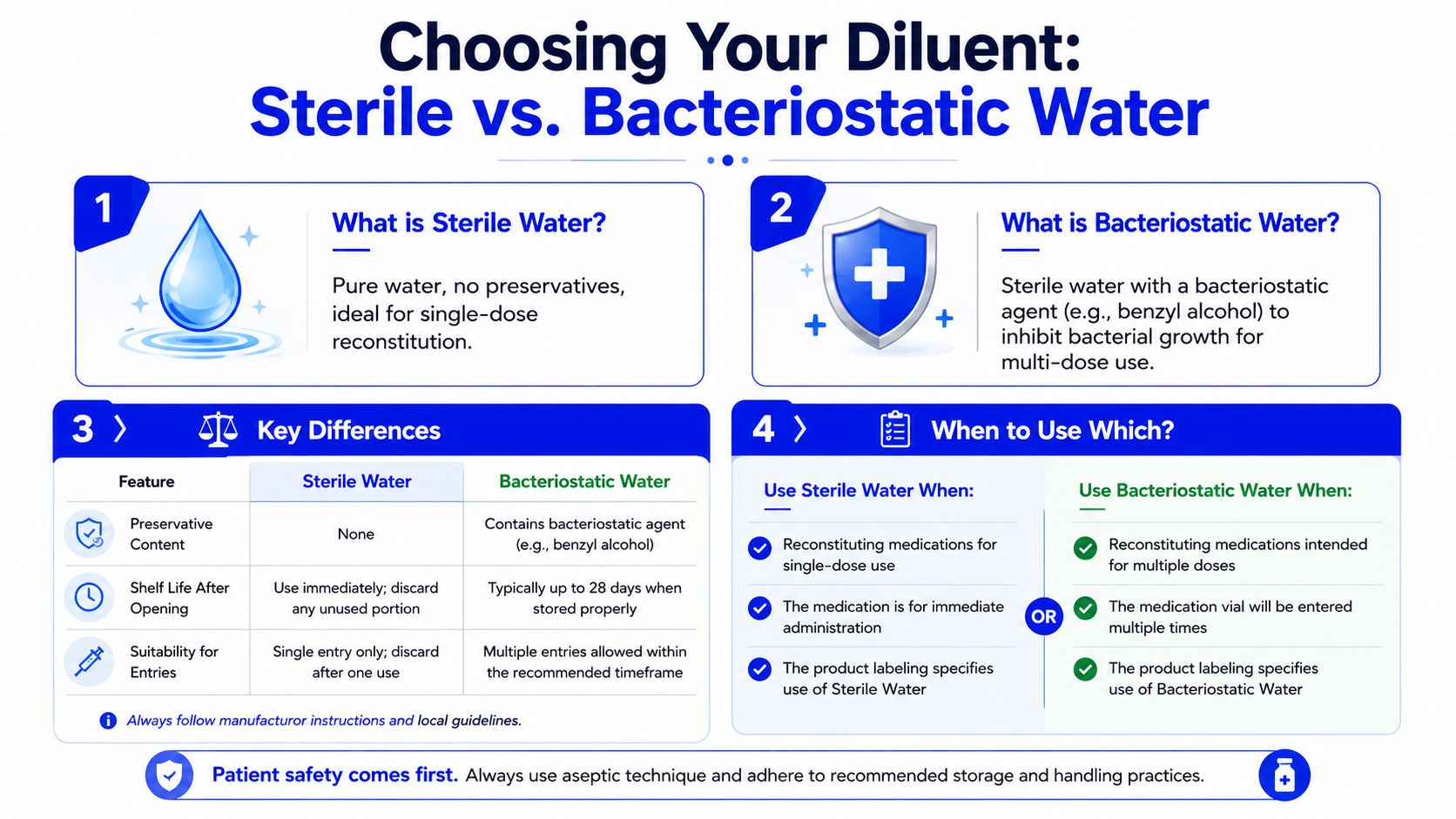
Sterile water is a sterile, nonpyrogenic, preservative-free diluent supplied in single-dose containers, and it contains no bacteriostat or antimicrobial agent (DailyMed label). That profile makes it the correct choice when the product label requires a preservative-free diluent or when the workflow cannot tolerate any antimicrobial additive in the finished preparation.
For RUO work, the practical point is simple. Preservatives can alter the behavior of sensitive materials, and that can change the way a compound disperses, dissolves, or performs in downstream testing. If the label calls for sterile water, substituting a preserved liquid because it is available is a formulation error, not a harmless approximation. For a broader reference on vial handling and entry risk, see choosing sterile water vials.
What bacteriostatic water is
Bacteriostatic water contains 0.9% benzyl alcohol, which supports multi-dose use. That preservative is the functional difference, and it changes how the vial behaves after opening. It can be appropriate when repeated withdrawals are planned and the protocol accepts a preserved diluent.
The mistake is to treat preserved and preservative-free products as interchangeable. They are not. The compatibility question becomes more sensitive with materials that are already constrained by label instructions, and the presence of 0.9% benzyl alcohol should be checked against the compound's requirements before it is used.
Sterile Water vs Bacteriostatic Water at a Glance
| Attribute | Sterile Water | Bacteriostatic Water |
|---|---|---|
| Preservative | None | 0.9% benzyl alcohol |
| Container use | Single-dose | Multi-dose |
| Typical intent | Preservative-free reconstitution | Repeated withdrawals |
| Risk profile | No antimicrobial additive | Compatibility must be checked for the specific compound |
| Best fit in RUO | When the label calls for sterile water or no preservative | When the formulation and workflow accept a preserved diluent |
For labs that need a reference point on multi-dose handling and documentation, a product such as Herbilabs bacteriostatic water/reconstitution solution is one preserved diluent format. It fits only when the protocol, compound, and access pattern support a bacteriostatic formulation.
Ensuring Accuracy Volume and Compatibility Factors
A reconstitution can fail even when the diluent itself is clean. If the volume is wrong, the final concentration is wrong, and the material no longer reflects the intended preparation. In RUO work, that becomes a reproducibility problem, not just a handling mistake.
Match the supplied volume to the finished preparation
Manufacturers often package reconstitution waters in precise presentations, including 5 mL, 10 mL, 15 mL, 20 mL, 25 mL, 28 mL, and 30 mL formats (Onyx Biotec). Those fills are selected so the final suspension lands at the intended volume after powder displacement is accounted for, which is why the container size is part of the dosing logic rather than a packaging detail.
A clear example is the staged addition used for Augmentin DDS, where the supplied 30 mL sterile purified water is added first to 3/4 of the fill mark, then topped up after shaking to the line (Onyx Biotec). That method is used to wet the powder completely and distribute it evenly before the final adjustment. It is slower than a single pour, but it reduces the risk of a partial mix.
If the powder is not fully wetted, the first aliquot can look correct while the final mixture remains uneven.
That point is easy to overlook during routine preparation, especially when several samples are being handled in sequence. The mixed suspension should be treated as a concentration-defined material, because a small volume error changes the working composition and can distort downstream results.
Compatibility is more than sterility
A liquid can be sterile and still be the wrong choice. A compound may react poorly to preservatives, or its suspension behavior may change if the diluent chemistry does not match the label. In RUO settings, the decision has to be made from the material instructions and the experimental goal, not from the appearance of the vial.
The pH range of a supplied diluent can matter as well, especially for delicate proteins or peptides. Herbilabs states a typical pH range of 4.5 to 7.0 for its reconstitution solution, which gives researchers a documented parameter to compare with the compound's own requirements. A parameter like that is useful only if it is checked against the protocol and not treated as a blanket fit for every reagent.
A simple decision check
- Check the label first. Use the diluent named by the manufacturer.
- Check the final volume. The target concentration depends on exact fill accuracy.
- Check the compound's sensitivity. Preservatives, pH, and storage conditions can all affect performance.
- Check the mixing method. Staged addition is there to improve wetting and homogeneity.
For labs that need a practical reference on handling steps, aseptic techniques during reagent preparation are the part of the process that protects the sample after the volume decision has already been made. Air control still matters in the workspace. For labs comparing environmental controls, the practical considerations in choosing HEPA air filters are relevant because airflow management affects how long a clean field stays clean.
Mastering Aseptic Technique for Reconstitution
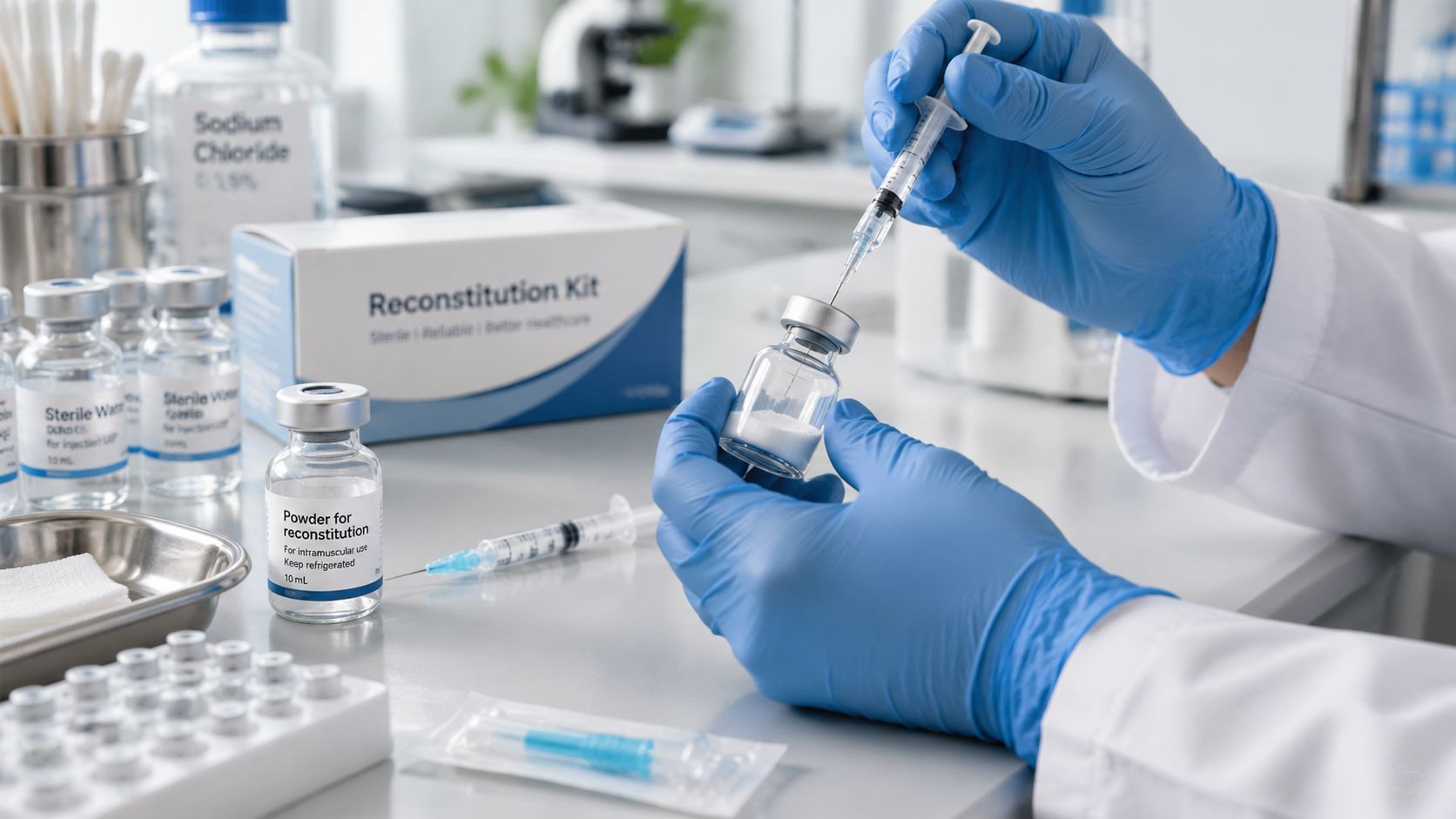
A clean diluent still fails if the operator introduces contamination during transfer. That's why aseptic technique isn't an add-on to reconstitution, it's part of the product's integrity. The same principle applies whether the vial contains sterile water or a preserved multi-dose formulation.
The handling sequence that actually protects the sample
The vial septum should be disinfected before entry, and the syringe should remain sterile from withdrawal to injection. The needle should pass through the stopper without touching any non-sterile surface, and the liquid should enter the powder vial in a controlled way to avoid splashing or foaming. Those basics sound obvious, but they're where routine failures usually begin.
Air exposure matters too. A work area with poor airflow control raises the chance that particulates settle on exposed surfaces or that the operator reaches over an open container. For labs comparing workspace controls, the practical considerations in choosing HEPA air filters are relevant because airflow management affects how long a clean field stays clean.
Repeated access raises the bar
Once a vial is entered more than once, aseptic discipline has to stay consistent every time. That's especially important for bacteriostatic water, since its preservative supports multi-dose use only when the handling is careful and the container is treated like a controlled access item. If the septum is breached carelessly, the preservative doesn't rescue the workflow from poor technique.
For a deeper procedural reference, aseptic techniques during reagent preparation is a useful internal point of comparison for lab teams that want their SOPs aligned.
Good aseptic work is boring by design. No shortcuts, no extra touches, no re-entry unless the workflow requires it.
What good technique prevents
Good aseptic technique reduces the chance that a finished solution becomes unusable before the experiment is done. It also protects reproducibility, because contamination often creates confusing effects long before it becomes visible. A sample that has been handled properly gives the assay a fair chance to perform as expected.
The discipline here is procedural, not cosmetic. Blue gloves, a clean bench, and the correct syringe matter only if the transfer itself is controlled from start to finish.
Labeling and Storing Reconstituted Solutions
Once the powder is mixed, the label on the vial needs to tell the whole story. A reconstituted solution that's not labeled clearly becomes a documentation problem first and a stability problem soon after. That's why post-mixing handling has to be strict.
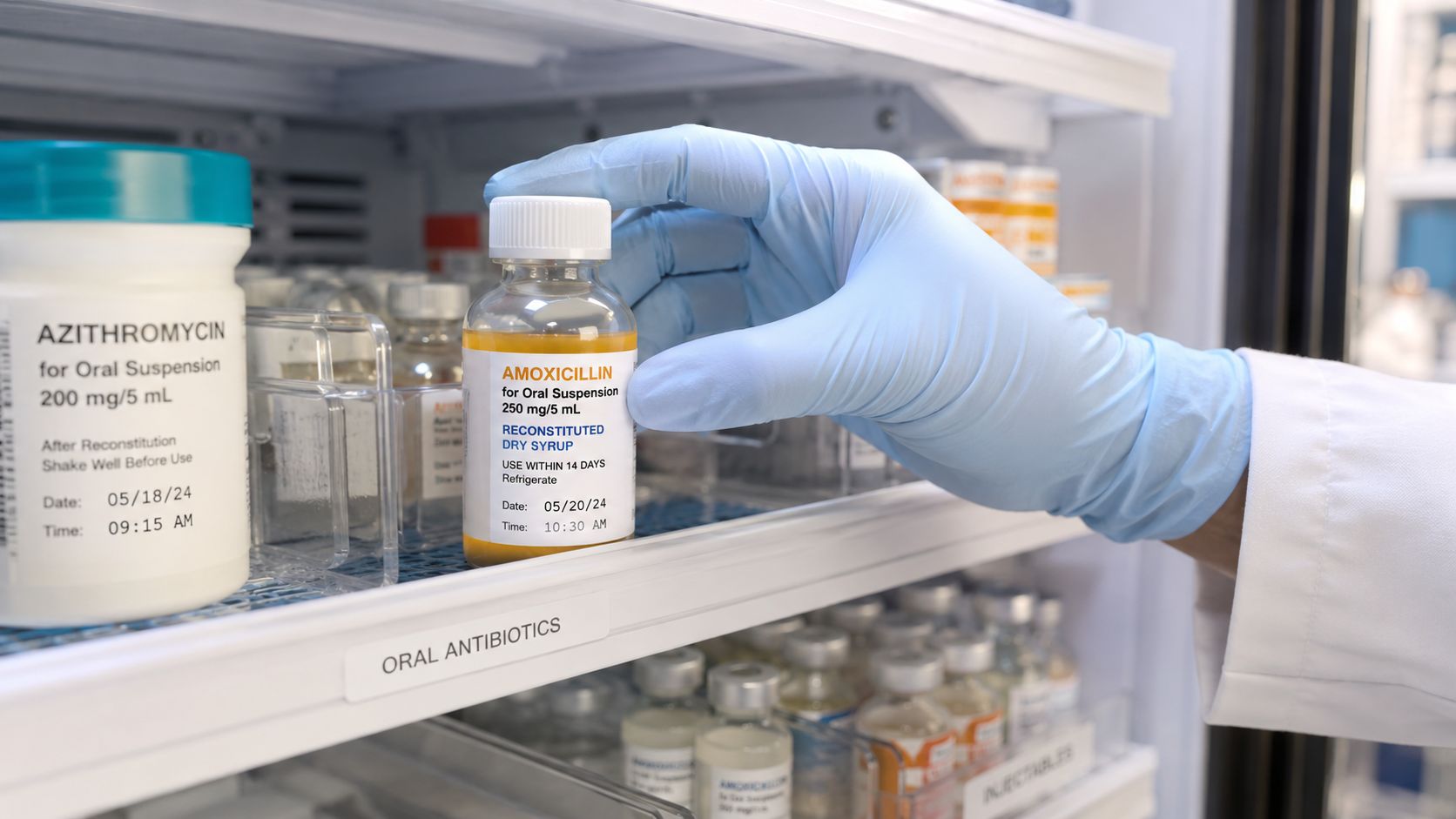
What belongs on the label
A complete label should include the compound name, the final concentration, the date and time of reconstitution, the beyond-use date, and the preparer's initials. Those fields make it possible to trace the sample back to the exact preparation event instead of guessing later.
That documentation also helps prevent mix-ups when several similar vials sit in the same rack. In a shared lab fridge, a bottle without a clear label is a liability.
Manufacturer instructions define the usable window, not convenience. A GSK Augmentin ES insert specifies refrigeration at 2–8°C and use within 10 days after reconstitution, which makes it clear that stability is time- and temperature-dependent once sterile water is added (GSK insert). A summary on what stability testing is can help teams understand why those storage limits exist in the first place.
Why storage discipline matters
Reconstituted dry syrups are not stored the same way as the original powder. The dry format is stable because water hasn't yet activated the instability pathways. After mixing, the finished suspension has a different risk profile, and refrigeration or in-use limits become part of the material definition.
That's why the storage instruction has to stay attached to the sample, not buried in a notebook. If the vial moves across benches or into another freezer, the label must still make the handling limits obvious.
A short storage checklist
- Use the stated temperature. If the insert says refrigerate, the fridge is not optional.
- Track the in-use window. Once mixed, the clock starts immediately.
- Avoid unlabeled transfers. Decanted material should never lose its identity.
- Keep the bottle closed. Every extra access raises contamination risk.
For teams managing archived or shared reconstituted materials, labeling and storing reconstituted samples gives a useful framework for building tighter internal controls.
Advanced Considerations for RUO Labs
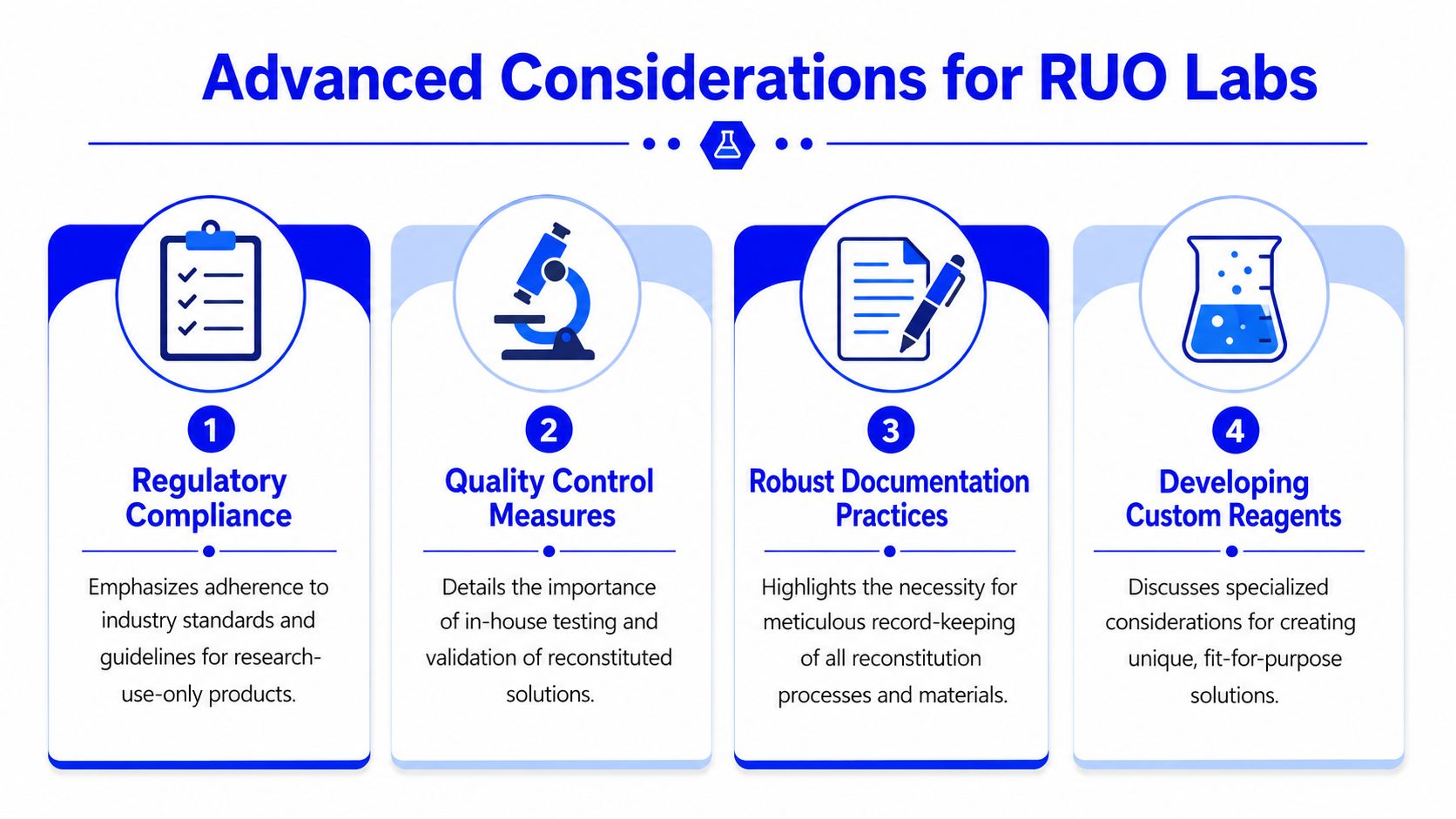
RUO labs need more than the right liquid. They need a defensible decision record that shows why a specific diluent was selected, how the lot was verified, and what risks were accepted before the first vial was opened. Under procurement pressure, that decision layer becomes part of quality management, not an afterthought.
Documentation beats assumption
A supplier that provides lot-specific documentation makes it easier to connect a material to a particular batch. That traceability matters when a lab compares runs, reviews an unexpected result, or explains why one preparation behaved differently from another. In practice, quality documentation is what turns a purchase into a usable laboratory input.
Herbilabs positions its reconstitution solution as a sterile, non-pyrogenic, 0.9% benzyl alcohol product for RUO applications, with lot-specific QA documentation and controlled production practices. For labs that need a preserved multi-dose format with clear batch identity, that file trail supports more consistent internal review.
Substitution is the highest-risk shortcut
Sterile water shortages create pressure to substitute, but compatibility does not change because stock is tight. ASHP has addressed the shortage issue in professional practice, yet the end-user answer can still be unclear when a specific compound names sterile water for reconstitution. That gap is where avoidable mistakes happen. The ASHP shortage FAQ is a useful reminder that procurement pressure does not replace product-specific instructions.
Practical takeaway: if the label specifies sterile water, a preserved alternative should only be used when the compound's formulation and instructions clearly support it.
0.9% benzyl alcohol changes the diluent's chemistry and its use pattern, so it cannot be treated as a universal replacement. In RUO work, that substitution can alter experimental integrity even when the sample still looks acceptable.
What good RUO decision-making looks like
A sound framework starts with the label, continues through the COA, and ends with the storage and access plan. If the lab needs repeated withdrawals, a preserved multi-dose format may fit. If the reagent calls for no preservative, sterile water remains the correct choice.
That logic is the main quality control layer. It keeps the diluent aligned with the experimental goal instead of the convenience of the moment.