Private Label, White Label, Wholesale partnerships available - EU, USA and UK - Free shipping from €75
0.9 Benzyl Alcohol Water: Lab Professional’s Guide
Discover the benefits of 0.9 benzyl alcohol water in peptide research. Learn its properties and how it supports laboratory workflows.
TL;DR:
- Bacteriostatic water containing 0.9% benzyl alcohol is used as a preservative diluent for multi-dose peptide reconstitution. It maintains peptide stability with a pH near 5.7 and prevents bacterial growth over 28 days using aseptic technique. Replacing it with sterile water risks contamination and compromise of experimental results.
Bacteriostatic water for injection is defined as a sterile, non-pyrogenic aqueous solution containing 0.9% benzyl alcohol as a preservative per USP 2026 standards. Researchers and laboratory professionals use this formulation, more formally called 0.9 benzyl alcohol water or bacteriostatic water, as the standard diluent for multi-dose peptide reconstitution and repeated vial access. The solution maintains a pH range of 4.5 to 7.0, with a target near 5.7, which supports peptide stability across common research compounds. Its bacteriostatic properties allow multiple withdrawals from the same vial without introducing contamination, making it a foundational reagent in any peptide research workflow.
What are the chemical and physical properties of 0.9% benzyl alcohol water?
The formulation of bacteriostatic water is straightforward but precise. It consists of water for injection combined with benzyl alcohol at 0.9% (9 mg/mL), with no additional excipients in standard USP preparations. That simplicity is intentional. Any additional components would introduce variables that could compromise sensitive compounds or interfere with downstream assays.
| Property | Specification |
|---|---|
| Benzyl alcohol concentration | 0.9% (9 mg/mL) |
| pH range | 4.5–7.0 (target ~5.7) |
| Sterility | Sterile, non-pyrogenic |
| Intended use | Multi-dose reconstitution |
| Packaging | Multi-dose glass vials |
The pH range of 4.5 to 7.0 is not arbitrary. Peptides are pH-sensitive molecules, and reconstituting them outside their stability window accelerates degradation. A target pH near 5.7 places the solution in a mildly acidic range that suits the majority of lyophilized research peptides without triggering hydrolysis or aggregation.
Sterility and non-pyrogenicity are non-negotiable quality requirements. Pyrogens, particularly bacterial endotoxins, can invalidate experimental results even at trace concentrations. USP-grade bacteriostatic water complies with exacting sterility and particulate matter standards, and lot-specific documentation should be available from any credible supplier.
Multi-dose vial design also matters. Glass vials with rubber stoppers allow repeated needle penetration while maintaining a sealed environment. Researchers should confirm that packaging meets USP Type I borosilicate glass specifications, which resist leaching and maintain solution integrity over the in-use period.
Pro Tip: Always verify the benzyl alcohol concentration on the product label before use. Some specialty formulations contain up to 1.1% benzyl alcohol, which can affect compatibility with sensitive compounds. The difference between 0.9% and 1.1% may appear minor but is significant for concentration-sensitive peptides.
How does 0.9% benzyl alcohol inhibit bacterial growth?
Benzyl alcohol at 0.9% works by disrupting bacterial cell membranes and denaturing proteins, which inhibits microbial growth without necessarily killing the organisms outright. This distinction between bacteriostatic and bactericidal action is critical for researchers to understand. A bacteriostatic agent suppresses growth and replication. A bactericidal agent kills. Bacteriostatic water does not sterilize a contaminated solution; it prevents contamination from establishing itself during normal multi-dose use.
The 0.9% concentration is carefully chosen to balance two competing demands:
- Antimicrobial efficacy: The concentration must be sufficient to inhibit common lab contaminants, including gram-positive and gram-negative bacteria as well as common fungal species.
- Chemical compatibility: The concentration must remain low enough to avoid denaturing or degrading the peptides being reconstituted.
- Tissue tolerability: For research applications involving biological systems, the concentration must not cause significant irritation at the volumes typically used.
- Regulatory alignment: The 0.9% level aligns with USP standards and is the accepted benchmark for bacteriostatic water formulations used in research.
The 0.9% concentration achieves effective inhibition of common lab contaminants without harming peptide integrity. This is why researchers should not substitute alternative preservatives or attempt to prepare bacteriostatic solutions in-house. Concentration accuracy at the 0.9% level requires pharmaceutical-grade manufacturing controls that a standard lab cannot replicate reliably.
“Substituting bacteriostatic water with plain sterile water or vice versa can compromise experiment reproducibility due to stability and contamination risks.” — Peptides Direct
Pro Tip: When accessing a multi-dose vial repeatedly, use a new sterile needle for each withdrawal. Reusing needles is the most common route by which contamination bypasses the benzyl alcohol preservative system. Strict aseptic technique is the preservative’s necessary partner, not its replacement.
What are the safety considerations when using 0.9% benzyl alcohol water?
Safety considerations for bacteriostatic water are well-defined, and researchers must apply them without exception. The most critical contraindication is use in neonates and infants. Benzyl alcohol toxicity in this population causes Gasping Syndrome, a potentially fatal condition characterized by metabolic acidosis, respiratory distress, and neurological deterioration. This contraindication is absolute and applies regardless of dose.
For laboratory research applications, the relevant safety considerations are:
- Verify benzyl alcohol sensitivity. Researchers handling the solution directly should confirm no personal sensitivity to benzyl alcohol prior to repeated exposure. Skin and mucous membrane contact should be minimized.
- Respect the 28-day in-use shelf life. The multi-dose vial shelf life is a maximum of 28 days after initial puncture. Beyond this window, the preservative’s efficacy is not guaranteed. Label each vial with the date of first puncture.
- Store correctly. Bacteriostatic water should be stored at controlled room temperature, away from direct light and heat sources. Freezing is not recommended, as it can compromise vial integrity and solution homogeneity.
- Inspect before use. Discard any vial showing particulate matter, cloudiness, or discoloration. These are indicators of contamination or degradation that benzyl alcohol cannot reverse.
- Do not use for single-dose applications requiring preservative-free diluents. Certain assays and biological systems are sensitive to benzyl alcohol at any concentration. Confirm compatibility before reconstituting any compound.
Pro Tip: Write the puncture date directly on the vial label with a permanent marker at the moment of first use. Relying on memory across a multi-week experiment is a documented source of protocol deviations in peptide research workflows. Consistent lab handling practices eliminate this risk entirely.
How do the applications of 0.9% benzyl alcohol water differ from sterile water?
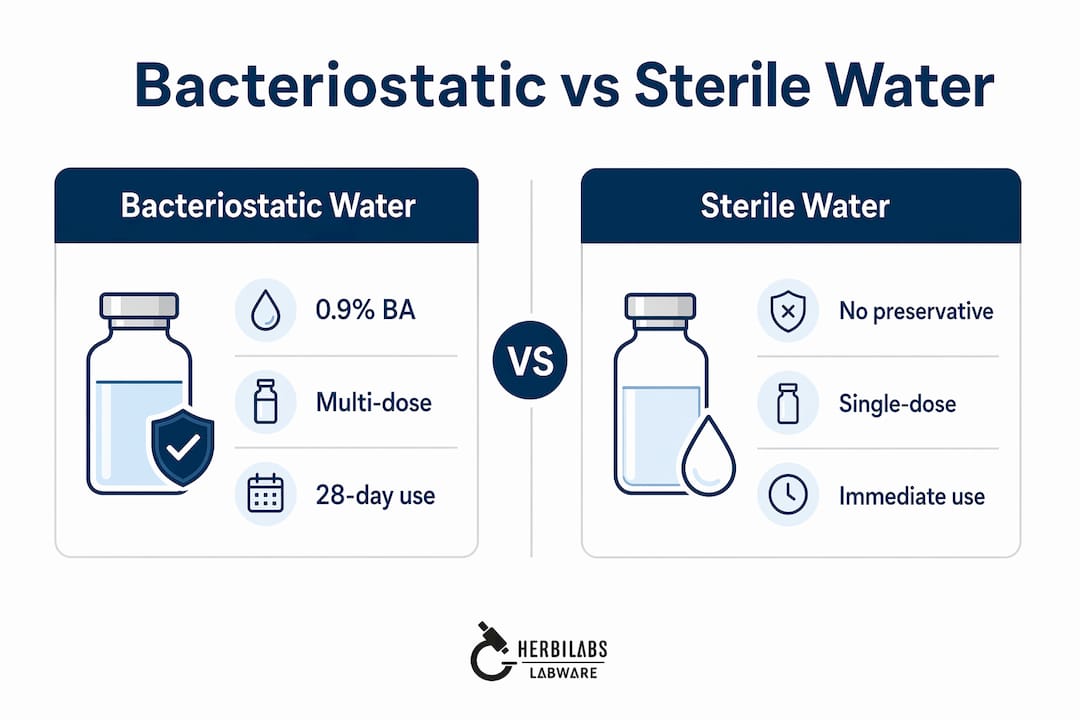
The distinction between bacteriostatic water and sterile water for injection is one of the most practically important in peptide research, yet it is frequently misapplied. Sterile water for injection lacks preservatives and is intended for single use only. Using it in multi-dose scenarios is a frequent source of avoidable contamination in research labs.
| Property | Bacteriostatic Water (0.9% BA) | Sterile Water for Injection |
|---|---|---|
| Preservative | 0.9% benzyl alcohol | None |
| Intended use | Multi-dose | Single-use only |
| In-use shelf life | 28 days post-puncture | Discard immediately after use |
| pH | 4.5–7.0 | Approximately 5.0–7.0 |
| Compatible peptides | Most standard research peptides | Preservative-sensitive compounds |
| Contamination risk | Low (with aseptic technique) | High if reused |
The practical implications of this distinction are significant. Bacteriostatic water allows multiple withdrawals from the same vial over 28 days without compromising sterility. This enables reproducible peptide reconstitution across multiple experimental sessions from a single preparation. Sterile water cannot provide this.
However, sterile water is the correct choice for specific compounds. Peptides like GHK-Cu, a copper-binding tripeptide used in regenerative research, are sensitive to benzyl alcohol and require preservative-free diluents for reconstitution. Copper-based peptides can degrade in the presence of benzyl alcohol, producing altered molecular species that compromise experimental validity.
The selection criteria are clear:
- Use bacteriostatic water for lyophilized peptides requiring multi-dose reconstitution over days or weeks.
- Use sterile water for single-use applications, preservative-sensitive compounds, or protocols where benzyl alcohol would interfere with the assay.
- Never substitute one for the other without first confirming compound compatibility and protocol requirements.
Researchers working across multiple peptide classes should maintain both formulations in inventory and document which diluent is assigned to each compound in their standard operating procedures.
What are the best practices for handling and storing bacteriostatic water?
Proper handling and storage of bacteriostatic water directly determine whether the 28-day in-use window delivers reliable results. The following practices apply to all multi-dose vial protocols:
- Aseptic technique is mandatory at every access. Use a new sterile needle and syringe for each withdrawal. Swab the rubber stopper with 70% isopropyl alcohol and allow it to dry before needle insertion.
- Store at controlled room temperature. The standard storage range is 20–25°C. Avoid refrigerating unless the product label specifies otherwise, as temperature cycling can stress the vial seal.
- Label every vial at first puncture. Record the date and the researcher’s initials. This is not optional documentation; it is the mechanism by which the 28-day limit is enforced in practice.
- Source from verified suppliers. USP-grade bacteriostatic water complies with sterility, non-pyrogenicity, and particulate matter standards. Lot-specific certificates of analysis should accompany every batch.
- Read the product label carefully. Confirm benzyl alcohol concentration (0.9% is standard; some products list 1.1%), pH specification, and expiry date before integrating any new lot into an active protocol.
Procurement decisions carry more weight than many researchers assign to them. A mislabeled or substandard formulation can introduce variables that are nearly impossible to identify after the fact. Quality control in lab water begins at the sourcing stage, not at the bench. Researchers should request and review certificates of analysis for every new lot, verifying that sterility testing, endotoxin levels, and benzyl alcohol concentration all meet specification.
Pro Tip: When evaluating a new supplier, request the certificate of analysis for the specific lot you are purchasing, not a generic product specification sheet. Lot-level documentation confirms that the actual batch you receive has been tested, not just that the product type meets a general standard.
Key Takeaways
Bacteriostatic water containing 0.9% benzyl alcohol is the standard multi-dose diluent for peptide reconstitution in research labs, defined by USP concentration, pH, and a strict 28-day in-use shelf life.
| Point | Details |
|---|---|
| Standard concentration | 0.9% benzyl alcohol (9 mg/mL) per USP 2026 is the accepted research benchmark. |
| Bacteriostatic mechanism | Benzyl alcohol disrupts bacterial membranes and denatures proteins to inhibit growth, not kill organisms. |
| 28-day shelf life | Label each vial at first puncture and discard after 28 days to maintain preservative efficacy. |
| Peptide compatibility | Compounds like GHK-Cu require preservative-free sterile water; always verify compatibility before use. |
| Procurement standard | Request lot-specific certificates of analysis confirming sterility, endotoxin levels, and benzyl alcohol concentration. |
Why the choice of diluent matters more than most researchers realize
The single most common error I observe in peptide research workflows is treating bacteriostatic water and sterile water as interchangeable. They are not. The consequences range from subtle, such as gradual peptide degradation that skews dose-response curves, to overt, such as visible contamination that invalidates an entire experimental series.
The 0.9% benzyl alcohol concentration is not a conservative default. It represents a deliberate formulation decision that balances antimicrobial efficacy against chemical compatibility. Researchers who substitute a higher-concentration formulation, or who attempt to prepare their own bacteriostatic solution, introduce concentration variables that standard protocols are not designed to accommodate. The single-use versus multi-use distinction is equally non-negotiable.
What I find underappreciated is the supplier quality dimension. Two products labeled as bacteriostatic water at 0.9% benzyl alcohol can differ substantially in endotoxin load, particulate matter, and actual pH. These differences do not always show up in visual inspection. They show up in your data, often weeks into an experiment when tracing the source of variability is difficult. Consistent supplier quality is not a procurement preference; it is an experimental control variable.
The practical lesson is this: treat your diluent selection with the same rigor you apply to your peptide sourcing. Verify the certificate of analysis, confirm the benzyl alcohol concentration matches your protocol, and never assume that a lower price reflects equivalent quality. The cost of a compromised experiment far exceeds the cost of a verified, pharmaceutical-grade vial.
— Ragnar
Herbilabs bacteriostatic water for research labs
Herbilabs supplies pharmaceutical-grade bacteriostatic water for research manufactured to USP standards, with lot-specific certificates of analysis confirming sterility, non-pyrogenicity, and 0.9% benzyl alcohol concentration. Each vial is produced in a dedicated facility under strict quality controls designed for the demands of peptide research and multi-dose reconstitution protocols.
Researchers sourcing diluents for active experimental programs can review Herbilabs’ full range of high-purity reconstitution solutions alongside detailed handling and storage guidance. Wholesale pricing is available for research institutions and resellers across the UK and Europe. Every order includes full documentation to support protocol compliance and audit requirements.
FAQ
What is 0.9% benzyl alcohol water used for in research?
Bacteriostatic water containing 0.9% benzyl alcohol is used as a diluent for reconstituting lyophilized peptides in multi-dose research applications. Its preservative action inhibits bacterial growth across repeated vial accesses over a 28-day in-use period.
How long can a vial of bacteriostatic water be used after opening?
The maximum in-use shelf life is 28 days after initial puncture, provided strict aseptic technique is maintained at every access. Discard any remaining solution after this period regardless of visual appearance.
Is bacteriostatic water safe for all peptides?
No. Certain peptides, including copper-based compounds like GHK-Cu, degrade in the presence of benzyl alcohol and require preservative-free sterile water for injection instead. Always verify compound-preservative compatibility before reconstitution.
What is the difference between bacteriostatic water and sterile water for injection?
Bacteriostatic water contains 0.9% benzyl alcohol and supports multi-dose use over 28 days. Sterile water for injection contains no preservative and must be discarded immediately after a single use to prevent contamination.
How do I verify the quality of bacteriostatic water before use?
Request a lot-specific certificate of analysis from the supplier confirming benzyl alcohol concentration at 0.9%, pH within the 4.5–7.0 range, sterility testing results, and endotoxin levels. A general product specification sheet is not sufficient for research-grade procurement.