Private Label, White Label, Wholesale partnerships available - EU, USA and UK - Free shipping from €75
Bac Water After Opening: Storage Guide for Researchers
Learn key guidelines for bac water after opening storage. Ensure safety and effectiveness by following proper refrigeration and labeling techniques.
TL;DR:
- Bacteriostatic water contains 0.9% benzyl alcohol to inhibit microbial growth, but it does not eliminate contamination risks. It remains safe for use up to 28 days after first puncture when stored properly at 2–8°C with strict aseptic technique. Freezing or storing in unstable refrigerators compromises preservative efficacy and research integrity.
Bacteriostatic water is defined as sterile water containing 0.9% benzyl alcohol as a preservative, formulated specifically to inhibit microbial growth across multiple vial entries. The critical rule governing bac water after opening storage is this: discard within 28 days of the first needle puncture, regardless of remaining volume, per United States Pharmacopeia (USP) guidelines. Benzyl alcohol is bacteriostatic, not sterilizing. It slows microbial growth but does not eliminate contamination risk entirely. Proper refrigeration, aseptic technique, and accurate labeling are the three variables that determine whether that 28-day window remains safe or collapses well before it.
What is the recommended storage method for opened bacteriostatic water?
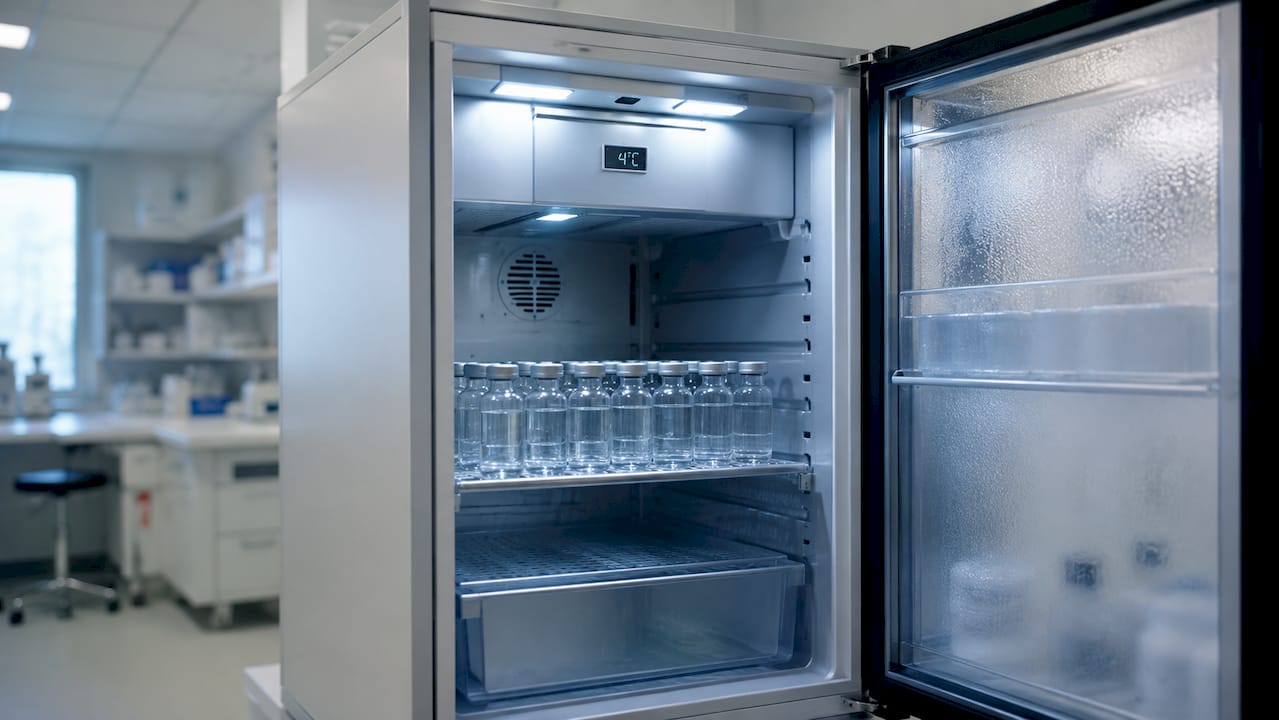
Refrigeration at 2–8°C is the accepted standard for storing opened bacteriostatic water in laboratory settings. The USP and CDC both support cold storage as the primary method for maintaining preservative efficacy and limiting microbial proliferation after the first puncture. Room temperature storage is technically permissible but shortens the safe use window considerably, as discussed in the next section.
Correct storage practice covers several specific requirements:
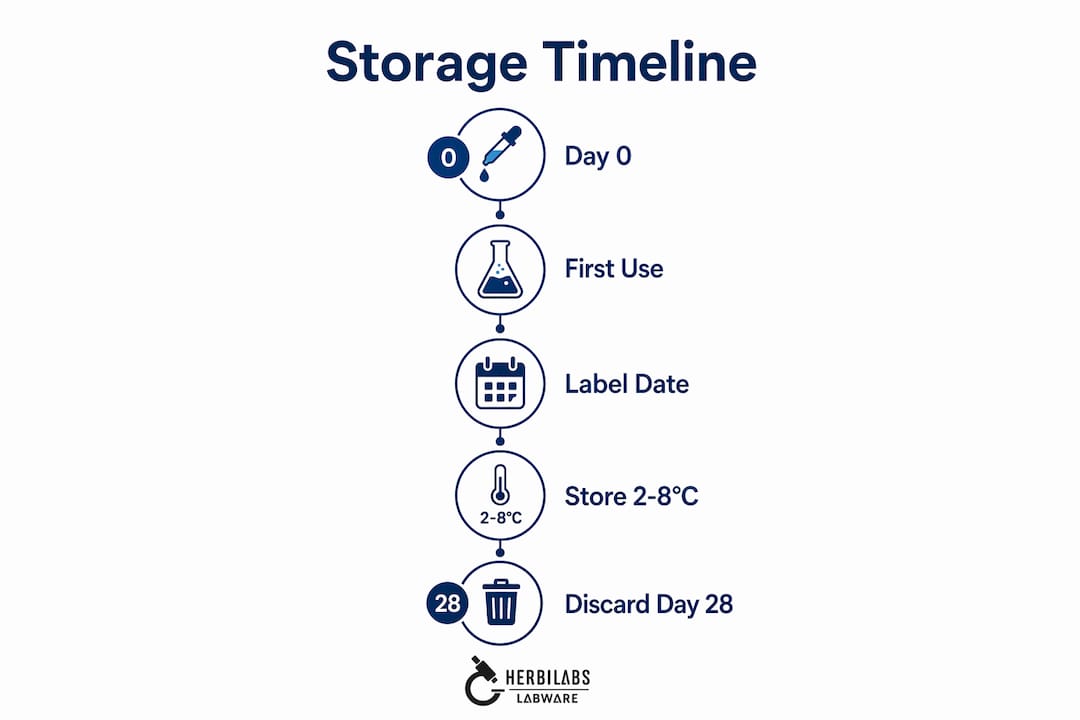
- Refrigerate immediately after first use. Store the vial upright at 2–8°C in a dedicated area away from food or volatile chemicals.
- Never freeze. Freezing damages vial integrity and alters preservative chemistry, rendering the solution unsuitable for research applications.
- Label the vial immediately with the first puncture date. The 28-day countdown starts at first puncture, not at purchase or unboxing.
- Protect from light. Store vials in opaque containers or in a refrigerator drawer to limit photodegradation of the preservative.
- Use aseptic technique on every draw. Wipe the rubber stopper with 70% isopropyl alcohol before each needle entry and use a fresh sterile syringe every time.
One detail that many laboratory protocols overlook is refrigerator type. Non-medical refrigerators with auto-defrost cycles generate temperature fluctuations that can push internal temperatures above 8°C repeatedly. Those temperature swings degrade preservative effectiveness prematurely, shortening the viable window before the 28-day cap is even reached. A dedicated laboratory or pharmaceutical refrigerator with stable temperature control is the correct choice for storing opened vials.
Pro Tip: Label opened vials with both the first puncture date and the discard date (28 days later) using a permanent marker directly on the vial. This removes any ambiguity during busy research periods and prevents accidental use of expired stock.
How long does bacteriostatic water remain stable after opening?
The safe use window for opened bacteriostatic water depends directly on storage temperature. The table below summarizes the relationship between temperature and usable shelf life after first puncture.
| Storage condition | Temperature range | Estimated safe use window |
|---|---|---|
| Refrigerated (recommended) | 2–8°C | Up to 28 days |
| Room temperature | 20–25°C | Approximately 14 days |
| Elevated temperature | Above 25°C | Approximately 7 days |
| Frozen | Below 0°C | Not suitable for use |
The 28-day refrigerated window is the industry standard derived from sterility assurance data, not an arbitrary cutoff. At room temperature, preservative degradation and microbial growth both accelerate, reducing the safe window to approximately 14 days. Temperatures above 25°C compress that window further to roughly 7 days. These are not conservative estimates. They reflect the rate at which benzyl alcohol loses bacteriostatic efficacy under thermal stress.
Multiple punctures compound the risk. Repeated needle entries degrade sterility even when benzyl alcohol is present, because each puncture introduces a potential contamination pathway. A vial accessed daily under poor aseptic conditions may become unsafe well before the 28-day limit. Visual inspection before each draw is a mandatory safety step, not an optional one.
Cloudiness, particulate matter, or color changes in opened bacteriostatic water indicate contamination and require immediate disposal. A clear solution does not guarantee sterility, but any visible change is definitive evidence of compromise. Researchers working with reconstituted peptides face an additional constraint: peptide stability after reconstitution often requires stricter cold storage timelines than the bacteriostatic water itself. Relying solely on the 28-day bac water limit without accounting for peptide-specific stability requirements is a protocol error with real consequences for data integrity.
Pro Tip: Keep a simple vial log in your lab notebook or digital protocol system. Record the vial lot number, first puncture date, storage location, and each draw date. This takes under 30 seconds per entry and provides a complete audit trail if results become anomalous.
What are common mistakes in storing and using opened bacteriostatic water?
Errors in opened bac water storage cluster around a small set of recurring misconceptions. Recognizing them is the first step toward eliminating them from laboratory practice.
-
Confusing the open date with the first puncture date. A vial may be opened (cap removed) days before the first needle entry. The 28-day limit applies from first puncture, not from the date the outer packaging was opened. Researchers who record the wrong start date systematically underestimate how much time has elapsed.
-
Assuming refrigeration extends the 28-day window. Refrigeration preserves efficacy reliably within the 28-day limit. It does not extend that limit. The 28-day cutoff is a hard sterility assurance boundary, not a guideline that cold storage can push further.
-
Freezing vials to extend shelf life. Some researchers freeze bacteriostatic water under the assumption that lower temperatures mean longer stability. Freezing damages vial structure and impairs preservative chemistry, making the solution unsuitable for research applications after thawing. This practice is contraindicated.
-
Neglecting aseptic technique during multiple entries. Benzyl alcohol is bacteriostatic, not sterilizing. Each unwiped stopper entry or reused syringe introduces contamination that the preservative cannot fully neutralize. Aseptic discipline must be consistent across every draw, not just the first.
-
Applying bac water stability rules to reconstituted peptides. Bacteriostatic water and the peptides dissolved in it have different stability profiles. A reconstituted peptide solution may degrade significantly within days even when stored in bacteriostatic water at 2–8°C. Researchers who treat the 28-day bac water rule as the governing timeline for their peptide solutions risk using degraded material without realizing it. Consulting peptide-specific stability data is mandatory for accurate research outcomes. The Herbilabs guide on selecting laboratory reagents covers this distinction in detail.
What practical steps ensure safe use of opened bacteriostatic water?
Safe use of opened bacteriostatic water in a laboratory setting requires a defined, repeatable protocol applied consistently across every vial and every draw. Ad hoc handling is the primary source of avoidable contamination events.
The following steps constitute the minimum standard for responsible use:
- Record the first puncture date immediately. Write it directly on the vial with a permanent marker. Include the calculated discard date 28 days later. Do not rely on memory or separate logs alone.
- Store opened vials upright at 2–8°C in a pharmaceutical-grade or laboratory refrigerator with stable temperature control. Avoid consumer refrigerators with auto-defrost cycles that cause temperature fluctuations above 8°C.
- Inspect the vial visually before every draw. Hold it against a light source and check for cloudiness, particulates, or any color change. Discard immediately if any abnormality is present.
- Wipe the rubber stopper with 70% isopropyl alcohol before each needle entry and allow it to dry for at least 30 seconds. Use a fresh sterile syringe for every draw without exception.
- Discard the vial at 28 days regardless of remaining volume. Partial vials that have reached the 28-day limit are not safe to use. The cost of a new vial is negligible compared to the cost of compromised research data or a failed experiment.
- Store reconstituted peptide solutions separately and apply peptide-specific stability guidelines in addition to bac water storage rules. The Herbilabs resource on reconstituting lyophilized powder provides detailed guidance on managing reconstituted solutions correctly.
Unopened bacteriostatic water, by contrast, remains stable for 2–3 years at controlled room temperature away from light and heat. That long shelf life disappears the moment the first needle punctures the stopper. Treating the post-puncture vial with the same casualness as an unopened one is a protocol failure that compromises both safety and data quality.
Key takeaways
Opened bacteriostatic water is safe for up to 28 days after first puncture when stored at 2–8°C with strict aseptic technique, and no storage condition extends that hard limit.
| Point | Details |
|---|---|
| 28-day hard limit | Discard opened vials 28 days after first puncture regardless of remaining volume. |
| Refrigeration is mandatory | Store at 2–8°C in a stable laboratory refrigerator; consumer fridges with defrost cycles compromise efficacy. |
| Freezing is contraindicated | Freezing damages vial integrity and degrades benzyl alcohol preservative chemistry. |
| Label first puncture date | Record puncture date and discard date directly on the vial immediately after first use. |
| Peptide stability differs | Reconstituted peptide solutions may require stricter timelines than the 28-day bac water rule. |
A researcher’s perspective on bac water integrity after opening
The 28-day rule is well documented, yet it remains one of the most consistently violated protocols in peptide research settings. The violation is rarely deliberate. It happens because researchers treat bacteriostatic water as a background consumable rather than an active variable in their experimental system.
What I have observed repeatedly is that the labeling step is where discipline breaks down first. A vial gets punctured during a busy session, the date does not get recorded, and within two weeks nobody in the lab can say with certainty when that vial was first used. At that point, the 28-day limit becomes unenforceable. The solution is not better memory. It is a non-negotiable labeling protocol that takes effect before the needle is withdrawn from the stopper.
The refrigerator choice matters more than most protocols acknowledge. A standard kitchen-style refrigerator with auto-defrost cycling is not an acceptable storage unit for opened bacteriostatic water in a research context. Temperature excursions above 8°C during defrost cycles are real and measurable. They shorten the effective preservative window in ways that are invisible to the researcher but consequential for sterility assurance.
The most underappreciated point is the distinction between bac water stability and peptide stability. Researchers sometimes assume that if the bac water is within its 28-day window, the reconstituted solution is also safe to use. That assumption is incorrect. Peptides reconstituted in bacteriostatic water can degrade significantly within days depending on the specific compound, concentration, and storage conditions. The bac water’s 28-day limit is a ceiling, not a guarantee. Peptide-specific stability data must govern the actual use timeline. Prioritizing sterility and protocol rigor over convenience is not excessive caution. It is the baseline standard for reproducible science.
— Ragnar
Herbilabs reconstitution solutions for research-grade applications
Researchers who apply strict storage and handling protocols deserve a starting material that meets the same standard.
Herbilabs supplies high-purity reconstitution solutions manufactured under rigorous quality control in a dedicated facility, formulated specifically for demanding research environments. Every batch is produced to strict purity standards, with contaminant-free composition verified before dispatch. For researchers working with lyophilized peptides and reconstitution workflows, Herbilabs also offers detailed guidance on optimizing shelf life of research-grade water solutions. Wholesale pricing is available for institutions and resellers across the UK and Europe. Contact Herbilabs directly for volume inquiries or to discuss product specifications suited to your laboratory’s requirements.
FAQ
How long is bacteriostatic water good for after opening?
Opened bacteriostatic water is safe for up to 28 days after the first needle puncture when stored at 2–8°C with proper aseptic technique. Room temperature storage reduces that window to approximately 14 days.
Does refrigeration extend the 28-day limit for opened bac water?
Refrigeration preserves preservative efficacy within the 28-day window but does not extend the limit. The 28-day cutoff is a hard sterility assurance boundary set by USP guidelines, not a flexible guideline.
Can you freeze bacteriostatic water to make it last longer?
Freezing bacteriostatic water is contraindicated. It damages vial integrity and degrades benzyl alcohol preservative chemistry, making the solution unsuitable for research use after thawing.
What visual signs indicate that opened bac water should be discarded?
Cloudiness, visible particulate matter, or any color change in the solution are definitive indicators of contamination. Discard the vial immediately if any of these signs are present, regardless of how recently it was opened.
Does the 28-day rule apply to peptides reconstituted in bacteriostatic water?
The 28-day rule governs the bac water itself, not necessarily the reconstituted peptide solution. Peptide stability after reconstitution often requires stricter timelines. Consult peptide-specific stability data to determine the correct use window for each compound.