Private Label, White Label, Wholesale partnerships available - EU, USA and UK - Free shipping from €75
Bacteriostatic Water Contamination Signs: 2026 Lab Guide
Discover key bacteriostatic water contamination signs to ensure lab integrity. Learn to identify risks and protect your research outcomes.
TL;DR:
- Signs of contamination in bacteriostatic water include cloudiness, particles, and discoloration indicating microbial or chemical degradation. Visual cues are late indicators, and non-visible signs like odor change and pH drift are also critical for quality assessment. Following strict aseptic techniques and adhering to a 28-day discard rule help prevent contamination and ensure research integrity.
Bacteriostatic water contamination signs are defined as detectable changes in clarity, odor, pH, and sterility that indicate the solution has lost its integrity and poses a microbial or chemical risk to research workflows. Bacteriostatic water (BAC water) is a multi-dose aqueous solution preserved with 0.9% benzyl alcohol, and its sterility is never guaranteed by appearance alone. Laboratory professionals and peptide researchers who rely on it for reconstituting lyophilized compounds must recognize both visible and non-visible indicators of compromise. This guide consolidates 2026 best practices for identifying, testing, and responding to contamination events before they affect research outcomes.
What are the primary visual bacteriostatic water contamination signs?
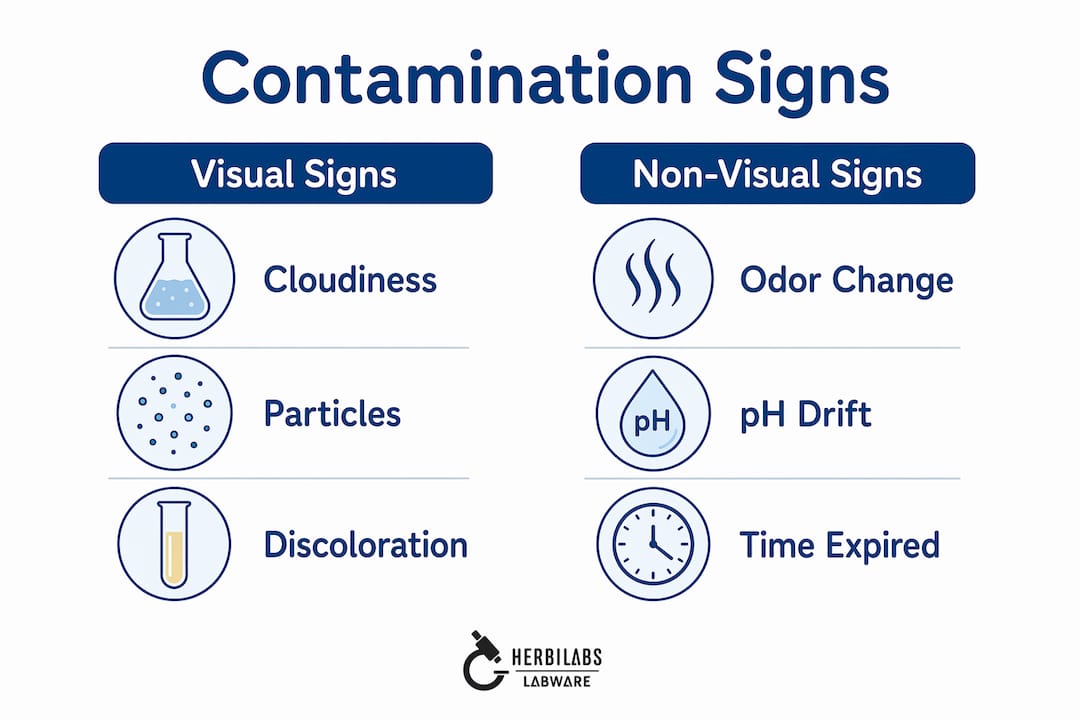
Fresh BAC water is clear and colorless. Any deviation from that baseline is a contamination signal that warrants immediate investigation. Visual turbidity, particulates, and discoloration are the primary contamination indicators and the first line of quality assessment before any chemical testing.
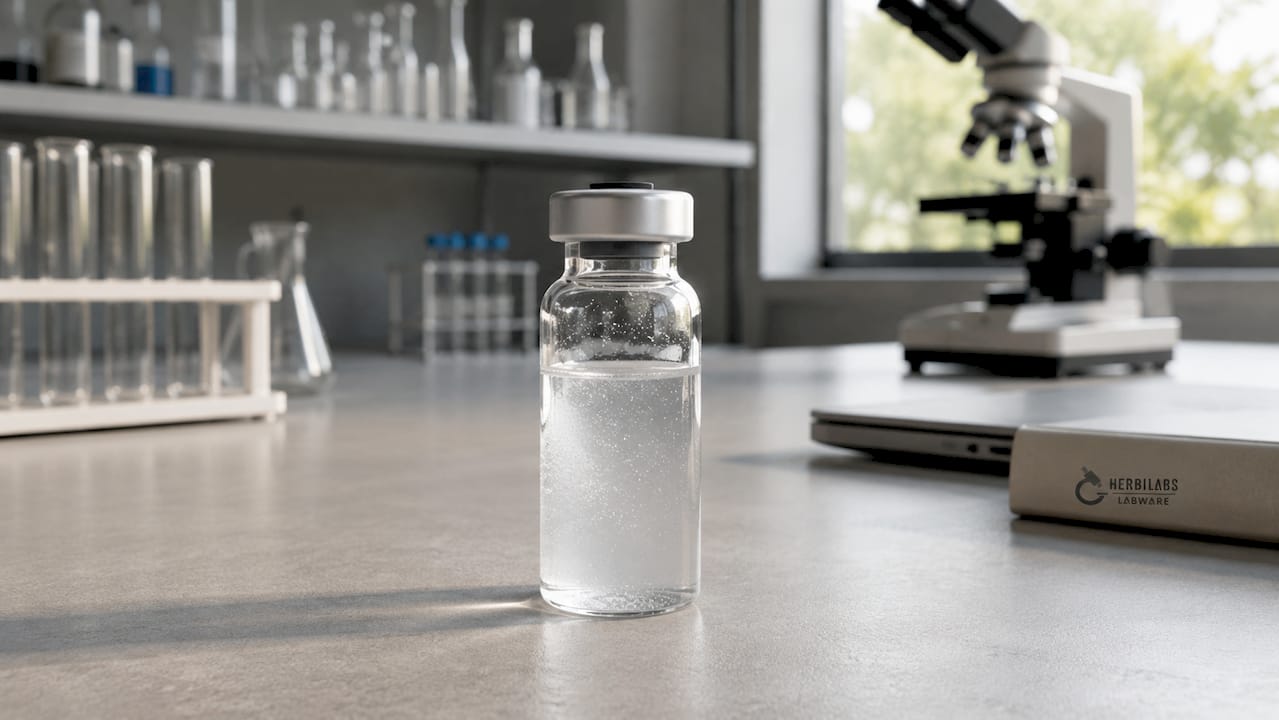
Cloudiness or turbidity is the most common late-stage sign. It typically indicates microbial proliferation has progressed to a point where the benzyl alcohol preservative can no longer suppress growth. Turbidity visible to the naked eye represents a significant contamination burden, not a borderline case.
Floating or suspended particles are equally serious. Particulate contamination from septum coring and reintroducing materials into the vial can introduce rubber fragments, fibers, or biological debris. These particles compromise vial sterility and may not be visible without holding the vial against a bright light source at an angle.
Discoloration toward yellow or brown tones signals chemical degradation. Benzyl alcohol oxidation and preservative breakdown produce these color shifts, and a yellow-brown tint indicates the solution is no longer fit for use regardless of clarity.
Pro Tip: Hold the vial against a white background under a bright light and slowly invert it once. This technique reveals fine particles and subtle haze that a quick glance will miss entirely.
The table below summarizes the key visual signs and their most likely causes:
| Visual sign | Likely cause | Recommended action |
|---|---|---|
| Cloudiness or turbidity | Microbial growth, preservative failure | Discard immediately |
| Floating particles or fibers | Septum coring, poor needle technique | Discard immediately |
| Yellow or brown discoloration | Benzyl alcohol oxidation, chemical degradation | Discard immediately |
| Visible precipitate at bottom | Particulate contamination, protein aggregation | Discard immediately |
| Clear but past 28-day limit | Silent contamination, preservative depletion | Discard per protocol |
What non-visual signs signal bacteriostatic water quality issues?
Visual clarity is necessary but not sufficient for confirming BAC water integrity. A visually clear vial can still be contaminated, making non-visual quality checks a required part of any rigorous laboratory protocol.
Odor is the first non-visual indicator to assess. Fresh BAC water carries only a faint benzyl alcohol scent. Unusual odors such as sour, vinegar-like, or sharp chemical smells indicate preservative degradation or microbial activity. Detecting these odors requires fully opening the vial and assessing immediately, since subtle odor changes dissipate quickly.
pH drift is a measurable and objective quality indicator. The acceptable pH range for BAC water is 4.5–7.0. pH testing with indicator strips detects quality deviations that neither visual inspection nor odor assessment can identify. A reading outside this range signals that the solution’s chemical composition has shifted and may no longer support stable peptide reconstitution.
Time is the most underestimated contamination risk factor. Bacteriostatic water must be discarded 28 days after first puncture regardless of visual appearance. Sterility and preservative effectiveness cannot be guaranteed beyond this window, even when the solution looks and smells normal.
Pro Tip: Label every vial with the date of first puncture at the time of opening. A simple permanent marker notation on the vial cap eliminates any ambiguity about the 28-day discard deadline.
The following non-visual checks should be performed routinely:
- Assess odor on first opening and after each subsequent use
- Test pH with indicator strips when sterility or composition is in doubt
- Record the puncture date on the vial at first use
- Monitor storage temperature to confirm the vial has remained at 2–8°C
- Check vial cap and septum integrity for signs of damage or repeated coring
- Discard any vial that has experienced temperature excursions above 25°C for extended periods
How does contamination occur and what aseptic techniques prevent it?
Microbial ingress into BAC water vials occurs primarily through lapses in multi-dose vial access technique. Each needle insertion is a potential contamination pathway, and the cumulative risk increases with every use. Understanding the mechanism of contamination is the foundation of effective prevention.
The following numbered protocol reflects current 2026 best practices for aseptic BAC water handling:
- Swab the septum with 70% isopropyl alcohol before every use. Allow it to dry for at least 30 seconds before inserting the needle. This step eliminates surface microorganisms that would otherwise be pushed into the vial.
- Use a new sterile needle for every withdrawal. Septum swabbing and fresh sterile needles are the two controls that most directly minimize microbial introduction and particulate contamination.
- Never reintroduce any fluid or material back into the BAC vial. Backflow from syringes or reconstituted peptide solutions introduces biological material and disrupts the sterile environment inside the vial.
- Store the vial at 2–8°C consistently. Refrigerated storage slows microbial growth and preserves benzyl alcohol concentration. Do not store BAC water at room temperature between uses.
- Minimize handling frequency and temperature excursions. Repeated short warming cycles accelerate benzyl alcohol breakdown, producing invisible early contamination risk before any visual signs appear. Remove the vial from refrigeration only for the duration of the withdrawal.
- Inspect the vial visually before every use. Confirm clarity, absence of particles, and normal color under bright light. Visual inspection does not replace aseptic technique, but it catches late-stage contamination before it enters a reconstituted compound.
Reviewing a full aseptic technique checklist before working with multi-dose vials reduces procedural errors that accumulate across a research session.
What laboratory testing methods confirm bacteriostatic water quality?
Laboratory quality control for BAC water relies on a combination of physical inspection, chemical testing, and time-based discard policies. No single method is sufficient on its own. pH and preservative concentration are silent quality drivers that affect peptide research integrity beyond what any visual check can detect.
The table below summarizes the primary testing methods, their advantages, and their limitations:
| Test method | What it detects | Advantage | Limitation |
|---|---|---|---|
| Visual inspection | Turbidity, particles, discoloration | Immediate, no equipment needed | Cannot detect early or silent contamination |
| Odor assessment | Preservative degradation, microbial activity | Simple, requires no instruments | Subjective; requires vial to be opened |
| pH indicator strips | pH drift outside 4.5–7.0 range | Objective, low cost, rapid | Does not confirm sterility or microbial count |
| Time-based discard | Preservative depletion risk | Eliminates silent contamination risk | Discards potentially usable product |
| Environmental monitoring | Storage temperature excursions | Tracks invisible degradation drivers | Requires logging equipment or manual records |
Documentation is a non-negotiable component of any quality control program. Every contamination incident, including discarded vials and the reason for discard, should be recorded with the date, lot number, and storage conditions at the time of disposal. This record supports root cause analysis and prevents recurrence.
The following practices strengthen a laboratory’s quality control program for BAC water:
- Maintain a vial log that records puncture date, storage location, and discard date
- Set refrigerator temperature alarms to detect excursions above 8°C
- Perform pH testing on any vial that has been stored outside standard conditions
- Discard any vial that fails visual inspection without attempting further testing
- Review lab handling best practices periodically to align with updated guidance
How to interpret contamination signs in peptide reconstitution workflows
Early-stage contamination in BAC water is often invisible. Contamination frequently precedes visible signs, which means the decision to discard cannot wait for cloudiness or particles to appear. Researchers working with lyophilized peptides must apply a conservative discard policy based on protocol adherence, not appearance alone.
The distinction between early-stage and late-stage contamination is operationally significant. Late-stage signs such as turbidity and visible particles confirm contamination that has already progressed. Early-stage risk is defined by time elapsed since first puncture, temperature excursion history, and handling technique quality. Neither stage is safe to use.
Slight haze in a reconstituted peptide vial is a red flag that may indicate microbial contamination or peptide aggregation. The safest response is immediate discard. Using a hazy reconstituted solution introduces an uncontrolled variable into the experiment and risks invalidating results or causing harm in applied research contexts.
Pro Tip: The cost of a replacement BAC water vial is negligible compared to the cost of a failed experiment or a compromised peptide batch. When in doubt, discard. The financial argument for reuse is never stronger than the scientific argument for integrity.
The following decision criteria apply at the point of use:
- Discard any vial showing turbidity, particles, discoloration, or abnormal odor
- Discard any vial that has exceeded 28 days since first puncture
- Discard any vial that has experienced confirmed temperature excursions above 25°C
- Discard any reconstituted peptide solution showing haze, color change, or visible precipitate
- Consult single-use vs multi-use sterile water guidance when evaluating whether BAC water is the appropriate diluent for a specific application
Key takeaways
Bacteriostatic water contamination is confirmed by visual, chemical, and time-based indicators, and no single check replaces a complete quality control protocol.
| Point | Details |
|---|---|
| Visual signs are late indicators | Cloudiness, particles, and discoloration confirm advanced contamination; clear vials can still be unsafe. |
| 28-day discard rule is absolute | Discard BAC water 28 days after first puncture regardless of visual condition or remaining volume. |
| pH testing adds objective data | Use indicator strips to detect drift outside the 4.5–7.0 range when sterility is in doubt. |
| Aseptic technique prevents ingress | Swab septa with 70% isopropyl alcohol and use a fresh sterile needle for every withdrawal. |
| Temperature excursions accelerate degradation | Repeated warming above 25°C breaks down benzyl alcohol before any visible signs appear. |
The contamination risk you cannot see is the one that matters most
Working with bacteriostatic water for over a decade in peptide research contexts has reinforced one consistent observation: the contamination events that cause the most damage are the ones nobody saw coming. A vial that looks perfect, smells normal, and was stored correctly can still be compromised if the 28-day window has passed or if a single needle insertion was performed without septum swabbing.
The benzyl alcohol preservative in BAC water is a bacteriostatic agent, not a sterilizing one. It slows microbial proliferation. It does not eliminate contamination that has already been introduced. Researchers who treat the preservative as a safety net rather than a supplement to aseptic technique are operating on a false assumption that eventually produces a failed experiment or a contaminated batch.
The most effective shift I have seen in laboratory culture is moving from appearance-based decisions to protocol-based decisions. When a team commits to the 28-day rule without exceptions and to fresh needles without shortcuts, the contamination incident rate drops to near zero. The vials that get discarded “unnecessarily” are a small price for the research integrity that is preserved.
Documentation also changes behavior. When researchers record puncture dates and storage conditions on every vial, they become more deliberate about handling. The act of writing the date creates accountability that a verbal reminder never achieves. Building that habit into standard operating procedures is the single most cost-effective quality control investment a laboratory can make.
— Ragnar
Herbilabs bacteriostatic water for contamination-free research
Maintaining contamination-free workflows starts with the quality of the BAC water itself. Herbilabs supplies research-grade bacteriostatic water and reconstitution solutions manufactured to strict purity standards, with rigorous quality control at every production stage.

Researchers working with lyophilized peptides can review the full 2026 lab professional’s guide to confirm product specifications, beyond-use dating, and handling protocols aligned with current best practices. For laboratories requiring multiple vials or wholesale quantities, Herbilabs offers tiered pricing and secure ordering across the UK and Europe. The top reconstitution solutions comparison provides a structured overview of available sterile diluents to match specific research requirements.
FAQ
What does contaminated bacteriostatic water look like?
Contaminated BAC water typically appears cloudy or turbid, may contain visible floating particles or fibers, and can show yellow or brown discoloration. Any deviation from a clear, colorless appearance is grounds for immediate discard.
Can bacteriostatic water be contaminated without looking cloudy?
Yes. Loss of sterility can precede visible signs, meaning a visually clear vial may still harbor microbial contamination or degraded preservative. Time-based discard rules and aseptic technique exist precisely because visual clarity is not a reliable sterility indicator.
How do you test bacteriostatic water quality in the lab?
pH indicator strips detect drift outside the 4.5–7.0 acceptable range and provide an objective, low-cost quality check. Visual inspection and odor assessment complement pH testing but cannot confirm sterility independently.
When should bacteriostatic water be discarded?
BAC water must be discarded 28 days after first puncture, regardless of visual condition. Any vial showing turbidity, particles, discoloration, abnormal odor, or confirmed temperature excursions above 25°C should be discarded immediately, before the 28-day limit.
Does benzyl alcohol prevent all contamination in bacteriostatic water?
No. Benzyl alcohol acts as a bacteriostatic preservative that slows microbial proliferation. It does not sterilize the solution or eliminate contamination introduced through poor aseptic technique. Strict handling protocols remain the primary defense against contamination.