Private Label, White Label, Wholesale partnerships available - EU, USA and UK - Free shipping from €75
Bac Water for Research: Lab Professional’s 2026 Guide
Discover how bac water enhances research efficiency with its antimicrobial properties. Learn its benefits for peptide reconstitution in our 2026 guide!
TL;DR:
- Bacteriostatic water contains 0.9% benzyl alcohol, inhibiting bacterial growth during multi-dose use for 28 days. It differs from sterile water, which lacks preservatives and is single-use, requiring strict aseptic handling. Proper storage, handling, and verification of documentation are critical to ensure experimental reliability and safety.
Bacteriostatic water, commonly abbreviated as bac water, is defined as sterile water for injection containing 0.9% benzyl alcohol as a preservative, formulated specifically to inhibit bacterial growth during repeated vial access. This composition distinguishes it from standard sterile water, which offers no antimicrobial protection after the septum is first punctured. The 0.9% benzyl alcohol concentration is stable for 28 days post-opening, making bacteriostatic water the solvent of choice for multi-dose peptide reconstitution protocols in research laboratories. For researchers working with lyophilized compounds, this 28-day window translates directly into fewer vial openings, reduced contamination risk, and more consistent experimental conditions across a study period.
What is bac water and how does it work?
Bacteriostatic water consists of two components: pharmaceutical-grade sterile water and benzyl alcohol at a precisely calibrated 0.9% concentration. No additional salts, buffers, or excipients are present in standard formulations, which keeps the solution chemically neutral and compatible with a broad range of lyophilized research compounds.
The mechanism of action is specific and worth understanding precisely. Benzyl alcohol at 0.9% disrupts bacterial cell membranes, preventing cell division without killing existing bacteria. This is the critical distinction between a bacteriostatic agent and a bactericidal one. Bactericidal agents destroy bacteria outright; bacteriostatic agents arrest their replication. The practical implication is that bac water controls microbial proliferation during repeated vial access, but it does not sterilize a solution that was already contaminated before or during preparation.
Key properties of research-grade bacteriostatic water include:
- Benzyl alcohol concentration: 0.9% w/v, the established preservative threshold
- pH range: 4.5–7.0, which supports compatibility with most peptide substrates
- Sterility: Manufactured under aseptic conditions and verified by Certificate of Analysis (COA)
- Preservative action: Inhibits bacterial replication, not bacterial viability
- Shelf life post-opening: 28 days, regardless of storage temperature within the recommended range
Pro Tip: Always request a COA from your supplier before use. Consistent pH and sterility documentation directly affect experimental reproducibility, particularly in long-term peptide stability studies.
How does bacteriostatic water compare to sterile water for injection?
The choice between bacteriostatic water and sterile water for injection is determined by protocol design, not by convenience. Each solvent serves a distinct purpose, and substituting one for the other without considering the implications introduces avoidable variables into research data.
| Property | Bacteriostatic water | Sterile water for injection |
|---|---|---|
| Preservative | 0.9% benzyl alcohol | None |
| Vial use | Multi-dose, up to 28 days | Single-use only |
| Post-opening sterility | Maintained by benzyl alcohol | Not maintained |
| Peptide compatibility | Broad, with noted exceptions | Universal, no additive interference |
| Neonatal use | Contraindicated | Acceptable |
| Cost efficiency | Higher per-protocol value | Higher per-vial cost for multi-dose work |
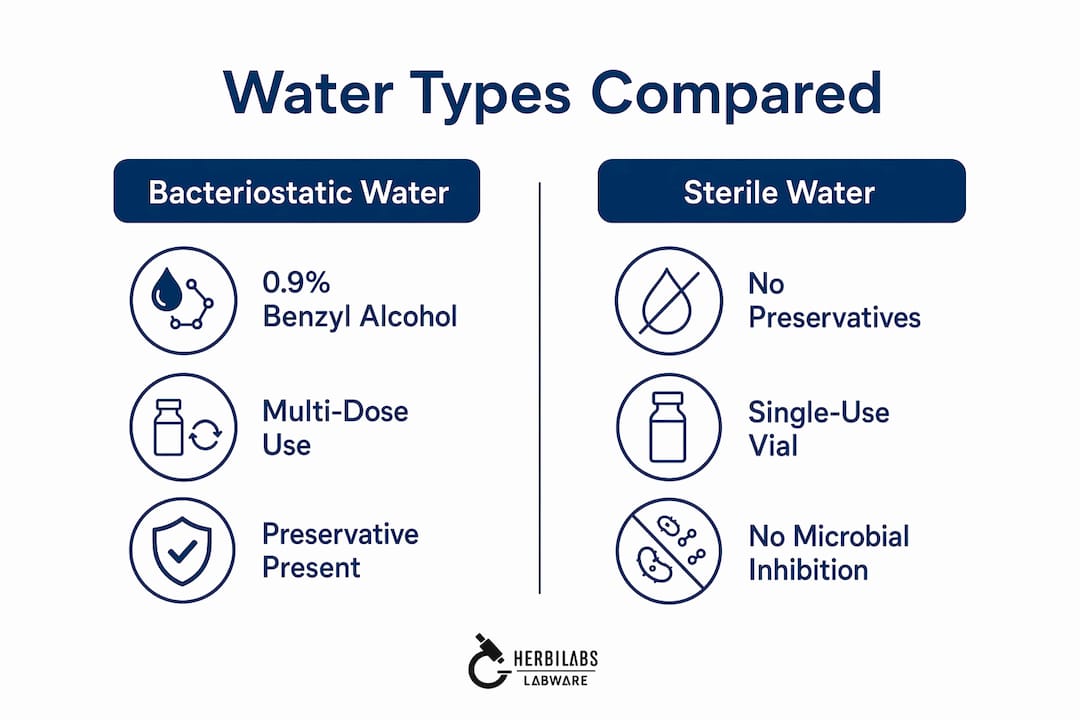
Sterile water for injection is discarded after a single puncture because it contains no preservative to prevent microbial growth in the remaining volume. For protocols requiring only one reconstitution event, sterile water is appropriate and eliminates any concern about benzyl alcohol interaction with the compound. Bacteriostatic water, by contrast, reduces reagent waste by up to 80% in multi-dose research settings. That figure reflects the difference between discarding a partially used vial after one draw versus accessing the same vial multiple times over several weeks.
There are specific scenarios where sterile water is the correct choice. Benzyl alcohol carries documented toxicity risks in neonatal models, and bac water is contraindicated in any protocol involving neonatal subjects due to the risk of gasping syndrome. Additionally, researchers working with pH-sensitive peptides or compounds that interact with aromatic alcohols should evaluate benzyl alcohol compatibility before selecting bacteriostatic water as their reconstitution solvent.
Pro Tip: When designing a new peptide protocol, consult the compound’s technical data sheet for solvent compatibility before defaulting to bacteriostatic water. Benzyl alcohol can interfere with certain analytical assays or alter peptide tertiary structures in sensitive applications.
Proper handling, storage, and shelf life in the lab
Correct storage and handling practices are not optional considerations. They determine whether the preservative system in bacteriostatic water functions as intended throughout the 28-day post-opening window.
-
Store at 15°C–25°C. Lab-grade bacteriostatic water should be kept at room temperature within this range. Avoid exposure to direct heat sources, UV light, and freezing conditions, all of which can degrade benzyl alcohol concentration or compromise vial integrity.
-
Do not rely on refrigeration to extend shelf life. Refrigeration is permitted but does not extend the 28-day post-opening limit. The clock starts at first puncture, not at the point of refrigeration. Label every vial with the date of first use.
-
Disinfect the septum before every access. Wipe the vial septum with 70% isopropyl alcohol and allow it to dry completely before inserting a needle. This step removes surface contaminants that could be introduced into the solution during withdrawal.
-
Use a fresh sterile needle for each draw. Reusing needles between draws introduces particulate matter and potential microbial contamination. Aseptic technique is the primary defense against contamination, not the preservative itself.
-
Discard at 28 days regardless of remaining volume. Residual volume in a vial opened more than 28 days prior should not be used, even if the solution appears clear. Benzyl alcohol concentration may have shifted, and the preservative guarantee no longer applies.
-
Inspect before use. Check for particulate matter, cloudiness, or discoloration before each draw. Any visual abnormality is grounds for immediate discard.
The most common handling error in laboratory settings is the assumption that the preservative compensates for lapses in aseptic technique. It does not. Bac water cannot sterilize a solution already contaminated before or during vial access. The benzyl alcohol system prevents replication of bacteria introduced during subsequent draws, but only when the initial reconstitution was performed under proper aseptic conditions. For a comprehensive aseptic technique checklist, Herbilabs provides detailed procedural guidance for multi-dose reagent preparation.
Typical applications and protocols using bacteriostatic water
Bacteriostatic water is used across a defined set of research applications where multi-dose access and solvent purity are both required. Understanding these applications helps researchers determine when this solvent is appropriate and when an alternative is preferable.

The primary application is the reconstitution of lyophilized peptides. Lyophilized compounds are freeze-dried to extend stability during storage and shipping. Reconstitution requires adding a precise volume of solvent to restore the compound to a usable solution. Bacteriostatic water is the standard solvent for this process in peptide research because it maintains the reconstituted solution’s integrity across multiple withdrawal events. The multi-dose compatibility of bacteriostatic water is particularly valuable when working with expensive or limited-quantity compounds, where discarding a partially used vial after a single draw represents a significant resource loss.
Additional research applications include:
- Serial dilution preparation: Bacteriostatic water serves as a diluent in protocols requiring sequential concentration reductions, where consistent solvent quality across multiple steps is critical.
- Reconstitution of lyophilized growth factors and hormones: Many research-grade growth factors are supplied in lyophilized form and require a sterile, preservative-containing solvent for multi-dose use.
- Preparation of standard solutions: In assay development, bacteriostatic water can be used to prepare standard curves when benzyl alcohol compatibility has been confirmed for the analyte in question.
- Multi-dose vial management: In research settings where a single compound is accessed repeatedly over days or weeks, bacteriostatic water reduces the number of vials consumed per study, lowering both cost and preparation time.
Volume guidelines for reconstitution depend on the target concentration specified in the research protocol. A common starting point for peptide reconstitution is adding 1–2 mL of bacteriostatic water per milligram of lyophilized compound, though the precise volume is always determined by the desired molarity and the compound’s molecular weight. Researchers should calculate target concentration before reconstitution and document the volume added to each vial for traceability. For guidance on selecting the right reconstitution solutions for peptides, Herbilabs provides a detailed reagent selection resource.
Bacteriostatic water is not appropriate for all research contexts. Protocols involving benzyl alcohol-sensitive assays, neonatal models, or compounds with known incompatibility with aromatic alcohols require sterile water or an alternative solvent. Reviewing the bacteriostatic vs sterile water comparison in detail helps researchers make protocol-specific decisions with confidence.
Key takeaways
Bacteriostatic water is the standard multi-dose reconstitution solvent in peptide research, defined by its 0.9% benzyl alcohol content, 28-day post-opening stability, and strict aseptic handling requirements.
| Point | Details |
|---|---|
| Composition and mechanism | Bacteriostatic water contains 0.9% benzyl alcohol, which inhibits bacterial replication without killing existing bacteria. |
| 28-day post-opening limit | The shelf life is fixed at 28 days from first puncture; refrigeration does not extend this window. |
| Aseptic technique is non-negotiable | The preservative prevents replication of introduced bacteria but cannot sterilize a contaminated solution. |
| Sterile water is not interchangeable | Sterile water for injection is single-use only and the correct choice for benzyl alcohol-sensitive or neonatal protocols. |
| COA verification matters | Consistent pH (4.5–7.0) and documented sterility are required for reproducible experimental results. |
Why I think researchers underestimate the bacteriostatic distinction
After working extensively with reconstitution protocols, the single most persistent misconception I encounter is the conflation of “bacteriostatic” with “self-sterilizing.” Researchers who understand the chemistry intellectually still sometimes handle bac water as though the benzyl alcohol will compensate for a lapse in technique. It will not.
The bacteriostatic concentration of benzyl alcohol is calibrated to inhibit replication, not to kill. If a vial is accessed with a contaminated needle or without septum disinfection, the introduced bacteria are not destroyed. They are merely slowed. Over 28 days, even slowed replication can produce a contaminated solution. The preservative buys time and reduces risk under proper conditions. It does not replace those conditions.
The second misconception worth addressing directly is the idea that bac water alters peptide potency. It does not. Bac water does not affect peptide potency; it reduces contamination risk during repeated access. Researchers who avoid bacteriostatic water out of concern for compound integrity are often making that decision based on incomplete information.
My practical recommendation is straightforward: verify your COA for every batch, label every vial with the date of first use, and treat aseptic technique as the primary control, not the preservative. The 28-day window is a maximum, not a target. If a vial has been accessed under suboptimal conditions, discard it early. The cost of a replacement vial is far lower than the cost of compromised data.
— Ragnar
Research-grade bacteriostatic water from Herbilabs
Herbilabs supplies bacteriostatic water manufactured to strict purity standards, with consistent 0.9% benzyl alcohol concentration and verified pH within the 4.5–7.0 range required for reliable peptide reconstitution. Every batch is produced in a dedicated facility and accompanied by a Certificate of Analysis, giving researchers the documentation needed for reproducible, traceable protocols. Whether you require a single vial or wholesale quantities for institutional use, Herbilabs offers high-purity reconstitution solutions in multiple formats, including 3 mL, 10 mL, and 20 mL glass vials. For researchers prioritizing lab water quality control and consistent reagent performance, Herbilabs provides the supply chain reliability and product documentation that demanding research environments require.
FAQ
What is bac water used for in research?
Bacteriostatic water is used primarily to reconstitute lyophilized peptides, growth factors, and hormones for multi-dose research protocols. Its 0.9% benzyl alcohol content maintains sterility across repeated vial access events for up to 28 days post-opening.
How long can you use bac water after opening?
Bacteriostatic water is usable for 28 days after the first vial puncture. Refrigeration does not extend this limit; the 28-day window applies regardless of storage temperature within the recommended 15°C–25°C range.
Is bac water the same as sterile water for injection?
No. Sterile water for injection contains no preservative and is discarded after a single use. Bacteriostatic water contains 0.9% benzyl alcohol, which inhibits bacterial replication and permits multi-dose use over a defined period.
Can bac water sterilize a contaminated solution?
No. Bacteriostatic water prevents replication of bacteria introduced during subsequent vial access but cannot sterilize a solution that was already contaminated. Strict aseptic technique during reconstitution and every subsequent draw remains the primary contamination control.
When should you avoid using bacteriostatic water?
Bacteriostatic water is contraindicated in neonatal research models due to benzyl alcohol toxicity risks, including gasping syndrome. It should also be avoided in protocols involving benzyl alcohol-sensitive assays or compounds with known incompatibility with aromatic alcohols.