Private Label, White Label, Wholesale partnerships available - EU, USA and UK - Free shipping from €75

What Is Static Water? a Clear Lab Guide
Static water is water held still or moving too slowly for its conditions to stay the same over time. A sealed bacteriostatic laboratory solution is a different case from a pond or an unused tap, because containment, sterility, and handling history change what stillness means.
The most popular advice, flush it and move on, fails on both sides of that distinction. Flushing doesn't prove a plumbing system is clean, and stillness doesn't prove a sealed vial is dirty. Readers asking what is static water usually need a decision rule, not a photograph of motionless water.
Table of Contents
- Why Still Water Is Not One Thing
- What Static Water Means in Storage
- Why Static Does Not Mean Unchanging
- When Still Water Becomes a Risk
- Bacteriostatic Water in Research Use
- How to Choose the Right Water
- A Practical Next Step for Your Lab
Why Still Water Is Not One Thing
Motionless water isn't automatically unsafe, and moving water isn't automatically clean. That assumption causes the main confusion. A glass of water on a bench, water sitting in a rarely used pipe, and a sealed laboratory vial can all look still while carrying completely different risks and controls.
At the simplest level, static water is water that isn't moving through a stream, pipe, or other flowing system. That definition answers the visual question but not the practical one. The useful questions are how long the water has remained still, what container holds it, whether it's open or sealed, and whether anyone has accessed it.
Three Cases Readers Often Merge
- Exposed standing water: Water sits open to air, dust, insects, and surrounding surfaces, so environmental contact drives the concern.
- Stagnant building water: Water ages inside pipes, tanks, or unused fixtures, where temperature and disinfectant loss can change conditions out of sight.
- Sealed laboratory water: Water is stored in a closed, quality-controlled container, so container integrity and opening history matter more than visible stillness.
The third case explains why household tap rules travel poorly into research work. A reconstitution solution hasn't spent time aging in a building distribution system before opening. Judging it by pond or plumbing logic leads to the wrong control, either discarding a documented product for the wrong reason or trusting an opened container for too long.
Stillness describes movement. It doesn't, by itself, describe sterility, contamination, or fitness for a protocol.
Restoring flow creates the opposite error in buildings. Water can move again while surfaces inside the system remain unchanged, so flow alone isn't evidence of safety. The distinction matters because each case calls for a different response: remove or manage exposed water, control building water age and temperature, or document seal, sterility, preservative status, and aseptic handling for laboratory water.
A researcher who can name the case can stop asking whether still water is good or bad in the abstract. The better question becomes specific and recordable: what container holds the water, how long has it been there, what has entered it, and what does the intended method allow?
What Static Water Means in Storage
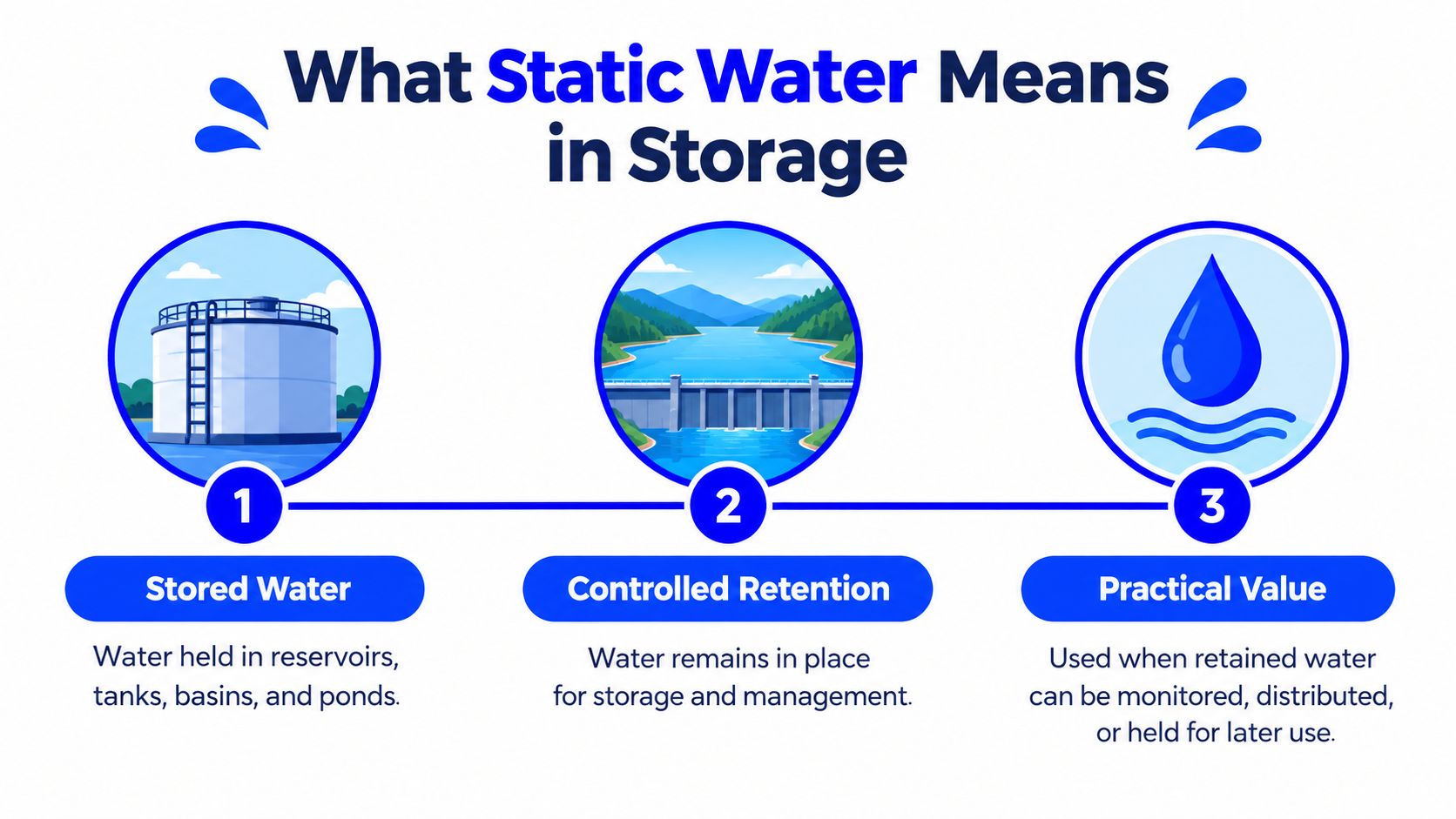
The storage meaning is older and more deliberate than the everyday image of water left sitting by accident. In environmental and engineering contexts, static water commonly means standing or stored water in reservoirs, tanks, basins, and ponds. Its value comes from retention: the water is held now so people can release or use it later.
That planned availability supports municipal supply, irrigation, hydropower, flood management, and industrial use. A reservoir isn't valuable because the surface looks calm at noon. It's valuable because operators know a measurable volume is contained, can be monitored, and can be released when demand or conditions require it.
Storage as Ancient Infrastructure
Historical records show that controlled water storage isn't a modern invention. The USGS historical account of reservoirs and water storage records irrigation basin systems in Egypt as early as 2000 BC, reservoirs near ancient Jerusalem for municipal supply, improvements to Athens's supply during approximately AD 115-130, Roman collection and distribution systems, about 359 million acre-feet of usable capacity in major United States reservoirs of at least 5,000 acre-feet in a 1963 inventory, and capacity growth of about 80% per decade until the early 1960s.
Those examples vary in scale, but the operational idea doesn't change. People built a boundary, held water inside it, and treated the stored volume as a resource with a future use. Forgotten water and managed storage may both be still, yet only one has an intended release, a known container, and a reason for retention.
The Laboratory Parallel
A laboratory container applies the same principle at bench scale. A closed vial holds a defined volume for later use, and the container boundary is part of the definition. That's why asking what is static water in a lab can't stop at whether the liquid moves.
- Containment: The vessel separates the stored volume from the surrounding environment.
- Retention: The water remains available until a planned withdrawal.
- Measurement: The labeled volume and lot identity make the stored material traceable.
Storage therefore gives readers the first half of a workable definition. Static water is contained water whose usefulness depends on controlled retention, not water that someone merely failed to notice.
Why Static Does Not Mean Unchanging
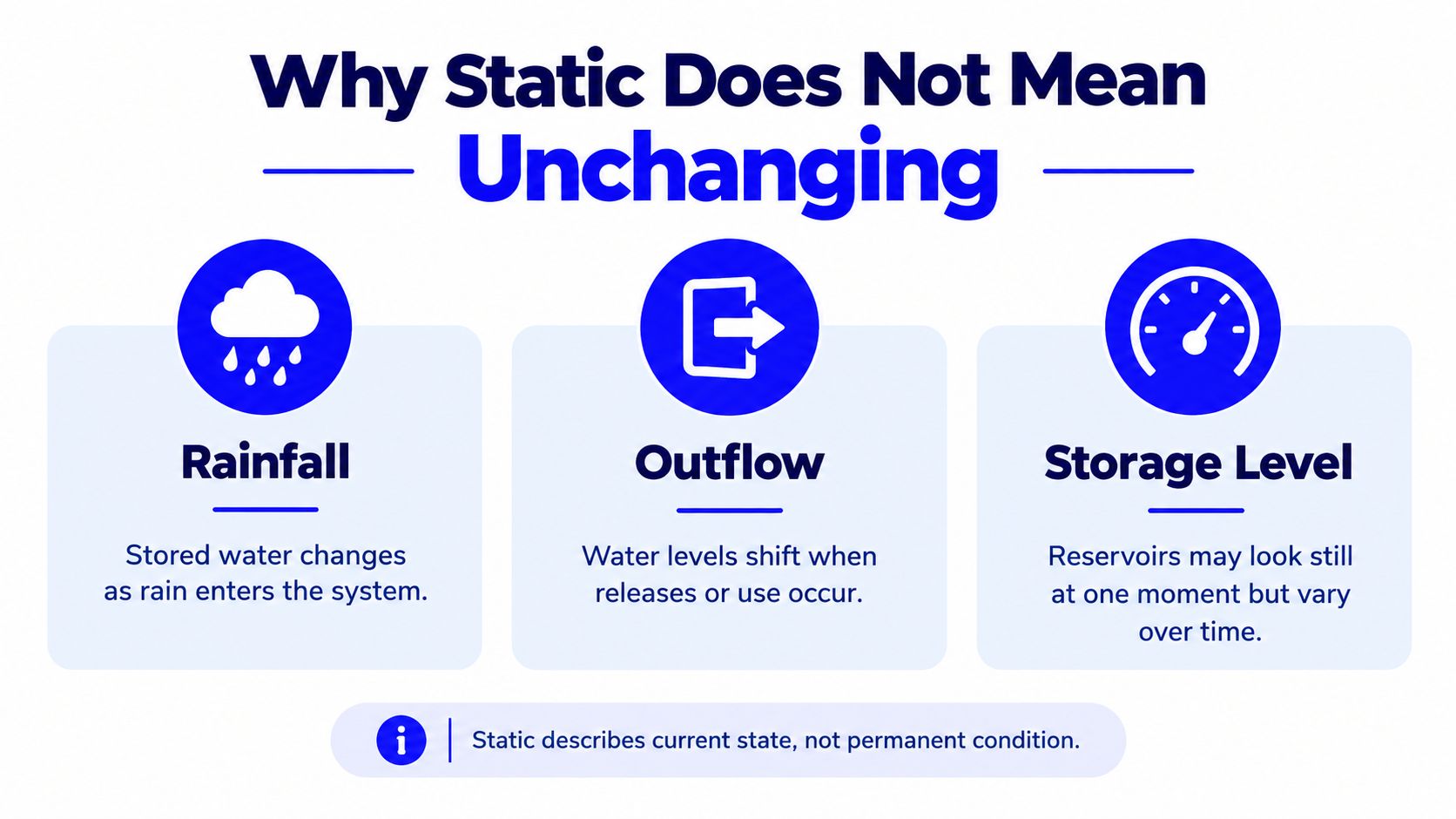
Water can sit without a visible current and still change. In a reservoir, rain and inflow can raise the level, while evaporation, withdrawals, and releases lower it. “Static” describes water held in a place at a given time, not water whose volume and condition remain fixed.
A sealed vial changes on a different scale from a reservoir, but the same principle applies: storage sets the conditions; it does not freeze them. Temperature can shift, and the time in storage matters. In an opened or punctured container, handling also affects how well the contents remain protected.
What Changes Inside a Contained Volume
A container limits contact with the outside environment, but its contents still respond to storage conditions. A reservoir may gain or lose volume through inflow and outflow. In a closed tank or vial, the volume may stay nearly constant while temperature or the container's condition changes.
Practical rule: Record how long water has been stored, its temperature conditions, and whether the container has remained sealed.
For bacteriostatic water, storage and handling follow the product's labeling and the requirements of the research protocol. A sealed vial and a tap-water line are different systems: household plumbing guidance addresses water moving through a building, while a research vial is judged by its container, storage conditions, and handling history.
“Static” is therefore a description of an operational condition, not a guarantee of permanence. A researcher can document that condition with the water's identity, storage history, and any opening or puncture details required by the protocol.
When Still Water Becomes a Risk
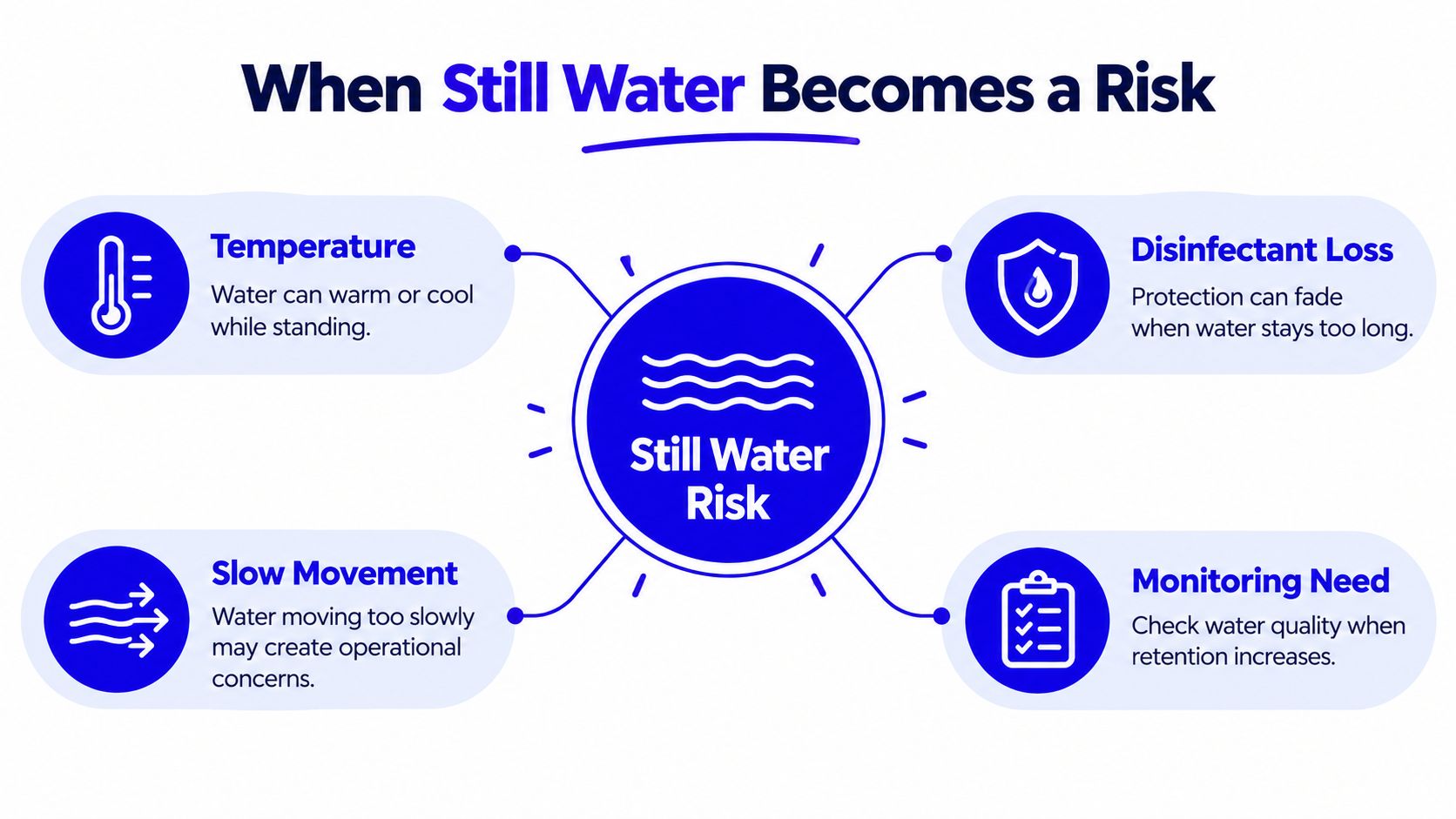
Risk begins when stillness lasts long enough for conditions to change. The operational definition is therefore more useful than appearance: water has remained still or moved too slowly for temperature, disinfectant residual, water age, sediment, and biofilm conditions to remain as they were. Clear water can meet that description, and cloudy water isn't the only warning sign.
Building plumbing gives the clearest example. CDC guidance on building water systems and Legionella control identifies stagnant plumbing water as a condition that can reduce disinfectant levels, allow hot water to cool into the approximately 25-42°C range favorable to Legionella growth, and notes that biofilms can develop under both stagnant and flowing conditions.
Compare the Container Before Choosing a Control
- Open standing water: Environmental exposure is the dominant issue because air, surfaces, and debris have direct access.
- Pipes, tanks, and unused fixtures: Water age, warming or cooling, disinfectant loss, sediment, and biofilm interact inside a distribution system.
- Sealed sterile laboratory water: The water is static because it's stored, while sterility, closure, preservative status, and handling determine the relevant controls.
Those cases shouldn't share one rule. Brief flow through a fixture doesn't prove an established biofilm is gone, just as a sealed vial shouldn't be treated as though it had aged inside plumbing. The microbiology contamination control guide is relevant to the laboratory side because access technique becomes important once a sterile container is opened.
Four questions separate concern from guesswork. How long has the water been still, at what temperature has it been held, what container encloses it, and what hygiene controls have applied since filling or opening? A researcher also needs to separate sterility from preservative status, since a sterile product may contain no preservative and a preserved product still depends on aseptic handling.
The practical answer to what is static water is therefore conditional. Still water becomes a risk when time and container conditions allow microbial or chemical conditions to move outside the intended limits. Naming those limits comes before flushing, discarding, or using the water.
Bacteriostatic Water in Research Use
The laboratory case becomes concrete with bacteriostatic water, a sterile, non-pyrogenic purified water containing 0.9% benzyl alcohol as an antimicrobial preservative for research use only. It isn't a treatment for plumbing and it isn't a synonym for every still liquid. Its job is to serve as a documented diluent for defined non-clinical work.
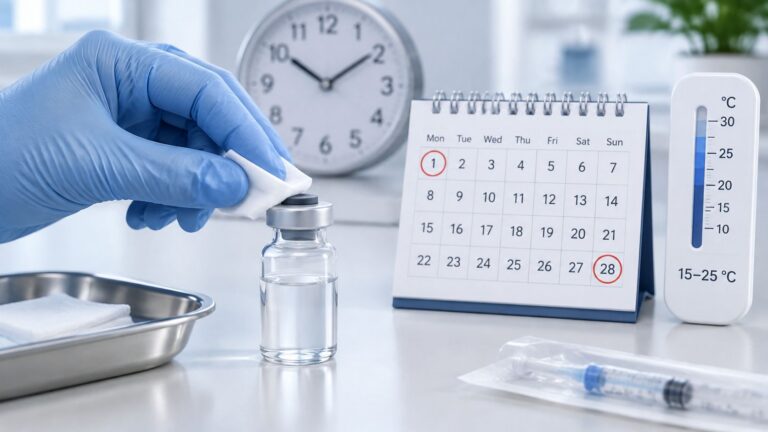
The image below shows the handling context that matters: a sealed vial, a syringe, and controlled access rather than an open container.

What the Preservative Does
Benzyl alcohol inhibits growth of many bacteria in the stored solution, which supports repeated withdrawals from one multi-dose vial when aseptic technique is used. The stated in-use window is up to 28 days after proper handling, with a typical filled-product pH of 4.5-7.0. Production through 0.22 µm filtration, premium glass multi-dose vials, lot-specific certificates of analysis, and QA review before release gives researchers records that an unused tap can't provide.
That preservation has limits. It doesn't make an opened vial immune to poor technique, damaged closures, or use beyond its in-use window. It also doesn't override a protocol that forbids preservatives or a method where benzyl alcohol could interfere with the material being prepared.
The short video below gives a visual walkthrough of the vial-and-syringe handling context discussed in this section.
A Documented Vial Routine
- Record first puncture: The date goes on the label before the vial returns to storage.
- Withdraw aseptically: Each access follows the laboratory procedure for septum disinfection and sterile equipment.
- Discard at the limit: Remaining volume doesn't extend the in-use window.
Typical research uses include reconstituting peptides, proteins, and antibodies and preparing working solutions from lyophilized materials. Facility teams comparing infection control investments for facility managers face a related documentation problem at building scale, but the control differs: equipment and building systems require facility programs, while a vial requires lot traceability and disciplined access.
How to Choose the Right Water
Choice starts with composition and intended job, not with whether the liquid looks still. Bacteriostatic water, additive-free sterile water, and stagnant building water occupy different categories. Treating them as interchangeable creates either contamination risk or chemical incompatibility.
Which Water Fits the Job
| Water type | What it contains | Typical job | Repeated access |
|---|---|---|---|
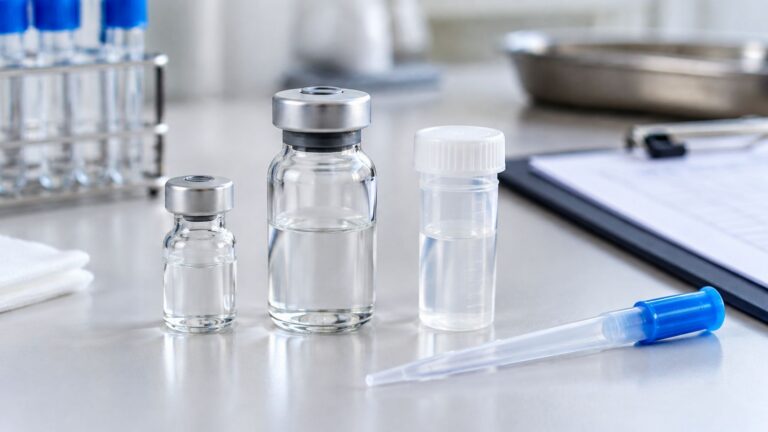
| Bacteriostatic water | Purified water with 0.9% benzyl alcohol | Multi-dose research reconstitution when protocols allow preservative | Repeated aseptic withdrawals within the stated in-use window |
| Sterile water | Sterile water with no preservative | Methods where added substances could interfere | Treat as limited-access because no preservative is present |
| Building water | Potable supply affected by plumbing age and conditions | Building distribution, not a laboratory diluent | Managed through building controls rather than vial access |
Sterile water fits a protocol when any additive could affect the result. Bacteriostatic water fits when repeated research withdrawals are expected and benzyl alcohol is compatible with the material and method. The comparison behind saline osmolarity for lab methods adds another reminder: diluent choice also depends on the chemical environment a method requires, not sterility alone.
Building water belongs in a different control system. CDC potable water systems guidance treats water age, sediment, biofilm, temperature, and disinfectant residual as interacting factors, recommends flushing low-flow runs and dead legs at least weekly, and notes that biofilms may persist in storage tanks and piping.
Unused doesn't mean safe, and brief flow doesn't mean microbiologically clean.
A sealed, quality-controlled vial hasn't accumulated plumbing water age before opening, so flushing logic doesn't apply. For a documented research-use-only option, Herbilabs bacteriostatic water is supplied in 3 mL, 10 mL, 20 mL, and 30 mL vials and multi-packs such as 10×3 mL and 10×10 mL, with lot certificates of analysis, ISO 13485:2016 and GMP facility credentials, ISO 9001:2016 procedures, and distribution across the EU, UK, and USA.
The lab notebook should show why the selected water fits the protocol. Composition, preservative permission, lot record, opening date where relevant, and discard rule give another researcher enough information to reproduce the choice.
A Practical Next Step for Your Lab
A same-day decision doesn't need a long theory of still water. It needs the container, the concern, and the protocol limit stated plainly. Environmental static water is managed storage, plumbing stagnation is a building control problem, and a sealed bacteriostatic solution is static because it's contained for research use.
Decision Checklist
- Name the container: Reservoir, pipe, tank, unused fixture, sealed vial, or opened multi-dose vial.
- State the concern: Microbial growth, chemical compatibility, or both.
- Check preservative permission: Confirm whether the protocol allows 0.9% benzyl alcohol.
- Record access: Write the first-puncture date on an opened multi-dose vial.
- File the lot record: Keep the certificate of analysis with the experiment documentation.
That sequence prevents the two common errors. It stops a sealed research solution from being judged by tap-water rules, and it stops preservative content from being treated as permission to ignore aseptic technique or an in-use limit. Each answer can be documented without relying on whether the water looked clear or still.
For non-clinical reconstitution of peptides, proteins, antibodies, or other lyophilized research materials, the next action is to match vial size to expected withdrawals within the 28-day in-use window and confirm documentation before ordering. Smaller formats can reduce leftover volume for limited work, while larger vials or multi-packs can fit repeated preparations when the protocol permits the preservative.
Researchers comparing current research-use-only formats can check the supplier information already described, including lot documentation and EU, UK, and USA supply options, with private-label or wholesale arrangements where those models are relevant. The order should follow the checklist, not precede it: protocol compatibility first, expected withdrawals second, and format third.
The final test is simple. If a colleague can identify the container, composition, opening status, and discard rule from the record, the phrase static water has become an operational decision rather than a vague description.
Herbilabs supplies sterile bacteriostatic reconstitution solutions for research use, with documented lots and multiple vial formats for non-clinical laboratory preparation. Researchers who have confirmed that a protocol allows 0.9% benzyl alcohol can review current formats and documentation at Herbilabs before matching a vial size to expected withdrawals.