Private Label, White Label, Wholesale partnerships available - EU, USA and UK - Free shipping from €75
Sterile Water vs Normal Saline: A Practical Lab Guide
Sterile water is the near-zero-osmolarity, additive-free choice when a neutral starting vehicle is needed; 0.9% normal saline is a roughly 308 mOsmol/L sodium-chloride solution for methods validated to require near-physiological ionic strength. The lyophilized material's instructions should determine the choice, not whichever vial is closest at the bench.
A researcher weighing the two usually has a specific powder or assay in mind and a practical question: which diluent will preserve the conditions the material needs? The answer depends on the validated formulation and intended workflow. Sterile water offers control over added ions, while saline brings a defined salt load from the start. Neither is a universal upgrade, and neither should be substituted for the other just because both products are sterile.
For research-use-only products, the distinction is especially important: RUO materials aren't for human or veterinary injection, diagnosis, or treatment. Use the manufacturer's validated diluent and handling directions, then check that the product grade and container match the intended laboratory task.
Table of Contents
- Why This Comparison Matters at the Bench
- Composition and Osmolarity at a Glance
- What Ionic Strength Does to Peptides and Proteins
- Bacteriostatic Water as the Third Option
- Matching the Diluent to Your Workflow
- Sterility, Storage, and Handling for RUO Use
- Putting It Together and Choosing a Supplier
Why This Comparison Matters at the Bench
A vial of lyophilized peptide, protein, or antibody is on the bench. One hand holds the material's instructions, the other is reaching for a diluent. That's the moment when “sterile” can sound like the only specification that matters. It isn't. The fluid's composition affects the reconstituted solution, and the correct choice begins with what the material's validated formulation allows.
Sterile Water for Injection is a solvent with no intentional electrolyte content. It's useful when added ions would interfere with the experiment or when the researcher needs to set the solution's final ionic strength deliberately. Normal saline is a sodium-chloride solution with a fixed ionic contribution. It fits workflows whose validated method calls for saline or near-isotonic conditions.
Bench rule: Follow the lyophilized material's validated diluent instructions first. Convenience is not compatibility evidence.
Start with the material, not the vial
Check the product insert, supplier documentation, and assay protocol before opening either diluent. Confirm the named vehicle, required reconstitution volume, concentration, and any constraints on preservatives or salt. If documentation doesn't establish that a substitute is compatible, don't assume it is. Similar appearance, sterility, or intended use doesn't make two formulations interchangeable.
The same discipline applies to the use context. A reconstituted solution for an in-vitro assay has different requirements from a clinical preparation, and RUO supplies must remain within research workflows. Research use only does not mean suitable for injection or for any diagnostic or therapeutic application.
Define the decision
The comparison is best understood as a trade-off between ionic-load control and validated isotonicity. Sterile water gives the researcher a low-ion starting point; saline supplies sodium and chloride immediately. The right option is whichever matches the material's validated formulation and the experiment's design.
That framing also prevents a common shortcut: treating sterile water as “purer” for every application, or saline as automatically “safer” because it resembles physiological conditions. A fluid can be appropriate for one assay and unsuitable for another. The container, the analyte, the route within the laboratory workflow, and the approved product labeling all matter.
Composition and Osmolarity at a Glance
The central difference is straightforward: sterile water contains no added electrolytes, while normal saline is water with sodium chloride at a defined concentration. The consequences are not interchangeable. One lets the researcher control the salt content; the other starts with a substantial, fixed sodium-and-chloride load.
FDA labeling describes Sterile Water for Injection, USP as sterile and nonpyrogenic, with 0 mOsmol/L osmolarity and a typical pH of 5.5, within an allowed range of 5.0–7.0 (FDA labeling for Sterile Water for Injection). With no electrolytes or other solute, it is profoundly hypotonic relative to blood. The FDA warns that unmodified sterile water given intravenously can cause hemolysis, meaning red blood cells rupture, and requires a suitable solute to be added to produce an approximately isotonic admixture.
By contrast, 0.9% normal saline contains 9 mg/mL sodium chloride, equivalent to approximately 154 mmol/L each of sodium and chloride. Its calculated osmolarity is about 308 mOsmol/L. A peer-reviewed historical review reports an in-vitro osmolality of about 308 mOsmol/kg and calculated in-vivo osmolality of approximately 287 mOsmol/kg, which is why saline is generally classified as isotonic (FDA labeling for 0.9% sodium chloride injection).
| Attribute | Sterile Water for Injection | 0.9% Normal Saline |
|---|---|---|
| Composition | H₂O, with no intentional electrolytes or added solute | Sodium chloride in water |
| Salt content | No added sodium or chloride | 9 mg/mL sodium chloride |
| Osmolarity | 0 mOsmol/L | Calculated osmolarity about 308 mOsmol/L |
| Sodium and chloride | None intentionally added | Approximately 154 mmol/L of each |
| pH | Typical pH 5.5; allowed range 5.0–7.0 | Commonly specified around 4.5–7.0 |
| General role | Solvent or diluent when low ionic content is needed | Vehicle when the validated workflow requires saline or near-isotonic conditions |
Why the difference matters
Sterile water's hypotonicity is a serious safety issue for direct intravenous administration, not a reason to dismiss it as a laboratory solvent. Its intended role in parenteral formulations is as a solvent or diluent that must be adjusted with a suitable solute before intravenous use. Normal saline, by comparison, is already osmotically suitable for many routine fluid and medication-delivery applications, subject to the product's approved labeling and the formulation's compatibility.
For bench work, the same compositional difference can be useful. If salt could confound the assay or alter the sample, starting with water leaves the researcher in control of the final ionic content. If the validated method requires saline, replacing it with water changes the conditions the method was designed around. Sterility alone doesn't settle the choice.
What Ionic Strength Does to Peptides and Proteins
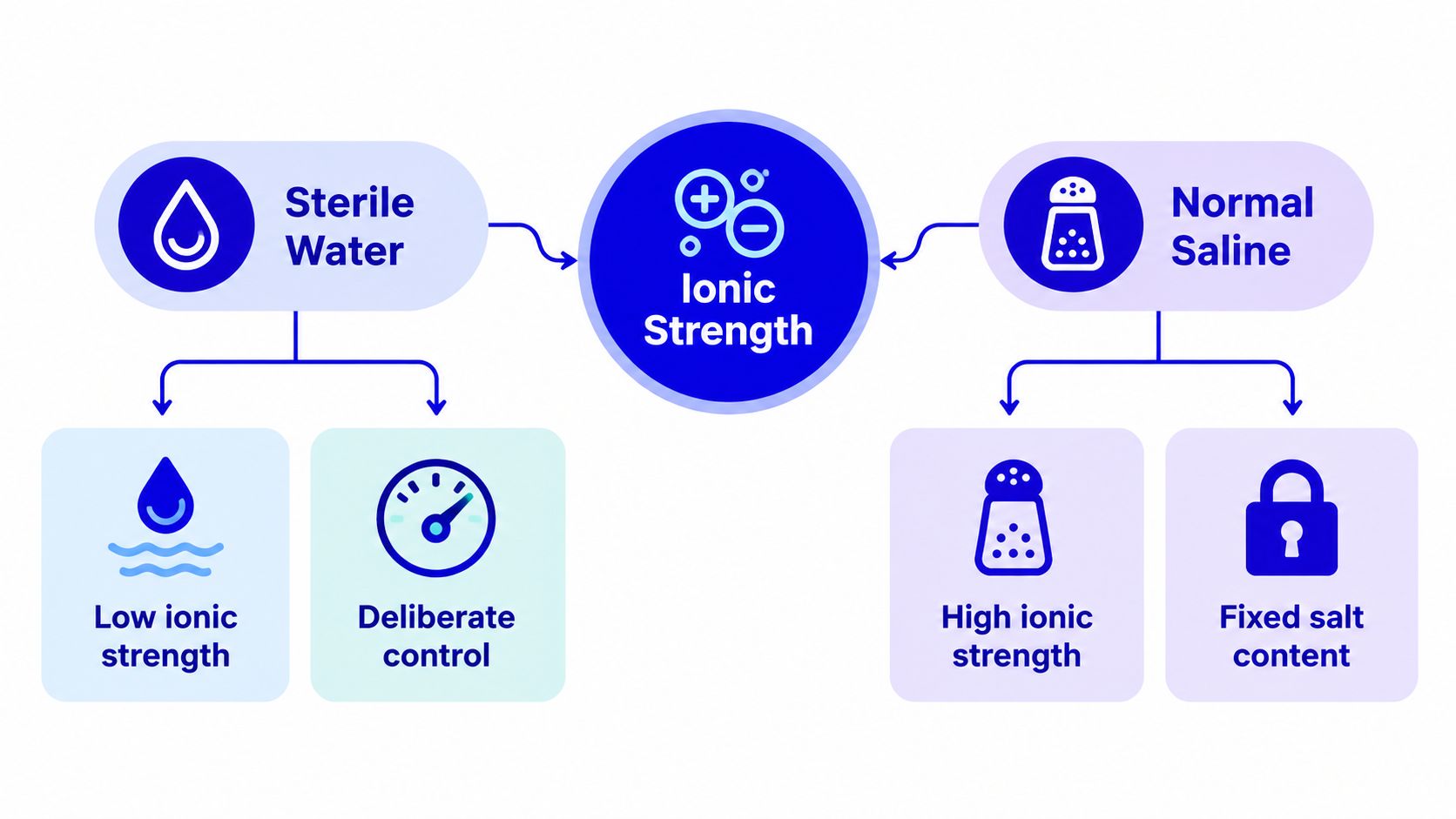
A diluent doesn't merely dissolve a lyophilized material. It establishes the chemical environment in which that material will be handled and measured. Because sterile water adds no intentional electrolytes, it gives the researcher room to control ionic strength. Saline starts with a substantial, fixed salt content.
That difference can matter for protein solubility, aggregation kinetics, antibody charge-state behavior, enzyme activity, and chromatographic retention. The effect depends on the molecule and assay, so there's no blanket rule that salt always helps or always harms. What matters is whether the validated formulation and downstream method were designed for that ionic environment.
Choose the vehicle the formulation supports
When the manufacturer-validated diluent permits a neutral vehicle, sterile water is generally the more compositionally neutral starting point. It avoids introducing sodium and chloride before the researcher has confirmed they're needed. That's useful when added ions might destabilize a reagent, affect a measurement, or complicate a concentration calculation.
Use normal saline when the validated formulation or assay explicitly requires near-isotonic ionic conditions. A saline-validated cell-associated or protein assay should stay in its specified vehicle. Switching to water changes the ionic environment; switching from water to saline adds salt that wasn't part of the original formulation. Neither substitution should be made on intuition alone.
Reproducibility starts at reconstitution: Record the diluent identity and lot, the reconstitution volume, and the final calculated salt concentration. Note any turbidity or precipitate, too.
For research-use-only workflows, capture those details with the batch record rather than relying on memory. The record makes it easier to trace a result to its preparation conditions and identify whether a vehicle change could explain unexpected behavior. Isotonicity by itself doesn't prove chemical compatibility; the manufacturer's stability information and the assay's validated conditions remain decisive.
Bacteriostatic Water as the Third Option
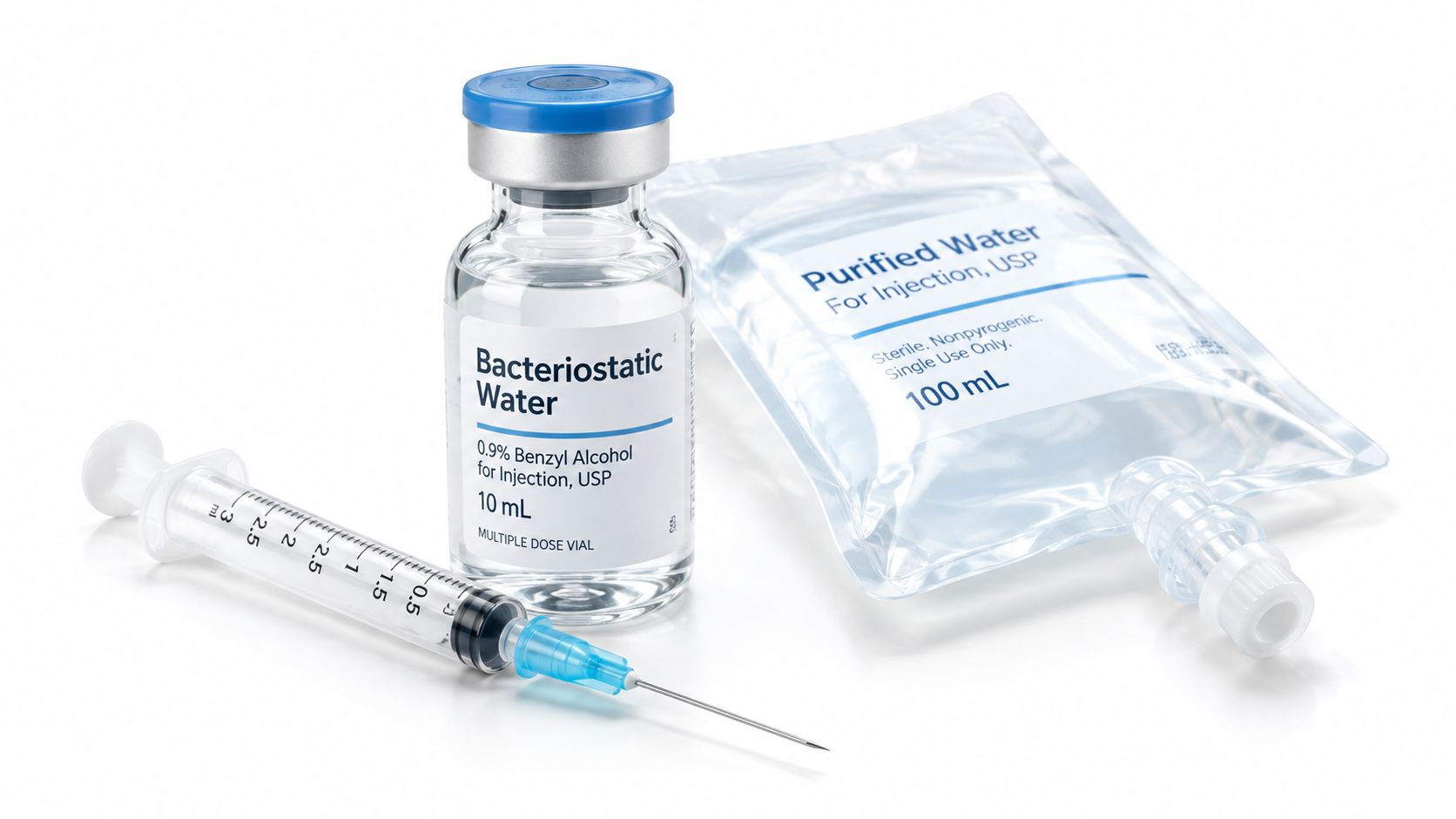
Some labs comparing sterile water and saline are really weighing a different question: whether the workflow needs a preservative-containing diluent for repeated access. Bacteriostatic water is a separate formulation, not sterile water with a different label. The formulation described here is purified water with 0.9% benzyl alcohol. That preservative can support multi-dose withdrawals for an in-use period of up to 28 days when the product's instructions permit it and aseptic technique is maintained.
This can suit workflows that need repeated withdrawals from one vial, but the preservative also creates a compatibility question. Benzyl alcohol may not suit every drug, research material, or assay. A preservative can support microbial control; it doesn't sterilize a contaminated vial and doesn't replace validated handling. FDA labeling describes sterile water for injection as having no antimicrobial agent, and ASHP's shortage guidance notes that switching between sterile water and saline may lack definitive compatibility or stability data. The right diluent depends on the specific material, access pattern, container, storage conditions, and supplier stability evidence.
When the preservative fits
Bacteriostatic water may be appropriate when a validated research workflow calls for a preservative-containing multi-dose vehicle and the analyte tolerates benzyl alcohol. It's a poor shortcut when compatibility hasn't been established, when the assay is sensitive to preservatives, or when the product's approved instructions specify a different diluent. Repeated access is not a reason to override formulation requirements.
Herbilabs offers an RUO bacteriostatic reconstitution solution described as sterile, nonpyrogenic, and 0.22 µm filtered, in glass multi-dose vial formats with a typical pH range of 4.5–7.0. Those product characteristics don't establish compatibility with a particular molecule or assay. Researchers still need to verify the material's validated diluent and the supplier's stability information before use.
Before choosing any preservative-containing option, check the expected access pattern, the product's in-use directions, the assay's sensitivity, and the container's handling requirements. Treat bacteriostatic water, preservative-free sterile water, and saline as different formulations, not interchangeable versions of one product.
Matching the Diluent to Your Workflow
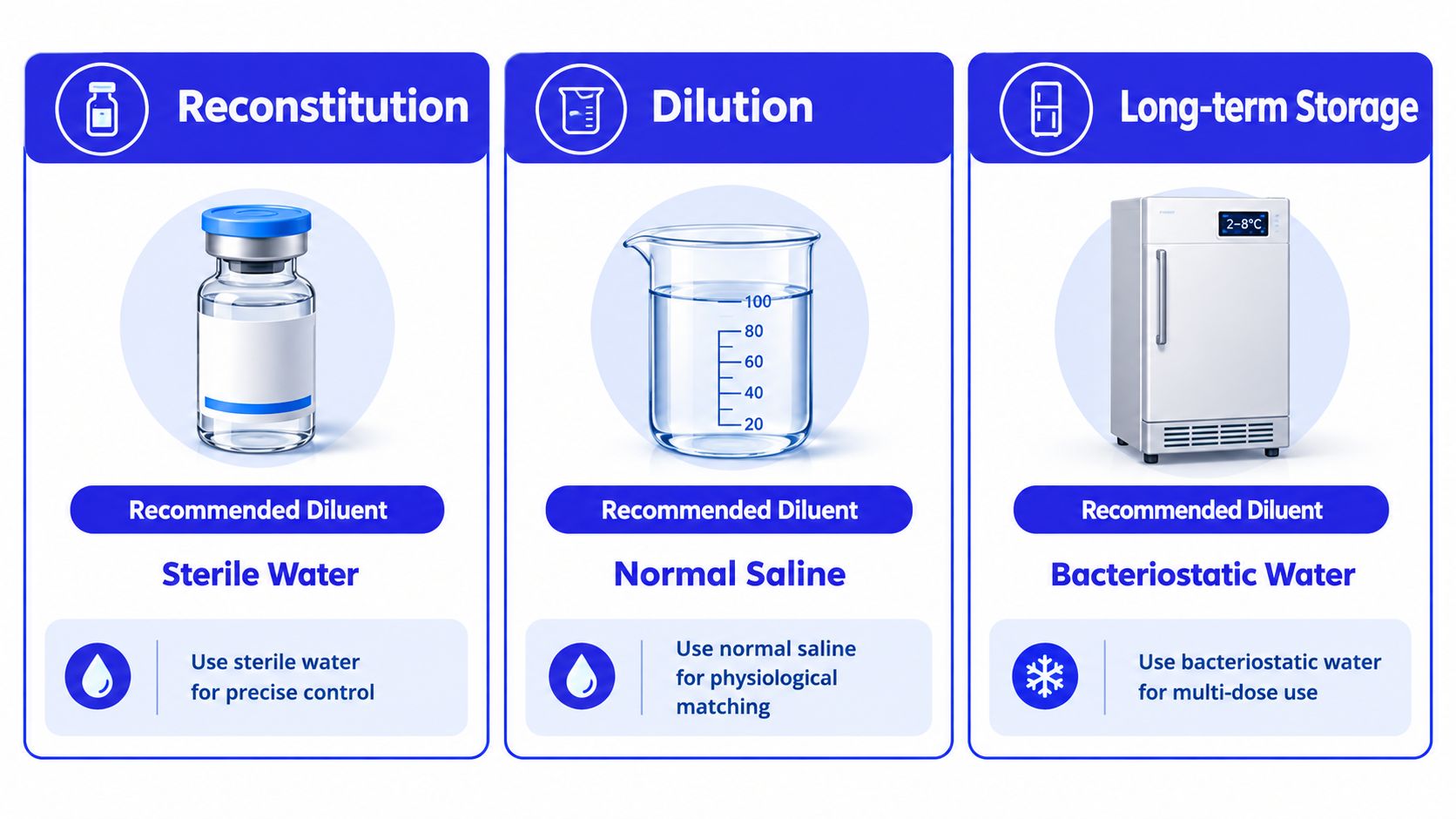
Make the choice in this order: check the validated formulation, identify the workflow, then confirm product grade and handling instructions. That prevents the two most common mistakes: changing the diluent without compatibility evidence, and choosing saline or water solely because one seems more familiar.
Reconstitute and use once
For a single-use preparation, sterile water is a sensible choice when the validated instructions allow it and a low-ion starting vehicle fits the experiment. It avoids adding salt that the method may not need. If the documentation specifies saline or another vehicle, follow that instead. The preparation's immediate use doesn't justify changing the validated diluent.
Make repeated withdrawals
For a multi-dose workflow, consider bacteriostatic water only if the formulation and assay allow benzyl alcohol. Confirm the product's in-use instructions and follow aseptic handling requirements. Preservative protection isn't a substitute for clean access, and it doesn't make a contaminated solution usable.
Preserve validated assay conditions
If a cell-associated or physiological assay was validated in normal saline, keep saline in the workflow. Don't substitute water just because it has fewer components. Likewise, don't swap saline for sterile water merely because saline seems safer. Each change alters the formulation, and compatibility must be established rather than assumed.
The peptide dilution calculator reference can help organize dilution calculations, but it can't determine whether a specific diluent is chemically compatible with a particular material. That answer belongs to the validated product or assay documentation.
Check the grade before opening
Don't use irrigation saline in place of injectable-grade saline. FDA labeling distinguishes irrigation products from products approved for injection. Even within a laboratory workflow, the product grade and labeling must match the intended use; “saline” alone isn't enough to confirm that it's the right product.
For either vehicle, verify the grade, sterility and endotoxin specifications, container closure, storage conditions, and post-opening hold time before use. Those details determine whether the product suits the protocol, not the convenience of its packaging.
Sterility, Storage, and Handling for RUO Use
Composition determines what enters the vial; handling determines how the solution is managed after opening. Use the product's label and supplier instructions for storage. Don't assume that all sterile diluents share the same temperature range, light sensitivity, or post-opening hold time.
After puncture, use aseptic technique appropriate to the product and workflow. Keep the container closure intact, prevent avoidable contact with the septum or needle, and record the opening date when the protocol requires it. If the product's instructions specify an in-use period, follow that limit rather than carrying a general rule from another formulation into the workflow.
Keep preparation details traceable
A useful batch record identifies the diluent and lot, preparation time, reconstitution volume, storage conditions, and any visible change in the solution. For materials where repeated access is part of a validated procedure, document each access as required by the lab's procedures. Lot-specific documentation can help connect a preparation to its source material and quality records.
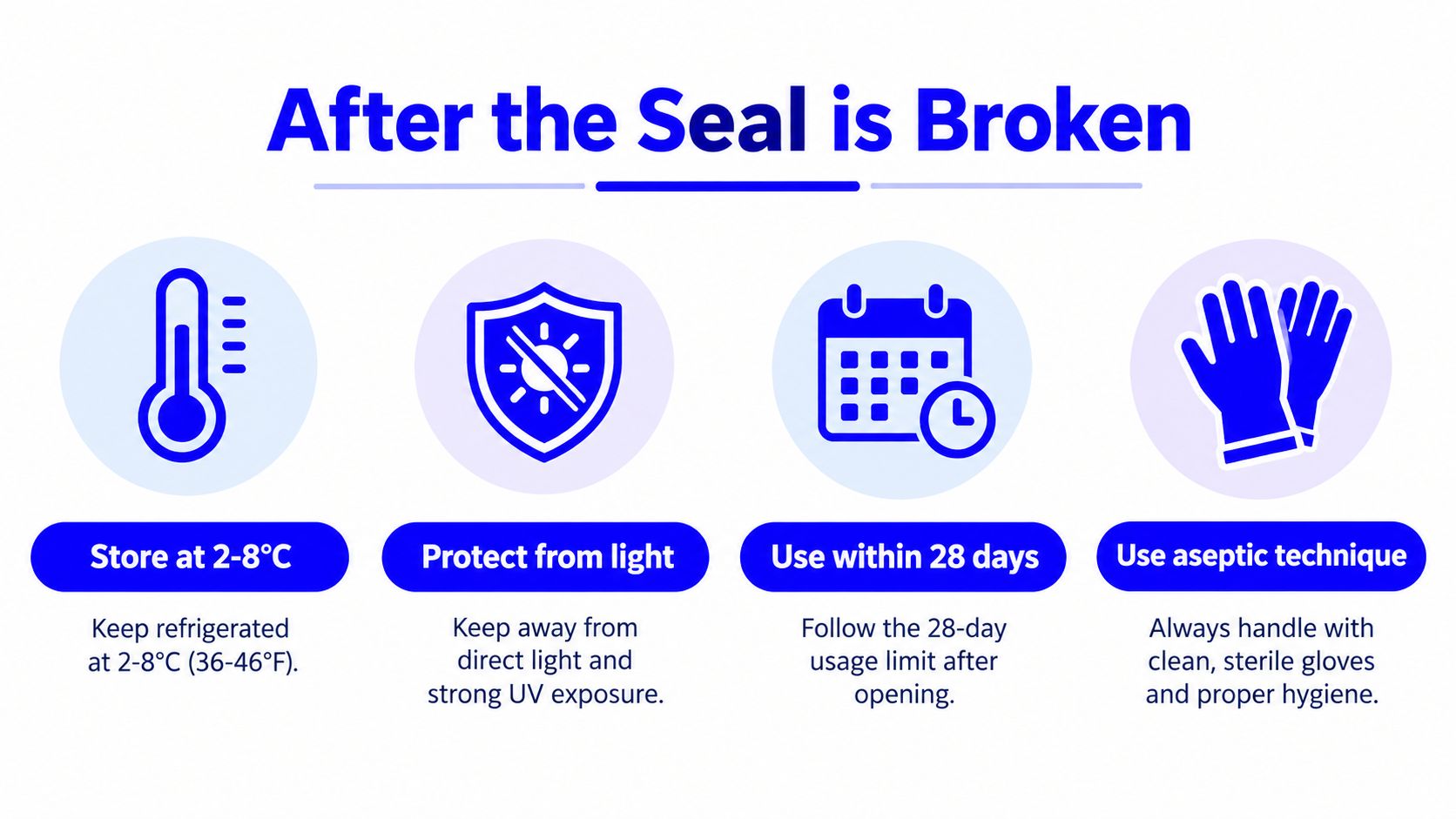
Discard a vial if the solution becomes cloudy or develops a precipitate, if its container closure is compromised, or if aseptic handling fails. Also discard it when the labeled or validated in-use period has expired, even if liquid remains. A preservative doesn't reverse contamination, and a clear appearance alone doesn't prove that a solution remains suitable.
For additional handling considerations, use the lab's procedure alongside supplier-specific guidance on bacteriostatic water. Don't carry storage temperatures or in-use periods from one product to another unless that product's labeling supports them.
Putting It Together and Choosing a Supplier
The operational rule is simple: the validated formulation picks the diluent, the workflow picks the vial format, and the supplier's documentation supports traceability. Use sterile water when the validated method permits a neutral starting vehicle, saline when near-isotonic ionic conditions are required, and a preservative-containing diluent only when both the material and workflow support it.
Herbilabs describes its RUO reconstitution solutions as sterile, nonpyrogenic, and 0.22 µm filtered, with lot-specific Certificates of Analysis and QA review. Its listed glass vial formats include 3 mL, 10 mL, 20 mL, and 30 mL options. Researchers considering a reconstitution solution should still confirm that the specific formulation matches their material's validated instructions.
These products are for research use only, not for human or veterinary use, and not for diagnostic or therapeutic applications. They aren't approved as drugs or medical devices. Before ordering, confirm the validated diluent and the documentation needed for the intended workflow.
Review the material's validated diluent instructions, then match the workflow to a compatible product and vial format. Herbilabs offers RUO reconstitution solutions and laboratory vial options; visit Herbilabs to review the available products and documentation.