Private Label, White Label, Wholesale partnerships available - EU, USA and UK - Free shipping from €75
Why Aseptic Technique Is Important in Microbiology
A new researcher often notices contamination only at the end of a workflow. The plate that should show one colony type suddenly shows several. The sterile broth control turns cloudy. A reagent that looked fine at setup behaves unpredictably in the assay. By that point, the damage is already done. The culture, the readout, and often the time spent getting there can't be trusted.
That's why aseptic technique matters so much in microbiology. It isn't just about being tidy or following old lab habits. It's the set of actions that separates a meaningful result from a misleading one. In research use only workflows, that difference is especially important because reproducibility depends on whether each transfer, opening, and handling step stayed under control.
Many beginners assume contamination is mostly about bad supplies or a dirty room. In practice, the bigger issue is often human handling. Two people can use the same media, the same incubator, and the same protocol, yet one gets a clean result and the other gets mixed growth. That's the part many quick explanations miss.
Aseptic technique turns contamination from an unavoidable mystery into a controllable variable.
Understanding why aseptic technique is important in microbiology starts with that idea. Unwanted microbes are everywhere, but their access to cultures, media, and sterile reagents can be limited by disciplined handling. Once that clicks, the individual rules stop feeling arbitrary. Keeping lids closed, minimizing open exposure, organizing the workspace, and handling sterile items carefully all serve one goal. They block extra microbes from entering a system that needs only the organism of interest.
Table of Contents
- Introduction to Aseptic Technique in Microbiology
- What Aseptic Technique Means and How It Works
- Why Contamination Control Determines Experimental Integrity
- Core Aseptic Practices Every Microbiologist Should Master
- Real World Examples of Contamination and Its Consequences
- Training Documentation and Quality Assurance for Reliable Results
- Putting Aseptic Principles Into Practice
Introduction to Aseptic Technique in Microbiology
A microbiology bench can look calm even when contamination risk is high. A researcher labels tubes, opens a plate for a few seconds, reaches across the workspace, sets down a cap without thinking, then continues. Nothing dramatic happens in the moment. The problem appears later, when the culture no longer represents what the researcher intended to grow.
That delayed failure is what makes aseptic technique easy to underestimate. The mistake and the consequence are often separated by hours or days. A mixed colony plate on Friday may have started with one careless transfer on Tuesday. That's why experienced labs treat aseptic handling as part of experimental design, not as cleanup.
The hidden problem is extra biology
Microbiology depends on controlling which organism is present, where it is present, and when it is introduced. If an outside microbe enters the sample, the experiment is no longer testing only the planned condition. It is testing the planned condition plus an unknown biological variable.
That extra variable changes more than appearance. It can alter growth curves, consume nutrients, produce byproducts, change pH, interfere with selection, and confuse downstream identification. Even when contamination is subtle, it can distort interpretation.
Practical rule: If a result depends on purity, every open-handling step is part of the experiment.
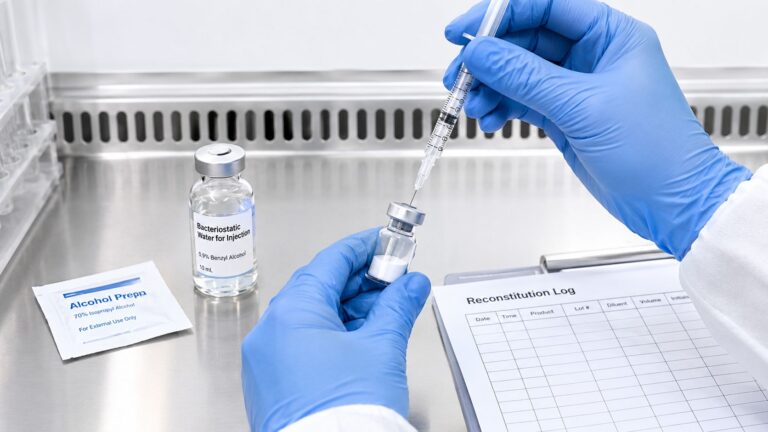
This is especially relevant in common RUO tasks such as reconstituting lyophilized material, preparing inocula, aliquoting sterile diluents, or transferring cultures between vessels. Researchers sometimes treat those as simple prep steps. They are not simple. They are points where unwanted organisms can enter and change everything downstream.
Why new researchers get confused
Aseptic technique is often taught as a list of rules. Flame this. Don't touch that. Open only briefly. Keep the field clean. Without the reason behind those actions, the method can feel ceremonial.
A clearer way to think about it is this:
- The sample is vulnerable: The moment a sterile or pure item is opened, it can pick up microbes from hands, tools, air, or surfaces.
- Exposure adds risk: The longer that item stays open, or the more it moves around the bench, the more chances contamination has to enter.
- Technique controls access: Good aseptic practice doesn't eliminate microbes from the room. It limits their path into the material that matters.
Once a researcher sees contamination as a preventable handling problem, the rules become logical. Aseptic technique stops being a checklist and starts becoming a method for protecting evidence.
What Aseptic Technique Means and How It Works
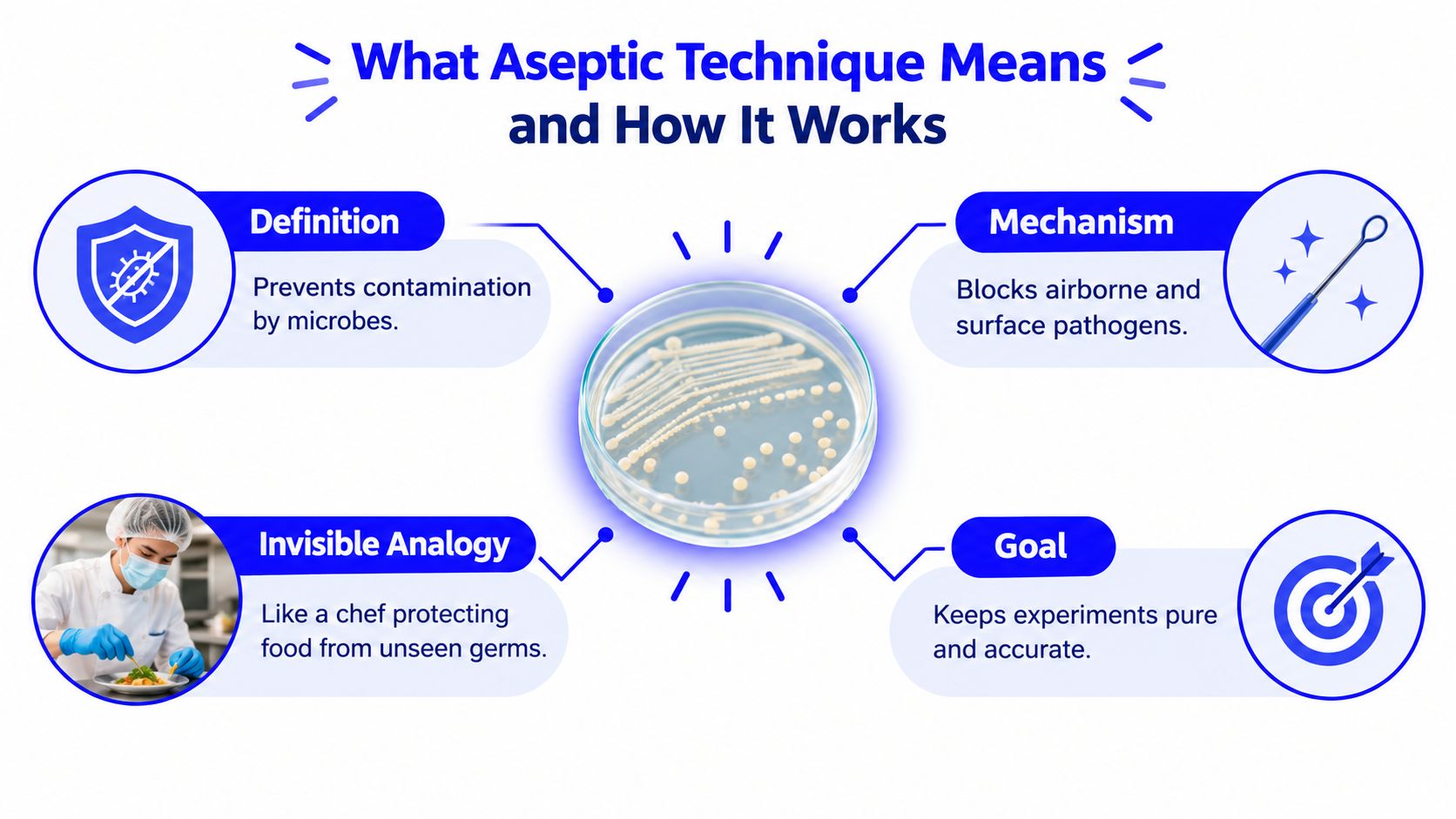
Aseptic technique means handling cultures, media, instruments, and sterile reagents in a way that prevents unwanted microorganisms from being introduced. In plain language, it is the practice of keeping the right microbes in and the wrong microbes out.
That sounds similar to “clean,” but the terms aren't the same.
Sterile, aseptic, and clean are different
A lot of confusion starts here. These three words overlap, but they do different jobs.
- Sterile means free of viable microorganisms.
- Clean means visibly free of dirt or residue. Something can look clean and still carry microbes.
- Aseptic describes the method used to maintain sterility or purity during handling.
A useful analogy is food preparation. A clean kitchen counter may look spotless, but that doesn't mean it is suitable for an exposed sterile instrument. Aseptic technique is more like how a careful chef protects prepared food from unseen contamination by controlling hands, tools, surfaces, and exposure time.
What the technique actually controls
Aseptic technique doesn't create a magical contamination-proof zone. It controls the routes by which microbes travel into a sample.
The main routes are familiar:
- Hands and gloves pick up organisms from ordinary contact.
- Tools and vessel openings can carry microbes from one item to another.
- Air and nearby surfaces can introduce environmental organisms when containers stay open too long.
A useful mental model is an invisible shield around the material being protected. Every action either strengthens that shield or opens a gap in it. Opening a tube briefly and handling it carefully keeps the shield mostly intact. Leaving it uncapped while searching for a pipette creates a large gap.
Why transfers are the critical moment
Microbiology work is full of transfers. A colony goes from plate to broth. A stock goes into fresh medium. A sterile diluent enters a vial. A filter-sterilized reagent is aliquoted into clean containers. Each transfer is a point where purity can be lost.
That's why good technique focuses on small physical behaviors:
- Keeping open vessels exposed for as little time as possible
- Avoiding contact between sterile parts and nonsterile surfaces
- Organizing materials before opening anything
- Working with deliberate, economical movements
Good aseptic technique isn't fast in the rushed sense. It is efficient because nothing unnecessary happens while sterile material is exposed.
This is the practical core of why aseptic technique is important in microbiology. The field relies on selective growth, accurate observation, and reproducible handling. Those outcomes depend on controlling what enters the system during every bench step.
Why Contamination Control Determines Experimental Integrity
A new researcher inoculates two flasks from the same stock, follows the written steps, and gets two different growth patterns a day later. The protocol did not change. The person-to-person handling did. That gap is the heart of contamination control, and it is why experimental integrity depends on technique quality, not just rule awareness.
Contamination does not need to be dramatic to damage a study. A stray organism can shift growth rate, alter turbidity, change metabolite levels, or blur a readout enough to weaken the conclusion. The sample may still look usable. The answer it gives is no longer clean.
One useful way to frame this is quality drift. Sterile work is like keeping dust out of a camera sensor during assembly. A single speck may not ruin every image, but it can change what you think you are seeing. In microbiology, low-level contamination does the same thing to data.
The effect is measurable. A systematic review and meta-analysis found microbial contamination in 3.7% of doses prepared in clinical environments (10,272 doses) versus 0.5% in pharmaceutical environments (6,280 doses), with a statistically significant difference (P = 0.007), as reported in this systematic review on contamination by preparation environment.
Technique quality explains why the same rules produce different outcomes
It is easy to look at those numbers and conclude that the room is the whole story. It is not. Rooms matter because they shape behavior. A controlled environment reduces interruptions, supports cleaner workflow, and makes good habits easier to repeat. Training matters for the same reason. Two people can know the same SOP and still produce different contamination risk because one handles caps, exposure time, and transfer order with tighter control.
| Environment | Contamination Rate | Sample Size |
|---|---|---|
| Clinical environment | 3.7% | 10,272 doses |
| Pharmaceutical environment | 0.5% | 6,280 doses |
This human-factor piece is often underestimated in research-use-only work. RUO materials do not stop being sensitive just because the setting is less regulated than manufacturing. If peptide reconstitution, media preparation, or assay setup is performed with variable sterile handling, the result is variable input quality. Variable inputs reduce reproducibility long before anyone notices visible contamination. Guidance on sterile technique for peptide researchers is useful for that reason. The contamination pathways are the same.
Integrity means the experiment still answers the question you asked
A microbiology experiment has integrity when you can trust that the observed result came from the intended system. If a culture was meant to contain one organism, then even a small unintended addition changes the meaning of the outcome. Growth may still occur. A plate may still look tidy. The interpretation is weaker because the system was no longer what you thought it was.
New researchers often expect contamination to announce itself with a mixed colony plate or cloudy negative control. Sometimes it does. Often it does not. The more common problem is subtle interference, small enough to hide inside normal variation, large enough to affect conclusions.
That is why contamination control belongs in the same conversation as calibration, media choice, and incubation settings. Clean technique protects the link between the procedure and the claim. Once that link is weakened, reproducibility suffers, troubleshooting gets harder, and the experiment costs more time than it first appears.
Core Aseptic Practices Every Microbiologist Should Master
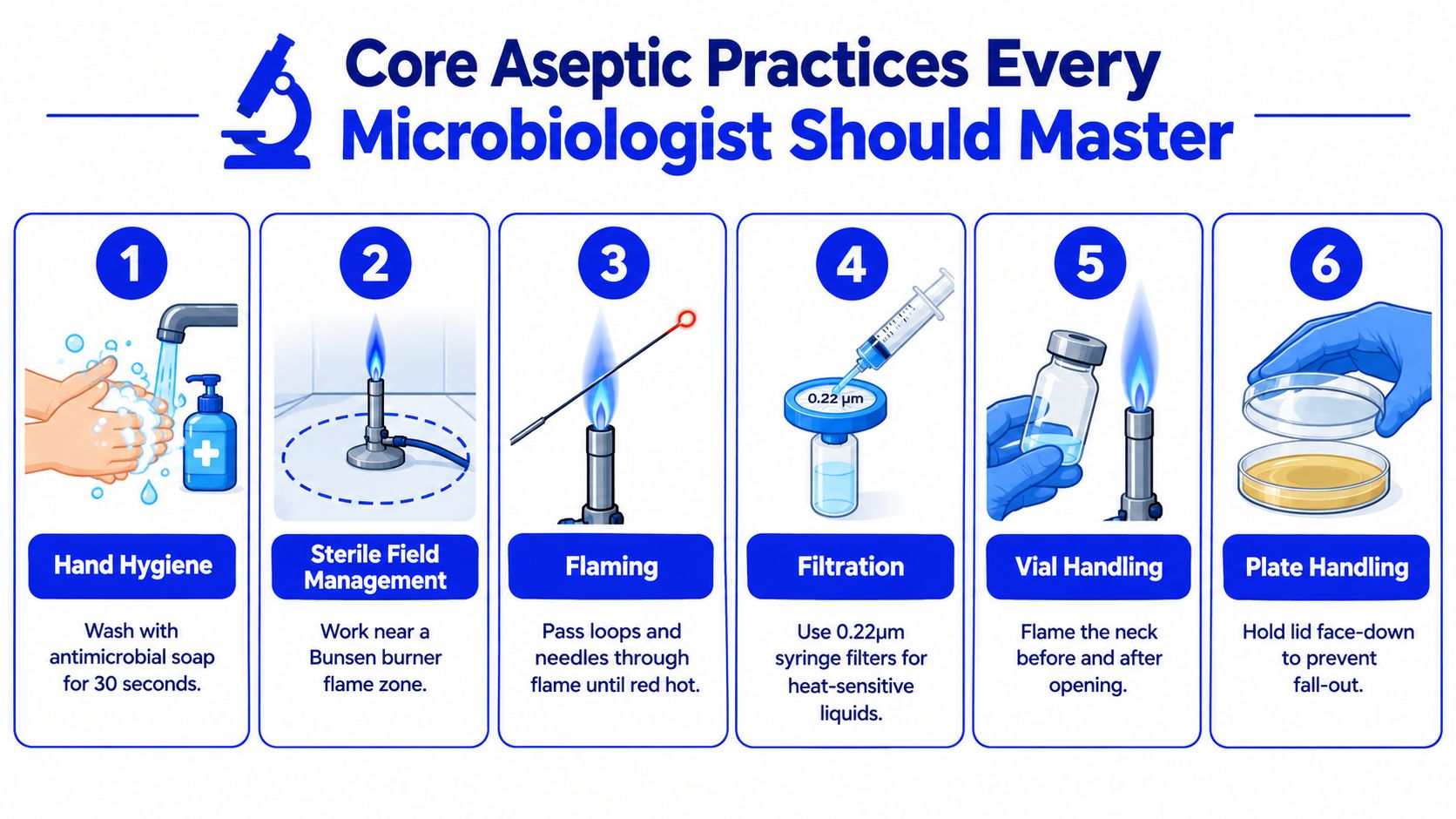
Most contamination problems don't come from one dramatic error. They come from a chain of small, ordinary slips. A glove touches a nonsterile surface. A tube stays open while labels are being checked. A cap is handled casually. The strongest aseptic practice is a connected system that removes those openings one by one.
Start before anything is opened
Aseptic work begins with setup, not with the transfer itself. If a researcher has to stop mid-procedure to find markers, tips, or tubes, sterile items stay exposed longer than necessary.
A practical setup sequence usually includes labeling vessels first, arranging tools in reach, clearing clutter, and making sure waste disposal is close by. The bench should support short, direct movements. It should not force crossing over open containers or searching with gloved hands.
One useful way to reinforce this is with visual bench aids. Short, high-clarity reminders work better than long SOP pages during live work. Teams building those supports can borrow these job aid design tips to make quick-reference instructions easier to use at the bench.
Protect hands, tools, and openings
These actions matter because they block the most common contamination routes:
- Hand hygiene and glove discipline: Hands are a major contamination source. Gloves help only if the wearer treats them as potentially contaminable, not magically sterile forever.
- Sterile tool handling: Loops, needles, pipette tips, and filters protect the sample only when they avoid contact with nonsterile surfaces.
- Minimal exposure time: Open tubes, plates, and vials should stay open only as long as needed for the transfer.
- Cap and lid control: Caps and lids shouldn't wander across the bench. Their inner surfaces need protection too.
A short demonstration helps more than a lecture. This bench-focused video shows the rhythm and hand control that written instructions often fail to convey.
Treat each action as linked to the next
Aseptic technique works best when researchers stop seeing it as isolated rules.
Consider a common reagent-prep sequence. A vial is opened, diluent is drawn up, transferred, mixed, and accessed again later. Sterility depends on every link holding together. Clean gloves don't compensate for poor vial handling. A sterile syringe doesn't rescue a vial neck that was exposed carelessly. The process is only as strong as its weakest step.
That is why consistent habits matter:
- Prepare the field first. Set up labels, containers, and waste before opening anything.
- Move with intent. Avoid extra reaching, talking over open vessels, or turning away mid-transfer.
- Close promptly. Once the transfer is complete, re-cover the item immediately.
- Reset between tasks. Don't carry hidden contamination from one preparation into the next.
For researchers handling sterile reconstitution workflows, the herbilabs aseptic reagent guide is one example of a process-specific reference that aligns these steps around reagent preparation rather than general culture handling.
Practice for plates, vials, and sterile liquids
Different materials create different weak points:
- Agar plates are vulnerable when lids stay lifted too long or are held in a way that invites fallout.
- Culture tubes and vials are vulnerable at the opening, especially during repeated access.
- Sterile liquids are vulnerable during transfer, aliquoting, and storage after first puncture.
Aseptic technique is easier to maintain when the researcher can predict the next hand movement before the current one finishes.
That is the skill to build. Not memorizing isolated rules, but developing a controlled sequence that keeps purity intact from start to finish.
Real World Examples of Contamination and Its Consequences
Contamination is often taught as a lab nuisance. In reality, it behaves more like a chain reaction. One weak transfer can spread into false growth patterns, unusable controls, repeated prep work, and uncertain conclusions.
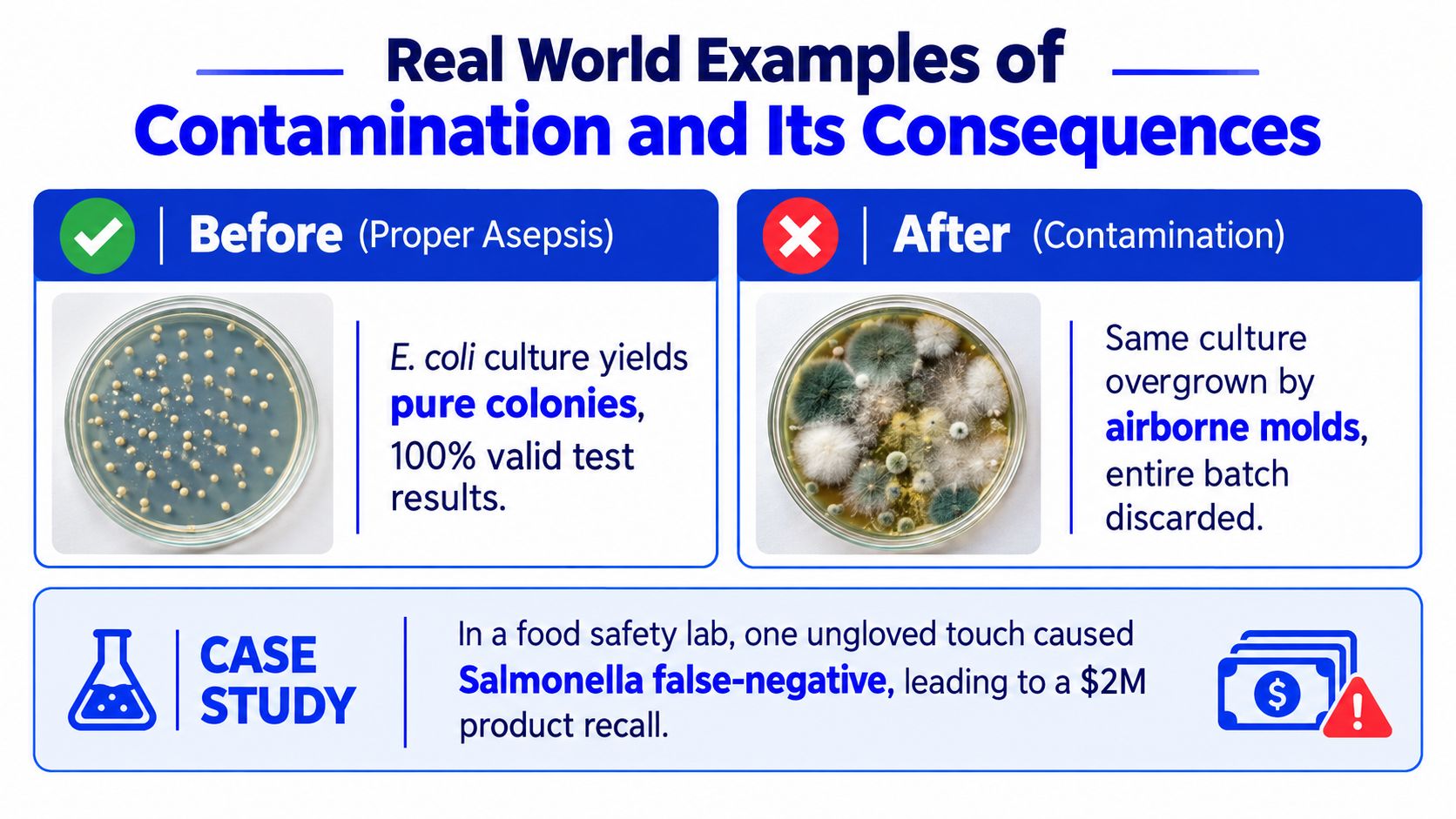
A useful example comes from aseptic simulation testing. In one study, the overall operator failure rate was 40%, 2.3% of preparations were contaminated, and every preparation performed with inappropriate aseptic technique became contaminated within 48 hours, as reported in this aseptic simulation test study. That last point is the part new researchers often remember. Poor technique doesn't just raise risk a little. It can completely defeat the sterile workflow.
What failure looks like at the bench
In microbiology, contamination can appear in several familiar ways:
- Mixed colony morphologies on a plate expected to yield a pure culture
- Unexpected turbidity in a negative control
- Drifting assay behavior after reagent preparation that seemed routine
- Inconsistent replicate outcomes even when the written method stayed the same
The visible symptom isn't always the first consequence. Often the first consequence is interpretive confusion. A researcher starts asking whether the organism changed, whether the medium was wrong, or whether the incubation conditions drifted. Sometimes the answer is much simpler. An unwanted microbe got in during handling.
Why the downstream cost grows quickly
A contaminated inoculum doesn't stay neatly confined to one tube. It can pass into subcultures, seed fresh media, distort growth comparisons, and affect any measurement built on that material. In RUO settings, that can mean a full repeat of reconstitution, prep, incubation, and data collection.
The cost is not only materials. It also includes lost confidence. Once contamination is discovered, the team has to decide how far back the problem might reach. Was it this plate only? This batch? This operator's entire session? The less disciplined the handling record, the harder that answer becomes.
Contamination rarely wastes one step. It usually forces doubt across every step connected to that sample.
Human variation is part of the story
Another practical lesson from real-world contamination events is that the same protocol does not produce the same outcome in every pair of hands. Some people maintain a stable sterile field almost automatically. Others know the rules but break the sequence in subtle ways. They pause too long, touch the wrong surface, or create unnecessary exposure.
That human-factor piece matters because reproducibility depends on behavior, not only on written instructions. Aseptic technique protects a workflow only when the operator can execute it consistently under ordinary bench conditions, not just describe it correctly during training.
Training Documentation and Quality Assurance for Reliable Results
Aseptic technique becomes dependable when labs treat it as a trainable, documented process instead of a personal style. That shift matters because contamination control is partly technical and partly behavioral. People need both instruction and verification.
A strong example comes from microbiology training itself. One lab course reported 21 contaminated syringes out of 504 at baseline, then 0 contaminated syringes out of 498 after instruction, with the proportion of students producing any contaminated syringe falling from 18 of 84 to 0 of 83 (both p < 0.001), as shown in this lab training study on contamination before and after instruction. That result is important because it shows contamination isn't just a fixed background hazard. Training can change outcomes dramatically.
Training should verify performance, not just attendance
Many labs make a common mistake. They document that someone read the SOP, watched a demonstration, or completed onboarding. That proves exposure to instruction, not competence.
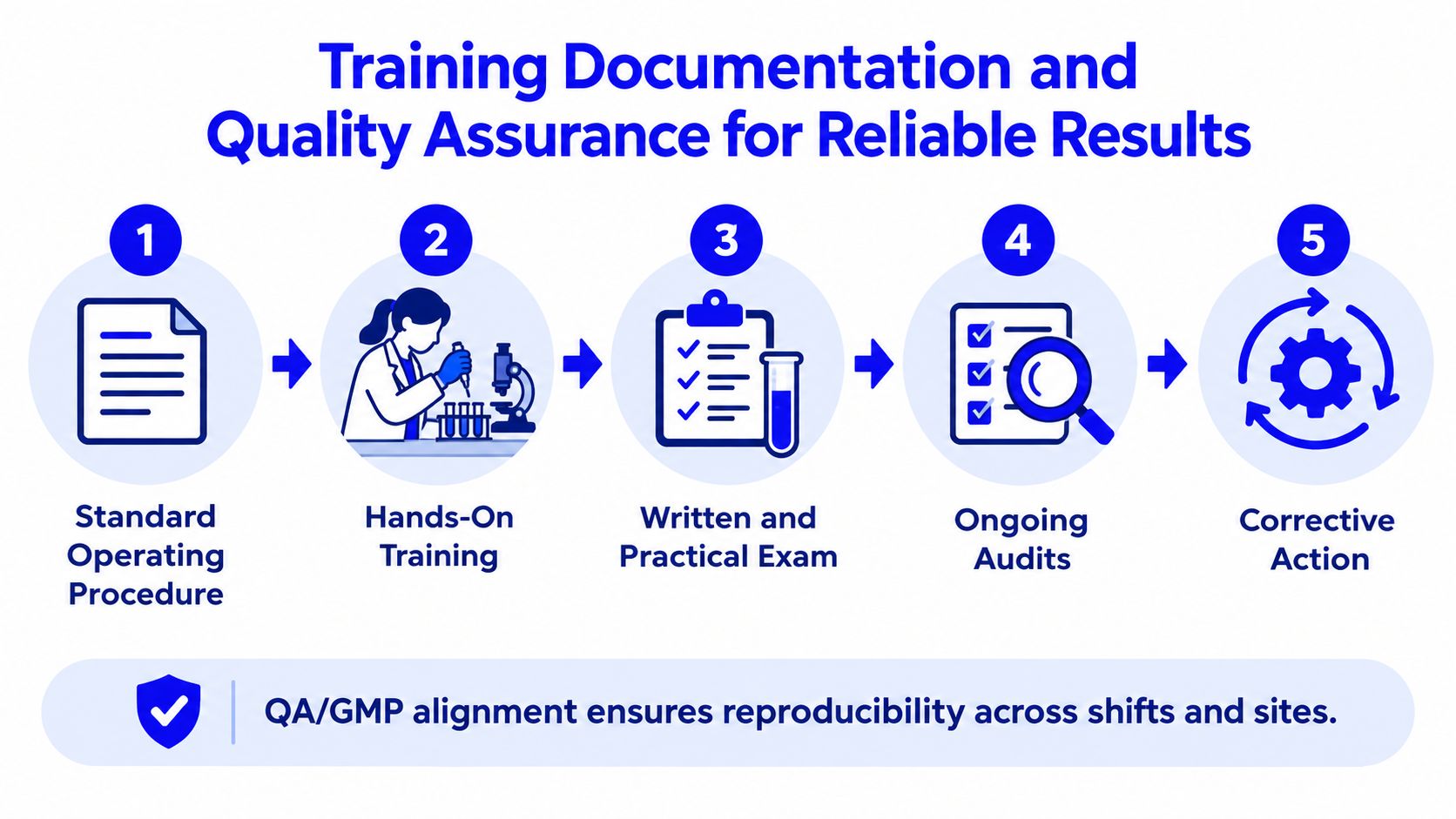
A better system checks whether the person can produce clean results repeatedly under realistic conditions. Useful QA-minded training usually includes:
- Written SOP control: The procedure exists in a stable, readable form.
- Observed bench practice: A trainer watches hand placement, sequencing, and exposure control.
- Practical verification: The operator demonstrates contamination-free execution.
- Retraining triggers: Errors, deviations, or trend changes lead to review.
- Documentation trail: The lab can show who was trained, how, and when.
Teams formalizing these materials can use resources on scalable SOPs and training tools to make documentation easier to maintain across growing groups.
Quality assurance supports reproducibility
Microbiology and QA thinking meet here. Reliable results don't come only from sterile supplies. They come from controlled systems. That includes batch review, traceability, training records, and clear handling procedures for sterile materials.
In RUO environments, documentation is especially useful for repeat-preparation workflows. A lot-specific COA, a defined preparation method, and a recorded handling sequence help a lab distinguish material issues from operator issues. One option used in such workflows is Herbilabs sterile reconstitution solution supplied with lot-specific documentation and produced with 0.22 µm filtration, which fits labs that need traceable sterile diluent handling within documented prep systems.
Why systems matter even for skilled operators
Even careful researchers drift over time. Shortcuts creep in when workloads increase, bench spaces change, or repeated tasks start to feel routine. A quality system catches that drift earlier than memory alone.
Good aseptic culture in a lab usually sounds simple:
- The SOP is clear.
- The bench setup is standardized.
- Training includes hands-on verification.
- Deviations are recorded and reviewed.
- Corrective actions change behavior, not just paperwork.
That is how a lab turns aseptic technique from a personal habit into a reproducible operational control.
Putting Aseptic Principles Into Practice
The clearest answer to why aseptic technique is important in microbiology is that it protects the meaning of the result. Without it, a culture may still grow, a reagent may still dissolve, and an assay may still produce data. But the result may no longer reflect the intended biology.
Human variation is a major part of that reality. A controlled study found IV dose contamination ranged from 0.0% for a pharmacy operator to 6.9% for nurses, with contamination differing significantly between nurses at about 2% to 17%, as reported in this study on operator-dependent contamination differences. The lesson is direct. Knowing the rule is not the same as executing it well.
For day-to-day microbiology work, three habits matter most:
- Reduce exposure: Open sterile or pure materials only when everything else is ready.
- Control contact: Protect hands, tools, vial tops, lids, and transfer paths from avoidable touch contamination.
- Standardize the sequence: Use the same clean setup and handling rhythm every time.
Those habits apply whether the task is streaking a plate, preparing a broth inoculum, or repeatedly accessing sterile diluents such as bacteriostatic water in RUO workflows. The goal stays the same. Keep unwanted biology out so the intended biology can be interpreted with confidence.
Aseptic technique is a learnable skill. It improves when labs teach it clearly, verify it practically, and treat it as part of scientific quality rather than bench etiquette.
Herbilabs offers sterile diluents and related RUO labware for researchers who need controlled preparation workflows, lot-specific documentation, and consistent handling materials. For teams working to reduce contamination risk during reconstitution and repeated vial access, the guidance and product information at Herbilabs can support more disciplined sterile practice.