Private Label, White Label, Wholesale partnerships available - EU, USA and UK - Free shipping from €75

28 Day Rule for Multi-Use Vials: How the Clock Works
The 28 day rule allows use of a multi-use vial for up to 28 days after first puncture, unless the label specifies another period or the original expiry date comes sooner. That window can end earlier if handling, storage, or sterility becomes questionable.
But what does a discard date prove if nobody recorded the first puncture? A calendar reminder is only useful when the laboratory can show when the clock started and whether the vial remained suitable throughout its use.
Table of Contents
- What the 28 Day Rule Actually Measures
- When the Clock Starts, Stops Early, or Cannot Be Proven
- How to Date and Track a Punctured Vial
- Aseptic Habits That Keep the Window Valid
- Planning Draws Inside One 28 Day Window
- Set Your Discard Dates Before the Next Draw
What the 28 Day Rule Actually Measures
The 28 day rule is a default beyond-use limit, not a replacement for the manufacturer's expiry date. U.S. Food and Drug Administration guidance establishes a 28-day period for an opened or entered multi-dose container unless the manufacturer specifies another period on the label.
A sealed jar offers a useful analogy. Before opening, its printed date governs; after opening, an additional use-by instruction may apply. Opening it doesn't erase the original date or promise that poor handling won't spoil the contents sooner.
For a vial, the laboratory must distinguish three dates: the manufacturer's expiry, the first-puncture date, and the calculated discard date. The first belongs to the original product, the second records an event, and the third tells staff when continued use must stop.
Which Date Governs Each Vial State
| Vial state | Clock that applies | Governing date |
|---|---|---|
| Sealed, never punctured | Manufacturer expiry on the label | Labeled expiry date |
| Punctured, no other label period | 28 day beyond-use period from first puncture | Puncture date plus 28 days |
| Punctured, original expiry earlier than day 28 | Original expiry date | Earlier of expiry or day 28 |
| Punctured, label sets a shorter period | Manufacturer's stated period | Puncture date plus that period, without exceeding original expiry |
A manufacturer-specified period printed on the label replaces the default. Staff should look for post-access instructions on the product label, in the package insert, and in accompanying quality documentation rather than assuming every multi-use container follows the same schedule.
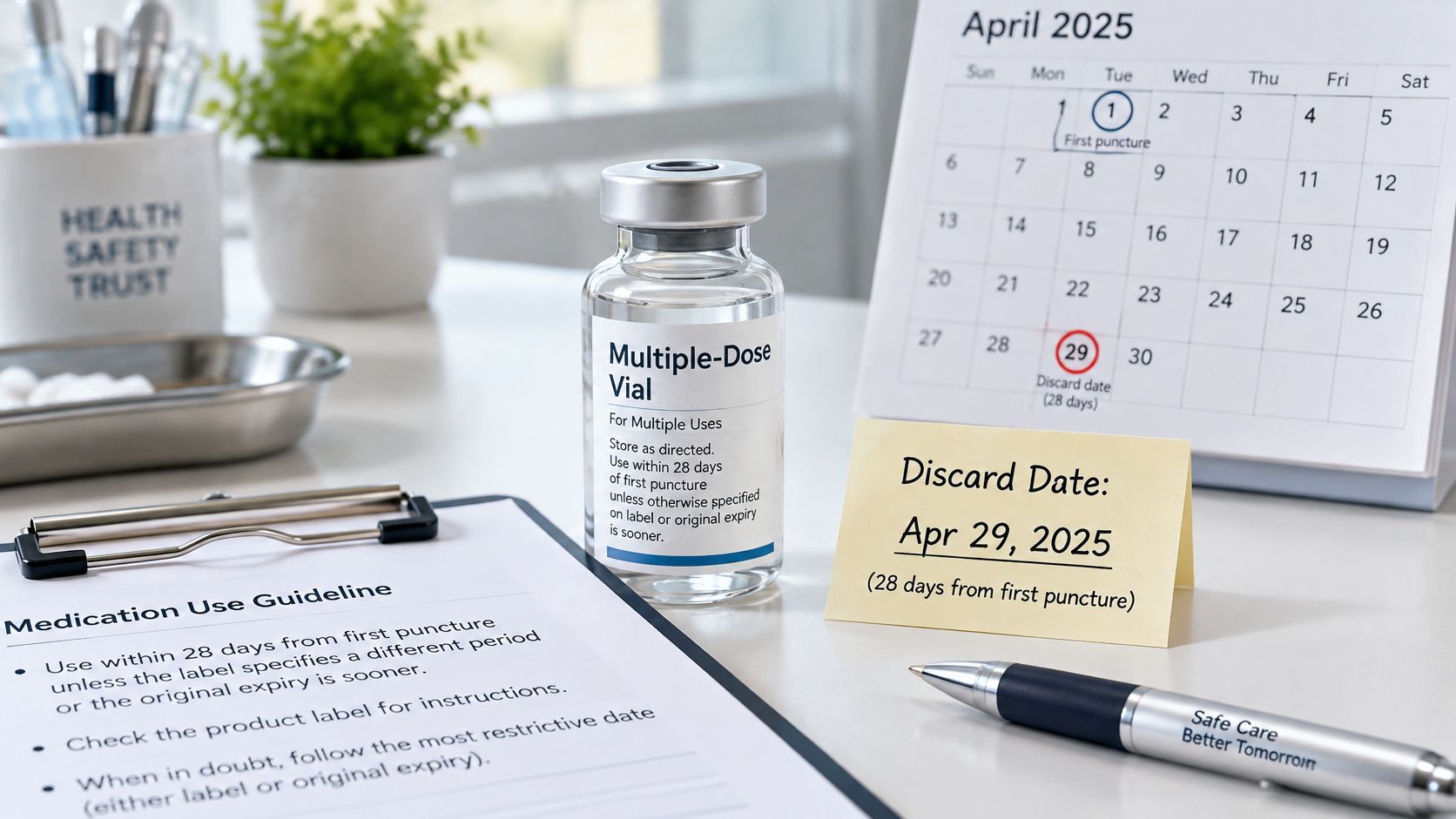
For laboratory context, bacteriostatic water may be supplied in multi-use glass vials containing 0.9% benzyl alcohol, with storage at 15–25 °C and research-use-only labeling. Those product conditions belong alongside the dating instructions, not in a separate mental checklist.
Practical rule: A discard date sets the latest permitted use under the applicable conditions. It doesn't certify that sterility will last until that date.
The immediate task is straightforward: locate the printed expiry, establish the first-puncture date, and identify the controlling discard date. Any suspected sterility breach can end use before that date arrives.
When the Clock Starts, Stops Early, or Cannot Be Proven
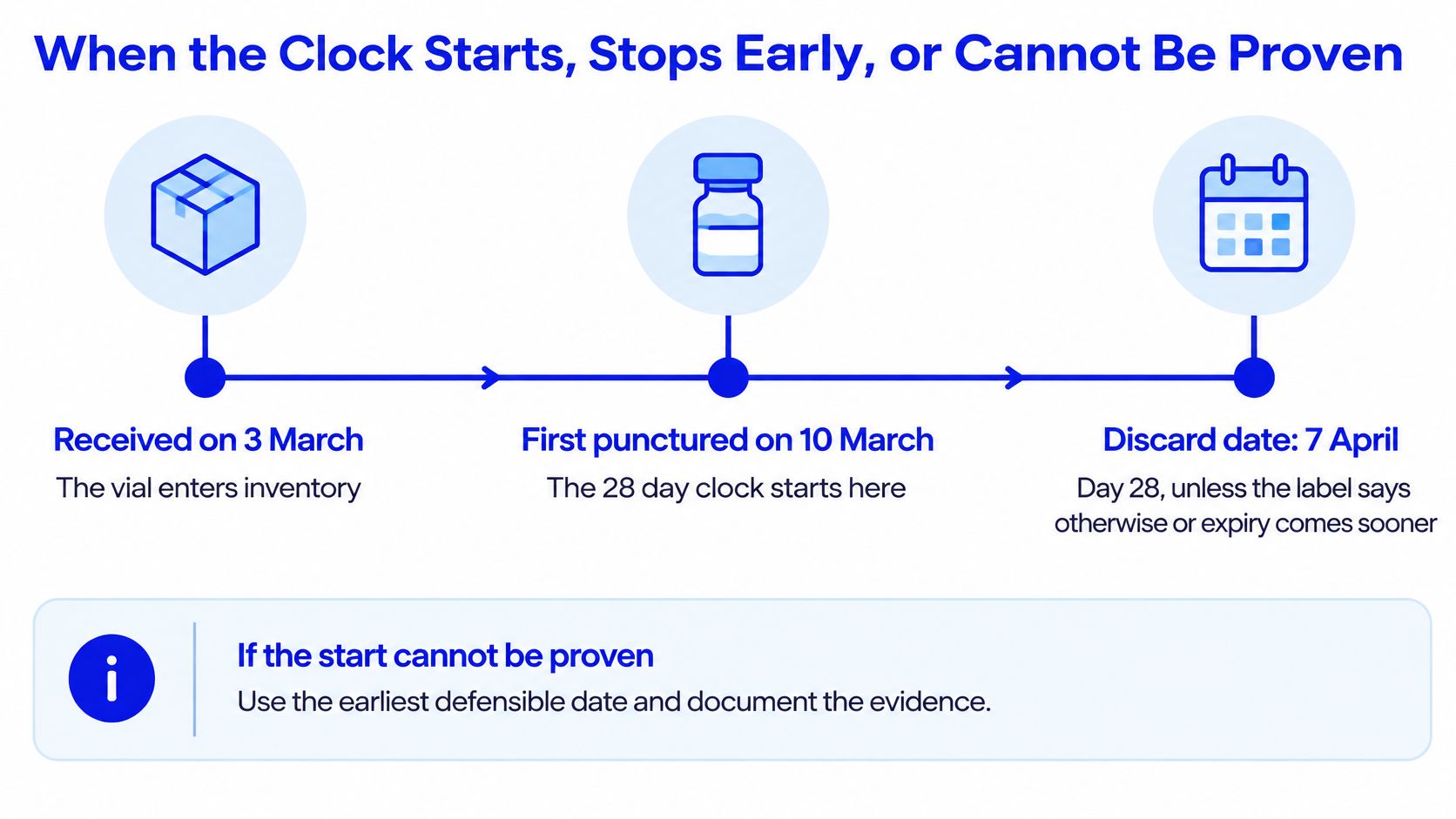
Consider a hypothetical vial received on 3 March, bearing a labeled expiry of 2 November. Its first puncture occurs on 10 March, so the default calculation gives 7 April as the discard date. Arrival and shelving didn't start the clock; first entry did.
In this example, 10 March is day 0, and recording the entry time removes uncertainty about the endpoint. The Joint Commission's multi-dose vial guidance describes a 28-day beyond-use date after puncture unless the manufacturer specifies another period, without extending the original expiry.
Now consider another hypothetical first puncture on 20 October, with the same 2 November expiry. Only 13 days separate those dates, so the vial must be retired on 2 November, not kept until the full post-puncture interval has elapsed.
Events That End Use Before the Scheduled Date
The CDC's vial-handling guidance makes the calendar conditional on appropriate storage, handling, and confidence in sterility. In a laboratory workflow, the following events require action immediately:
- Sterility concern: Suspected contamination ends continued use, even when material remains.
- Visible change: Unexpected cloudiness, particles, or another abnormal appearance requires rejection.
- Stopper damage: Cracks, leakage, or a compromised closure invalidate routine access.
- Storage excursion: For material labeled for 15–25 °C, an excursion outside that range requires quarantine and review.
- Undocumented puncture: An unverified access history means the window cannot be established.
- Shorter label period: A manufacturer's shorter interval brings the endpoint forward.
Quarantine means removing a vial from available inventory while an authorized person evaluates the issue. It isn't permission to continue drawing from it during that review.
Common Misunderstandings
- Arrival isn't first access: Receiving a parcel or placing a vial on a shelf doesn't start the post-puncture clock.
- Cooling isn't a reset: Changing temperature doesn't erase elapsed time and may conflict with labeled storage.
- Sealed isn't punctured: An unopened vial follows its labeled expiry.
- Preserved isn't protected from every mistake: A preservative doesn't make aseptic technique optional.
Edge Cases and What to Do
| Situation | Action | Reason |
|---|---|---|
| First-puncture date missing | Treat access history as unverified and discard | The window cannot be proven |
| Original expiry falls before day 28 | Use the earlier expiry date | Expiry is never extended |
| Storage outside 15–25 °C | Quarantine and check the label for guidance | Excursions can change the material |
| Visible change or stopper damage | Discard the vial | Sterility cannot be confirmed |
| Label gives a shorter period than 28 days | Follow the label period | The manufacturer's limit controls |
A missing date shouldn't be reconstructed from a guess about when work probably began. If the access history cannot be proven, discard the vial.
How to Date and Track a Punctured Vial
A useful record connects the physical vial to its inventory history. The USP General Chapter 797 FAQs describe a general component-use limit of 28 days after initial entry for conventionally manufactured multiple-dose containers unless the manufacturer specifies another labeled limit.
A Routine That Leaves an Audit Trail
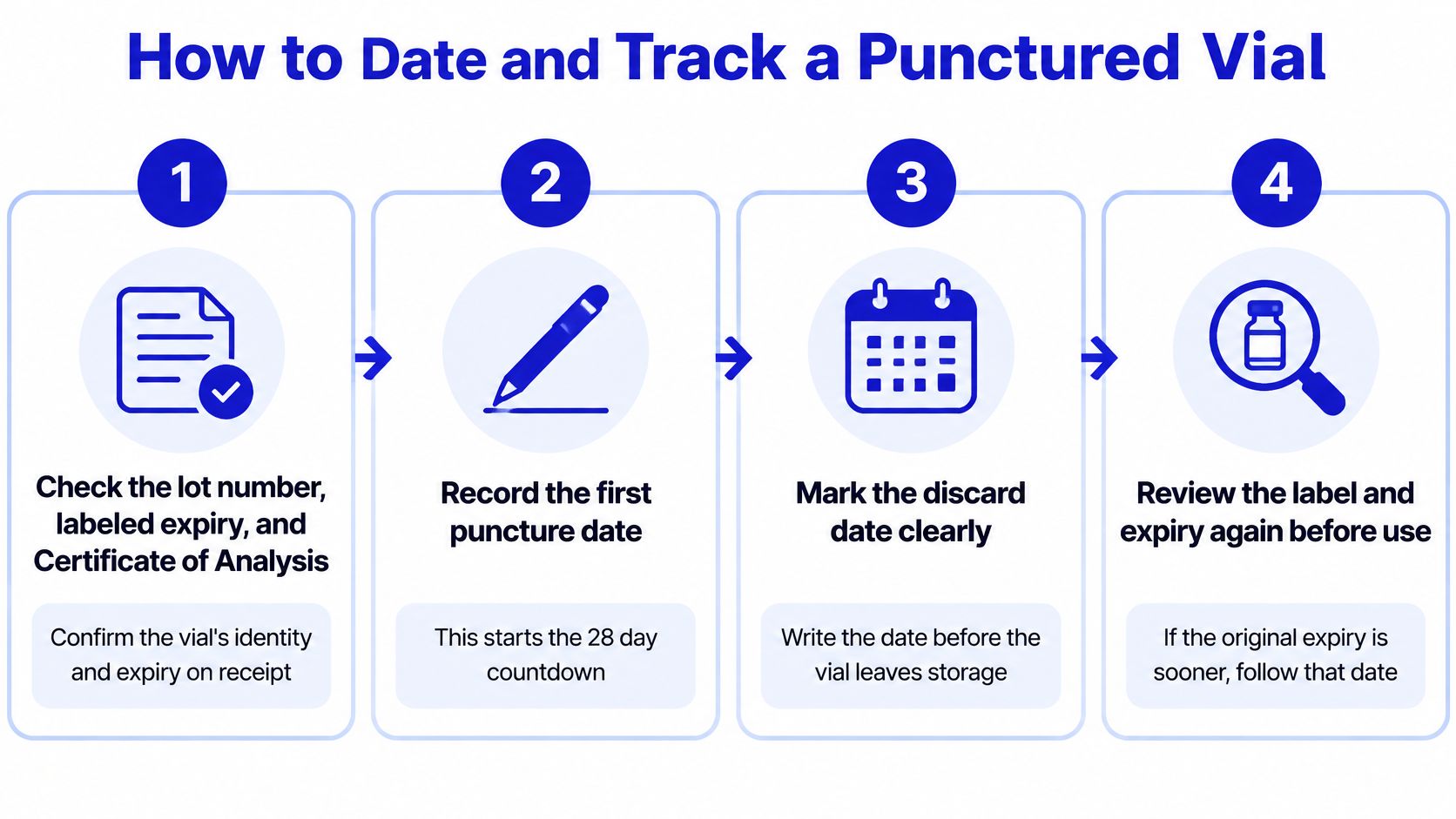
Check identity on receipt. Record the lot number, labeled expiry, and the Certificate of Analysis supplied with that lot. Herbilabs checks each lot through lot-specific Certificates of Analysis and quality assurance review before product release.
Prepare the first-entry record. Immediately before first access, prepare the label and record the actual puncture date and time when entry occurs. This prevents the receipt date from accidentally becoming the start date.
Calculate and compare. Under the default rule, calculate puncture date plus 28 days, then compare the result with the original expiry and any manufacturer-specified post-access period. Mark the controlling date clearly, including a time where the laboratory's procedure requires one.
Create a complete log entry. Keep the lot, operator, first-entry timestamp, storage check, and discard date together. A vial identifier helps distinguish separate containers from the same lot.
Return the vial to controlled storage. Keep the container closed at 15–25 °C for the Herbilabs laboratory workflow and away from unclean surfaces. Recording the storage location makes later checks easier.
Review before every draw. Confirm that the discard deadline hasn't passed and inspect the stopper and material. A failed check means removing the vial from use, with quarantine or disposal determined by the documented issue.
Record disposal. Retire the vial on or before its deadline and log the disposal. Leaving an expired container beside usable stock invites an avoidable selection error.
Keep Reminders Separate From the Official Record
For teams that benefit from visual reminders, Pretty Progress explains how to track deadlines with visible countdowns. Such a display can supplement the inventory log, but it shouldn't replace the vial label or become the only record of first access.
The reminder prompts a check. The controlled record supports the decision.
A source vial's component-use limit is separate from the beyond-use date assigned to material prepared from it. Transferring material into another container doesn't automatically give the resulting preparation the source vial's remaining lifetime.
The laboratory should therefore maintain separate preparation records and consult storage guidance for reconstituted lab samples where relevant. Its SOP should define first-puncture dating, authorized handling, storage conditions, and a hard discard date, with the lot number and COA linked to each use record.
Aseptic Habits That Keep the Window Valid
The preservative supports a multi-use design; it doesn't replace clean technique. FDA bacteriostatic-water labeling describes sterile, nonpyrogenic preparations that include a 0.9% benzyl alcohol formulation, equivalent to 9 mg/mL, in multi-dose containers permitting repeated withdrawals.
Formulations can differ, so the specific label remains essential. Plain sterile water and preserved bacteriostatic water shouldn't be treated as interchangeable merely because both appear clear.
A seatbelt is a useful comparison: it adds protection, but it doesn't make careless driving safe. Likewise, a preservative doesn't justify a reused access device, a contaminated stopper, or a damaged closure.
Handling Habits That Protect the Window
| Habit | What it prevents | Common slip |
|---|---|---|
| New sterile needle and syringe for every draw | Transfer of microbes from used equipment or contaminated handling | Reusing one needle across several draws |
| Disinfect the stopper and let it dry before entry | Surface contaminants carried into the vial | Entering a wet or unwiped stopper |
| Never leave a needle inserted | Persistent access pathway and loss of closure integrity | Parking the needle in the stopper between draws |
| Close the vial between draws | Unnecessary air and surface exposure | Leaving it open on the bench |
| Inspect the stopper before each entry | Missed cracks or damage | Skipping the check on busy days |
The CDC's aseptic handling recommendations support sterile access equipment, stopper cleaning, appropriate storage, and rejection whenever sterility is compromised or questionable. These are conditions of continued use, not optional refinements.
Make Each Entry Deliberate
A new sterile needle and syringe should be ready before handling begins. If an access device touches an unclean surface, replacing it is more defensible than trying to judge whether the contact mattered.
The stopper should be disinfected and allowed to dry before entry. Leaving a needle inserted between draws defeats the purpose of restoring a closed container, so equipment should be removed after the withdrawal and the closure left intact.
Keeping a vial closed doesn't mean replacing its original protective cap and treating that as a sterile seal. The essential checks concern the stopper's integrity, cleanliness, and freedom from unnecessary exposure.
Herbilabs's aseptic reagent handling advice from Herbilabs can support a consistent bench routine. A suspected breach means quarantine rather than continued use, regardless of how much time remains on the calendar.
Planning Draws Inside One 28 Day Window
Consider a hypothetical project requiring two draws each week over four weeks, giving eight draws in total. A vial first punctured on 1 April has a calculated default discard date of 29 April, assuming its label, original expiry, and handling conditions permit that window.
The schedule below uses illustrative dates, not recommended withdrawal amounts. Days remaining are calculated as the difference between each planned date and the discard date.
| Planned draw | Illustrative date | Days remaining |
|---|---|---|
| First | 1 April | 28 |
| Second | 4 April | 25 |
| Third | 8 April | 21 |
| Fourth | 11 April | 18 |
| Fifth | 15 April | 14 |
| Sixth | 18 April | 11 |
| Seventh | 22 April | 7 |
| Eighth | 25 April | 4 |
All planned draws fit before the endpoint. A delayed experiment moved beyond that endpoint would require a fresh vial with its own first-puncture record, not a handwritten extension.
Plan for Delays Without Extending Use
Grouping compatible work earlier in the available window leaves scheduling room for a postponed experiment. For a hypothetical April planning exercise, Dayleaf's printable calendar for April 2027 provides a place to mark proposed draw dates and the discard deadline; it isn't evidence that a particular vial remains suitable.
A reusable planning check can stay short:
- Place every draw: List actual calendar dates rather than relying on a weekly pattern.
- Check the final event: Confirm the last planned withdrawal precedes the controlling deadline.
- Preserve traceability: Where feasible, keep a project segment within a single lot and COA.
- Review open stock weekly: List each vial's discard date and days remaining.
A delayed experiment changes the schedule, not the vial's permitted lifetime.
Keeping one lot within a project window can simplify interpretation, but each physical vial still needs its own access record. Shared lot identity doesn't establish a shared puncture date.
Set Your Discard Dates Before the Next Draw
The next decision isn't whether an open vial still contains useful material. It's whether the laboratory has enough evidence to keep that vial in service.
A clear label and a matching inventory entry make that decision routine. An unclear history turns the next withdrawal into an assumption.
Put the Open-Vial Inventory in Order
- First, audit every open vial. Confirm that its identifier, first-puncture date, and discard date agree with the inventory log. A vial without a provable puncture date should be treated as unverified and discarded, not assigned a convenient replacement date.
- Second, plan fresh starts for reconstitution work. Opening a fresh vial for each reconstitution batch gives that vial a distinct, documented in-use period and suits laboratories processing many small vials. Vial capacity should match the draws planned within the permitted window rather than encourage use beyond it.
- Third, connect the COA before first entry. Check the lot's Certificate of Analysis and attach its reference to the vial's log entry. Keeping those records together makes later review possible without relying on the original operator's memory.
For Herbilabs, each multi-dose vial supports repeated withdrawals for up to 28 days after first puncture with aseptic handling. The Reconstitution Solution 10 mL vial follows that same conditional in-use period; capacity doesn't change the dating requirement.
Make the Weekly Review a Decision Point
The weekly inventory review should show each open vial's discard date and days remaining, alongside any unresolved storage or handling issue. Staff should remove retired stock from the usable inventory rather than leave it on the bench awaiting a quieter day.
A simple log is enough if it's complete, legible, and consistently maintained. An elaborate tracking system offers little value when staff omit the first entry or fail to record disposal.
The practical standard is reassuringly clear: a vial past its discard date is retired, not extended. With the start recorded and exceptions handled promptly, laboratory staff can make the next draw decision from evidence rather than guesswork.
Signed, the Herbilabs team.
Herbilabs offers research-use-only bacteriostatic water and lot-specific Certificates of Analysis to support documented laboratory workflows. Laboratory teams can visit Herbilabs to review available supplies and quality documentation before establishing the next vial's first-puncture record and discard date.