Private Label, White Label, Wholesale partnerships available - EU, USA and UK - Free shipping from €75

Vial for Injection: Types, Sizes and Handling Guide
A vial can pass a sterility test without that result proving its closure will protect the contents throughout storage and repeated access. Container integrity, preservative effectiveness and laboratory handling answer different questions. For researchers evaluating a vial for injection format for laboratory work, the useful starting point isn't the glass alone, but the container, closure and records together.
This guide addresses research-use-only workflows, not human or veterinary use. It separates material selection from handling controls so researchers and QA staff can assess what a vial's documentation supports.
By Herbilabs
Table of Contents
- Vial Formats and Sizes at a Glance
- Choosing Single-Use or Multi-Use Vials
- How Glass, Stoppers and Seals Work as One System
- Reading the 28-Day Rule for Each Vial State
- How to Handle a Multi-Use Vial Without Contamination
- Storage Conditions and When to Quarantine a Vial
- Reviewing a COA and Closure Records Before You Buy
- Next Steps and Related Topics
Vial Formats and Sizes at a Glance
Vial formats at a glance
| Format | Closure | Withdrawals | Use limit after opening | Best fit |
|---|---|---|---|---|
| Single-dose glass vial | Elastomeric stopper and crimp seal | One | Discard after the single use | One-time transfer of one material |
| Multi-dose glass vial | Elastomeric stopper and crimp seal | Repeated | 28 days after first puncture unless the manufacturer specifies otherwise | Several reconstitutions or withdrawals from one vial |
| Plastic vial | Screw or snap closure | Single or repeated access as documented | Product-specific, check documentation | Lower breakage risk in transit, compatibility to confirm |
| Type I borosilicate glass vial | Stopper and seal | Single or repeated access according to the labeled format | Labeled expiry before opening; format-specific limit afterward | Common glass baseline for chemical stability |
The table combines two different classifications: access format and container material. Single-use and multi-use describe the intended access pattern. Type I borosilicate describes the glass, so a borosilicate vial may belong to either access category.
A single-use vial suits a transfer that finishes in one session. Remaining liquid doesn't make the container suitable for another session, and a stopper that appears resealable doesn't change the labeled format.
Match capacity to the work schedule
A multi-use vial supports a planned series of withdrawals, provided its documentation permits that workflow. Plastic can reduce breakage concerns during transport, but the laboratory still needs to confirm compatibility between the particular plastic and the stored material.
For planning, consider these illustrative volume bands, not recommended reconstitution amounts:
- About 3 mL: A capacity to consider for one reconstitution of a small lyophilised material.
- 10 mL: A capacity to assess for several reconstitutions within the permitted in-use window.
- 20 to 30 mL: Capacities to evaluate for larger batches drawn over that same window.
These examples describe container selection, not how much diluent any material requires. The worksheet and material-specific procedure determine the actual volume.
Selection rule: Choose the format and volume first, then check the closure components and supporting records.
The useful comparison is the volume the laboratory expects to withdraw before discard, not the purchase price per vial.
Choosing Single-Use or Multi-Use Vials
The decision starts with the withdrawal schedule, not the apparent convenience of a larger container. A lab manager can compare the formats using the following criteria:
- Transfer frequency: A single reconstitution has a different handling burden from withdrawals spread across several sessions.
- Volume per session: Small withdrawals may leave substantial material unused in a large container.
- Repeated-access risk: Every entry adds another opportunity for a handling error.
- Discarded remainder: Compare the material likely to be discarded, not just the nominal fill.
- Operator access: A shared vial needs a record that different staff members can interpret consistently.
- Storage capability: The laboratory must maintain the specified conditions between sessions.
Single-use vials suit one-time transfers and leave no ongoing puncture history to manage. Multi-use vials can reduce waste and effective cost per millilitre when the laboratory uses the contents within the permitted window. That saving isn't automatic: unused remainder, extra documentation and a rejected vial can change the comparison.
A worked withdrawal schedule
Consider a hypothetical laboratory that reconstitutes a small lyophilised material on Monday and needs five more transfers over the following two weeks. A 10 mL multi-use vial could support that schedule if its usable contents cover the worksheet total and its documentation permits the planned access.
For a product with a 28-day in-use period, that hypothetical schedule falls within the calendar limit. It doesn't establish that the material remains acceptable: storage, puncture count, compatibility and handling must also remain within the laboratory's controls.
Opening a fresh vial for each batch gives each container its own opening record and discard plan. That approach may be preferable when different operators prepare batches or when a deviation would otherwise affect several projects.
A vial intended for repeated access beyond the first week needs multi-use handling records from its first puncture, not a reconstructed history later.
How Glass, Stoppers and Seals Work as One System
The FDA's foundational container-closure documentation guideline appeared in February 1987, and its final guidance, Container Closure Systems for Packaging Human Drugs and Biologics, followed in July 1999, replacing the earlier guideline. The central principle is that protection depends on the assembled container-closure system, not an isolated glass specification.
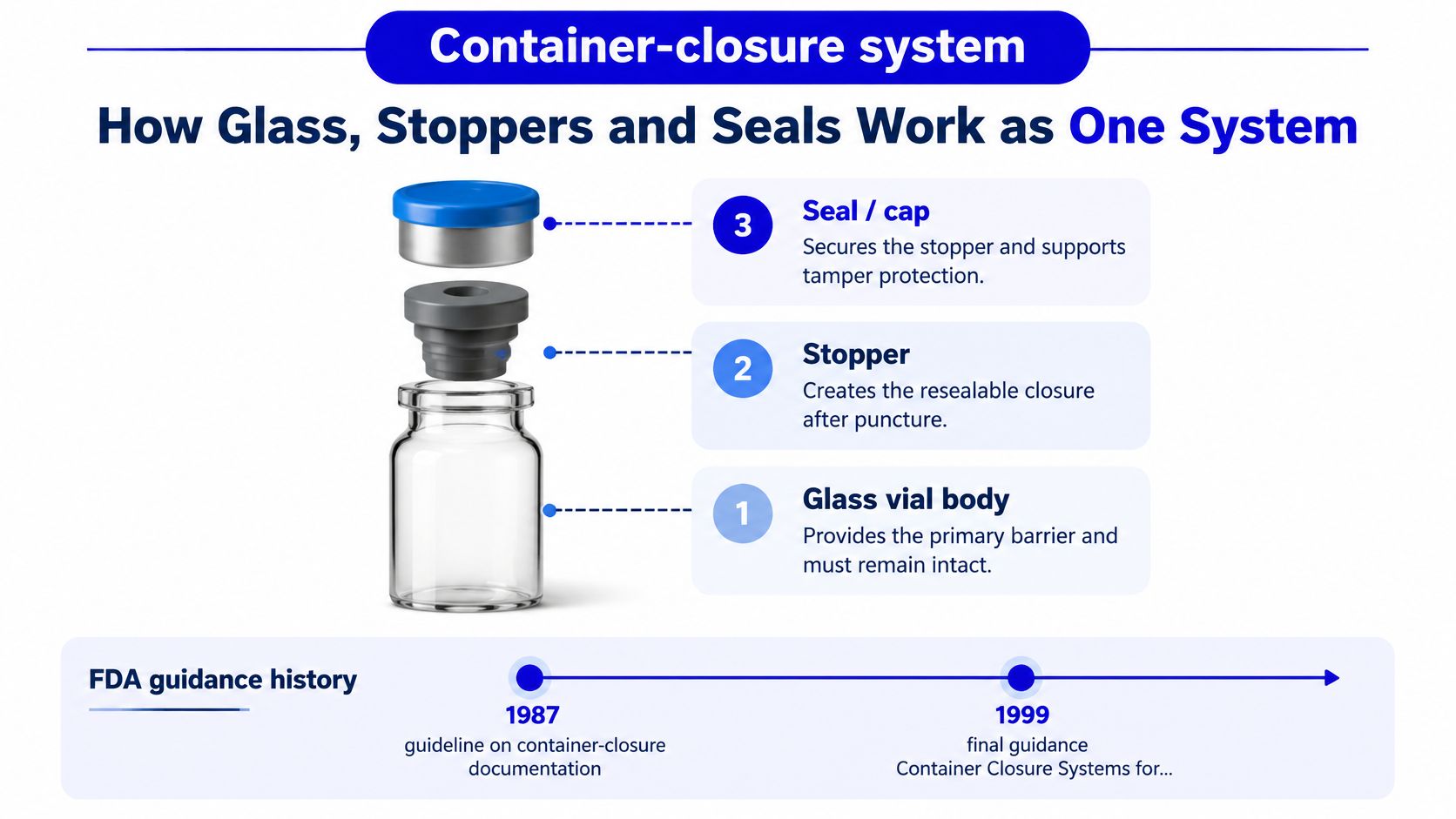
What each component contributes
The glass body provides the primary physical barrier. Type I borosilicate is a common baseline for chemical resistance, but the material name doesn't eliminate breakage risk or establish compatibility with every preparation. On arrival, the buyer should confirm that the specification names the glass type and inspect the body and neck for damage.
The elastomeric stopper closes the opening and receives the access device. Its suitability includes puncture performance, resealing behaviour, extractables and leachables, and moisture or gas transmission. The buyer should verify that the stopper material is identified rather than described only as rubber.
The crimp seal holds the stopper in position. An intact-looking cap isn't a complete integrity test, but a loose, distorted or lifted seal is an actionable defect. Receiving staff should inspect its seating without pulling or twisting it.
Outer packaging protects the assembled vial during shipping and storage. Crushed dividers, wet cartons or displaced protective inserts warrant inspection and a receiving deviation, even when the vial initially appears intact.
Why repeated punctures need records
The stopper is the component deliberately penetrated during use, making it a critical control point for a multi-use vial. Repeated punctures can damage the access area; appearance alone can't establish whether the system still meets its intended performance.
A useful record therefore identifies the supplied closure configuration and tracks access against an established SOP limit. A generic statement that the glass is suitable doesn't answer whether the actual stopper and seal support the planned workflow.
Before purchase, the specification sheet should confirm:
- Component identity: Named glass and stopper materials, with seal details.
- Configuration suitability: Evidence applicable to the assembled vial and intended access pattern.
- Protection conditions: Storage requirements and relevant integrity or compatibility documentation.
Reading the 28-Day Rule for Each Vial State
Twenty-eight days isn't a universal expiry date. The CDC safe-injection checklist gives 28 days as the general discard interval after puncturing a multi-dose vial unless the manufacturer specifies another period; an unopened vial remains governed by its labeled expiration date.
Governing limit for each vial state
| Vial state | Governing limit | What to record |
|---|---|---|
| Unopened vial | Manufacturer expiration date on the label | Lot, expiry and storage history |
| First puncture of a multi-dose vial | 28 days unless the manufacturer specifies another period | Puncture date, time and operator |
| Product with a shorter stated limit | The shorter product-specific limit | The limit copied into the lot record |
| Vial used late in its window | Same 28-day ceiling under the default rule, with no automatic extension | Days remaining at each withdrawal |
| Suspected contamination or stopper damage | Discard now, regardless of days elapsed | Reason and quarantine entry |
Calendar permission isn't proof of suitability
Under the default rule, the interval is a ceiling, not a guarantee. A vial may become unacceptable sooner because of a damaged closure, uncertain storage or a handling deviation. A manufacturer-specified alternative must be supported by the product documentation, not inferred from another product.
The same distinction matters when reviewing bacteriostatic water. Preservative presence doesn't establish how a particular opened vial was handled.
A common question concerns material prepared near the end of the vial's permitted window. The source vial's puncture limit and the hold time of the resulting preparation are separate decisions. A research laboratory should assign the latter through its written SOP, material-specific risk assessment and supporting validation, rather than automatically copying or extending the source vial's deadline.
Make the opening event traceable
The opening record should connect the container to its original lot and expiry, while preserving a clear history of storage and deviations:
- At first puncture: Record date, time, operator and vial identifier.
- During use: Record withdrawals and any handling or storage departure.
- At rejection: Record the reason and prevent further access.
The laboratory should write the calculated discard date on the vial label on the day of first puncture. A date entered later from memory isn't an adequate substitute.
How to Handle a Multi-Use Vial Without Contamination
No procedure can guarantee freedom from contamination after an uncontrolled event. The practical aim is to reduce opportunities for contamination and make deviations visible. The CDC handling checklist supports clean preparation areas, stopper disinfection and sterile single-use access devices, with a default 28-day opened-vial discard interval unless the manufacturer specifies otherwise.
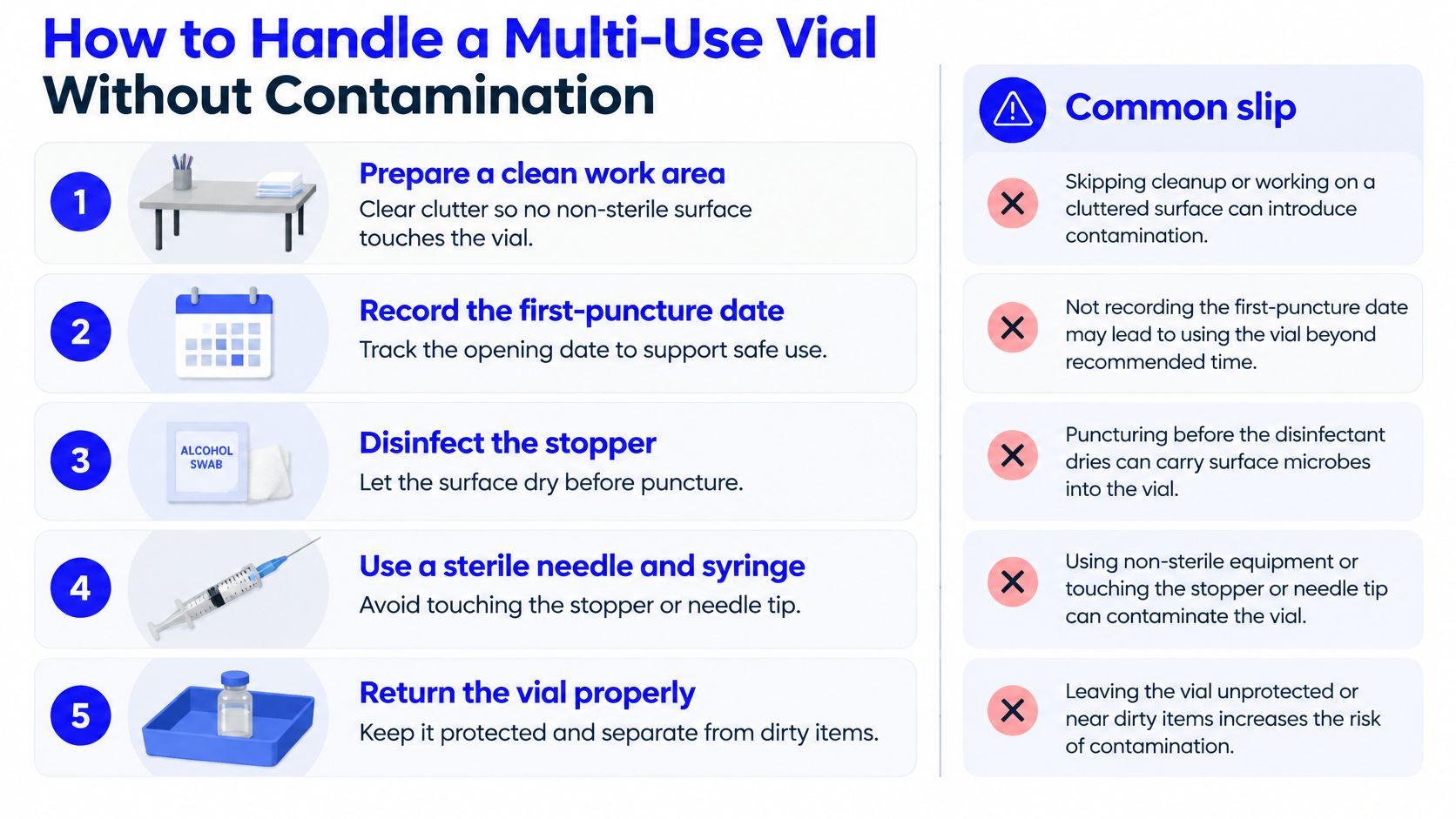
A bench procedure with failure points
Prepare a clean work area. Clear clutter and separate clean supplies from used equipment. A common slip is placing a prepared vial beside discarded wrappers or other dirty items.
Create the opening record. Enter the first-puncture date, time, operator or work area, and lot or vial identifier before access. Recording only a date can leave shared containers difficult to trace.
Inspect before use. Check for cracks, visible particles, unexpected cloudiness and a loose seal. Proceeding because the label hasn't expired ignores defects that require immediate segregation.
Maintain the labeled storage range. Plan retrieval and return so bench time remains controlled. Leaving a vial beside equipment until the end of a shift creates an undocumented exposure.
Disinfect the stopper before every entry and let it dry. Use the disinfectant and contact procedure established in the laboratory SOP. Skipping a wipe because the previous operator cleaned the stopper removes a necessary control.
Use a sterile single-use access device for each withdrawal. Open it when needed and protect its critical surfaces. Reusing a device can introduce contamination despite an apparently clean tip.
Avoid contact after disinfection. Fingers, gloves and non-sterile objects mustn't touch the prepared access area. Gloves aren't automatically sterile, and touching the stopper to steady the vial can undo preparation.
Restore applicable protective packaging promptly. Return the vial to its designated clean storage position. Packaging doesn't sterilise the closure, but leaving it off can expose the vial to avoidable handling and mix-ups.
Log the withdrawal and disposition. Record access, relevant observations and deviations, then apply the documented discard rule or any earlier stopping condition. A skipped entry can conceal that a puncture-count limit has been reached.
What an acceptable vial looks like
For a solution specified as clear, acceptable appearance includes clear liquid, an intact stopper and a legible label. The identifier should match both the handling record and the rack position, but normal appearance doesn't prove sterility.
The SOP should integrate these checks with sterile reagent handling practices, including operator training and segregation of compromised units.
Storage Conditions and When to Quarantine a Vial
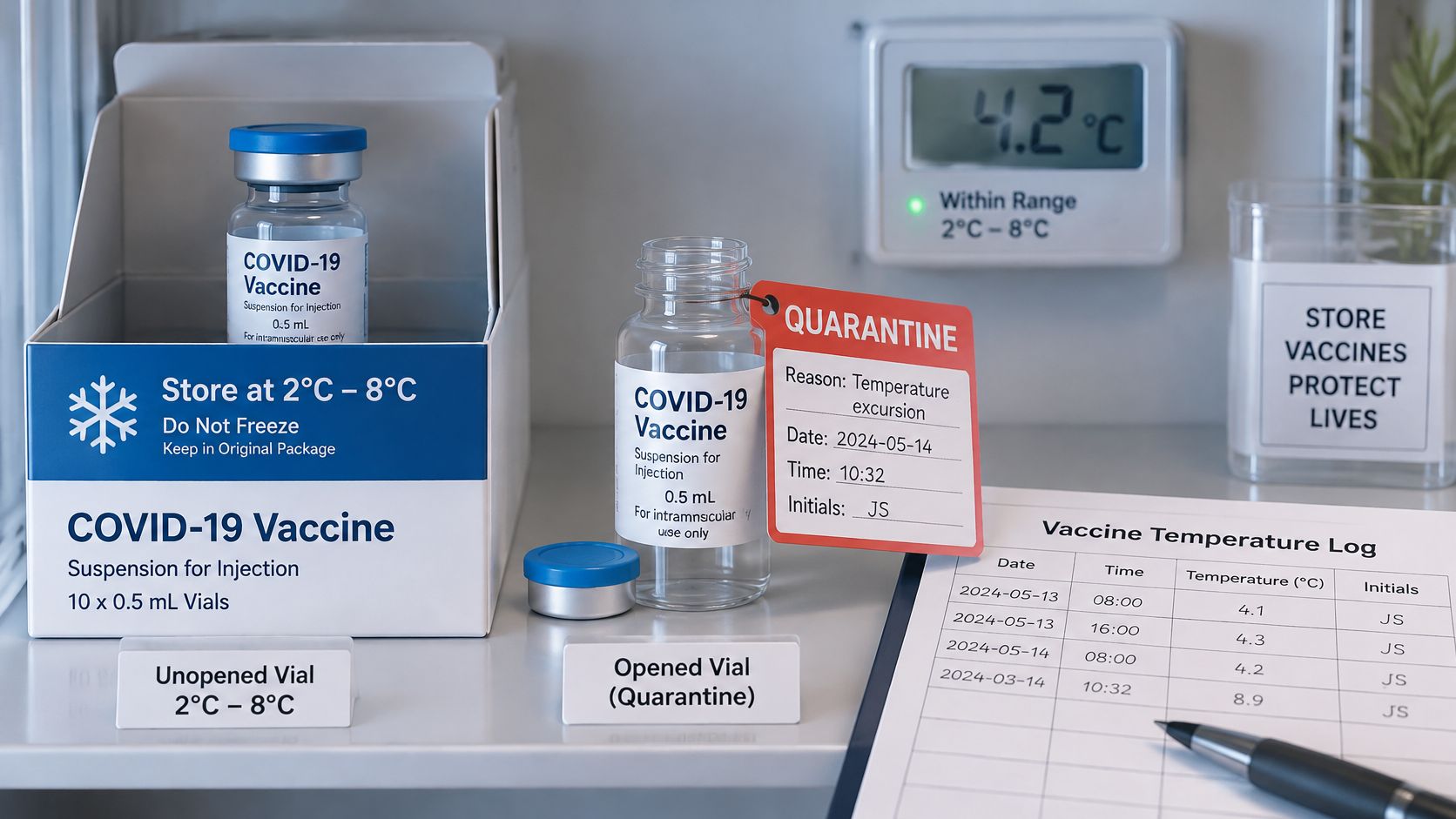
Unopened and opened vials both require the labeled storage conditions. Staff should avoid freezing unless explicitly permitted and document any excursion with its duration, temperature reached and affected vial identifiers. A refrigerator isn't the correct default for every material.
Supplier changes need review
FDA finalized its dedicated glass-vial and stopper component-change guidance in July 2024; its separate integrity guidance, finalized in February 2008, recommends appropriate stability-program integrity testing annually and at expiration, unless regulations require otherwise.
These are manufacturer-focused recommendations, not a requirement for laboratories to perform that testing schedule on every received vial. For procurement teams, the practical question is whether a component change affects the evidence supporting the supplied configuration. Change notification should cover stopper, seal and other relevant closure modifications.
Quarantine checklist
A vial should be removed from routine use when staff identify:
- Unexpected appearance: Particles or cloudiness inconsistent with the specification.
- Glass damage: Cracks, chips or other visible damage.
- Closure damage: A lifted or damaged stopper or loosened seal.
- Storage uncertainty: An excursion outside the permitted range or unknown storage history.
- Access-limit breach: Punctures exceeding the laboratory SOP limit.
- Lost identity: A missing or unreadable lot label.
Staff should mark the vial quarantined, segregate it physically and record the reason. QA should document the disposition, with disposal appropriate for suspected contamination or closure damage; moving the vial back to the rack doesn't resolve the deviation.
For workflows involving bac water, the same storage discipline applies between withdrawals. A storage log kept beside the vial rack makes missed entries easier to detect.
Reviewing a COA and Closure Records Before You Buy
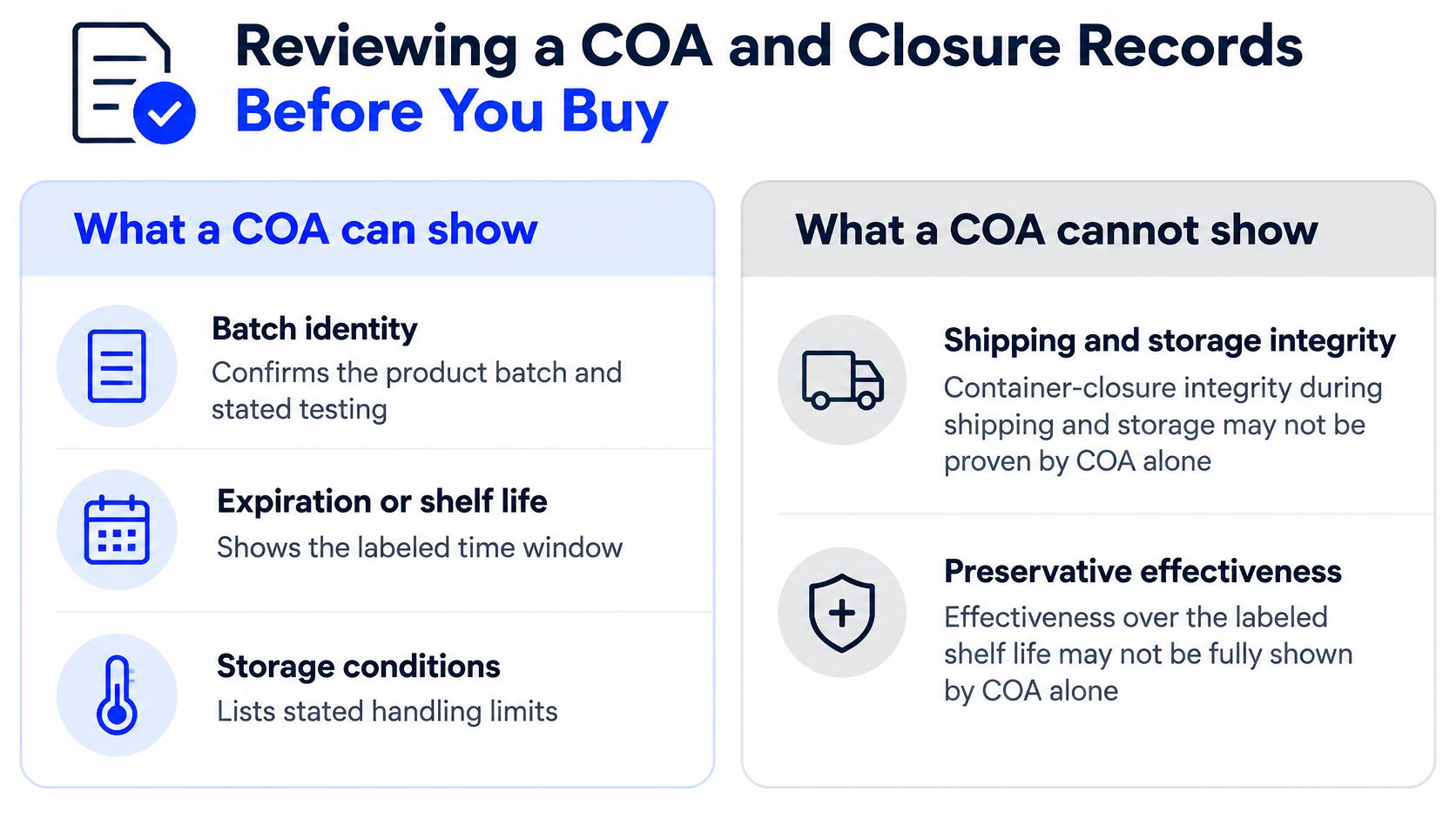
A Certificate of Analysis (COA) isn't a blanket assurance that every aspect of a vial's future use has been validated. FDA guidance on integrity and preservative effectiveness distinguishes protection provided by the container-closure system from antimicrobial effectiveness over the labeled shelf life. A reported sterility result doesn't answer both questions.
Closure and COA checks before approving a lot
| Document item | What to verify | Question for the supplier |
|---|---|---|
| COA for each lot | Lot number matches the vial label | Is a COA issued for every lot? |
| Sterility and endotoxin testing | Test scope and method are listed | Which tests apply to this vial configuration? |
| Preservative | Identity and stated concentration of benzyl alcohol, when present | Is the concentration specified per lot? |
| Container-closure specification | Stopper and seal materials are named | Which stopper and seal are used? |
| Storage statement | Labeled temperature range is stated | How are excursions addressed? |
| Change notification | Notice of closure or component changes | How are closure changes communicated to buyers? |
| Configuration coverage | Evidence covers the supplied vial, fill and closure combination | Does the supporting testing apply to this exact configuration? |
Match identity before interpreting results
Receiving staff should compare the lot number printed on the vial with the COA and the laboratory's lot record. A mismatch is a stop condition, even if the document reports acceptable results. A certificate for another lot doesn't establish the identity or quality of the received material.
Herbilabs provides a COA for every lot, and each vial in a pack carries the same lot number and COA. Individual opened-vial records still need separate identifiers because staff may open or store those vials differently.
Benzyl alcohol presence isn't proof of sterility or a substitute for aseptic technique. Likewise, evidence of preservative effectiveness doesn't establish that a damaged closure remains acceptable.
A printable QA approval check
- Identity: Does the vial lot match the COA and receiving record?
- Test scope: Are the relevant methods and results identifiable?
- Configuration: Does supporting evidence cover the actual supplied system?
- Conditions: Are storage and opened-use limits clear and workable?
- Exceptions: Have discrepancies and changes received documented review?
Approval boundary: No single document replaces supplier qualification, receiving inspection or the laboratory's deviation-control process.
Next Steps and Related Topics
The most useful related questions concern preservative function, access format and preparation arithmetic. They belong in the same purchasing decision, but they shouldn't be treated as interchangeable evidence.
Questions to bookmark before ordering
- Does benzyl alcohol replace aseptic technique? No. The COA review questions distinguish preservative documentation from closure evidence and handling controls.
- Does bacteriostatic water or sterile water fit the workflow? The withdrawal schedule should be established first using the single-use versus multi-use criteria. Material compatibility and diluent composition then require their own assessment.
- How much volume belongs in a reconstitution? The laboratory should check a worksheet before opening the vial. The capacity examples help select a container, but they don't determine the required reconstitution volume.
This guide covers vial format, handling and records. Diluent composition and material-specific preparation conditions belong to the applicable protocol and related technical guidance.
Put the decisions in operational order
A purchasing decision becomes useful only when the laboratory can translate it into a bench procedure:
- Select format and capacity. Match expected withdrawals to usable volume and available storage, rather than choosing solely on unit price.
- Set the discard plan. Define how the opening event produces a clearly labeled deadline and how earlier rejection conditions override it.
- Write the handling controls. Establish access technique, withdrawal records, storage monitoring and quarantine responsibilities.
- Review the evidence. Compare the COA and closure records with the approval table before releasing the lot for use.
For the publisher's laboratory workflow, Herbilabs' 10 mL vial is its most popular size and holds enough for several reconstitutions within its 28-day in-use period. Actual suitability still requires a worksheet total and product-compatible handling.
Opening a fresh vial for each reconstitution can suit laboratories processing many small lyophilised containers: each newly opened vial starts its own permitted period. That approach doesn't reset an older vial's clock or justify retaining an otherwise compromised container.
Final bench checks
The final checks should happen before equipment is laid out, not after material has been measured. The vial lot must match its COA, and the opening record must identify the particular container.
On opening day, staff should enter the first-puncture date and discard date on the label. Before measuring, another check of the reconstitution worksheet should confirm the intended volume, units and amount per draw. Those actions connect purchasing documentation to the material used at the bench.
Herbilabs offers research-use-only bacteriostatic water in multi-use glass vials, with a COA for every lot. Researchers and QA staff can visit Herbilabs to review the available 10 mL vial and 10 × 10 mL kit, then match the product documentation to the laboratory's handling and storage SOP.