Private Label, White Label, Wholesale partnerships available - EU, USA and UK - Free shipping from €75

What Is Sodium Chloride Used for in IV Therapy?
Intravenous sodium chloride, most often 0.9% normal saline, is used to deliver water and electrolytes, restore extracellular fluid, dilute compatible injectable medicines, and flush or prime IV lines. Each liter contains 9 g of sodium chloride, providing 154 mEq of sodium and 154 mEq of chloride.
A patient may encounter it in several very different situations. Someone who arrives dehydrated may receive it for extracellular-volume replacement. A clinician may use it to prepare an IV antibiotic, while a nurse may flush a catheter with a labeled saline presentation before a contrast scan. The bag looks simple, but its concentration, sterility, intended use, and compatibility determine whether it's appropriate.
The important question isn't only, “What is sodium chloride used for in IV therapy?” It's also, “Which role does it serve here, and could another fluid be safer for this patient?” Normal saline can support circulation and medication delivery, but large or unsuitable doses may worsen fluid overload, sodium excess, or chloride-related acid-base problems.
Table of Contents
- Why Sodium Chloride Matters in an IV Line
- What 0.9% Sodium Chloride Contains
- The Main Clinical Roles of IV Sodium Chloride
- Formulation Differences That Change the Decision
- When IV Sodium Chloride Can Be the Wrong Choice
- Supply Continuity and the Research vs Clinical Divide
- A Practical Framework for Choosing Sodium Chloride in IV Use
Why Sodium Chloride Matters in an IV Line
A patient arrives after fluid loss, needs an injectable antibiotic, or has a catheter that must remain open. In each situation, 0.9% normal saline may appear in the IV setup, but it is serving a different purpose. The same clear solution can replace extracellular fluid, carry a compatible medicine, flush a vascular-access device, or prime equipment.
U.S. labeling describes 0.9% sodium chloride injection as a source of water and electrolytes and as an option for extracellular-fluid replacement and mild sodium depletion (FDA labeling for 0.9% sodium chloride injection). The labeling also identifies uses involving metabolic alkalosis associated with fluid loss, hemodialysis priming, and blood transfusion procedures. These labeled roles show why “saline” is not one single clinical action.
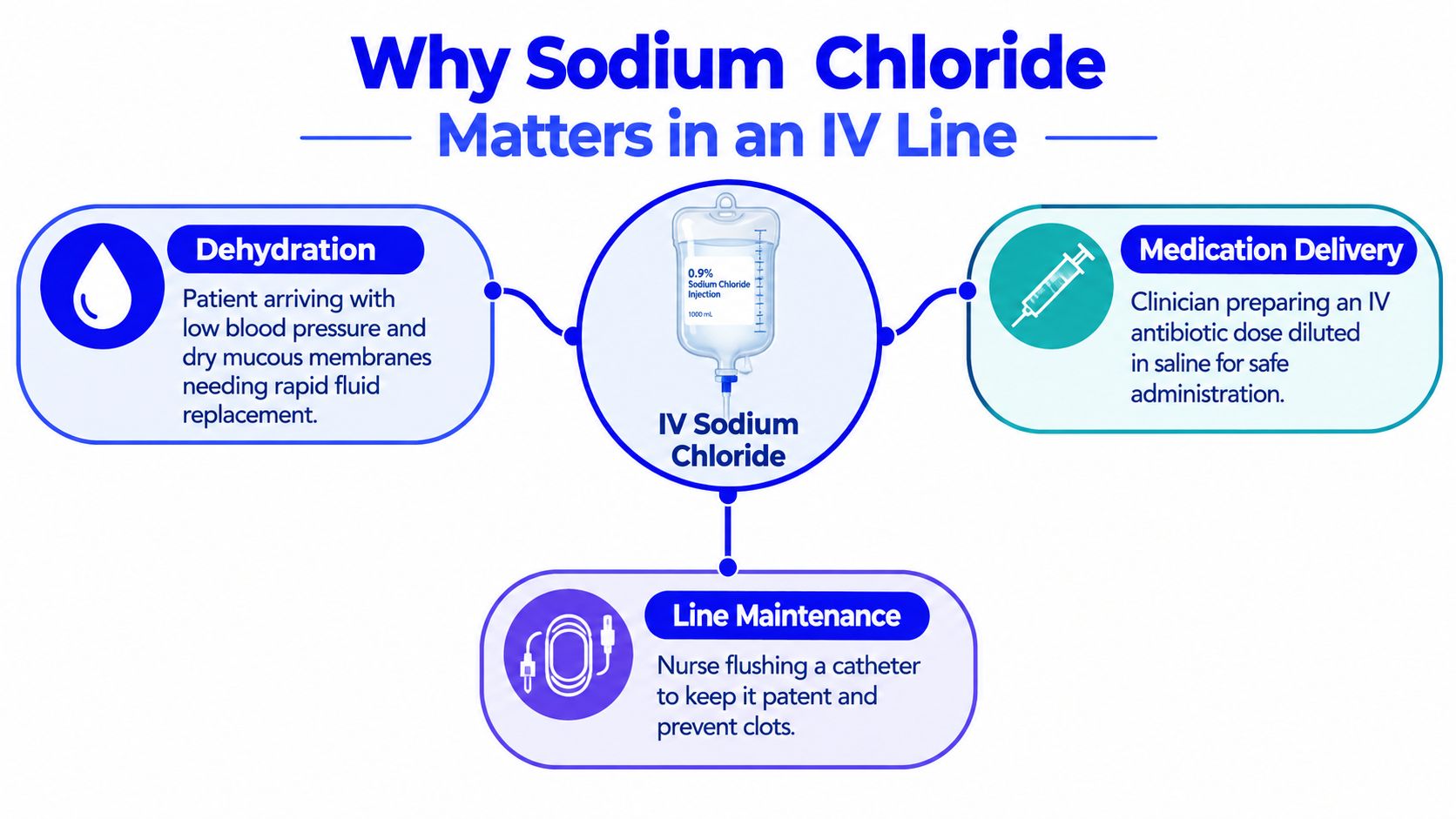
The intended role comes first. Saline given to expand extracellular volume is a treatment. Saline mixed with a compatible antibiotic is a pharmaceutical vehicle. Saline used to flush a device has a procedural purpose, and that presentation may be labeled specifically for flushing.
Patient factors then determine whether the choice fits. A fluid suitable for one indication may be unsuitable for someone with sodium retention, severe renal impairment, heart failure, cirrhosis, edema, or another fluid-balance problem. In those cases, the clinical question is not merely what sodium chloride can do. It is whether its salt content and fluid volume match the patient's needs, or whether another IV fluid would be safer.
What 0.9% Sodium Chloride Contains
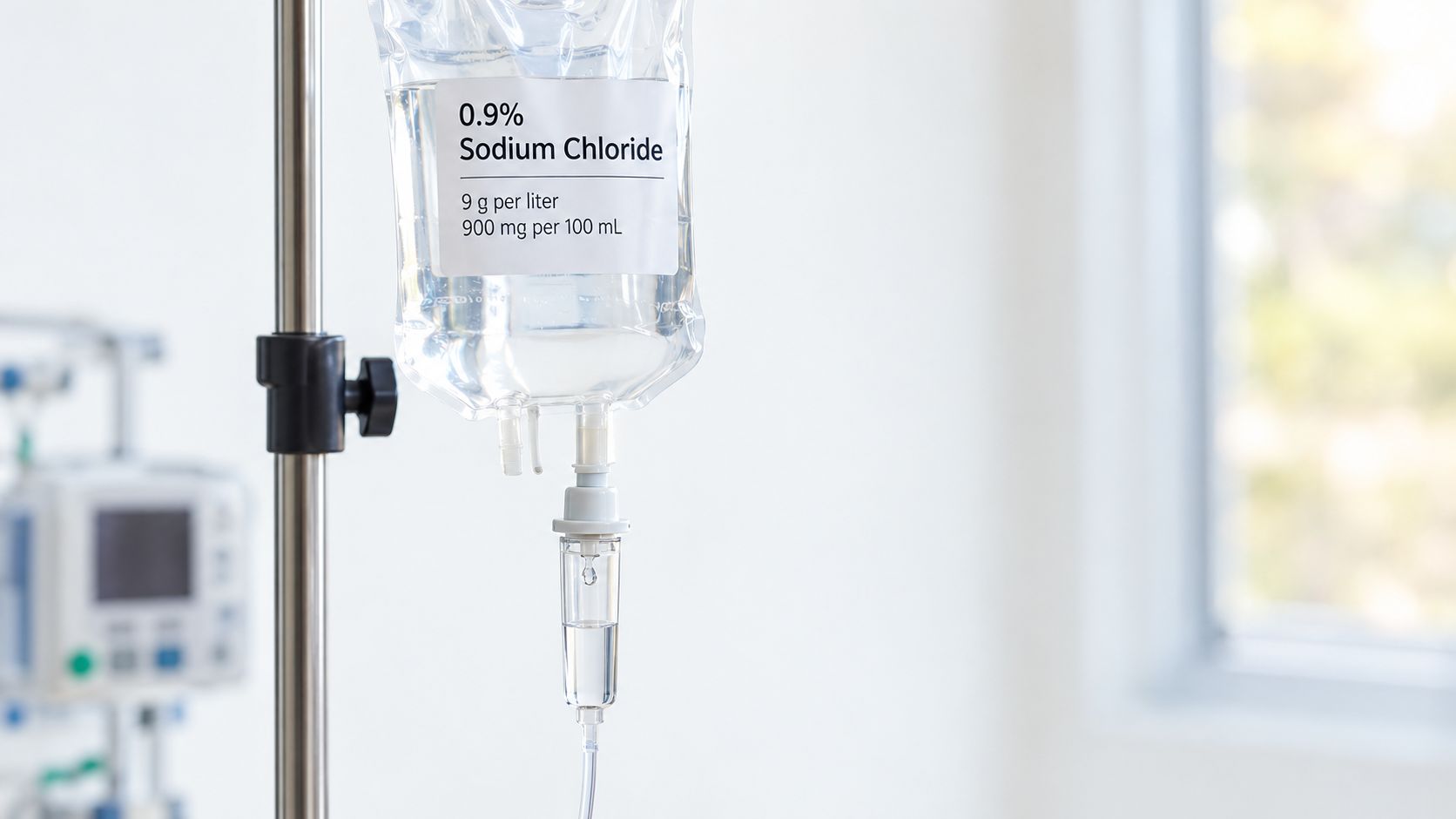
A bag labeled 0.9% sodium chloride contains a defined injectable formulation, not ordinary salt water. Each liter contains 9 g of sodium chloride, equivalent to 900 mg per 100 mL or 9 mg per mL. It provides 154 mEq of sodium and 154 mEq of chloride, with a calculated osmolarity of approximately 308 mOsmol/L. These values appear in FDA product labeling for normal saline injection. The Herbilabs saline injection guide also describes sterile saline containing 9 g of sodium chloride per liter.
Osmolarity describes the number of dissolved particles in a fluid. Think of it as a particle headcount. Normal saline's particle concentration is close enough to plasma for routine IV use, so water does not rapidly shift into or out of cells when the solution enters the bloodstream. That property gives it the name isotonic. A markedly dilute or highly concentrated fluid would create a stronger pull of water across cell membranes.
Why the formulation matters
The sodium and chloride make the solution relevant to body-fluid replacement, while its measured concentration creates a consistent medium for selected medication-preparation tasks. The same label does not make every saline product interchangeable, however. FDA labeling describes sodium chloride injection as sterile and nonpyrogenic, with no bacteriostatic antimicrobial agent and no added buffer.
Those details support controlled preparation, but staff still need to check the medicine's compatibility, storage requirements, handling instructions, and manufacturer directions before adding anything to the bag or syringe.
Practical rule: “0.9% saline” identifies a concentration. It does not, by itself, show that a product is authorized for human IV administration. Distinguishing FDA-approved injectable saline from research-use sterile diluents is part of using the right product safely.
The Main Clinical Roles of IV Sodium Chloride
A patient with vomiting, blood loss, or another source of fluid loss may need more than “hydration.” The clinical question is what has been lost, what the circulation needs, and whether 0.9% sodium chloride matches that goal. Normal saline can act as a treatment, a medication vehicle, or a procedural fluid, depending on the patient and the product instructions.
Fluid and electrolyte replacement
When extracellular fluid volume falls, 0.9% sodium chloride supplies water, sodium, and chloride while expanding the fluid within the bloodstream. FDA labeling identifies it for extracellular-fluid replacement, mild sodium depletion, and metabolic alkalosis associated with fluid loss. It may suit selected cases of dehydration or other losses when an isotonic crystalloid fits the therapeutic objective. The patient's condition still determines whether it is appropriate.
“Hydration” is too broad to guide treatment. One patient may need restoration of circulating volume. Another may need replacement of sodium and chloride, while a patient with impaired kidney function may be unable to handle an added sodium and fluid load. Examination findings, laboratory results, renal function, and the current fluid balance therefore shape the choice.
Diluting compatible medicines
Saline can dilute compatible medicines intended for intravenous, intramuscular, or subcutaneous injection when the drug manufacturer permits that use. The medicine being mixed determines the required concentration, compatibility, storage limits, infusion instructions, and route. A saline bag is not a universal mixing solution.
A useful analogy is a carrier vehicle. Saline can transport a medicine through an IV line, but the vehicle must be suitable for that particular passenger. A solution may work for one injectable drug and be unsuitable for another, so clinicians check the drug-specific instructions rather than relying only on the saline label. FDA labeling on sodium chloride as a pharmaceutical diluent describes saline as a vehicle for parenteral drugs and as a sterile irrigation medium.
Flushing, irrigation, and procedural support
Some sodium chloride injection presentations are labeled for flushing compatible contrast media through administration sets and indwelling vascular-access devices. The fluid helps clear compatible material through the device and supports line function. A flush uses a limited amount for a defined procedure, whereas a large-volume infusion is intended to affect the patient's fluid status.
Saline also has labeled roles in sterile irrigation and as a priming solution during hemodialysis. In transfusion practice, normal saline can initiate or terminate blood transfusions without hemolyzing red blood cells when used according to applicable procedures.
These roles separate therapy, vehicle, and procedural tool. Explaining that distinction helps patient education avoid reducing every use of saline to “hydration.” A healthcare SEO guide for medical practices covers how to structure complex clinical topics without losing those distinctions.
Formulation Differences That Change the Decision
“Saline” isn't one interchangeable product. Concentration changes the direction in which water tends to move, while added electrolytes change the solution's overall balance. 0.9% sodium chloride is isotonic in the bag and commonly selected for extracellular-volume replacement, but other formulations may better match a different objective.
A more dilute saline formulation, such as 0.45% sodium chloride, provides less sodium and chloride per liter and may be selected when free-water replacement is part of the plan. It still requires careful prescribing because hypotonic fluids can shift water into cells and may be inappropriate in particular neurologic or volume states.
A concentrated formulation, such as 3% sodium chloride, is reserved for situations requiring controlled hypertonic therapy, including severe symptomatic hyponatremia. It isn't a routine hydration fluid. Administration requires close clinical monitoring because an overly rapid or poorly matched sodium correction can create serious harm.
Balanced crystalloids, such as lactated Ringer's, contain a different electrolyte pattern and are used when clinicians want to reduce reliance on a high-chloride fluid. The choice depends on the patient's acid-base status, electrolyte results, renal function, clinical indication, and local protocol.
| Formulation | Sodium (mEq/L) | Chloride (mEq/L) | Osmolarity (mOsm/L) | Typical clinical use |
|---|---|---|---|---|
| 0.45% sodium chloride | Varies by product labeling | Varies by product labeling | Varies by product labeling | Selected free-water replacement |
| 0.9% sodium chloride | 154 | 154 | Approximately 308 | Extracellular-volume and electrolyte replacement, compatible dilution, selected procedures |
| 3% sodium chloride | Varies by product labeling | Varies by product labeling | Varies by product labeling | Carefully monitored hypertonic therapy |
| Lactated Ringer's | Varies by product labeling | Varies by product labeling | Varies by product labeling | Selected volume replacement with a more balanced electrolyte profile |
The verified FDA labeling specifically quantifies 0.9% sodium chloride at 154 mEq/L each of sodium and chloride and approximately 308 mOsmol/L. Other formulations should be checked against their own product labels rather than assumed to share normal saline's composition.
A research diluent is a separate category. For example, bacteriostatic water is not a substitute for an FDA-approved saline injection, even when both are sterile solutions used in laboratory preparation. The intended route, authorization, preservatives, and product labeling must match the task.
When IV Sodium Chloride Can Be the Wrong Choice
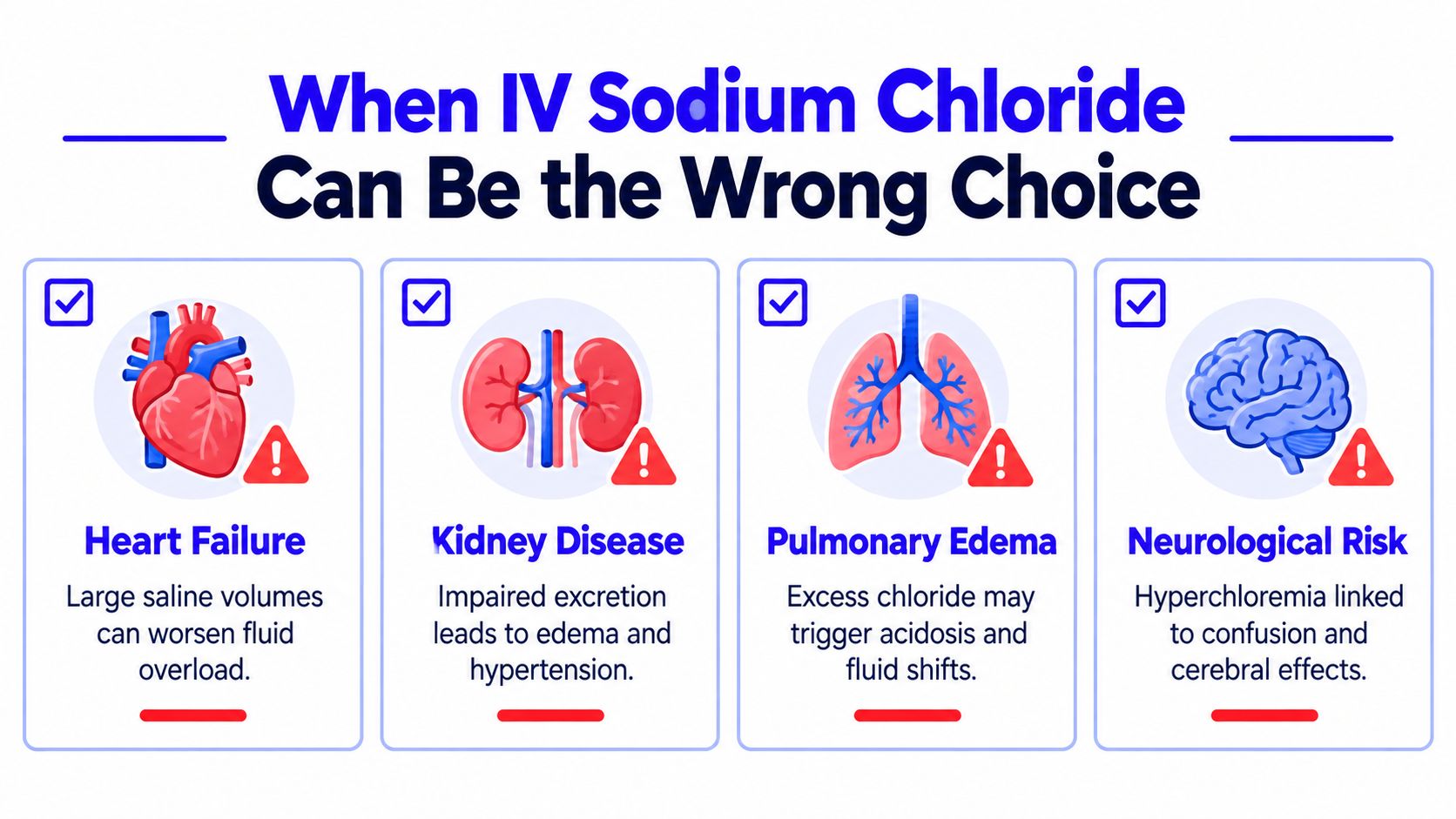
A patient with heart failure may become breathless after receiving fluid that was appropriate for someone with dehydration. 0.9% sodium chloride is isotonic in the bag, but that describes its concentration, not whether the patient can safely handle more sodium or volume.
Large or repeated amounts may worsen hypernatremia, edema, pulmonary congestion, or fluid overload. Its chloride content can also raise serum chloride and contribute to hyperchloremic metabolic acidosis, particularly when substantial volumes are given without reassessing laboratory results and clinical response. Guidance on intravenous fluid therapy advises daily serum-chloride monitoring for patients receiving fluids containing more than 120 mmol/L of chloride, including 0.9% sodium chloride.
Patient factors that should prompt caution
Heart failure can limit tolerance for additional intravascular volume. Severe renal impairment may reduce the body's ability to remove sodium and water. Cirrhosis with ascites and other sodium-retention states can also make routine saline a poor fit.
The bedside clues may appear before a laboratory result changes. New or worsening breathlessness, pulmonary congestion, peripheral swelling, rising blood pressure, or a deteriorating fluid balance should trigger reassessment. Clinicians need to ask whether the patient still needs volume, whether this fluid matches the physiology, and whether a different strategy would be safer.
For adults who need fluid resuscitation, NICE recommends a 500 mL crystalloid bolus over less than 15 minutes, followed by reassessment of circulation, renal function, electrolytes, and fluid balance. A bolus is therefore a monitored intervention, not an automatic reason to continue the infusion.
A saline bag can suit the indication and still be wrong for the patient's current fluid balance.
Supply Continuity and the Research vs Clinical Divide
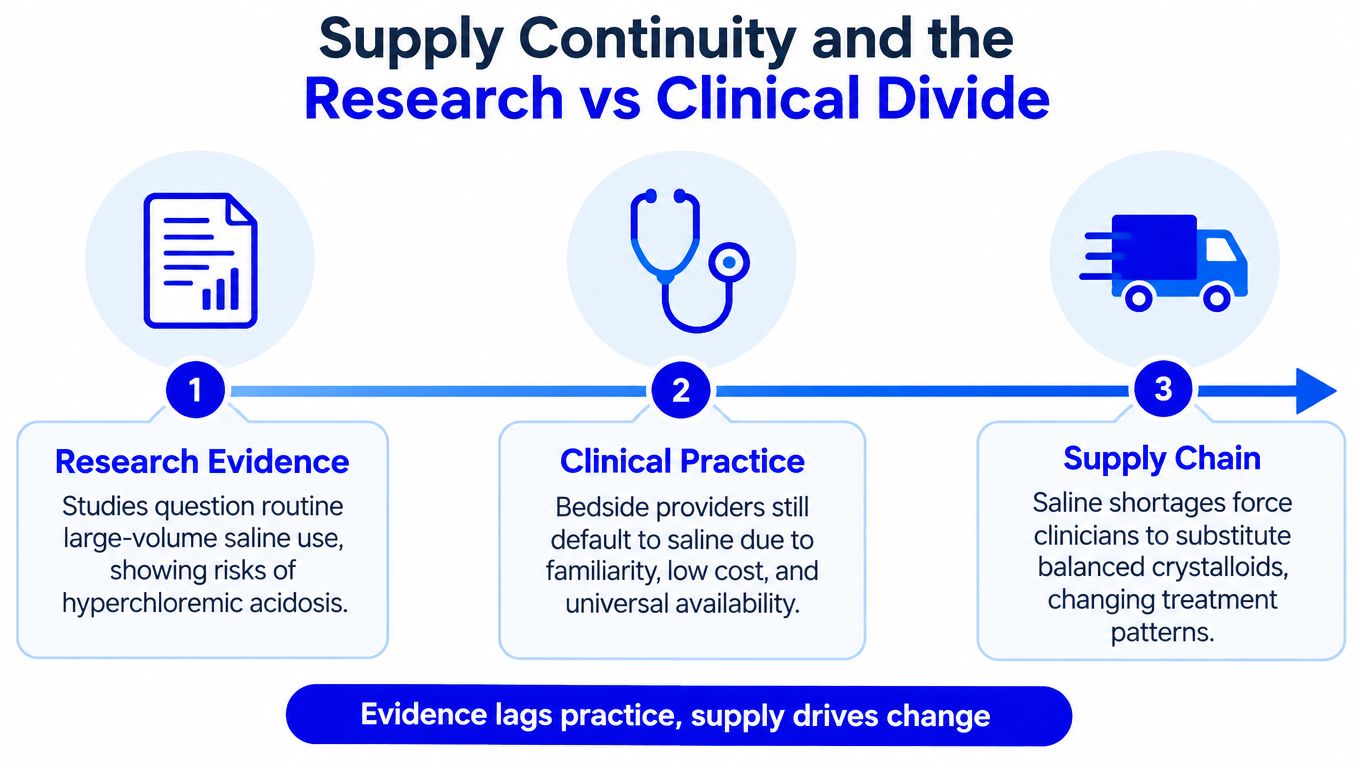
Saline's routine status can hide its operational importance. Hospitals use 0.9% sodium chloride for hydration, medication delivery, infection treatment, chemotherapy administration, transfusion-related procedures, and other clinical workflows. If supply falls, substitution depends on the indication, concentration, compatibility, patient condition, and local protocol. A hospital can't replace every saline use with one alternative fluid.
The FDA announced in August 2025 that the nationwide shortage of 0.9% sodium chloride injection products had ended. The announcement followed a period in which products had been listed as unavailable, while hospital reporting connected the disruption to Hurricane Helene's impact on a Baxter facility and described saline as having been in shortage since 2018. The FDA statement on the resolution of the IV saline shortage illustrates why procurement continuity can influence bedside decisions.
Authorization matters as much as appearance
A vial or bag labeled “0.9% saline” isn't automatically suitable for human IV administration. An FDA-approved injectable drug product must meet requirements related to sterility, endotoxin control, container suitability, manufacturing, and labeling for its authorized route. A sterile diluent manufactured for laboratory or research use only may have a different intended purpose and regulatory status.
That distinction protects against a dangerous shortcut: treating “sterile” as equivalent to “approved for injection.” Research-use products may be appropriate within their documented laboratory workflow, but they shouldn't be substituted for clinical injectable products.
For research organizations, procurement teams, and independent laboratories, documentation and intended-use statements are essential. Herbilabs supplies sterile diluents and reconstitution solutions for research-use workflows, including documentation such as lot-specific certificates of analysis. Information about how long bacteriostatic water lasts after opening still belongs to laboratory handling, not to decisions about replacing an authorized injectable saline product in patient care.
A Practical Framework for Choosing Sodium Chloride in IV Use
A safe decision starts with the purpose, not the product name.
Define the job. Is the fluid intended for extracellular-volume replacement, electrolyte support, compatible drug dilution, line flushing, irrigation, dialysis priming, or transfusion support?
Match the formulation. Determine whether the clinical objective calls for 0.45% saline, 0.9% saline, 3% saline, or a balanced crystalloid. The concentration and accompanying electrolytes should serve the treatment goal.
Check the patient. Review renal function, cardiac status, sodium level, chloride trend, edema, pulmonary findings, and overall fluid balance. A patient's tolerance can change even when the indication hasn't.
Reassess after administration. NICE guidance supports monitoring chloride with high-chloride fluids and reassessing circulation, renal function, electrolytes, and fluid balance after a resuscitation bolus. Worsening breathlessness, swelling, sodium excess, or acid-base concerns call for escalation rather than routine continuation.
Confirm authorization. A product intended for human IV use must be an appropriately authorized injectable product. Research-use sterile diluents and clinical saline injections aren't interchangeable just because their labels look similar.
The clearest answer to “what is sodium chloride used for in IV therapy” is therefore conditional. It can replace extracellular fluid, deliver electrolytes, carry compatible medicines, and support line or procedure care, but the formulation and patient determine whether it's the right choice.
Herbilabs offers sterile diluents and reconstitution solutions for research-use workflows, with multiple vial formats and lot-specific documentation for laboratory preparation. Visit Herbilabs to review its research-use product range and handling information.