Private Label, White Label, Wholesale partnerships available - EU, USA and UK - Free shipping from €75

0.9 Sodium Chloride Injection USP 1000 mL: A 2026 Guide
A procurement officer may have two nearly identical containers on the desk: a 1000 mL bag of 0.9% sodium chloride injection USP and a small vial of bacteriostatic water, with both described informally as diluents. The labels look familiar, but the decision isn't interchangeable. Route, sterility, tonicity, preservative content, container size, intended use, and current supply status all matter.
The question is especially practical after the saline disruptions that affected hospitals and buyers. The FDA announced that the nationwide IV saline shortage ended on August 8, 2025, while product-specific availability and recall checks still deserve attention. A buyer choosing a 1 L bag needs to know what the formulation contains, which uses are appropriate, how injection differs from irrigation, and whether a smaller or differently balanced fluid fits better.
Table of Contents
- Why a 1 L Saline Bag Still Matters in 2026
- What 0.9% Sodium Chloride Injection USP 1000 mL Is
- How 1 L Normal Saline Is Used in Practice
- Comparing 0.9% NaCl Injection to Other Diluents
- Storage, Handling and Compatibility Essentials
- Choosing the Right Fluid and Looking Ahead
Why a 1 L Saline Bag Still Matters in 2026
The 1000 mL presentation remains a familiar hospital and infusion-market format, not a niche package. FDA and DailyMed-derived labeling identifies 0.9 sodium chloride injection USP 1000 mL as a standard isotonic intravenous formulation, with a simple composition designed for clinical use in larger-volume containers (DailyMed labeling).
That familiarity creates a procurement risk. Staff may use “normal saline” as a shorthand for several different products, including IV injection, irrigation solution, flush products, and laboratory diluents. A 1000 mL irrigation container can look close enough to an IV bag to cause a dangerous selection error if the route statement isn't read carefully.
The post-shortage question is more specific than “Is saline back?”
The 2025 shortage story changed the buyer's workflow. The FDA's resolution announcement addresses the nationwide shortage, but hospital purchasers still need to validate manufacturer, bag construction, allocation status, available channels, and any product-specific recall information before treating a supply line as stable. Earlier shortage reporting from ASHP's drug shortage resources described constraints affecting large-volume saline products after damage to Baxter's North Cove plant.
Practical rule: A shortage-ending headline doesn't make every manufacturer, container, or presentation immediately interchangeable.
The decision also depends on the task. A clinician may need a preservative-free isotonic vehicle for medication dilution, while a researcher may need a small-volume reconstitution solution, and a sterile-processing team may need an irrigation product. The remaining sections address those distinctions through formulation, use, alternative diluents, handling, and purchasing controls.
What 0.9% Sodium Chloride Injection USP 1000 mL Is
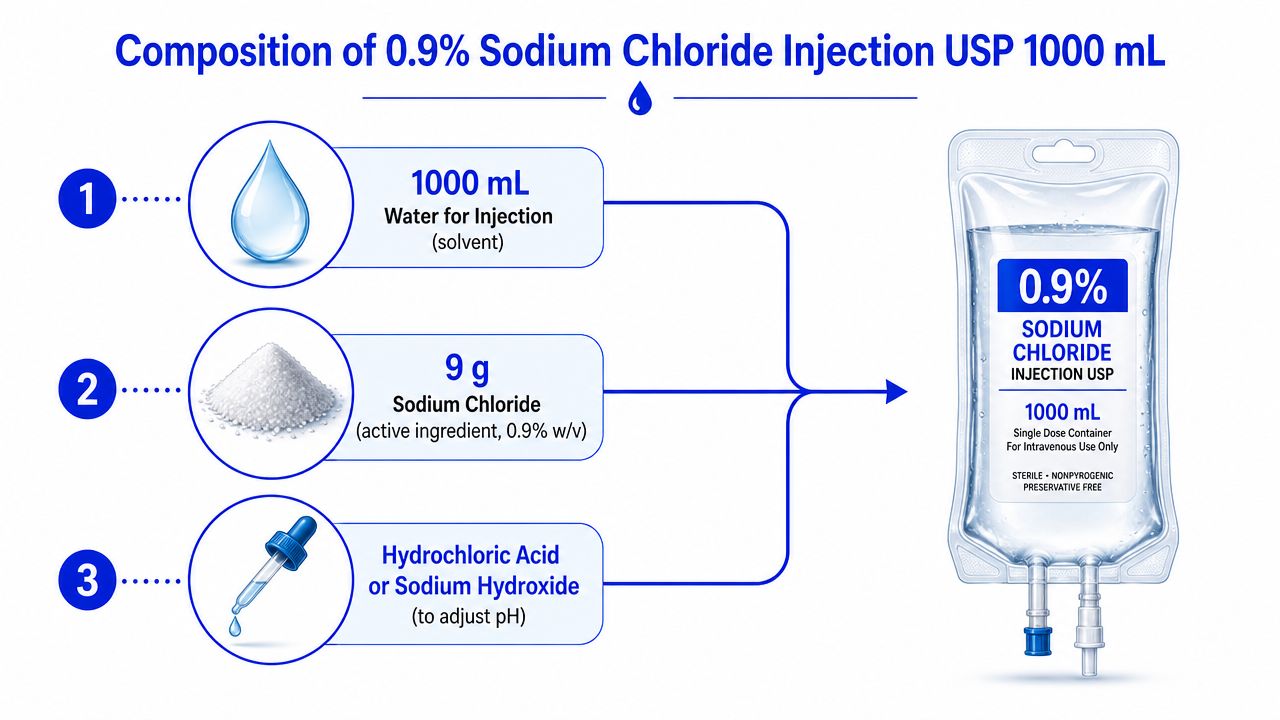
If a product search shows several 1000 mL saline containers, the concentration alone cannot identify the right one. 0.9% Sodium Chloride Injection USP contains 9 g of sodium chloride in 1000 mL, or 0.9 g per 100 mL, in water for injection. Its labeled calculated osmolarity is around 308 mOsmol/L, with 154 mEq/L sodium and 154 mEq/L chloride (DailyMed labeling).
The formulation resembles the osmotic environment outside cells. It therefore does not pull water as strongly as a concentrated solution or dilute that space like sterile water. This makes it a useful reference crystalloid for intravenous care, while clinical reviews also explain why it is not a precise replica of physiological fluid (historical and clinical review).
The label lists a pH range of 4.5 to 7.0. The product is generally supplied without preservatives or added buffer. Container materials can differ by manufacturer, including flexible PVC and non-PVC designs, so the exact label, presentation, and manufacturer instructions govern selection.
Injection is not irrigation
The word injection identifies a sterile product intended for an approved injectable route or compatible injectable preparation. Irrigation saline may have the same concentration and may also be sterile and isotonic, but its labeled purpose is washing, rinsing, irrigating, or other non-IV use. DailyMed irrigation labeling shows why two similar-looking 1000 mL containers cannot be treated as interchangeable.
For handling terminology and route checks, consult this safe saline use guide. The product label, institutional policy, and pharmacist verification still control the final choice.
How 1 L Normal Saline Is Used in Practice
A 1 L bag serves three broad roles, and each role has a different decision point.
In hospital care, clinicians may use isotonic saline for fluid replacement, maintenance decisions, or electrolyte-containing volume support. The patient's condition determines whether saline is suitable, and balanced crystalloids such as lactated Ringer's may be selected instead when the clinical objective calls for a different electrolyte profile. A large bag also supports medication delivery, but the drug's prescribing information and local compatibility reference must determine the final preparation.
The second role is dilution or reconstitution of compatible injectable medicines. A pharmacy may use saline as the vehicle for a prepared infusion, such as a vasoactive drip or selected antibiotic, but compatibility depends on concentration, container, administration set, exposure time, and the specific medication. A small reconstitution solution may fit a research workflow better when a 1 L infusion bag would create unnecessary volume.
The third role involves sterile equipment or laboratory workflows where both sterility and tonicity matter. Examples can include line-related procedures, selected device rinsing tasks, and validated tissue or laboratory applications. These uses must remain within the product labeling and the facility's approved procedure.
| Use Role | Typical Scenario | Key Caution |
|---|---|---|
| IV fluid administration | Volume support or fluid replacement under clinical direction | The patient's needs and the product label determine suitability |
| Medication dilution | Preparation of a compatible injectable infusion | Confirm drug-specific compatibility before admixture |
| Sterile laboratory or device work | A validated rinse or isotonic vehicle application | Injection and irrigation presentations aren't automatically interchangeable |
A 1000 mL bag also isn't automatically the right size. Small-volume pediatric care, single-dose dilution, and research reconstitution often call for a smaller container or syringe. Once a sterile bag is spiked, staff must follow institutional aseptic and single-patient-use procedures rather than treating the remaining contents as a communal stock source.
Comparing 0.9% NaCl Injection to Other Diluents
A post-shortage purchasing decision can look simple: choose the available sterile fluid and move on. Route and tonicity make that approach unsafe. The word “sterile” does not tell you whether a product is isotonic, contains a preservative, is approved for direct IV administration, or fits repeated access.
Bacteriostatic water for injection commonly contains benzyl alcohol and supports repeated withdrawals from a multi-dose vial when the application permits that preservative. Its role is reconstitution, not volume replacement. Sterile water for injection has no salt-based tonicity, so direct venous administration without an appropriate solute or drug formulation can cause serious osmotic injury. The USP sterile water for injection category therefore requires route and labeling checks before substitution.
Lactated Ringer's uses a different electrolyte pattern. It contains lactate and multiple electrolytes, so it is not saline with an added ingredient. It may suit a balanced replacement strategy, but the choice still depends on patient factors, medication compatibility, and the intended therapy.
| Fluid | Preservative | Tonicity | Container | Intended Use |
|---|---|---|---|---|
| 0.9% sodium chloride injection | Typically preservative-free | Isotonic | Often a larger flexible bag | IV administration or compatible injectable dilution |
| Bacteriostatic water for injection | Benzyl alcohol preservative | Not an isotonic saline replacement | Multi-dose vial | Repeated small-volume reconstitution when permitted |
| Sterile water for injection | Preservative-free | Hypotonic without added solute | Usually a smaller sterile container | Diluent for approved preparations, not direct IV water administration |
| Lactated Ringer's | Contains multiple electrolytes and lactate | Near-isotonic balanced fluid | Commonly a flexible infusion bag | IV replacement when its composition and compatibility fit |
The injection-versus-irrigation route deserves a separate check. A fluid selected for irrigation is not automatically suitable for injection, even when both containers are sterile. In a tighter 2025 supply market, availability may influence procurement, but it cannot replace the labeled route, formulation, and compatibility review.
Cost comparisons also need a usable-volume view. A 1 L saline bag and a small multi-dose vial are not equivalent merely because both may be called diluents. Include waste, storage, access requirements, preparation labor, and whether the product can serve the intended route under the applicable procedure.
Storage, Handling and Compatibility Essentials
A technician's pre-use check should treat the 1 L bag like a sealed system, not just a volume of fluid. Confirm the product name, concentration, injection route, labeled pH range of 4.5 to 7.0, and storage instructions. Temperature requirements can vary by product, so the package insert and facility policy should govern. A bag labeled for irrigation cannot be substituted for injection because sterility alone does not establish route suitability.
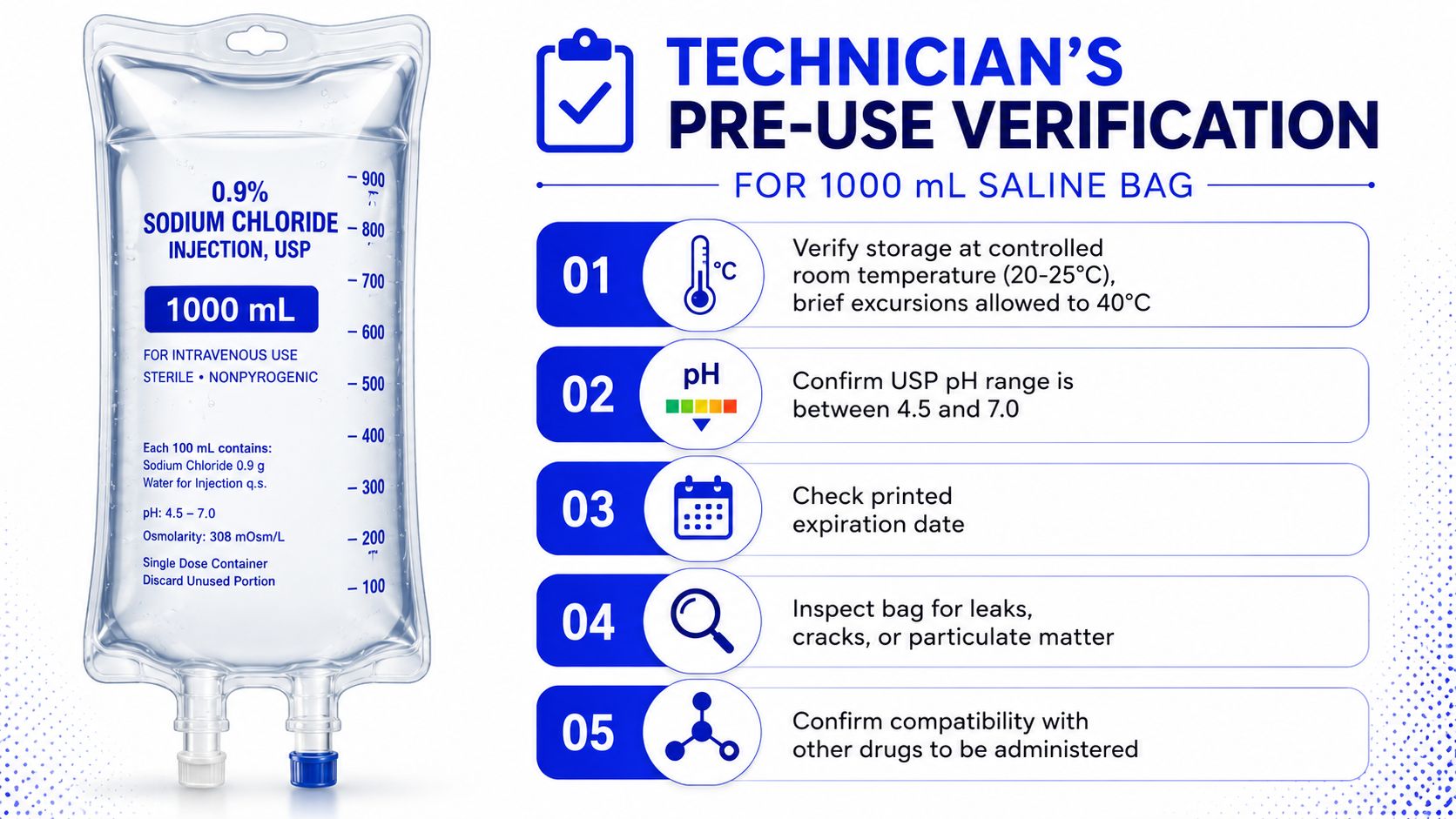
Inspect the bag under suitable lighting. Look for particles, discoloration, leaks, or damage, then verify the lot and expiry details. A gentle squeeze can expose a compromised flexible container before connection. If the container or contents raise a quality concern, quarantine the product according to facility procedure.
Compatibility requires a drug-specific answer
Saline is widely used, but it is not a universal mixing vehicle. Amphotericin B, ceftriaxone in neonates, and lipid emulsions require particular caution. Before adding any drug, confirm compatibility for the actual medication, concentration, container, and administration conditions through a pharmacist or validated institutional reference. The pH range and compatibility guidance should come from the applicable product documentation or an authoritative formulary, not from assumption.
Before use: Verify route, label, lot, expiry, container integrity, visible appearance, storage history, and medication compatibility.
The post-shortage 2025 market may make an available bag tempting, but procurement pressure cannot override the labeled route or a compatibility review. For research staff comparing saline with bacteriostatic water, document the preservative, access model, storage history, and intended use in the protocol. Herbilabs' information may support that storage review, while the product label and institutional procedure should control the final decision.
Choosing the Right Fluid and Looking Ahead
The decision can be reduced to the intended route and the required properties.
Choose 0.9% sodium chloride injection USP 1000 mL when the workflow requires a preservative-free isotonic IV fluid or a compatible injectable vehicle in a larger volume. Select bacteriostatic water when the procedure calls for repeated small-volume withdrawals and the preservative is acceptable for that application. Choose sterile water only for an approved preparation that supplies the necessary solute or drug, never as an informal substitute for isotonic IV fluid.
Lactated Ringer's belongs in a separate decision branch. Its balanced electrolyte composition may suit some replacement-fluid plans better than saline, but it can also create medication compatibility questions that saline doesn't. The prescriber, pharmacist, or laboratory protocol should make that choice.
The 2025 supply disruption also changed procurement habits. Buyers now need alternate manufacturers, verified distribution routes, product-specific availability, and recall monitoring rather than dependence on a single familiar supplier. The injection-versus-irrigation distinction belongs in the purchasing specification itself, not as an afterthought when a shipment arrives.
A strong purchase record should capture the exact product name, route, concentration, container type, manufacturer, lot documentation, and current quality status. For research diluents, Herbilabs offers bacteriostatic water and reconstitution solutions in sterile multi-dose vial formats for research-use workflows, while clinical IV saline decisions remain governed by approved medical labeling and institutional controls.
The most reliable question isn't “Does this say saline?” It is “Does this exact container match the required route, tonicity, volume, compatibility profile, and quality documentation?”
Researchers and procurement teams can visit Herbilabs to review sterile bacteriostatic water and reconstitution solutions for research-use workflows. The product format should be matched to the protocol, access frequency, preservative requirements, and documentation needs before ordering.