Private Label, White Label, Wholesale partnerships available - EU, USA and UK - Free shipping from €75

Gdf 8 Peptide
What exactly is being measured when a vial is sold as GDF-8 peptide, the gene product, the latent precursor, or a fully active signaling ligand? That question matters because the keyword gets used for very different materials, and the bench consequences are not interchangeable. A researcher who separates biology, assay design, and supplier documentation will usually avoid the most common mistakes.
Table of Contents
- What GDF-8 Peptide Means in a Research Context
- How Myostatin Was Discovered and Why It Mattered
- How the Myostatin Signaling Pathway Works
- Molecular Forms You Can Actually Order
- What the Clinical Evidence Actually Shows
- Assay Selection and Measurement Validity
- Reconstitution and RUO Handling at the Bench
- Regulatory, Ethical, and Sourcing Considerations
What GDF-8 Peptide Means in a Research Context
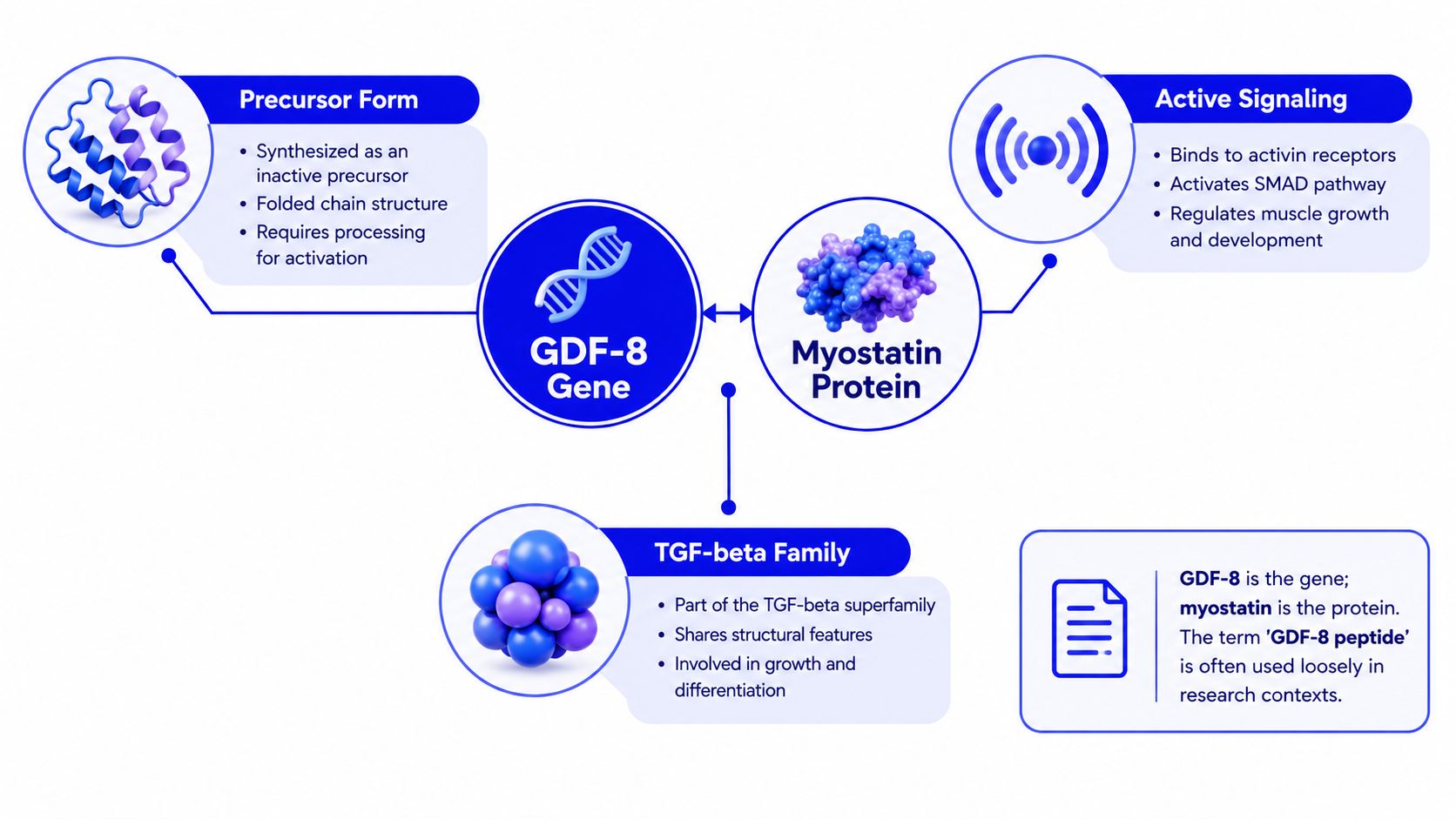
In lab language, GDF-8 is the gene name, while myostatin is the protein name. The phrase GDF-8 peptide is often used loosely, but at the bench it usually points to a recombinant research reagent, not a finished drug product or a supplement.
A working definition before the mechanism
The cleanest way to think about the term is this. GDF-8 is the signaling system, myostatin is the active protein product, and the material in a vial may be a mature ligand, a latent complex, or a recombinant fragment built for an assay. Those are different tools, even if the catalog copy compresses them into one phrase.
A useful mental model has three layers:
- Biology, the native molecule and its role in skeletal muscle
- RUO use, the recombinant form chosen for cell, receptor, or biomarker work
- Sourcing and quality, the construct, purity, and bioactivity details that make a result interpretable
Practical rule: a label that says “GDF-8 peptide” is not enough. The molecular form has to be stated clearly before any receptor assay, binding assay, or functional study can be trusted.
The term also pulls people toward the wrong comparison set. In many conversations, “GDF-8 peptide” gets discussed as if it were a muscle-building intervention, yet the research use case is usually analytical or mechanistic. That distinction matters because a reagent that helps map signaling in a dish is not the same thing as a therapeutic product with human dosing evidence.
A reader who keeps those boundaries straight can ask better questions before ordering anything. What is the construct? What form is present in the vial? Was bioactivity confirmed? Those questions matter more than the marketing language on the product page.
How Myostatin Was Discovered and Why It Mattered
The field's starting point is a 1997 Nature paper that identified GDF-8 as a new member of the TGF-β superfamily and showed that it was expressed specifically in developing and adult skeletal muscle original Nature study. That muscle-restricted pattern immediately separated it from the broader class of growth regulators that researchers had been studying at the time.
The decisive experiment was a targeted gene disruption in mice. Animals lacking GDF-8 were significantly larger than wild-type controls, and individual muscles weighed about 2 to 3 times as much as those in normal mice Nature 1997 study. The increase came from both hyperplasia and hypertrophy, which means the muscle tissue expanded through more cells and larger cells.

Why the knockout mouse became the anchor model
That mouse result changed the field's vocabulary. Instead of treating the factor like a general promoter of growth, researchers began to describe myostatin as a negative regulator of skeletal-muscle growth Nature 1997 study. That single idea still shapes muscle-wasting research, muscular dystrophy work, livestock genetics, and the development of myostatin inhibition strategies.
The historical importance is simple. Once a gene deletion produced visibly enlarged muscles, every later study had a clear benchmark to work against. If a reagent changes muscle phenotype, researchers ask whether it is acting through the same brake on growth that the knockout removed.
The knockout mouse made one point impossible to ignore, muscle mass can be released from restraint when the pathway is altered.
That finding also explains why the field keeps returning to the original paper. It's not just a citation for historical color. It is the foundation for how the biology is framed, how assays are built, and how later translational claims are judged.
How the Myostatin Signaling Pathway Works
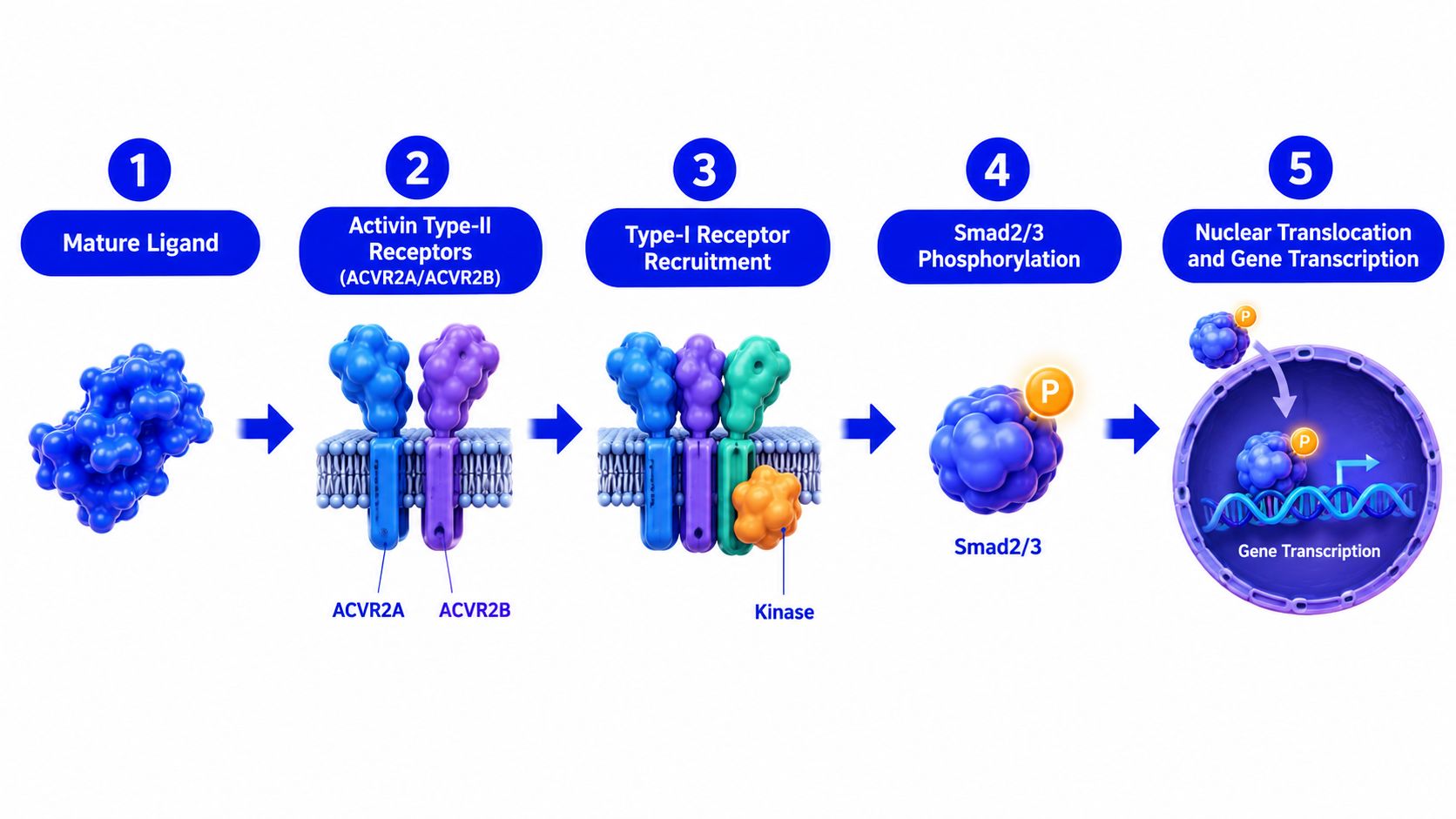
GDF-8 is synthesized as a precursor with an N-terminal signal peptide, a propeptide, and a C-terminal mature growth-factor domain with the cystine-knot architecture typical of TGF-β ligands structural review. Proteolytic processing separates the mature ligand from the propeptide, but the circulating molecule often remains in a latent complex that keeps receptor-binding surfaces masked until activation structural review.
The receptor sequence in plain language
The canonical signaling sequence starts when the mature dimer engages activin type-II receptors, mainly ACVR2A or ACVR2B, with stronger evidence for ACVR2B signaling review. After that first contact, the complex recruits type-I receptors, usually ALK4 or ALK5, and the downstream cascade phosphorylates SMAD2 and SMAD3 signaling review.
Those phosphorylated SMADs associate with SMAD4, move into the nucleus, and alter transcriptional programs that suppress myogenic differentiation and muscle growth signaling review. In bench terms, that makes SMAD2/3 phosphorylation the most obvious mechanistic readout for an in-vitro assay.
Why the pathway is more than one line
The pathway also reaches into p38 MAPK, ERK1/2, and Wnt signaling signaling review. That matters because a single endpoint can miss meaningful biology, or worse, overstate it.
GDF-8 also overlaps with GDF-11 in receptor usage, so identity matters when an assay reads “activin pathway” activity signaling review. A lab that ignores that overlap can misread cross-reactive signals as target-specific effects.
Bench takeaway: if the experiment is meant to test GDF-8 biology, the readout should include receptor- or ligand-level controls, a concentration-response curve, and a SMAD2/3 phosphorylation endpoint, then an orthogonal functional readout if possible.
That sequence is why myostatin assays are rarely as simple as a binding event. The molecule has to be activated, the receptor system has to be right, and the readout has to match the biological question.
Molecular Forms You Can Actually Order
The hardest part of shopping for GDF-8 peptide is that the term hides multiple molecular forms. A vial can contain the mature dimer, a propeptide-bound latent complex, or a recombinant fragment designed for a narrow assay use. Those are not equivalent materials, because they do not behave the same way once they hit cells or receptors structural review.
Comparing common GDF-8 reagent forms
| Form | Receptor activity | Typical research use | Spec to confirm with supplier |
|---|---|---|---|
| Mature GDF-8 dimer | Directly active when correctly folded | Receptor activation, SMAD assays, functional studies | Construct boundaries, oligomeric state, bioactivity confirmation |
| Latent GDF-8 with propeptide | Masked until activation | Structural work, activation studies, latency assays | Propeptide presence, activation state, purification details |
| Recombinant fragments | Variable, often reduced or altered activity | Epitope mapping, method development, assay controls | Exact sequence, expression system, expected activity profile |
Why form matters more than a purity number
The prodomain masks receptor-interacting surfaces, so latent GDF-8 is not just a more “diluted” version of the active ligand structural review. Structural studies also suggest the latent molecule can transition into a triggered state that is effectively non-reversible under the examined conditions structural review. That means the state of the protein matters as much as the sequence on the label.
For a lab buyer, the most useful specs are practical ones:
- Construct boundaries, so the actual protein length is clear
- Expression system, because folding and processing can differ
- Oligomeric state, because dimerization affects activity
- Purification state, because latent and mature forms behave differently
- Bioactivity confirmation, ideally in a receptor or SMAD2/3 assay
A nominal purity percentage doesn't answer those questions. A vial can be very pure and still be the wrong molecular form for the experiment.
For labs that want to understand the production side of these materials, how lyophilized peptides are made is a useful companion read, because freeze-drying and reconstitution choices affect how a reagent behaves after the vial is opened.
What the Clinical Evidence Actually Shows
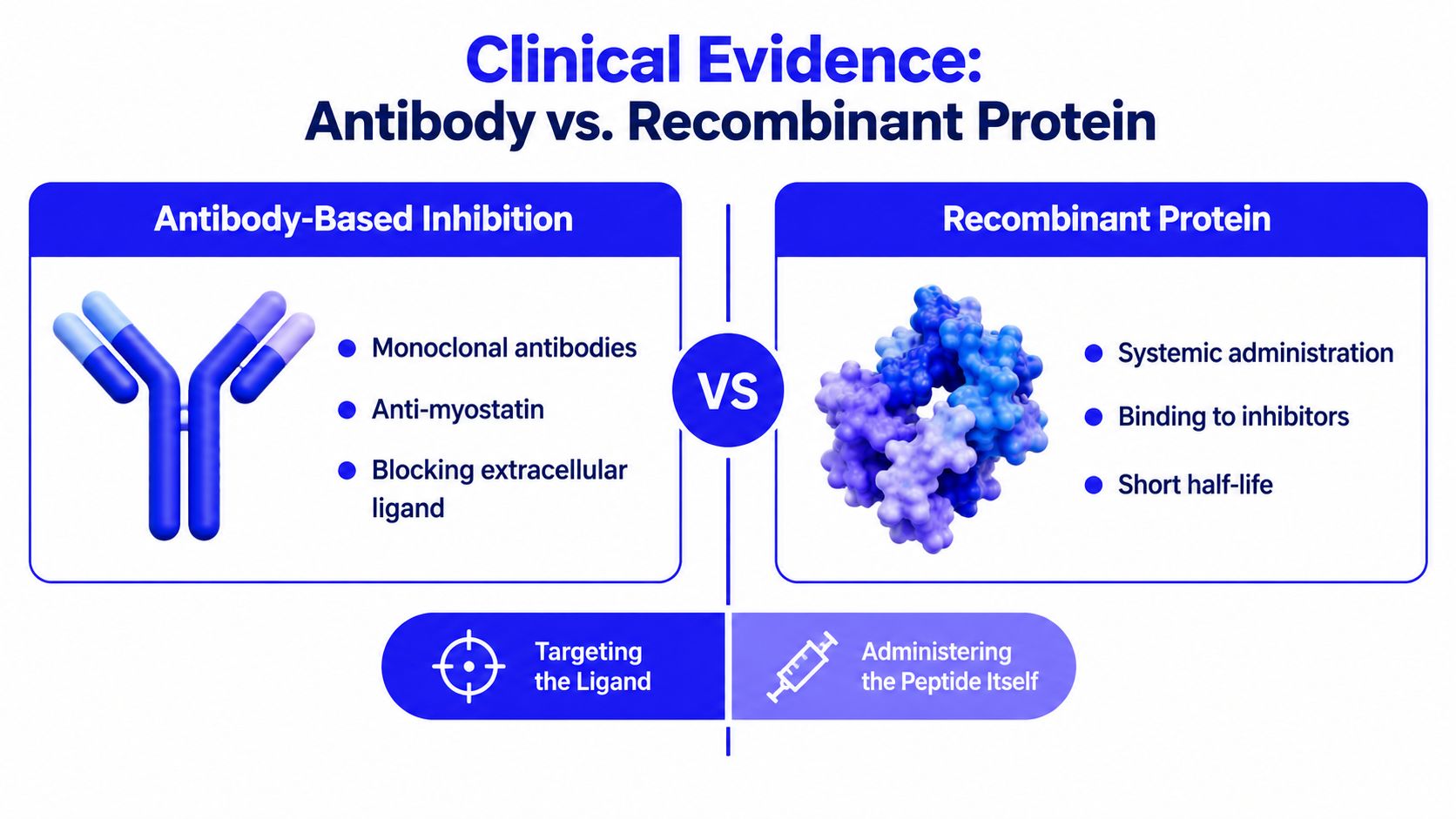
A common mistake is to treat GDF-8 peptide as though human dosing evidence exists for the recombinant protein itself. The clinical literature is centered on pathway inhibition, mostly with antibodies or other modulators, not administration of exogenous recombinant GDF-8 clinical review. That difference is easy to miss, but it changes what can be claimed about safety and effect.
What the human data actually support
A phase 1 study of the follistatin-related agent ACE-083 produced an approximately 14.5% increase in locally treated muscle mass in healthy women, yet did not increase muscle strength clinical review. Later studies in facioscapulohumeral muscular dystrophy and Charcot-Marie-Tooth disease similarly reported localized muscle-volume gains without clear functional benefit clinical review.
That pattern matters more than any single positive finding. Pathway inhibition can enlarge muscle tissue, but tissue volume doesn't automatically translate into strength, mobility, or disease improvement.
Why that distinction changes how a marketing claim should be read
The strongest translational evidence is for blocking endogenous myostatin, not adding GDF-8 as a human-use intervention clinical review. That makes recombinant GDF-8 work mainly a preclinical research question, while therapeutic claims belong to a different evidence category entirely.
For a scientist reading a product page, the right question is not whether “myostatin” sounds powerful. The question is whether the specific molecule in the vial has a defensible research purpose and a matching assay design.
Interpretation rule: if a human study showed volume change without functional gain, a reagent claim about muscle mass alone should be treated cautiously.
Assay Selection and Measurement Validity
GDF-8 measurement looks straightforward until the assay platform is changed. GDF-8 and GDF-11 share receptor systems, and immunoassays can differ in cross-reactivity or in the molecular form they detect measurement review. That means a reported concentration is not automatically comparable across kits.
What a good measurement strategy needs
An LC-MS/MS method has been developed specifically to measure GDF-8 and GDF-11 with high specificity, including no detectable GDF-8 cross-reactivity in the GDF-11 assay measurement review. That is useful because it reduces ambiguity when the lab needs identity-level confidence rather than a broad immunoreactive signal.
A careful workflow should ask these questions before trusting a number:
- What molecular form is measured? total, free, or bioactive protein
- How was identity confirmed? especially if GDF-11 is in the matrix
- What matrix effects were tested? serum, plasma, conditioned media, or buffer
- How was freeze-thaw handled? repeated cycles can change recovery
- What calibration system was used? one ELISA curve is not another
- Was the assay validated on the same platform? comparability is not guaranteed
Why this matters at the bench
The frequent error is to treat “GDF-8 level” like a stable biological constant. It isn't. It is a method-dependent number, and the number can shift if the assay binds a different isoform, a different complex state, or a related protein measurement review.
The linked guide to batch testing for labs is worth using as a quality mindset, because the same discipline that protects batch consistency also protects analytical consistency. If the assay platform changes, the interpretation has to change with it.
Reconstitution and RUO Handling at the Bench
Once a vial is in the lab, the biggest source of avoidable error is handling, not theory. GDF-8 is a protein reagent, so its performance depends on how it is reconstituted, stored, and accessed over time. A sterile diluent with 0.9% benzyl alcohol, supplied through 0.22 µm filtration into glass multi-dose vials, is built for repeated withdrawals under aseptic technique product specification.
Bench habits that protect the reagent
A sensible workflow starts before first puncture. The label should show the receipt date, the first-open date, and the planned discard date, so the team doesn't guess later. That matters because the in-use window depends on discipline, not just chemistry.
The handling checklist is simple:
- Keep access sterile, because repeated punctures raise contamination risk
- Use the right vial format, so the opening frequency matches the workload
- Store under temperature control, because protein stability is not forgiving
- Record the lot number, so an outlier result can be traced
- Keep the COA with the record set, so the material identity is documented
Why documentation matters as much as reconstitution
A lot-specific Certificate of Analysis is more than paperwork. It lets a lab connect the vial in hand to the batch that was released after QA review, which supports reproducibility when multiple teams compare data product specification. That is especially important when the same protein is being used in different assay systems, because the readout can change with the lot, the buffer, or the handling sequence.
For labs that already use multi-dose diluents, bacteriostatic water provides a useful handling reference point. The principle is the same, protect the reagent from contamination, document the opening cycle, and make the storage plan part of the experiment rather than an afterthought.
Regulatory, Ethical, and Sourcing Considerations
GDF-8 research reagents are for research use only, not for human use. That label should be treated as a hard boundary, not a marketing footnote. Any supplier claim should be judged against the molecule's intended bench use, the assay it supports, and the documentation that comes with it.
When a lab evaluates a source, a few operational signals matter. Facility credentials such as ISO 13485:2016, GMP, and ISO 9001:2016 procedures, batch traceability, and documented training all speak to process discipline rather than hype. Those features don't replace experimental validation, but they do make the material easier to integrate into a controlled R&D workflow.
What to verify before ordering
- COA availability, with batch-specific release records
- Construct specification, including exact molecular form
- Bioactivity data, ideally tied to a receptor or SMAD assay
- Storage chain, so temperature exposure is documented
- RUO labeling discipline, so the product isn't mistaken for a clinical material
Commercial model also matters. Private-label, white-label, and wholesale partnerships serve different operational needs, and a lab should choose the arrangement that fits its own compliance and distribution setup.
For readers comparing research-product governance with other areas of medical evidence, hormone therapy safety explained offers a useful parallel in how evidence quality and intended use shape what can responsibly be claimed.
Herbilabs supports RUO labs that need sterile diluents, documented batches, and reliable handling for protein and peptide workflows like this one. If your team is working with GDF-8 or other lyophilized research materials, review the product specs and quality documentation at Herbilabs and match the reagent form to the assay before you order.