Private Label, White Label, Wholesale partnerships available - EU, USA and UK - Free shipping from €75

0.9 Sodium Chloride Is Normal Saline: A Lab Guide
A researcher reaches into the cold cabinet, sees a vial labeled 0.9% sodium chloride, and pauses. Another shelf holds bacteriostatic water, sterile water for irrigation, and water for injection, and the labels look similar enough to invite a mistake. In that moment, the question isn't what saline is called in a textbook, it's which liquid fits the molecule, the workflow, and the documentation on the bench.
0.9 sodium chloride is normal saline in the standard laboratory and clinical sense, but that label only tells part of the story. The formulation is defined, not vague, and the same concentration label can appear on products with very different intended uses and regulatory status. That distinction matters every time a researcher chooses a diluent, a wash buffer, or a reconstitution medium.

Table of Contents
- Why This Question Comes Up at the Bench
- What 0.9 Percent Sodium Chloride Actually Means
- How Normal Saline Became the Reference Fluid
- Clinical and Laboratory Uses at a Glance
- Normal Saline Versus Bacteriostatic Water and Other Diluents
- Isotonic Does Not Mean Physiologically Identical
- Choosing and Verifying a 0.9 Percent Saline Diluent
Why This Question Comes Up at the Bench
A tube is thawing, a lyophilized reagent is waiting, and someone has to choose between saline, bacteriostatic water, or a sterile water product before the sample goes back on ice. The choice looks routine until the wrong diluent changes the chemistry, the osmolality, or the downstream assay readout.
A senior bench scientist learns quickly that labels can hide important differences. 0.9% sodium chloride can serve as a laboratory diluent, a vehicle for parenteral drugs, or a sterile irrigation medium, but those uses are not interchangeable, and the container, documentation, and intended route matter as much as the concentration.
Practical rule: a matching percentage does not mean a matching use.
That is why this topic deserves a step-by-step look. Normal saline is familiar, and that familiarity can make it easy to miss what the number means. The simplest way to use it confidently is to separate three questions that often get blended together: what the solution is, what it was made for, and what it can support in a specific workflow.
The same confusion shows up outside the lab. People hear “saline” and picture simple salt water, yet the product is a standardized electrolyte solution with defined ionic concentration and pharmaceutical specifications, not a casual mixture. Because sodium concentration is central to the specification, it is worth looking at the ion counts directly.
What 0.9 Percent Sodium Chloride Actually Means
Start with the concentration, not the nickname
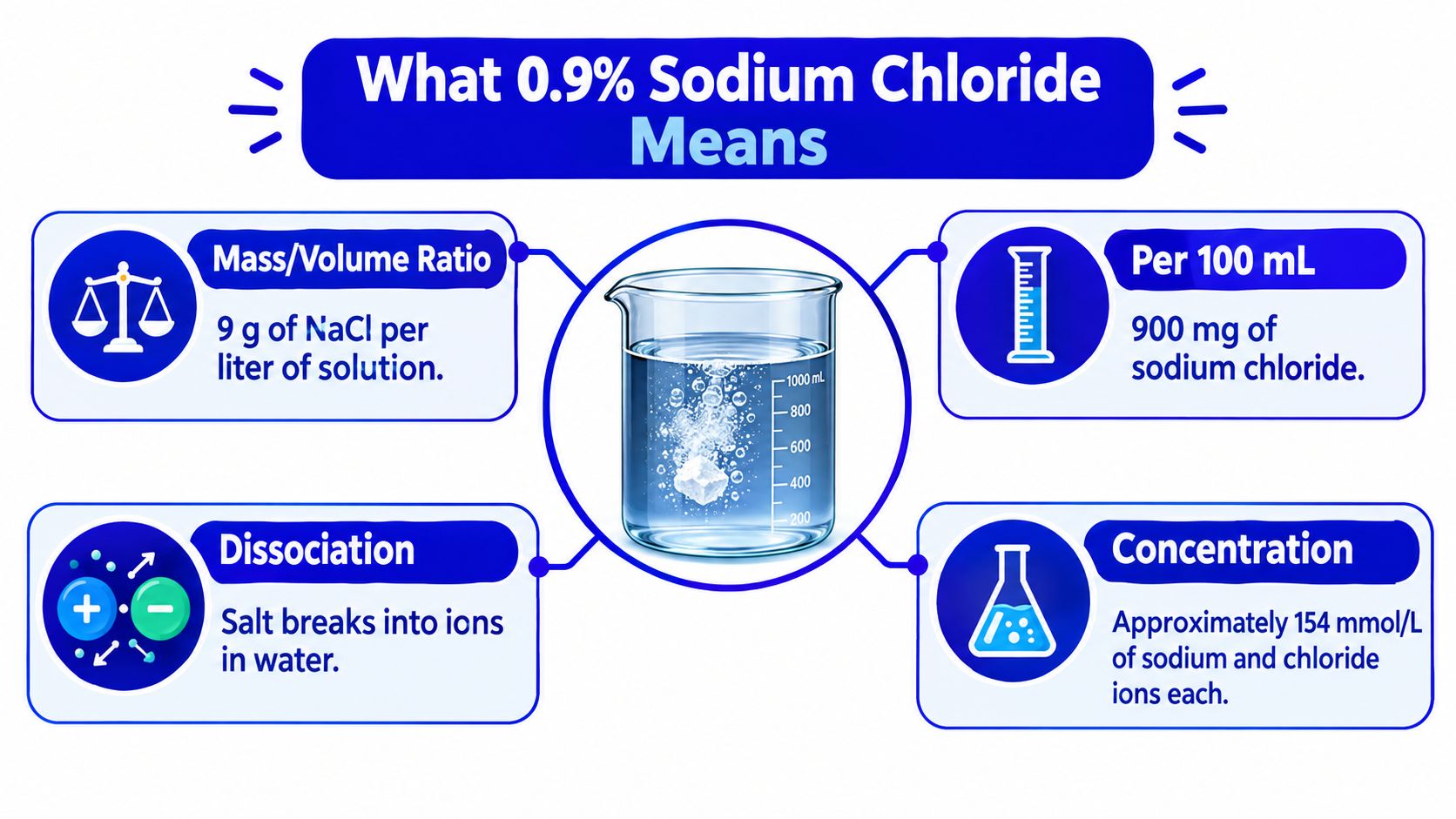
0.9% sodium chloride means 9 g of NaCl per liter of solution, or 900 mg per 100 mL (FDA labeling data). That is a mass-to-volume specification, so it tells you how much sodium chloride is present in the finished volume. In plain terms, the number is a recipe target, not a casual description.
Once sodium chloride dissolves, it separates into sodium and chloride ions. In the finished solution, the benchmark is about 154 mmol/L sodium and 154 mmol/L chloride, which is why saline is described in technical documents as an electrolyte solution rather than simple water with salt mixed in. For a related overview of sodium content and filtration considerations, see sodium filtration tips.
Why isotonicity matters, and what it does not mean
Those ions produce a calculated osmolarity of about 308 mOsmol/L, close enough to plasma tonicity for the solution to be called isotonic. That matters because it helps explain why the fluid moves in familiar ways across cell membranes and why saline became such a common reference fluid. It also explains why a vial of saline behaves very differently from pure water in a cell-containing system.
U.S. labeling also places the product in an acidic-to-near-neutral pH range of about 4.5 to 7.0. So saline is more than an ionic count. It is a finished formulation with analytic specifications, container considerations, and quality controls that matter when you choose a diluent for research use.
For researchers reviewing a technical data sheet or a certificate of analysis, the useful markers are the concentration, the ion content, the osmolarity, and the documented pH range. Those values tell you what kind of saline you have in hand, and how it is expected to behave in a workflow.
How Normal Saline Became the Reference Fluid
A medical convention grew out of repeated practical use
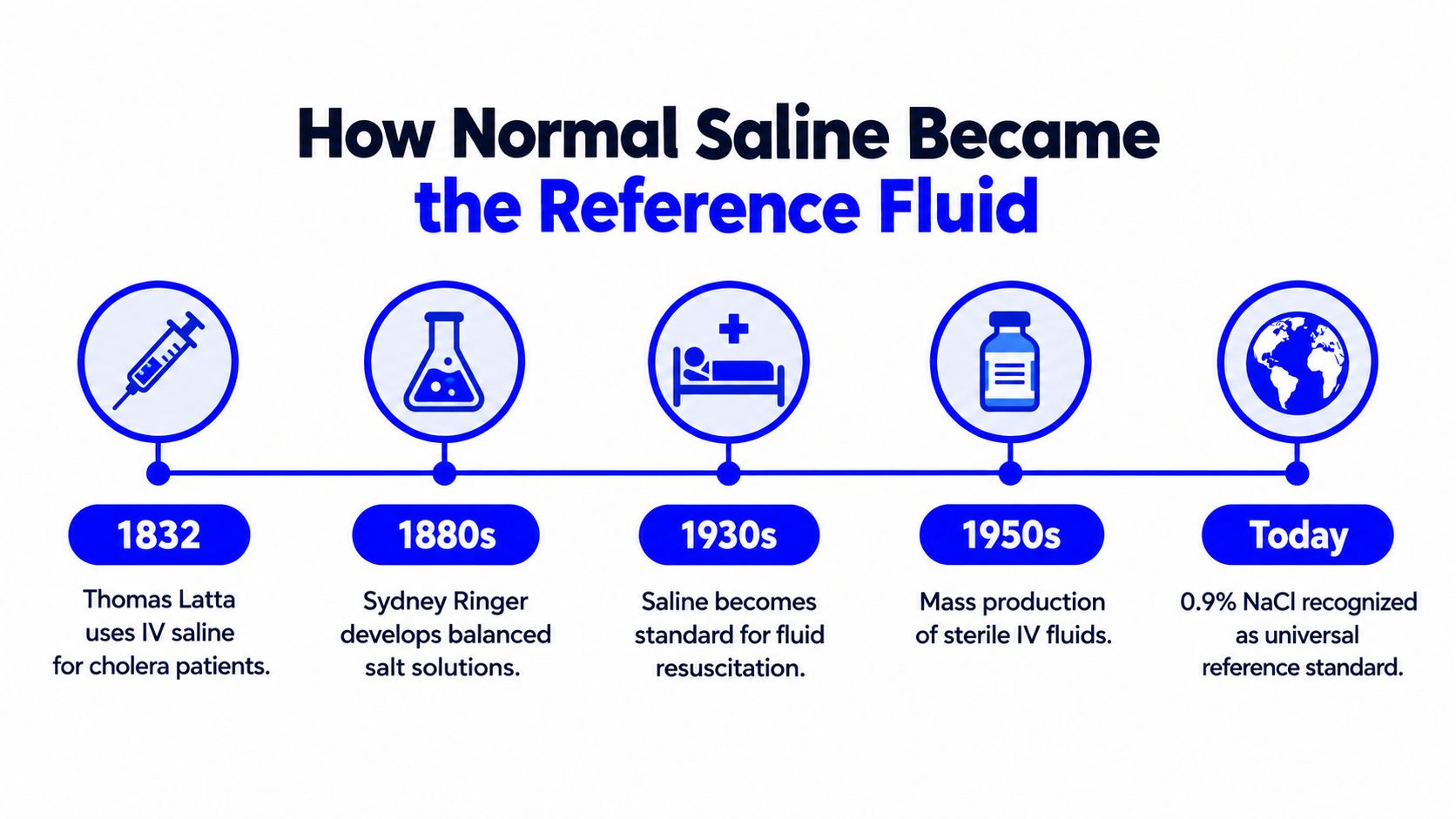
The word normal sounds biological, but here it is largely historical. During the 1832 cholera epidemic, Thomas Latta proposed giving salt solution by a non-oral route to replace fluid lost through severe diarrhea, a turning point in how clinicians thought about fluid replacement (historical review). That shift mattered because it moved treatment from the gut to direct circulation.
In the 1880s, Sidney Ringer identified salt concentrations that preserved frog-heart contractility, which helped push crystalloid solutions from crude mixtures toward experimental precision. Soon after, Hartog Hamburger's 1882 to 1883 experiments helped spread the idea that 0.9% represented a normal blood concentration, even though later measurements showed actual plasma sodium chloride was closer to 0.6%, per the same historical review.
Why the historical label still matters
That history explains a lot of modern confusion. Normal saline sounds like an exact match to blood, but the name reflects laboratory convention rather than an exact match to plasma. By the first three decades of the twentieth century, saline had moved from an experimental or laboratory fluid to one of the most commonly administered intravenous fluids worldwide, and that broad adoption made the term feel more fixed than it really is, as noted in the same historical review.
The label stayed because the fluid was useful, reproducible, and widely accepted in practice. For a new researcher, that is the key lesson. A solution can become a reference fluid because it performs predictably in common workflows, while still falling short of being a universal answer for every dilution problem.
Clinical and Laboratory Uses at a Glance
Same concentration, different decisions
A vial labeled 0.9% sodium chloride can sit in two very different workflows. In clinical care, it may serve as a vehicle for parenteral drugs or as a sterile irrigation medium. FDA labeling also warns that excessive administration may cause hypernatremia, fluid overload, pulmonary edema, and acid-base disturbances (FDA labeling data). That warning matters because saline is useful, but it still has physiologic limits, especially during large-volume use or in patients who need close fluid monitoring.
In the laboratory, the same concentration appears on products used as sterile diluents, wash solutions, or baseline electrolyte media. The label alone does not tell you the route of administration, the sterility grade, or whether the material fits a specific assay. Research-use-only material is not an injectable product, and the label alone does not change that status.
| Dimension | Clinical Setting | Laboratory RUO Setting |
|---|---|---|
| Intended use | Vehicle for parenteral drugs, irrigation medium | Diluent, wash buffer, baseline electrolyte medium |
| Decision focus | Patient status, route, fluid balance | Reagent compatibility, assay behavior, documentation |
| Risk lens | Hypernatremia, fluid overload, acid-base disturbances | Precipitation, adsorption, altered osmolality, workflow mismatch |
| Status of the product | Authorized medical use | Research-use-only use, no clinical implication from label alone |
For readers comparing product formats, packaging and route matter as much as composition. A separate discussion of inhalation saline vs injectable helps show why two saline products can share a concentration and still belong in different settings.
Normal Saline Versus Bacteriostatic Water and Other Diluents
Four products that sound similar but solve different problems
A vial may look interchangeable on the bench, but the diluent changes the behavior of the final mixture. Normal saline adds sodium and chloride, which suits some reagents that tolerate an ionic background. Bacteriostatic water is different, because it contains 0.9% benzyl alcohol in sterile water and is supplied in multi-dose vials with an in-use period of up to 28 days when handled aseptically (FDA guidance). Sterile water for injection or irrigation contains no additives and is generally intended for single use.
That distinction matters in RUO workflows because dissolution is only the first test. Stability, precipitation behavior, adsorption to surfaces, and fit with the biological system that follows all have to be considered. A peptide may reconstitute in more than one liquid, yet the finished prep may not behave the same way in storage or in assay readout.
Practical rule: choose the diluent for the molecule, the storage plan, and the downstream assay, not for the label alone.
A quick comparison at the bench
- 0.9% Sodium Chloride: Ionic solution with sodium and chloride, useful when an isotonic electrolyte background is desired, but not automatically suitable for every protein or assay.
- Bacteriostatic Water: Preservative-containing sterile water, better suited to repeated vial access in workflows that allow a multi-dose handling pattern. Herbilabs offers a bacteriostatic water option built around that kind of RUO use.
- Sterile Water: No preservative, no added ions, and generally a single-use product.
- Water for Injection: A formulation benchmark for purity and vehicle quality, but still not a substitute for a product-specific compatibility decision.
For a practical product example, Herbilabs offers a bacteriostatic water option that fits controlled multi-dose access in RUO workflows. Plain sterile water sits in a different category, which is why the label has to be read together with the use case.
Start with the molecule. If the compound is fragile, hydrophobic, protein-based, or sensitive to ions, the diluent can change the result before the first aliquot leaves the vial.
Isotonic Does Not Mean Physiologically Identical
Why the shortcut breaks down
A vial can be labeled 0.9% sodium chloride and still be the wrong fit for a specific use. Tonicity describes how a solution pulls water across a membrane, while physiologic compatibility asks a broader question, whether the fluid matches the chemical and biological setting the assay or sample needs.
That gap matters. Normal saline has a chloride profile that is different from plasma, and in clinical use large volumes can contribute to hyperchloremia and non-anion-gap metabolic acidosis. The label may be acceptable, but the downstream effect is not always neutral.
In the lab, the same distinction shows up in smaller, practical ways. A protein may remain soluble yet shift conformation, a peptide may survive reconstitution but adsorb to the tube wall, and an antibody may dissolve cleanly while still behaving differently in the assay readout. Isotonicity helps with one part of the problem, not all of it.
The four-part compatibility question
For RUO work, the check should be operational, not just descriptive.
Will it dissolve?
A lyophilized peptide may disperse in saline, while a more hydrophobic construct can clump or wet poorly and never form a uniform solution.Will it stay chemically stable?
Salt and pH can change folding or accelerate breakdown. A protein that looks fine at first can drift if the ionic environment is a poor match.Will it stay in the tube?
Some analytes adsorb to glass or plastic within hours, especially when the molecule is sticky, low abundance, or highly hydrophobic. A clear solution can still lose material to the container.Will it behave in the biological system?
A diluent can be analytically acceptable and still be a poor choice for the downstream assay, where cells, enzymes, or detection chemistry respond to the full formulation, not the label alone.
A practical rule follows from that. Sterile and 0.9% are useful descriptors, but they do not prove fit by themselves. The molecule, the container, and the assay all have to agree.
Choosing and Verifying a 0.9 Percent Saline Diluent
A short checklist that saves trouble later
Before a 0.9% saline product is adopted in an RUO workflow, the documentation should answer the same questions a formulator would ask at the bench. The material should be traceable by lot, and the quality record should state the actual NaCl mass concentration, the vehicle quality, and the osmolality or the data needed to calculate it. It should also identify the pH, container material, fill volume, and storage conditions.
That's the practical difference between a product that is merely labeled well and one that is usable with confidence. A vial can look clean and still be a poor choice if the final prep depends on a preservative, a different ionic background, or a specific closure system.
For teams building a reconstitution workflow, a reconstitution solution can be one option among several, but the same bench discipline still applies. Read the lot-specific record, check the intended use, and confirm that the diluent matches the molecule and the assay before the first dilution is made.
If the workflow also calls for clean handling materials, a resource to find sterile swabs for labs can support the broader aseptic setup without changing the basic rule, which is that documentation should lead the choice, not guesswork.
Bottom line: “sterile” and “0.9%” are a starting point, not the final answer.
For researchers who need a clean, documented diluent path in RUO work, Herbilabs supplies sterile reconstitution and saline-based labware products with lot-specific documentation. Visit Herbilabs to review the available formats and match the product to the workflow before the next reconstitution step.